
New Orleans Boat Crash, Atlantic Asphalt Tanker Hits American Heritage Cruise Ship, 32 Hospitalized, All Accounted For, and What Passengers’ Legal Rights Are
Developing story. Last updated: November 14, 2026 | New Orleans, Louisiana
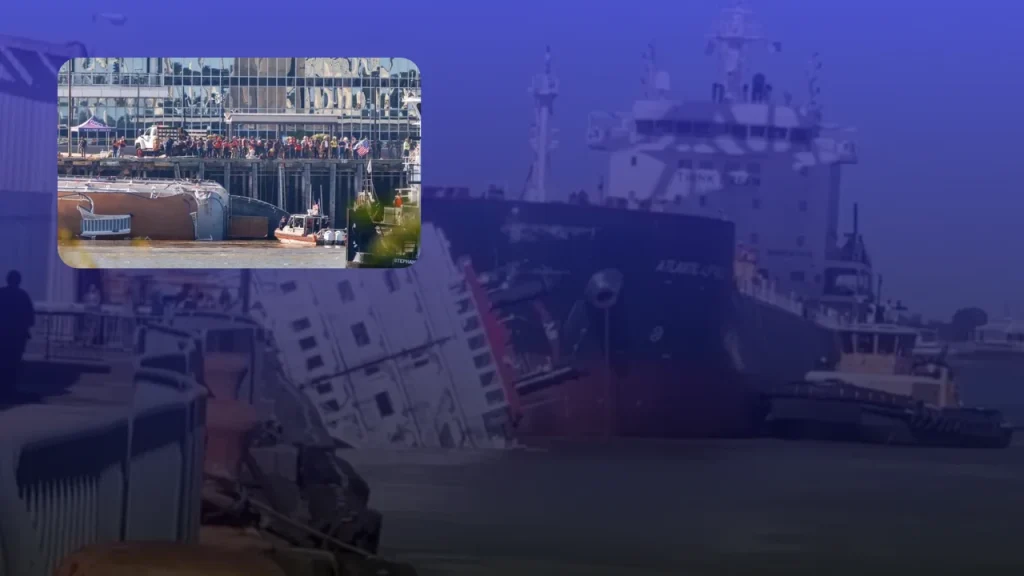
A tanker struck a docked Mississippi River cruise ship at the Port of New Orleans on Friday, November 13, 2026, and the passenger vessel capsized. Officials say everyone aboard has been accounted for, 32 people went to hospitals, and no deaths or critical injuries were reported. Mayor Helena Moreno and Governor Jeff Landry called the outcome a “miracle on the Mississippi.”
The tanker Atlantic Asphalt hit American Cruise Lines’ American Heritage at about 12:30 p.m. Central Time. The Coast Guard is investigating, and early indications point to a possible loss of steering on the tanker. No final cause has been established and no company or person has been found legally responsible.
New Orleans Cruise Ship Collision: What Is Confirmed
| Detail | Latest information |
| Date and time | Friday, November 13, 2026, about 12:30 p.m. CT |
| Location | Mississippi River outside 1350 Port of New Orleans Place, near mile marker 96, below the Crescent City Connection |
| Passenger vessel | American Heritage, operated by American Cruise Lines (U.S.-flagged, about 81 meters, formerly Queen of the Mississippi) |
| Tanker | Atlantic Asphalt, about 160 meters (520 feet), Marshall Islands-flagged, built 2017, owned by Nave Shipping SA of Liberia, designed to carry asphalt and bitumen |
| People aboard | About 129 passengers plus crew; officials later put the total at nearly 200 |
| Hospitalized | 32 |
| Deaths | None reported |
| Missing | None; all accounted for |
| Condition of the American Heritage | Took on water, capsized and partially submerged at the dock |
| Possible cause | Reported loss of steering on the tanker; under investigation |
| River closure | Coast Guard closed the Mississippi to vessel traffic between mile markers 93 and 96 during the response |
| Lawsuit or settlement | None verified |
What Happened When the Atlantic Asphalt Hit the American Heritage?
According to Port of New Orleans officials, the American Heritage had docked about two hours before the collision and was letting passengers off at the end of an eight-day Mississippi River cruise through Louisiana and Mississippi. MarineTraffic data showed it had arrived from Natchez, Mississippi earlier that day.
Video shows the tanker striking the riverboat’s port side. The vessel took on water, listed and rolled onto its side alongside the dock. Some passengers entered the river wearing life jackets, others crowded the tilted decks waiting for help. A crew member told ABC News he first felt the boat shake and thought the captain was moving it.
The New Orleans Fire Department, police, Port NOLA Harbor Police, the Coast Guard and EMS responded, and private vessels helped pull people from the water. Survivors were taken to a port facility for medical checks. The city arranged hotel rooms for affected passengers, and the Regional Transit Authority suspended ferry service across the river as a precaution.
Did Anyone Die in the American Heritage Cruise Ship Collision?
No deaths were reported, and every passenger and crew member was accounted for. Early reports of people possibly trapped or missing proved wrong. LCMC Health is treating 32 injured passengers, and none were reported to have critical injuries when officials spoke.
The absence of critical injuries does not mean everyone escaped without lasting harm. Some people may need follow-up care, and psychological effects can appear later.
Why Did the Atlantic Asphalt Tanker Hit the American Heritage?
Coast Guard Capt. Melanie Burnham said there were indications of “some type of a loss of steering” on the tanker, but the exact cause is unknown. Tracking data reportedly showed the tanker made a sharp turn before impact. The tanker was traveling upriver, and investigators will look at mechanical, human and environmental factors, including river current.
A steering failure can come from a mechanical defect, maintenance problem, control-system failure or an operational error. None of these has been confirmed. Whether the tanker’s crew or a river pilot contributed is also unknown.
Is the Atlantic Asphalt Captain or Owner Responsible for the Crash?
That has not been determined. A vessel striking another does not by itself decide who is legally liable. Investigators will review the tanker’s movements, equipment, pilotage, communications and any chance to avoid the impact.
Who Is Investigating the New Orleans Tanker Collision?
The U.S. Coast Guard is investigating the marine casualty, and the National Transportation Safety Board (NTSB) said it would investigate. Their work is likely to include:
- Inspection of the tanker’s steering and propulsion systems.
- Review of voyage data, navigation records and communications.
- Interviews with the masters, pilots and crew.
- Study of river current, visibility and traffic.
- Assessment of the damage to the American Heritage and the dock.
- Review of the evacuation and rescue response.
An NTSB or Coast Guard safety investigation is not a civil judgment on who must pay passengers.
Did the FAA Ground Stop Delay the NTSB Response?
The Associated Press reported that the NTSB’s initial travel to New Orleans was disrupted by the separate nationwide FAA ground stop the same day. Officials have not linked the two events.
Can Passengers Sue After the American Heritage Collision in New Orleans?
Potentially, yes. Passengers hurt in a maritime collision can bring negligence claims against responsible parties. Who can be sued, and for what, depends on what the investigation finds. Possible defendants include:
- The tanker’s owner or operator, if negligent navigation, maintenance or another failure contributed.
- A manufacturer or maintenance contractor, if defective equipment is shown.
- The cruise operator, only if a separate failure involving passenger safety or evacuation caused additional harm.
These are possible legal theories, not findings against anyone. A maritime negligence claim generally requires a duty of care, breach, causation and recoverable damages.
What Compensation Could Injured American Heritage Passengers Seek?
| Potential damages | What they may cover |
| Medical expenses | Emergency care, hospitalization, follow-up treatment |
| Future medical care | Ongoing treatment for collision injuries |
| Lost income | Wages lost because of injury |
| Pain and suffering | Physical pain and related harm |
| Psychological injury | Emotional harm, to the extent maritime law allows |
| Lost property | Phones, medication, documents and luggage, subject to applicable rules |
| Other losses | Proven, recoverable expenses caused by the incident |
No set amount is owed to every passenger. Someone with no compensable injury has different rights from someone who was hospitalized.
For an example of how maritime injury claims are litigated, see Disney Cruise Line Theater Lights Lawsuit, What the Manning Complaint Alleges — Manning v. Magical Cruise Company, Ltd. It is a separate case and says nothing about liability in New Orleans.
What Laws Apply to the New Orleans Tanker and Cruise Ship Collision?
The collision happened on the navigable Mississippi River, so federal maritime law is central.
Which Navigation Rules Apply to the Atlantic Asphalt Under 33 CFR Part 83?
The Inland Navigation Rules are designed to prevent collisions. Investigators may test the tanker’s conduct against these provisions:
- Rule 5, 33 CFR § 83.05: keep a proper lookout.
- Rule 6, 33 CFR § 83.06: proceed at a safe speed for conditions, including current and traffic.
- Rule 7, 33 CFR § 83.07: assess the risk of collision.
- Rule 8, 33 CFR § 83.08: take effective action to avoid a collision.
A mechanical failure does not automatically excuse a vessel from these duties or prove negligence. The facts decide.
Does the Oregon Rule Presume the Moving Tanker Was at Fault?
Under longstanding admiralty law, when a moving vessel strikes a stationary or docked vessel (a collision with a fixed or moored object is called an “allision”), courts apply a presumption of fault against the moving vessel, known as the Oregon Rule (The Oregon, 158 U.S. 186 (1895)). The moving vessel can rebut it, for example by proving the accident was unavoidable despite reasonable care or was caused by the other vessel. It is a rule of evidence, not a final finding, and it has not been applied here.
What Is the Pennsylvania Rule?
Under The Pennsylvania, 86 U.S. 125 (1873), if a vessel violated a statutory safety rule meant to prevent collisions, the burden can shift to that vessel to prove the violation did not cause the accident. Whether it could apply depends on what the Coast Guard and NTSB find.
What Is General Maritime Negligence Law for Cruise Passengers?
Federal maritime law requires reasonable care under the circumstances. A passenger harmed by actionable negligence may recover against the responsible party. See Carnival Tequila Lawsuit Verdict Carnival Found Liable for Serving Passenger 14 Shots, What Cruise Guests Need to Know for an unrelated example of a cruise operator’s duty of care.
What Is the Limitation of Liability Act and Could the Tanker Owner File a Limitation Action?
Under the Limitation of Liability Act (46 U.S.C. chapter 305), a vessel owner can ask a federal court to cap its liability at the value of the vessel and pending freight, unless the owner had “privity or knowledge” of the fault. The owner must file within six months after receiving written notice of a claim. Shipowners often use this procedure after serious casualties, which freezes related lawsuits into one federal proceeding. Whether Nave Shipping or anyone else does so here is unknown.
What Is the Three-Year Maritime Injury Deadline Under 46 U.S.C. § 30106?
Federal law generally allows three years to file a maritime personal injury or death lawsuit. Passengers should not assume they have three years against every party, because ticket contracts can shorten the time against the cruise operator.
What Do 46 U.S.C. §§ 30508, 30509, 30526 and 30527 Say About Cruise Ticket Terms?
Federal law lets a passenger vessel’s contract require notice of a personal injury claim within six months and a lawsuit within one year, but not shorter. Statutory sections cover these limits for passenger vessels (46 U.S.C. § 30508 and, for seagoing vessels, § 30526). Federal law also generally bars a passenger-vessel owner from using a ticket to excuse its own negligence in injuring or killing passengers (46 U.S.C. § 30509 and, in the newer subchapter, § 30527). Which section governs depends on how the American Heritage is classified, which is a question for a lawyer reviewing the booking contract.
Do Crew Members Have Different Rights Under the Jones Act, 46 U.S.C. § 30104?
Yes. Crew members who qualify as seamen and are hurt through an employer’s negligence can bring Jones Act claims, with remedies that differ from a passenger’s. Maintenance and cure and unseaworthiness claims may also apply.
Could the Oil Pollution Act of 1990 Apply?
If oil is discharged into the Mississippi, the Oil Pollution Act (33 U.S.C. § 2701 et seq.) imposes strict liability on responsible parties for removal costs and certain damages. The Atlantic Asphalt is built to carry asphalt and bitumen, but no verified spill, quantity or environmental damage had been announced in the reports reviewed. Its cargo status at impact is not confirmed.
Can Businesses Recover Economic Losses From the River Closure?
General maritime law usually bars purely economic loss claims by parties with no physical damage to their own property (Robins Dry Dock v. Flint, 275 U.S. 303 (1927), and the Fifth Circuit’s Louisiana ex rel. Guste v. M/V Testbank, 752 F.2d 1019 (5th Cir. 1985) (en banc)). Exceptions can apply, for example under the Oil Pollution Act if a covered discharge occurred.
American Cruise Lines Ticket Contract: Notice and Lawsuit Deadlines Passengers Should Check
American Cruise Lines’ published terms, as described in the reporting and policies reviewed, require written notice of a personal injury claim within six months and a lawsuit within one year, designate Connecticut courts for many disputes and include a class-action waiver. These are the company’s contract terms, not a ruling that each provision is enforceable against every passenger. Enforceability depends on federal maritime law, the vessel’s classification and the defendant being sued.
Do not rely on a general deadline from another cruise line’s ticket. Have the actual booking contract reviewed quickly by a licensed maritime attorney. Read the official American Cruise Lines Terms and Conditions.
Will American Cruise Lines Refund Passengers After the American Heritage Crash?
American Cruise Lines has a published cancellation and delay refund policy. As described, passengers can seek a refund when the company cancels a cruise or delays one by more than three calendar days and the passenger declines an alternative, with documents due within six months of the original embarkation date. Because the American Heritage was finishing its cruise when it was struck, passengers should not assume that policy automatically refunds a completed voyage. Injured passengers may also have separate injury claims whether or not they receive a refund or credit. Read the official American Cruise Lines Cruise Cancellation and Delay Refund Policy.
What Should American Heritage Passengers Do About Lost Belongings, Medication and ID?
Mayor Moreno said officials were helping survivors who lost identification, phones and vehicle keys. If you were aboard:
- Get medical care for injuries, even minor-seeming ones.
- Contact American Cruise Lines about lodging and transportation (published customer service line: 1-800-460-4518).
- Report lost passports, IDs, medications or medical equipment to the proper authorities or providers.
- Keep receipts for emergency purchases, replacement documents, travel and treatment.
- Save your booking confirmation, ticket contract and all messages from the cruise line.
- Ask how to get the incident report and recover belongings left aboard.
- Do not sign a broad release of claims without understanding it.
Emergency help such as a hotel room or replacement transport is not the same as a legal settlement, and what a signed document means depends on its terms.
Is There an American Heritage Cruise Ship Crash Lawsuit, Settlement or Claim Form?
As of the reporting reviewed on November 13, 2026, no verified class action, court-approved settlement or passenger compensation fund has been announced for this collision. Individual passengers may bring claims, and insurers may negotiate in the future. No one should advertise an official payout or claim form unless one exists. A class-action waiver in cruise contracts could also complicate a collective case.
For a different maritime liability example, see Can Shipowners Be Sued After a Pirate Attack? Crew Deaths, Insurance and Compensation. It is not connected to this accident.
Is the Mississippi River Still Closed at the Port of New Orleans?
The Coast Guard closed the river between mile markers 93 and 96 during rescue and assessment. No timetable for salvaging the American Heritage or fully lifting restrictions had been announced in the reports reviewed. The closure does not mean the entire Mississippi or all Port of New Orleans operations are indefinitely shut. Check the Coast Guard and Port NOLA for current status.
New Orleans Boat Crash FAQ
What boat crashed in New Orleans on November 13, 2026?
The Atlantic Asphalt tanker struck the docked American Heritage river cruise ship near the Port of New Orleans.
Did the American Heritage sink?
It took on water, capsized and became partially submerged alongside the dock.
How many people were aboard the American Heritage?
About 129 passengers plus crew. Officials later cited nearly 200 people in total, and all were accounted for.
How many people died in the New Orleans boat crash?
None were reported. Thirty-two people were hospitalized.
Why did the Atlantic Asphalt tanker hit the cruise ship?
A possible loss of steering is under investigation. The Coast Guard has not announced a final cause.
Who owns the Atlantic Asphalt?
Reporting identifies Nave Shipping SA of Liberia as the owner, with the vessel registered in the Marshall Islands.
Was there an oil or asphalt spill?
No verified spill or environmental damage had been announced in the reports reviewed.
Can injured passengers sue the tanker’s owner?
Potentially, if evidence shows actionable negligence or another basis for liability. The owner may also seek to limit its liability in federal court.
Can passengers sue American Cruise Lines?
Possibly, depending on the facts and the contract. The company is not automatically liable because another vessel struck its docked ship.
How long do passengers have to file a claim?
Federal law generally allows three years for maritime injury suits, but the cruise contract may require written notice within six months and a lawsuit within one year against the cruise line. Consult an attorney promptly.
Will passengers get compensation?
No universal payment has been announced. Refunds, insurance and individual injury claims must be evaluated separately.
Official Sources for the New Orleans Boat Crash
- American Cruise Lines
- American Cruise Lines Terms and Conditions
- American Cruise Lines Cancellation and Delay Refund Policy
- U.S. Coast Guard Marine Incident Investigation Reports
- National Transportation Safety Board
- Port of New Orleans
- 46 U.S.C. § 30106, Maritime Injury Limitation Period
- 46 U.S.C. § 30526, Contractual Claim Deadline Limits
- 46 U.S.C. § 30527, Passenger Liability Protections
- Associated Press, New Orleans Tanker Collision and Rescue
Bottom line: The Atlantic Asphalt tanker struck the docked American Heritage river cruise ship in New Orleans on November 13, 2026, and the vessel capsized. Everyone aboard was accounted for, 32 people were hospitalized, and no deaths were reported. A possible steering failure is under investigation, but no cause or legal responsibility has been established. Injured passengers may have maritime-law claims, and short contractual deadlines make it important to keep records and review the booking contract quickly.
This is a developing story, and investigation findings, injury figures and salvage details may change. This article provides general legal information, not legal advice.
Researched and written by Israr Ahmad, legal content researcher and founder of AllAboutLawyer.com. All facts verified against reporting from the Port of New Orleans, the U.S. Coast Guard and news outlets including ABC News, FOX News, WDSU, FreightWaves and gCaptain, and against the U.S. Code, as of November 14, 2026. Last Updated: November 14, 2026.
About the Author
Israr Ahmad is a legal content researcher with 4+ years of experience covering class action settlements and consumer rights cases. He has researched and published coverage of 2,500+ settlements using verified court records, settlement administrator filings, and government sources. Learn more about Israr.