
Did the FAA’s New SMART AI Tool Cause the November 13, 2026 Nationwide Ground Stop? Cyberattack Claims, What Officials Said and What the Law Requires
Developing story. Last updated: November 14, 2026
On Tuesday, November 10, 2026, the Federal Aviation Administration (FAA) said it was expanding its AI-supported air traffic planning tool, the Strategic Management of Airspace, Routes and Trajectories (SMART), to all 22 Air Route Traffic Control Centers. Three days later, on Friday, November 13, the FAA ordered a nationwide ground stop of departing flights after a telecommunications outage.
That timing raised two questions: Did the new AI tool cause the shutdown, or was it a cyberattack? As of the latest reports reviewed, neither has been established. The FAA and Transportation Secretary Sean Duffy have not linked SMART to the outage, and the cause remains under investigation.
For flight status, refunds and passenger rights, see our separate guide, FAA Nationwide Ground Stop on November 13, 2026: What Happened, When Flights Resume, and Your Refund Rights Under DOT Rules.
FAA SMART AI and the Ground Stop: What Is Confirmed and What Is Not
| Question | What the reporting establishes |
| What is SMART? | An AI-supported planning and decision-support tool for air traffic management |
| Who built it? | Boston-based Air Space Intelligence (ASI) |
| Contract | 12-year, $875 million FAA contract awarded in June, which also covers a related data platform |
| First use | September 21, 2026, in airspace around Reagan National, Dulles and Baltimore/Washington |
| Nationwide expansion | Announced November 10, 2026, to all 22 en route centers |
| What was the ground stop’s stated cause? | A telecommunications outage affecting Air Route Traffic Control Centers |
| Did SMART cause it? | Not established. ASI denies it; DHS says it cannot rule it out yet |
| Was it a cyberattack? | Officials said there was “no indication as of yet” of a malicious attack, but did not rule anything out |
| Was it linked to the Microsoft 365 outage? | DHS Secretary Markwayne Mullin saw no apparent link |
| Final technical cause | Under investigation |
What Is the FAA’s SMART AI System and What Does It Do?
SMART is a planning tool meant to move air traffic management from reactive to predictive, according to the FAA. It reportedly combines about 200 data streams, such as weather, flight paths, traffic volume, airline schedules, airport capacity and staffing, to predict congestion and recommend routes or departure times.
Does SMART Control Aircraft or Replace Air Traffic Controllers?
No, according to the FAA. FAA specialists review every recommendation, and local facility leaders can accept or decline it. The FAA says SMART cannot replace human controllers or take control of an aircraft.
That distinction matters here. A system that recommends traffic scheduling is a different thing from the radio, radar and telecommunications links that controllers use to talk to pilots. Reporting based on The Air Current said multiple facilities lost radio frequencies, radar capabilities and communications systems during the outage, so investigators must show whether any technical connection to SMART existed.
What Did Officials Say About SMART, AI and a Cyberattack After the Ground Stop?
Homeland Security Secretary Markwayne Mullin said the outage was a telecommunications problem affecting the FAA’s air traffic control centers and that the cause was not yet known. Asked whether the AI rollout was involved, he said, “You just can’t rule out anything at this point,” and that DHS was looking at it through the Cybersecurity and Infrastructure Security Agency (CISA). He also said officials had seen no indication of a malicious attack, were not ruling out a cyberattack, and saw no connection to the Microsoft outage.
Transportation Secretary Sean Duffy called it a communications issue. Neither he nor the FAA had linked SMART to the stoppage in the reports reviewed.
Air Space Intelligence posted: “The current ground stop is not based on or a result of the SMART system, any product of ASI or our integration with FAA and ATC.” This is a denial from the vendor. It is not an independent finding, and the company cannot determine the cause faster than investigators can.
Did Congress Warn the FAA About SMART Before the November 13 Ground Stop?
Yes, but the warnings were about safety review and oversight, not about this outage. On October 9, 2026, more than two dozen House lawmakers, led by Representatives April McClain Delaney, Alexandria Ocasio-Cortez, Don Beyer, Kweisi Mfume, Suhas Subramanyam and Sarah Elfreth, and joined by Senator Chris Van Hollen, asked Transportation Secretary Duffy and FAA Administrator Bryan Bedford to pause SMART at the three Washington-area airports. The letter asked for:
- Safety evaluation and testing reports.
- Details on controller training.
- Who within the FAA authorized the tool’s use at Reagan National and Dulles.
- Whether similar deployments were planned at other major airports.
- Who is accountable if the tool contributes to a safety incident.
The FAA responded around October 13 that it was continuing to test SMART and train employees. A later request for a Government Accountability Office review covering SMART and related systems has also been reported. The pause request came before the nationwide expansion, and it does not show that SMART caused the November 13 outage.
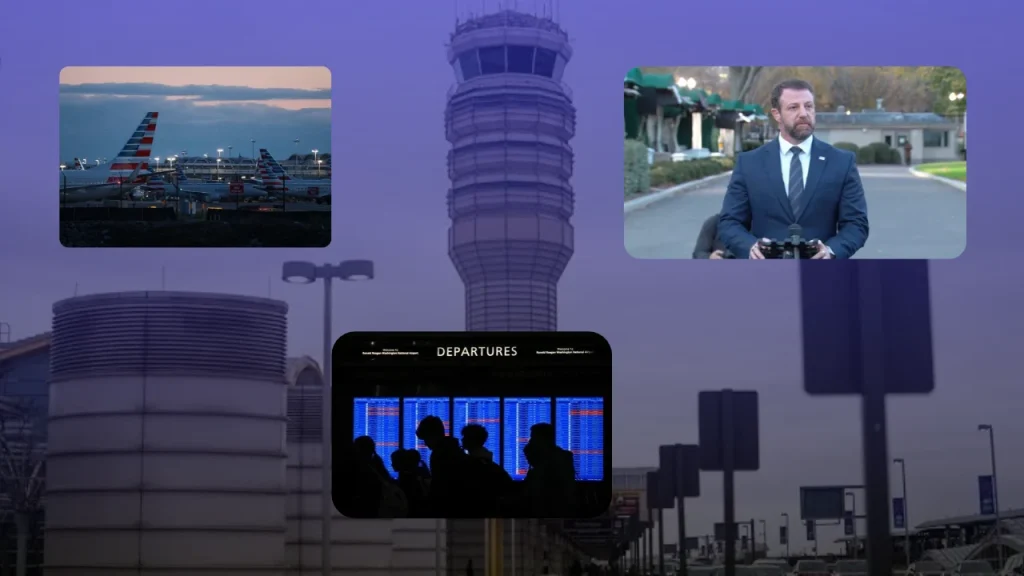
Was the FAA Ground Stop a Cyberattack?
Not confirmed. Federal officials said they had found no indication of a deliberate attack, while declining to rule one out. Possible causes of a communications failure include equipment failure, software errors, network outages, configuration mistakes or malicious interference. Those are general possibilities, not findings about this incident. Public reports of a software update or router problem have not established that any update involved SMART.
Was the Microsoft Outage Connected to the FAA Ground Stop?
A separate Microsoft 365 outage began the day before. Mullin said he saw no apparent link, and none has been established.
What Evidence Would Show Whether AI Caused the FAA Ground Stop?
Timing alone cannot prove cause. A credible technical finding would need:
- System logs, network monitoring records and equipment alarms.
- Software change histories and records of what was updated and when.
- An outage timeline showing where the failure began.
- Records of how SMART connects to existing FAA infrastructure.
- Proof that a SMART component, integration or change actually caused or contributed to the telecommunications failure.
Showing that SMART was running when the outage occurred is not enough.
What Federal Laws Apply to the FAA’s Use of AI and Its Cybersecurity?
Which Law Gives the FAA Authority Over Airspace Under 49 U.S.C. § 40103?
Federal law gives the United States sovereignty over navigable airspace and directs the FAA to manage its use. Ordering a ground stop during a serious communications failure is within that safety mission and is not evidence of unlawful conduct.
What Safety Authority Does the FAA Have Under 49 U.S.C. § 44701?
The FAA Administrator must prescribe standards and regulations needed for aviation safety. The oversight question about SMART is whether the agency’s testing, training and approvals were adequate for a tool used in air traffic management.
Does OMB Memorandum M-25-21 Govern the FAA’s AI Tools?
OMB Memorandum M-25-21 (April 2025) sets risk-management requirements for federal agencies’ “high-impact” AI, meaning AI whose output is a principal basis for decisions with a significant effect on safety or rights. It generally calls for practices such as pre-deployment testing, impact assessment, ongoing monitoring and human oversight, subject to agency determinations and waivers, with a compliance deadline that fell in 2026. Whether SMART is classified as high-impact, and what the FAA documented, is exactly what lawmakers asked about. No finding has been made that the FAA violated the memorandum.
What Are the FAA’s Cybersecurity Duties Under 44 U.S.C. § 3554 (FISMA)?
The Federal Information Security Modernization Act requires agencies to run information security programs and to report incidents, including to CISA. A major outage can prompt questions about whether those duties were met, but an outage alone does not prove a violation.
Could the Computer Fraud and Abuse Act, 18 U.S.C. § 1030, Apply?
Only if investigators find unauthorized access to FAA systems. No public evidence reviewed establishes unauthorized access or a crime.
Can the FAA or Air Space Intelligence Be Sued Over the Ground Stop?
No lawsuit or settlement alleging that SMART caused the November 13 ground stop was verified in the reporting reviewed. Legal exposure would depend on what investigators find.
Can Passengers Sue the FAA Under the Federal Tort Claims Act?
Claims against the federal government generally must proceed under the Federal Tort Claims Act (28 U.S.C. §§ 1346(b), 2671-2680). A claimant must first present an administrative claim (28 U.S.C. § 2675(a)) and generally has two years to do so (28 U.S.C. § 2401(b)). The statute excludes claims based on discretionary functions (28 U.S.C. § 2680(a)), a defense the government can raise over decisions such as halting flights for safety or choosing and rolling out a technology. It also does not allow recovery for many purely economic losses without an underlying tort. This is a high bar.
Can Passengers Sue Air Space Intelligence?
A private contractor can face negligence or product claims in some circumstances, but a contractor building to federal specifications may raise the government contractor defense (Boyle v. United Technologies Corp., 487 U.S. 500 (1988)). Disputes between the FAA and ASI over performance would be contract and procurement matters, not passenger claims. Being introduced shortly before an outage does not make a vendor liable.
For a separate example of litigation over how airlines use technology and data, see JetBlue Allegedly Used Customers’ Personal Data to Raise Pricing For Ticket’s, JetBlue Class Action Lawsuit, What Flyers Need to Know. That case concerns different allegations and has no connection to SMART.
Do Passengers Get Refunds Whether the Ground Stop Was Caused by AI, a Cyberattack or an Equipment Failure?
Yes, in many cases. Under 49 U.S.C. § 42305 and 14 CFR Part 260, a passenger whose flight is canceled or significantly changed can get a refund if they decline the alternative, regardless of the reason for the disruption. Federal law does not automatically require airlines to pay for hotels, meals or missed events after an FAA-caused disruption. No compensation fund tied to the November 13 outage has been announced.
For how airlines handle cash refunds versus credits, see Delta Airlines Is Being Sued for Hiding Your Cash Refund Behind an Expiring eCredit Here Is What Passengers Need to Know. For unrelated airline pricing litigation, see Airline Price-Fixing Putative Class Action Lawsuits 2026, Can American, Delta, United and Southwest Passengers Get Refunds?.
What Happens Next in the FAA Ground Stop Investigation?
The key development will be a technical explanation of what failed at the Air Route Traffic Control Centers. That could point to aging telecommunications equipment, a software change, a network provider, a cybersecurity incident or something else. The FAA may also face continued congressional questions about SMART’s testing, training, approvals and transparency. Until evidence ties them together, the AI rollout and the outage are two separate events whose timing has drawn scrutiny, not a proven cause and effect.
FAA SMART AI and Ground Stop FAQ
Did the FAA’s AI tool cause the nationwide ground stop?
No evidence publicly establishes that. The vendor denies it, the FAA and Secretary Duffy have not linked SMART to the outage, and DHS says it cannot rule it out yet.
What does SMART stand for?
Strategic Management of Airspace, Routes and Trajectories.
When did the FAA roll out SMART nationwide?
It began limited use on September 21, 2026, and the FAA announced expansion to all 22 en route centers on November 10, 2026.
Did Congress ask the FAA to pause SMART?
Yes. On October 9, 2026, more than two dozen House lawmakers, joined by Senator Chris Van Hollen, asked the FAA to pause SMART at three Washington-area airports pending safety answers.
Did hackers cause the FAA ground stop?
Officials said they had no indication of a malicious attack but were not ruling anything out.
Can SMART override air traffic controllers?
The FAA says no. Specialists review its recommendations, and local leaders can accept or decline them.
Who is the company behind SMART?
Air Space Intelligence, a Boston-based company, under a 12-year, $875 million FAA contract.
Was the FAA’s AI rollout illegal?
No such finding has been made. Lawmakers raised questions about testing, training and governance, which are not proof of a violation.
Is there a lawsuit over the FAA outage?
No lawsuit or settlement specifically alleging that SMART caused the November 13 ground stop was verified.
Official and Primary Sources on the FAA SMART AI Rollout and Ground Stop
- FAA Air Traffic Control System Command Center, Current Operations Advisory
- Washington Times, FAA expanded AI air traffic tool to all centers days before nationwide ground stop
- GeekWire, DHS chief sees no link between Microsoft outage and FAA ground stop, doesn’t rule out AI
- NBC News, Live updates: FAA grounds flights nationwide because of communication issue
- AVweb, Lawmakers Seek Pause on FAA AI Tool
- FedScoop, House Democrats push FAA to pause AI tool deployed in DC airspace
Bottom line: The FAA expanded SMART nationwide on November 10, and the nationwide ground stop followed on November 13. Both facts are confirmed. That SMART or a cyberattack caused the outage is not. The FAA’s stated cause is a telecommunications outage, the vendor denies involvement, DHS has not ruled anything out, and the open questions are the technical root cause and whether the FAA’s testing and oversight of SMART were adequate.
This is a developing story, and findings may change. This article provides general legal information and news analysis, not legal advice.
Researched and written by Israr Ahmad, legal content researcher and founder of AllAboutLawyer.com. All facts verified against reporting from the Washington Times, NBC News, GeekWire, AVweb, FedScoop and Reuters, and against FAA statements as quoted in that reporting and the relevant U.S. Code provisions, as of November 14, 2026. Last Updated: November 14, 2026.
About the Author
Israr Ahmad is a legal content researcher with 4+ years of experience covering class action settlements and consumer rights cases. He has researched and published coverage of 2,500+ settlements using verified court records, settlement administrator filings, and government sources. Learn more about Israr.