
North Carolina Court of Appeals Dismisses ‘Fair Elections’ Gerrymandering Lawsuit Are NC Voters Left Without Recourse?
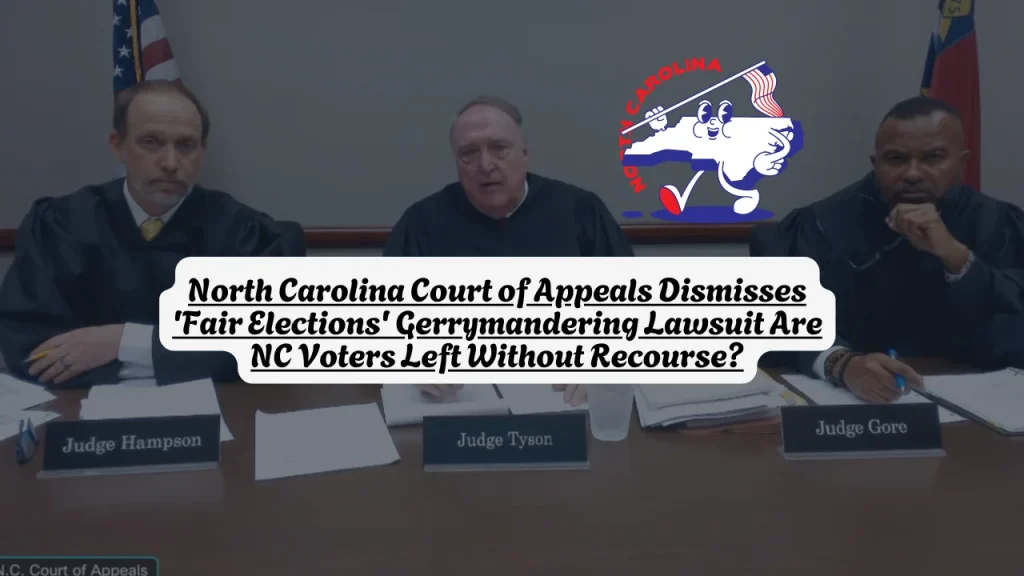
The North Carolina Court of Appeals rejected a lawsuit that argued partisan gerrymandering violates voters’ constitutional right to fair elections, dealing a blow to eleven North Carolina voters who challenged the Republican-drawn congressional and legislative maps currently set for use through 2030. A three-judge panel issued a unanimous unpublished opinion upholding a trial court’s 2024 decision against the plaintiffs — a victory for Republican state legislative leaders who defended the state election maps.
Quick Facts: NC Fair Elections Gerrymandering Lawsuit
| Field | Detail |
| Lawsuit Filed | January 2024 |
| Defendant | North Carolina General Assembly (Republican legislative leaders) |
| Alleged Violation | Article I, Section 36 of the North Carolina Constitution — unenumerated right to fair elections |
| Who Is Affected | North Carolina voters in gerrymandered congressional and state legislative districts |
| Current Court Stage | Court of Appeals dismissed — appeal to NC Supreme Court possible |
| Court & Jurisdiction | North Carolina Court of Appeals |
| Lead Attorney | Bob Orr, former NC Supreme Court Justice |
| Ruling Date | May 20, 2026 |
| Official Case Website | TBD — pending any future appeal filing |
| Last Updated | May 20, 2026 |
What the North Carolina Court of Appeals Ruled
Judge Christopher Freeman wrote for the unanimous panel that “plaintiffs alleged that the General Assembly acted unconstitutionally by drawing certain districts to favor one political party or group, which is tantamount to alleging partisan gerrymandering.” The court held that because the NC Supreme Court already decided partisan gerrymandering claims are nonjusticiable political questions, the claim was foreclosed by Harper III — the 2023 ruling in Harper v. Hall.
The panel further held that because plaintiffs relied on an “unenumerated right” — one not explicitly written into the state constitution — courts cannot use it as a basis for striking down a legislative act. Courts review only whether the General Assembly violated an express constitutional provision, and no express provision was identified.
Judges Donna Stroud and Julee Flood joined Freeman’s opinion. All three are Republicans. The court considered the case last August without oral argument.
What the NC Gerrymandering Lawsuit Was About — And Why It Mattered for 2026 Elections
Former Republican state Supreme Court Justice Bob Orr filed this lawsuit in January 2024 on behalf of nine Democrats and two unaffiliated North Carolina voters. Orr, who had previously served as a court-appointed expert in redistricting and helped draw fairer maps in 2022, argued that maps drawn by the Republican-led General Assembly in 2023 locked in partisan outcomes regardless of how North Carolinians actually voted.
The numbers behind the lawsuit are hard to ignore. In 2022, under maps Orr helped draw, North Carolina’s 14 U.S. House seats split 7-7 between Democrats and Republicans. Under the challenged 2023 maps, Republicans won 10 of 14 U.S. House seats — 71% of the congressional delegation — even as Republican presidential candidate Donald Trump won only 50.86% of the statewide vote.
Related article: Massachusetts School Segregation Lawsuit, Black and Latino Students Say the State Is Denying Them an Equal Education
Orr’s legal theory was deliberately different from prior partisan gerrymandering lawsuits. He argued that fair elections constitute an “unenumerated right” — not explicitly outlined in the constitution but foundational to other constitutional guarantees. His goal was to find a path around the 2023 state Supreme Court ruling that shut down earlier gerrymandering challenges. The Court of Appeals ruled that path does not exist under current precedent.
If you want to understand how courts have historically treated redistricting and voter rights challenges, our guide to gerrymandering law and your voting rights breaks down the legal landscape from the U.S. Supreme Court to state courts.
Are You Affected by North Carolina’s Gerrymandered Districts?
If you vote in North Carolina, this ruling affects you directly. Here is how to know where you stand.
You are likely affected by this lawsuit if:
- You live in a North Carolina congressional or state legislative district drawn in 2023
- You have voted in NC elections where Republican candidates won despite close statewide results
- You believe your district was drawn to prevent your vote from influencing the outcome
- You are an unaffiliated voter in NC whose district boundaries were redrawn after 2022
You are likely NOT included in any further legal action if:
- You live outside North Carolina
- Your district was not among those specifically targeted in Orr’s complaint
- You are pursuing a separate federal racial gerrymandering claim — that is a different lawsuit entirely
No settlement exists and no claim form is available. This is an active voting rights litigation — and whether it continues depends on whether Orr’s clients appeal to the North Carolina Supreme Court.
What Plaintiffs Asked the Court to Do — and What the Court Said
Orr’s suit targeted a specific and creative legal theory. His lawsuit asked courts to declare a state constitutional right to “fair elections” under Article I, Section 36 of the North Carolina Constitution, then to determine that targeted congressional and legislative districts violated that right.
The court ruled it was “constrained to reviewing whether the act of the General Assembly violated an express constitutional provision.” Because no express provision was violated, the court could not conclude the districts were drawn unconstitutionally.
The legislature’s lawyers were blunter. They argued that Orr’s plaintiffs were making “a desperate attempt to evade the failings of their own Complaint” and that there was “no mention of denial of the right to vote, or any other election integrity issues — put plainly, Plaintiffs challenge the 2023 Plans under theories of partisan gerrymandering.”
As an unpublished opinion, the ruling carries limited value as precedent for future court disputes. That detail matters: it leaves the door slightly open for future challenges framed differently — though the underlying legal obstacle, Harper v. Hall, remains firmly in place.
For context on how the broader national voting rights picture connects to cases like this one, see our analysis of the 2026 Voting Rights Act Supreme Court ruling and what it means for redistricting.
What North Carolina Voters Should Do Now
There is no claim form, and most voters do not need to take any action today to protect their legal standing. But these practical steps matter.
- Watch for an appeal. Orr has appealed earlier decisions in this case before. Monitor the North Carolina Supreme Court docket to see if this ruling gets challenged further.
- Track the federal lawsuits separately. At least three federal lawsuits in North Carolina claim the 2023 maps constitute illegal racial gerrymandering — two are currently in trial phase. Those are separate from Orr’s state-court case and are still active.
- Document your district. If you believe your congressional or legislative district was drawn in a way that dilutes your vote, keep records of your address and district assignment as further litigation develops.
- Consult a voter rights attorney. A free legal consultation with a voting rights or consumer rights lawyer familiar with redistricting law can help you understand whether your specific situation supports any individual or group action.
Timeline: NC Fair Elections Gerrymandering Lawsuit
| Milestone | Date |
| Republican-led General Assembly redraws maps | 2023 |
| Harper v. Hall (Harper III) bars partisan gerrymandering claims in state court | April 2023 |
| Bob Orr files fair elections lawsuit on behalf of 11 voters | January 2024 |
| Three-judge trial panel dismisses the case | June 2024 |
| Orr appeals to NC Court of Appeals | 2024–2025 |
| NC Court of Appeals hears arguments (without oral argument) | August 2025 |
| NC Court of Appeals issues unanimous ruling dismissing appeal | May 20, 2026 |
| Potential NC Supreme Court appeal | TBD — no filing confirmed yet |
Frequently Asked Questions
Is there a class action lawsuit against North Carolina’s gerrymandered maps?
The lawsuit brought by former Justice Bob Orr on behalf of 11 North Carolina voters has now been dismissed by the NC Court of Appeals. Separate federal racial gerrymandering cases remain active. No class action settlement exists and no claim process is open.
Do I need to do anything right now to be included in any future challenge?
Not at this stage. If a new appeal is filed or a separate case certifies a class, courts will issue public notice. Save records showing your home address and voting district in case eligibility matters later.
When will North Carolina’s gerrymandered maps be challenged again?
TBD — no new state court appeal has been confirmed. Federal lawsuits claiming racial gerrymandering in North Carolina’s congressional and legislative districts are in active trial, with outcomes expected to affect 2026 election maps if plaintiffs succeed.
Can NC voters file their own lawsuit against the legislature’s maps?
Individual voters can consult a civil rights or voting rights attorney about standing to challenge specific districts. However, Harper v. Hall currently blocks state courts from hearing partisan gerrymandering claims, which significantly narrows the available legal theories at the state level.
How will I know if this case is appealed to the NC Supreme Court?
Monitor the North Carolina Supreme Court’s public docket and TIRRC’s communications. If Orr’s team files a new appeal, it will appear in public court records. The ruling issued May 20, 2026 is the most recent action.
What was the Harper v. Hall decision and why does it block this lawsuit?
The NC Supreme Court’s 2023 ruling in Harper v. Hall — with a 5-2 Republican majority — rejected partisan gerrymandering claims under the state constitution and determined that North Carolina courts would no longer address cases involving partisan gerrymandering. That ruling is the wall every subsequent state-level challenge has hit, including Orr’s.
What happens to the 2023 NC maps if no court overturns them?
The new political maps approved by the Republican-led legislature ahead of the 2024 elections feature districts for the U.S. House, the state House, and the state Senate that are designed to favor Republicans electorally — and could remain in use through the 2030 elections if no court orders new maps.
Sources & References
- WBT Charlotte — Appeals Court rejects Orr’s ‘fair elections’ redistricting lawsuit, May 20, 2026: wbt.com
- WRAL News — NC voters appeal loss in ‘election integrity’ lawsuit challenging maps for Congress, state legislature, February 22, 2025: wral.com
- NC Voices — Former State Supreme Court Justice Bob Orr Thinks Plaintiffs Should Appeal “Fair Elections” Lawsuit Dismissal, July 2024: ncvoices.com
- WCNC — NC Supreme Court consider lawsuit on right to ‘fair’ elections, June 2024: wcnc.com
Prepared by the AllAboutLawyer.com Editorial Team and reviewed for factual accuracy against official court records and verified news sources on May 20, 2026. Last Updated: May 20, 2026.
Disclaimer: This article is for informational purposes only and does not constitute legal advice. Legal claims and outcomes depend on specific facts and applicable law. For advice regarding a particular situation, consult a qualified attorney.
About the Author
Israr Ahmad is a legal content researcher with 4+ years of experience covering class action settlements and consumer rights cases. He has researched and published coverage of 2,500+ settlements using verified court records, settlement administrator filings, and government sources. Learn more about Israr.