
Massachusetts School Segregation Lawsuit, Black and Latino Students Say the State Is Denying Them an Equal Education
A lawsuit filed Wednesday in Suffolk Superior Court by a group of students and several community organizations is challenging Massachusetts’ unequal school system, hoping to force state education leaders to foster greater racial integration in public schools. If your child attends school in Boston, Springfield, Holyoke, Brockton, Lawrence, Lynn, or Worcester — and they are Black or Latino — this case is directly about them.
Quick Facts: Massachusetts School Segregation Lawsuit
| Field | Detail |
| Lawsuit Filed | May 20, 2026 |
| Defendant | Massachusetts Department of Elementary and Secondary Education (DESE) and state education leaders |
| Alleged Violation | Massachusetts Constitution — right to an adequate and equal education |
| Who Is Affected | Black and Latino students in racially segregated public school districts across Massachusetts |
| Current Court Stage | Newly filed — active litigation |
| Court & Jurisdiction | Suffolk County Superior Court, Massachusetts |
| Lead Legal Teams | Lawyers for Civil Rights, Brown’s Promise, WilmerHale (pro bono) |
| Next Hearing Date | TBD — no hearing scheduled yet |
| Official Case Website | TBD — pending court assignment |
| Last Updated | May 20, 2026 |
What the Massachusetts School Segregation Lawsuit Accuses the State of Doing
The lawsuit alleges that state policies have led to tens of thousands of students concentrated in racially segregated school districts. Iván Espinoza-Madrigal, executive director of Lawyers for Civil Rights, said the state has a long history of connecting school and educational opportunities to residents, and that residential neighborhoods are extremely segregated — effectively locking residential segregation patterns directly into the schools.
At the center of the case are nine Black and Latino students who contend that state education leaders are denying them their right to an adequate and equal education under the state’s constitution by maintaining a system of racially segregated public schools. The students attend schools in Springfield, Holyoke, Boston, Lawrence, Brockton, Lynn, and Worcester — among the most racially segregated districts in the state.
The lawsuit focuses on the Massachusetts Constitution rather than the U.S. Constitution, putting the spotlight squarely on state education leaders and the state’s record of addressing school segregation. That distinction matters. By grounding the case in state constitutional law, plaintiffs are targeting Massachusetts specifically — and avoiding the federal legal landscape that has grown increasingly hostile to school integration claims.
The Numbers Behind This Lawsuit — How Segregated Are Massachusetts Schools?
Massachusetts sells itself as one of the top-performing states in the country for education. But that reputation does not reach every student equally.
Nearly two-thirds of all Massachusetts schools are “segregated” or “intensely segregated” by race, affecting more than 225,000 students, according to a report by the state’s own Racial Imbalance Advisory Council.
Intensely segregated white schools score a 66.3 out of 99 in performance assessments, while segregated nonwhite schools score 48 points lower. That is not a gap — it is a chasm. And it plays out in real classrooms, with real children, every day.
Related article: Black Hawk County Jail Release Fee Class Action, Were You Forced to Pay Before Walking Out?
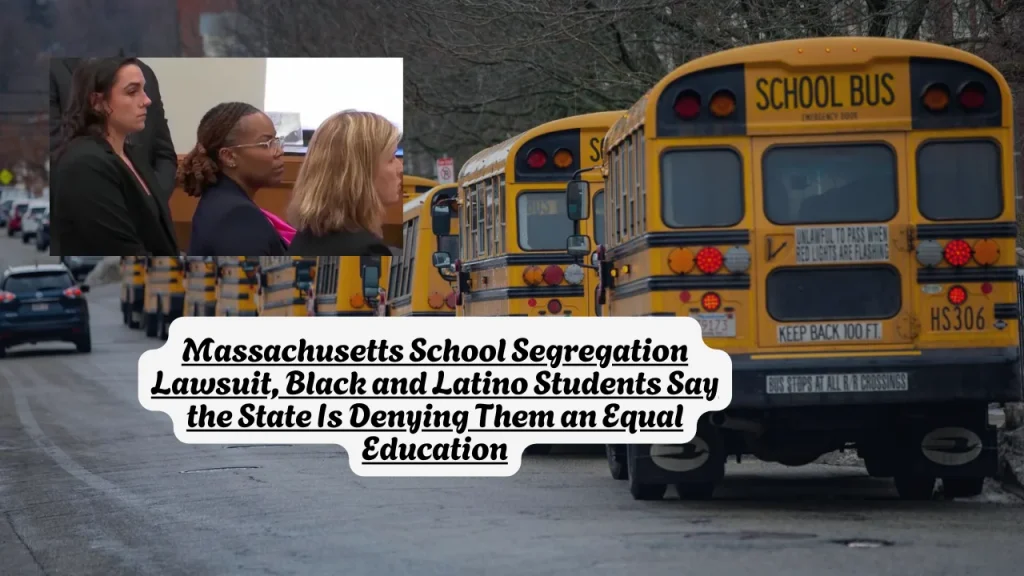
Massachusetts is known for having some of the top-ranked public schools in the country — but that is not actually true for many of the students in the state, said Ary Amerikaner, executive director at Brown’s Promise. The lawsuit names the communities where this gap hits hardest: Springfield, Lawrence, Holyoke, Brockton, and Lynn, in addition to Boston.
Understanding how school segregation and educational inequality intersect with civil rights law is essential context for this case. Our explainer on gerrymandering, redistricting, and how zip codes shape opportunity walks through how geography gets used as a proxy for race in public policy — including education.
Are You Part of This Massachusetts School Segregation Lawsuit?
If your child attends a public school in Massachusetts, here is how to know whether this case touches your family directly.
You may be part of this class if:
- Your child is Black or Latino and attends public school in Boston, Springfield, Holyoke, Brockton, Lawrence, Lynn, or Worcester
- Your child attends a school that is predominantly nonwhite and has experienced high teacher turnover or inadequate facilities
- You live in a neighborhood where residential segregation has directly shaped which school your child can attend
- You are a taxpayer in Massachusetts whose tax dollars fund a two-tier education system separated by race and zip code
You are likely NOT directly included if:
- Your child attends a school that already reflects diverse enrollment across racial and economic lines
- Your child attends a private or charter school not part of the affected district system
- You live outside Massachusetts
No money is available right now and no claim form exists. This is a civil rights injunction case — plaintiffs are asking the court to order the state to act, not to pay out a settlement.
What Plaintiffs Are Asking the Court to Order
This lawsuit is not seeking a financial settlement. It is asking a court to force the state to build a fundamentally different education system. The lawsuit is asking the court to proclaim that Massachusetts is violating the students’ constitutional right to an equal education, and it points to several policies that would make the system more equitable — including building better infrastructure, creating more vocational schools and magnet school programs, and allowing more students to attend programs in other districts.
The comprehensive plan plaintiffs are seeking would encompass voluntary measures to achieve integration, such as creating more regional vocational technical schools and expanding opportunities for students to attend schools outside their district through METCO, a voluntary school integration program involving Boston, Springfield, and their suburbs. Another measure calls on the state to bolster underperforming schools in lower-income areas so they attract suburban students — which could help urban districts integrate their schools.
A critical ingredient to ensure the plan works would be a guarantee of free transportation for students to take advantage of the opportunities, according to the lawsuit.
Senior attorney Jillian Lenson of Lawyers for Civil Rights summed up the goal plainly: “This lawsuit is about building a system where opportunity is not determined by zip code, and where our children learn how to live and lead in a diverse democracy. Our constitution demands nothing less.”
For more context on how civil rights litigation has shaped education access across the country, see our coverage of the 2026 Voting Rights Act Supreme Court ruling and what it means for minority communities.
What Affected Families in Massachusetts Should Do Right Now
You do not need to file anything today to preserve your connection to this lawsuit. But these steps matter.
- Document your child’s school conditions. If your child’s school has inadequate facilities, high teacher turnover, or limited course offerings compared to suburban schools, keep records. These facts matter in court.
- Connect with plaintiff organizations. Lawyers for Civil Rights, Brown’s Promise, and the four community organizations named as plaintiffs — Essex County Community Organization, Worcester Interfaith, YWCA of Central Massachusetts, and Out Now — are representing affected families. Reach out directly if you want to get involved.
- Track the case through Suffolk County Superior Court. Once the case is assigned a docket number, the public record will be accessible through the Massachusetts Court System’s online portal.
- Talk to a civil rights attorney. A free legal consultation with an education or consumer rights lawyer can help you understand whether your family’s specific situation supports a stronger role in this litigation.
- Save school records. Keep report cards, school communications, and any documentation of disparate resources or staffing that affected your child’s education.
Timeline: Massachusetts School Segregation Lawsuit
| Milestone | Date |
| Massachusetts Racial Imbalance Advisory Council issues segregation report | 2024 |
| State’s own report finds 63% of MA schools are segregated | October 2024 |
| DESE and Healey Administration decline to take action | 2024–2025 |
| Lawyers for Civil Rights, Brown’s Promise, WilmerHale file lawsuit in Suffolk Superior Court | May 20, 2026 |
| Class certification motion | TBD — no motion filed yet |
| Next scheduled hearing | TBD — pending court assignment |
| Expected resolution timeline | TBD — education civil rights cases typically take 2–4 years |
Frequently Asked Questions
Is there a class action lawsuit against Massachusetts for school segregation?
Yes. A lawsuit was filed Wednesday in Suffolk Superior Court challenging Massachusetts’ system of racially segregated public schools. It was filed on May 20, 2026 and is in its opening stage. No settlement or claim form exists yet.
Do I need to do anything right now to be included?
Not necessarily. In civil rights cases seeking injunctive relief, affected students and families are often covered by any court order automatically. Save school records, stay informed through the plaintiff organizations, and watch for any court-issued notices about class certification.
When will a settlement be reached in this Massachusetts school case?
TBD — no settlement has been proposed and none is expected soon. Cases of this type, which ask courts to restructure entire state education systems, typically take two to four years to resolve and often result in consent decrees rather than cash settlements.
Can my family file a separate lawsuit against our school district?
You may have grounds for individual legal action depending on your child’s specific circumstances. An education rights or civil rights attorney can assess whether your district’s conditions give rise to a separate claim. The individual school districts are not named as defendants in this lawsuit — the state itself is.
How will I know if this case results in changes to my child’s school?
If the court rules in plaintiffs’ favor, it will likely issue an order requiring DESE to submit and implement an integration plan. That plan would affect specific districts named in the lawsuit. Monitor updates from Lawyers for Civil Rights at lawyersforcivilrights.org and the Suffolk County Superior Court docket.
What is the METCO program and why does this lawsuit reference it?
METCO buses 3,200 students from overwhelmingly nonwhite Boston neighborhoods to predominantly white school districts in surrounding suburbs. Plaintiffs argue this program should be dramatically expanded — and made free — as one step toward meaningful integration across the state.
What makes Massachusetts a paradox on education and why does it matter here?
Massachusetts has long grappled with a troubling paradox: although the state has among the best-performing schools in the nation, it also has among the worst achievement gaps among students of different backgrounds. Many education advocates blame the problem on the failure of state education leaders to aggressively promote ways to integrate the state’s public schools. This lawsuit is the most direct legal challenge to that failure in decades.
Sources & References
- Boston Globe — Massachusetts faces lawsuit over racial divides in public schools, May 20, 2026: bostonglobe.com
- GBH News — Students sue Massachusetts, claiming ‘intensely segregated’ school districts, May 20, 2026: wgbh.org
- NBC Boston — 63% of Massachusetts schools are still segregated, report finds, October 2024: nbcboston.com
Prepared by the AllAboutLawyer.com Editorial Team and reviewed for factual accuracy against official court records and verified news sources on May 20, 2026. Last Updated: May 20, 2026.
Disclaimer: This article is for informational purposes only and does not constitute legal advice. Legal claims and outcomes depend on specific facts and applicable law. For advice regarding a particular situation, consult a qualified attorney.
About the Author
Israr Ahmad is a legal content researcher with 4+ years of experience covering class action settlements and consumer rights cases. He has researched and published coverage of 2,500+ settlements using verified court records, settlement administrator filings, and government sources. Learn more about Israr.