
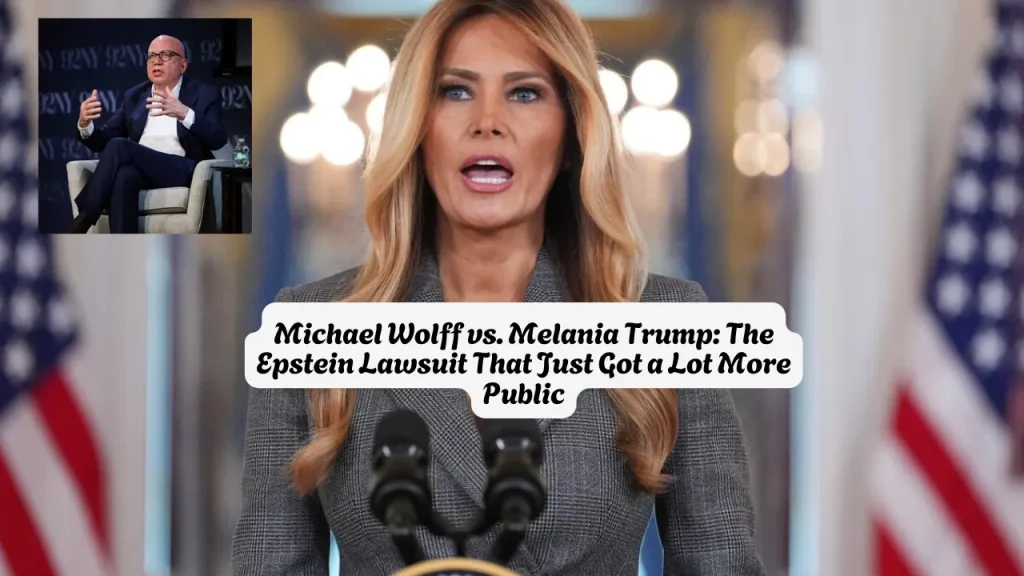
Michael Wolff vs. Melania Trump, The Epstein Lawsuit That Just Got a Lot More Public
Author Michael Wolff sued First Lady Melania Trump in October 2025 after her lawyers threatened him with a $1 billion defamation lawsuit over statements he made connecting her to Jeffrey Epstein. Rather than back down, Wolff went on offense — filing a preemptive lawsuit under New York’s anti-SLAPP law, designed to protect free speech from exactly this kind of legal pressure. On April 9, 2026, Melania Trump stepped in front of cameras at the White House and publicly denied any ties to Epstein — a rare and striking move that injected new life into a case that had been grinding through procedural motions for months.
Quick Facts
| Field | Detail |
| Plaintiff | Michael Wolff (journalist and author) |
| Defendant | Melania Trump, First Lady of the United States |
| Original Court | New York Supreme Court, Manhattan |
| Removed To | U.S. District Court, Southern District of New York |
| Federal Case Number | 1:25-cv-10752 |
| Assigned Judge | U.S. District Judge Mary Kay Vyskocil |
| Lawsuit Filed | October 22, 2025 |
| Legal Theory | New York anti-SLAPP law — declaratory judgment and damages |
| Melania’s Response | Motion to dismiss — improper service, lack of jurisdiction, failure to state a claim |
| Current Status | Pending — motion to dismiss and remand motions being briefed |
| Latest Development | Melania Trump delivers public White House statement on Epstein, April 9, 2026 |
Where Things Stand Right Now
- As of April 10, 2026, Judge Vyskocil has not ruled on Melania Trump’s motion to dismiss or Wolff’s competing motion to remand the case back to New York state court. The last known court filing was February 27, 2026.
- No merits ruling has been issued. The court is still resolving procedural disputes over service, jurisdiction, and venue before the underlying defamation and anti-SLAPP questions are even reached.
- Melania Trump’s April 9, 2026, White House statement — publicly denying Epstein ties and declaring she first met him at an event she attended with Trump in 2000 — is the biggest public development in this dispute since the lawsuit was filed.
How This Lawsuit Started
Michael Wolff is the author of “Fire and Fury” and three other books about Donald Trump. In 2025, he gave interviews and made statements — including to The Daily Beast — that included claims about Melania Trump’s connection to Jeffrey Epstein. Among those claims was an assertion that Epstein had said he introduced Melania Trump to Donald Trump.
Melania Trump’s legal team sent Wolff a formal demand letter from attorney Alejandro Brito, threatening to sue him for more than $1 billion in damages unless he immediately retracted and apologized. After threats from the first lady’s lawyers, The Daily Beast retracted its story and issued an apology “for any confusion or misunderstanding.”
Wolff refused to back down. Instead, on October 22, 2025, he filed a 15-page civil defamation suit in New York Supreme Court under the state’s anti-SLAPP law — a statute designed to block lawsuits intended to chill free speech. His argument was direct: Mrs. Trump’s claims were made for the sole purpose of harassing, intimidating, punishing, or otherwise maliciously inhibiting his free exercise of speech.
Related article: Loverboy Lawsuits, What Really Happened to Kyle Cooke’s Drink Brand
Wolff argued that the statements Melania Trump claimed to be defamatory were taken out of context and in proper context constituted protected opinion and hypothesis based on disclosed facts. He also announced publicly that he intended to subpoena both the President and the First Lady to testify under oath about their relationship with Epstein.
What Happened in Court After the Filing
Melania Trump’s legal team did not engage on the merits right away. Instead, they pursued procedural strategies to neutralize the case before it could reach discovery.
Step 1 — Removal to federal court. In late December 2025, Melania Trump asked the federal court to take jurisdiction of the suit from the New York State court. That moved the case to the U.S. District Court for the Southern District of New York, where it was assigned to Judge Mary Kay Vyskocil.
Step 2 — Motion to dismiss. In early January 2026, Melania Trump’s lawyers moved to dismiss Wolff’s lawsuit, arguing she was never properly served — stating that papers were handed to a doorman at Trump Tower, which is “not Mrs. Trump’s residence.” The motion also cited lack of personal jurisdiction and failure to state a claim and described the lawsuit as “meritless.”
Step 3 — Wolff fights back. On February 9, 2026, Wolff filed a memorandum of law opposing the motion to dismiss and simultaneously moved to remand the case back to New York state court — arguing the removal to federal court was improper. Wolff wants to stay in New York, where the anti-SLAPP protections are strongest.
Step 4 — Waiting on the judge. As of late February 2026, both motions are fully briefed and pending before Judge Vyskocil. No ruling has been issued. The case sits in a holding pattern — but it has not gone away.
The April 9, 2026, White House Statement
On April 9, 2026 — the same day the ICE class action and several other major legal stories broke — Melania Trump made an unexpected public appearance at the White House. Speaking in the Grand Foyer before cameras, she delivered a prepared statement and did not take questions.
“I am not Epstein’s victim. Epstein did not introduce me to Donald Trump,” she said, adding she first “crossed paths” with Epstein at an event she attended with Trump in 2000.
“The lies linking me with the disgraceful Jeffrey Epstein need to end today,” she said. “The individuals lying about me are devoid of ethical standards, humility and respect.”
She also made a notable call for congressional action: “Epstein was not alone. I call on Congress to provide the women who have been victimized by Epstein with a public hearing specifically centered around the survivors. Give these victims their opportunity to testify under oath in front of Congress.”
It was not immediately clear why Melania chose April 9 to make the rare public statement. She did not point to any specific inciting incident. The statement came one day after former Attorney General Pam Bondi defied a congressional subpoena related to the DOJ’s handling of Epstein files — and days after Trump fired Bondi. Whether Melania’s statement was coordinated with the White House’s broader communications strategy is not publicly known.
What This Case Is Really About — The Legal Stakes
On the surface this is a fight between a journalist and the First Lady of the United States. Underneath it, the case raises first-order questions about press freedom, the reach of anti-SLAPP protections, and whether threatening a billion-dollar lawsuit against a journalist constitutes unlawful suppression of speech.
New York’s anti-SLAPP law — which Wolff used as his legal basis — is among the strongest in the country. It was significantly expanded in 2020. It allows targets of strategic litigation designed to silence public commentary to sue the party making the threat and recover attorneys’ fees and damages if they prevail. The law is specifically designed to protect journalists, authors, and commentators from wealthy or powerful figures who use the cost of litigation itself as a weapon.
If Wolff wins on the anti-SLAPP claim, Melania Trump could owe him attorneys’ fees and potentially compensatory damages. If the court dismisses the case — on jurisdictional grounds or otherwise — Wolff would need to refile or abandon the action.
The bigger prize Wolff has publicly described is discovery — specifically, the right to depose both the President and First Lady under oath about their relationship with Epstein. That is the kind of legal proceeding that does not exist anywhere else in American public life right now. Whether the court ever lets it get that far is the central open question.
Full Case Timeline
| Date | Milestone |
| October 2025 | Melania’s lawyers send $1B demand letter to Wolff |
| October 22, 2025 | Wolff files anti-SLAPP lawsuit in NY Supreme Court, Manhattan |
| Late December 2025 | Melania removes case to federal court (SDNY) |
| December 29, 2025 | Case assigned to Judge Mary Kay Vyskocil (Case No. 1:25-cv-10752) |
| January 5–6, 2026 | Melania’s lawyers request pre-motion conference; Judge denies it |
| January 6, 2026 | Melania files motion to dismiss — improper service, no jurisdiction |
| January 7–8, 2026 | Wolff files response; Judge orders standard briefing schedule |
| February 9, 2026 | Wolff files motion to remand back to NY state court + opposes dismissal |
| February 27, 2026 | Last known court filing |
| April 9, 2026 | Melania delivers White House statement publicly denying Epstein ties |
| TBD | Judge Vyskocil rules on dismissal and remand motions |
| TBD | Discovery, depositions, or trial — if case survives |
Frequently Asked Questions
What is an anti-SLAPP lawsuit and why did Wolff use it?
SLAPP stands for Strategic Lawsuit Against Public Participation. These are lawsuits filed not to win in court, but to silence critics by burying them in legal costs. New York’s anti-SLAPP law lets the target of such a threat strike first — filing for a declaratory judgment that their speech was lawful and seeking fees and damages from the person making the threat. Wolff used the law to flip the situation: instead of waiting to be sued for a billion dollars, he became the plaintiff.
What did Wolff actually say about Melania and Epstein?
Wolff stated in interviews — including to The Daily Beast — that Epstein had told him he introduced Melania Trump to Donald Trump on his private jet. Wolff framed these as statements based on what Epstein told him and as protected opinion and hypothesis. Melania Trump’s lawyers called them false and defamatory. The Daily Beast retracted its story under legal pressure. Wolff has maintained his statements were accurate and taken out of context.
Why does it matter which court hears the case?
New York’s anti-SLAPP law is a state statute. Wolff wants to stay in New York state court where those protections are at their strongest. Melania’s team removed the case to federal court — a common tactic that can reduce the practical impact of state anti-SLAPP protections. Wolff filed a motion to send it back. Until Judge Vyskocil rules on that question, the threshold issue of which court applies which law remains unresolved.
Was Melania Trump ever properly served with the lawsuit?
Her lawyers say no — arguing that serving papers on a doorman at Trump Tower was not valid because Trump Tower is not her legal residence. Wolff’s team contests this. It is one of the pending issues before Judge Vyskocil.
Could Wolff actually depose Donald Trump?
That is what Wolff has said he wants. Under civil litigation rules, a party can subpoena witnesses — including the President — for depositions. However, courts have significant discretion to limit or quash such subpoenas, particularly for sitting presidents. Whether any deposition of the President or First Lady ever happens depends entirely on whether the case survives the motion to dismiss and reaches the discovery phase.
Why did Melania speak publicly on April 9, 2026?
She gave no specific reason. The statement came amid continued congressional pressure over the Epstein files, the firing of Attorney General Pam Bondi, and the ongoing Wolff lawsuit. Legal observers note that making public statements about disputed facts while litigation is pending is unusual and carries its own risks — anything she says publicly could potentially be used in the case.
Last Updated: April 10, 2026
Disclaimer: This article is for informational purposes only and does not constitute legal advice. Legal claims and outcomes depend on specific facts and applicable law. For advice regarding a particular situation, consult a qualified attorney.
About the Author
Israr Ahmad is a legal content researcher with 4+ years of experience covering class action settlements and consumer rights cases. He has researched and published coverage of 2,500+ settlements using verified court records, settlement administrator filings, and government sources. Learn more about Israr.
Surprisingly, no mention of Amanda Ungaro providing strength to Wolff’s claims. Yes, Wolff’s argument – that his opinion of how the Trumps met is coloured by what Epstein told him directly, is the basis of his anti‐SLAPP. However, Ungaro is alive, angry, and presumably willing to take the stand to spill the beans on a so‐called friend who did nothing to stop Ungaro being deported vindictiveness by her soon to be ex‐husband and Donald Trump. I sincerely hope that Ungaro gets her day in court.