
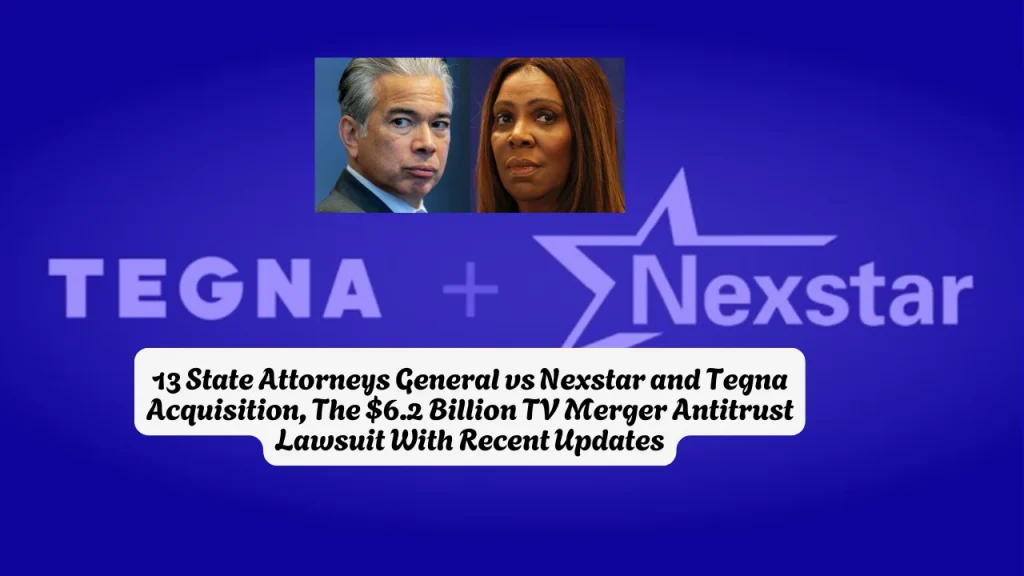
13 State Attorneys General vs Nexstar and Tegna Acquisition, The $6.2 Billion TV Merger Antitrust Lawsuit With Recent Updates
Thirteen state attorneys general, including Pennsylvania’s Dave Sunday, filed an amended antitrust complaint on April 30, 2026 seeking to permanently unwind Nexstar Media Group’s $6.2 billion acquisition of TEGNA — a completed merger that would make Nexstar the largest owner of local television stations in the United States, controlling stations that reach approximately 80% of American TV households. A federal judge already paused the deal on April 17, 2026. Nexstar is appealing that ruling, and a full antitrust trial is now expected.
Quick Facts
| Field | Detail |
| Plaintiffs | 13 state attorneys general: California (lead), Colorado, Connecticut, Illinois, Indiana, Kansas, Massachusetts, New York, North Carolina, Oregon, Pennsylvania, Vermont, Virginia; also DirecTV (consolidated) |
| Defendants | Nexstar Media Group, Inc.; TEGNA Inc. |
| Case Name & Number | In re: Nexstar-TEGNA Merger Litigation, No. 2:26-cv-00976-TLN-CKD |
| Court | U.S. District Court, Eastern District of California (Sacramento) |
| Legal Claims | Section 7 of the Clayton Act, 15 U.S.C. § 18; Sherman Antitrust Act — unlawful merger eliminating competition in local broadcast TV markets |
| Relief Sought | Permanent order to unwind and divest the merger; halt all integration |
| Current Stage | Preliminary injunction in effect (April 17, 2026) — merger paused; Nexstar appealing to the Ninth Circuit |
| Pennsylvania AG | Dave Sunday (Republican) |
| Lead Plaintiff AG | Rob Bonta, California (Democrat) |
| Next Scheduled Date | TBD — trial date not yet set; Nexstar appeal to Ninth Circuit pending |
| Last Updated | May 1, 2026 |
Case Timeline
| Date | Event |
| August 18, 2025 | Nexstar and TEGNA announce $6.2 billion merger agreement |
| February 2026 | President Trump publicly endorses the deal |
| March 19, 2026 | FCC and DOJ approve the merger; Nexstar closes the deal same day |
| March 19, 2026 | Eight state AGs and DirecTV file separate antitrust lawsuits within hours of approval |
| Late March 2026 | Judge Nunley issues temporary restraining order blocking Nexstar from integrating TEGNA |
| April 17, 2026 | Judge Nunley converts the restraining order to a full preliminary injunction; merger integration paused pending trial |
| Late April 2026 | Nexstar files notice of appeal to the Ninth Circuit Court of Appeals |
| April 30, 2026 | Pennsylvania, Indiana, Kansas, Massachusetts, and Vermont join via First Amended Complaint — coalition grows to 13 states |
| May 2026 | D.C. Circuit Court denies emergency stay of FCC approval |
| Trial date | TBD — not yet scheduled as of May 1, 2026 |
What Is the Nexstar-TEGNA Antitrust Lawsuit About? In re: Nexstar-TEGNA Merger Litigation, No. 2:26-cv-00976-TLN-CKD
Nexstar is the largest owner of local broadcast television stations in the United States, and TEGNA is the second-largest owner of local English-language television stations. The acquisition gives Nexstar control of 228 broadcast stations reaching 80% of television households in 132 local markets. The states argue that this level of consolidation violates Section 7 of the Clayton Act, 15 U.S.C. § 18, which prohibits mergers whose effect may be to substantially lessen competition in any line of commerce.
Chief Judge Troy L. Nunley of the U.S. District Court for the Eastern District of California issued a preliminary injunction on April 17, 2026, ordering Nexstar and TEGNA to halt all integration activities and maintain TEGNA as a separate, independently managed business unit pending adjudication on the merits. The court found the plaintiffs demonstrated a likelihood of success on their claims. Critically, the court also ruled that the FCC’s approval of the deal does not shield it from antitrust review — the judge said the regulatory oversight did not curb the manifest anticompetitive effects of the acquisition.
The states argue the deal violates antitrust laws because it concentrates too much power with a single broadcaster. They say Nexstar will be incentivized to consolidate news operations, resulting in journalist layoffs, and will have more leverage to raise distribution fees charged to cable and satellite companies who carry their Big Four affiliates — fees that are ultimately passed on to subscribers. For more background on how antitrust law applies to corporate mergers, see our overview of business and corporate litigation.
Who Are the Parties and Why Is This Bipartisan?
Nexstar Media Group is a Irving, Texas-based broadcaster that, before the TEGNA deal, already owned more than 200 local stations in 116 U.S. markets. CEO Perry Sook has argued that consolidation is necessary to compete against major technology and streaming companies. Nexstar spent months lobbying the Trump administration for approval and has called the deal a pro-competitive transaction that will make local stations stronger and support continued investment in local journalism. Nexstar consummated the merger within hours of receiving federal approval, before a court could stop it.
TEGNA Inc. was the nation’s third-largest broadcasting group before the merger, controlling 64 stations in 51 markets. It is now a subsidiary of Nexstar, held separately under court order while the litigation proceeds.
Related article: Paramount+ Subscribers vs. Paramount Skydance, The $110 Billion Warner Bros. Merger Antitrust Lawsuit
The eight original plaintiff states all had Democratic governors, but the addition of Indiana, Kansas, and Pennsylvania — states with Republican attorneys general — transformed the lawsuit into a bipartisan effort. Pennsylvania AG Dave Sunday said rising TV subscription costs are already stretching household budgets and this merger would only make that worse. Ohio AG Dave Yost took a different approach — instead of joining the lawsuit, he reached a separate agreement with Nexstar committing the company to maintain separate news teams and preserve existing levels of local programming in Cleveland and Columbus.
For context on how state attorneys general use antitrust law to challenge corporate consolidation, see our guide to consumer rights and antitrust enforcement.
Why Does This Affect Pennsylvania Specifically?
In Pennsylvania, the Harrisburg and Scranton/Wilkes-Barre media markets currently have broadcast TV options from both Nexstar and TEGNA. Those stations are WPMT, the FOX affiliate in the Harrisburg-Lancaster-Lebanon-York market, and WNEP, the ABC affiliate in the Wilkes-Barre-Scranton-Hazleton market. Under the merger, a single company would control competing Big Four affiliates in those markets, eliminating the competitive pressure that currently keeps distribution fees and ultimately consumer prices in check.
The deal also allowed Nexstar to re-acquire several Pennsylvania stations it was previously forced to sell to TEGNA in 2020 to satisfy antitrust concerns during its merger with Tribune Media. The states argue that allowing Nexstar to reclaim those stations effectively undoes a prior antitrust remedy that regulators already determined was necessary to protect competition.
The coalition argues the merger would significantly eliminate competition among local affiliates of the Big Four networks — ABC, CBS, NBC, and FOX — across 31 media markets nationwide where Nexstar and TEGNA each currently own competing stations.
What Is at Stake in This Lawsuit?
The plaintiffs are asking the court for a permanent order to unwind the merger entirely — which would force Nexstar to divest the 60-plus TEGNA stations it acquired. All integration and consolidation activities are currently enjoined until final judgment. Nexstar must allow TEGNA to continue operating as a separate, independently managed business unit, and is prohibited from influencing TEGNA’s decision-making regarding retransmission agreements, newsroom operations, programming, personnel, and advertisement sales.
If the states ultimately win at trial, Nexstar could be compelled to sell off the acquired TEGNA stations — reversing a $6.2 billion transaction that has already closed. If Nexstar wins, the merger proceeds and the company becomes the dominant force in local broadcast television by a wide margin. Nexstar says it will take the appeal to the Ninth Circuit, setting up a battle that could last for months and might wind up at the doorstep of the U.S. Supreme Court.
What Happens Next?
Nexstar is appealing the preliminary injunction to the Ninth Circuit Court of Appeals. The D.C. Circuit Court separately declined an emergency stay request, and ordered the FCC and Nexstar to respond to related petitions by May 11, 2026. No trial date has been set in the Eastern District of California as of May 1, 2026.
Nexstar CEO Perry Sook has signaled the company is digging in for the long haul, noting they are not in control of the timetable and that it will play out over a series of months. In the meantime, Nexstar owns TEGNA but cannot operate it as a unified company — a costly and operationally complex situation that increases pressure on both sides to resolve the case.
Frequently Asked Questions
Is there a class action lawsuit against Nexstar and Tegna?
No. This is a government antitrust enforcement action, not a class action. Thirteen state attorneys general and DirecTV filed suit directly in federal court under the Clayton Act and the Sherman Antitrust Act. Individual consumers are not named plaintiffs, but the case is designed to protect them from higher prices and reduced competition.
What is the current status of the Nexstar-Tegna merger lawsuit?
A preliminary injunction issued April 17, 2026 by Chief Judge Troy L. Nunley of the U.S. District Court for the Eastern District of California requires Nexstar and TEGNA to halt all integration activities while the antitrust case proceeds. Nexstar is appealing the injunction to the Ninth Circuit. No trial date has been set.
What court is handling this case?
The case is In re: Nexstar-TEGNA Merger Litigation, No. 2:26-cv-00976-TLN-CKD, in the U.S. District Court for the Eastern District of California in Sacramento. Chief Judge Troy L. Nunley is presiding.
How much is at stake in this lawsuit?
The merger’s enterprise value is $6.2 billion. The states are not seeking monetary damages — they are seeking a court order that would force Nexstar to unwind the deal entirely and divest the TEGNA stations it acquired. If that happens, Nexstar would need to resell 60-plus television stations in markets across 44 states.
Can I read the court filings?
Yes. The case is filed in the Eastern District of California. Court documents are accessible through the federal PACER system at pacer.gov using case number 2:26-cv-00976-TLN-CKD.
Why did Pennsylvania join if the DOJ already approved the deal?
The federal Department of Justice closed its antitrust investigation and approved the deal, creating a stark divide between federal and state-level antitrust enforcers. State attorneys general have independent authority to enforce federal antitrust laws and are not bound by the DOJ’s decision not to sue. The court agreed, ruling that FCC and DOJ clearance does not immunize the merger from judicial review.
What does the merger mean for my cable or satellite TV bill?
The plaintiffs argue that Nexstar will have increased leverage to raise distribution fees charged to cable and satellite companies carrying its Big Four affiliates — costs that have steadily increased over the past decade and are passed on directly to subscribers. DirecTV estimated the merger would raise cable fees by $135 million industry-wide. No rate increases have been confirmed, and the merger integration is currently blocked by court order.
Sources & References
- Pennsylvania Attorney General’s Office — Official press release, April 30, 2026 — attorneygeneral.gov
- Paul Weiss LLP — Preliminary injunction analysis, April 2026 — paulweiss.com
- NPR News — Judge halts Nexstar’s takeover of Tegna until antitrust trial, April 17, 2026 — npr.org
- Reuters — More states join legal challenge to Nexstar, Tegna merger, May 1, 2026
Prepared by the AllAboutLawyer.com Editorial Team and reviewed for factual accuracy against official court records and the Pennsylvania Attorney General’s official press release on May 1, 2026. Last Updated: May 1, 2026
Disclaimer: This article is for informational purposes only and does not constitute legal advice. Information about this case is based on publicly available court records and verified reporting. Allegations described in this article have not been proven at trial. For advice regarding a particular legal situation, consult a qualified attorney.
About the Author
Israr Ahmad is a legal content researcher with 4+ years of experience covering class action settlements and consumer rights cases. He has researched and published coverage of 2,500+ settlements using verified court records, settlement administrator filings, and government sources. Learn more about Israr.