
Massachusetts Public Records Law Changes in 2027, What Question 1 Means
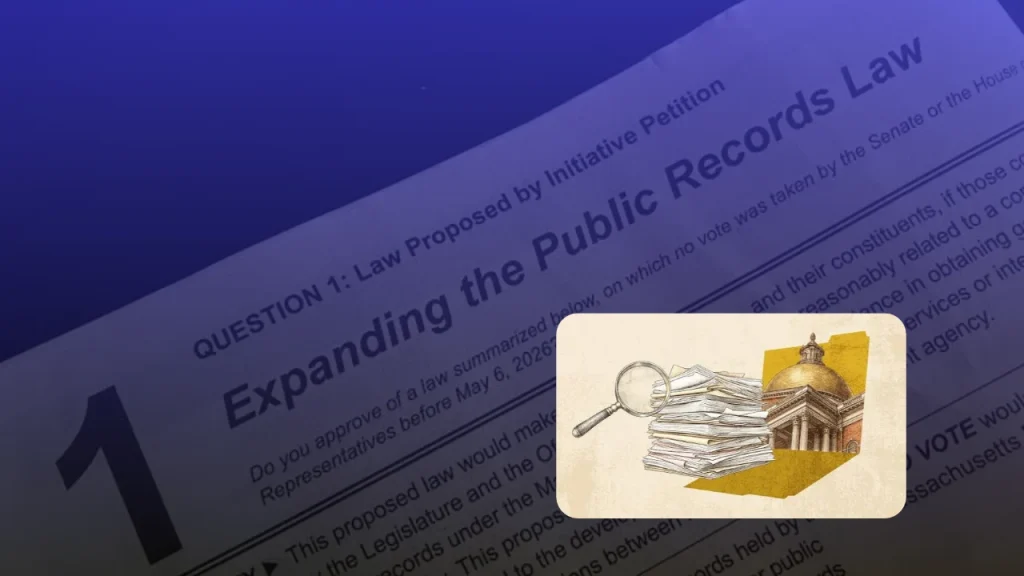
Massachusetts residents are set to get broader access to government documents starting January 1, 2027. Voters approved Question 1 on November 3, 2026, and it brings most records held by the governor’s office, the state House, and the state Senate under the state Public Records Law. Nearly 86% of voters backed it, according to unofficial results.
Until now, Massachusetts was an outlier: the governor’s office and the Legislature were not covered the way city governments and state agencies are. Question 1 changes that, which opens the door for residents, journalists, and watchdogs to request contracts, spending records, and other administrative documents.
But it does not make every email or private conversation public. The measure exempts documents tied to developing policy positions and certain communications between lawmakers and constituents seeking help from government. Existing privacy and confidentiality protections still apply.
One more thing to know: lawmakers have been negotiating their own public-records bills, and the campaign behind Question 1 has pledged to sue if the Legislature tries to replace it. More on that below.
Question 1 Quick Facts
| Detail | Information |
| Ballot measure | Massachusetts Question 1 |
| Election date | November 3, 2026 |
| Result | Approved, nearly 86% Yes (unofficial results) |
| Effective date | January 1, 2027 |
| Offices newly covered | Governor’s office, state House, state Senate |
| Main statutes involved | M.G.L. c. 4, § 7 (definitions and exemptions); c. 66, § 10 (requests) |
| Initial response deadline | Generally 10 business days |
| Appeal deadline | Generally 90 calendar days |
| Does every record become public? | No |
| Does it cover Massachusetts courts? | Not through Question 1 |
What Did Massachusetts Voters Approve?
Question 1 extends the existing Public Records Law, Chapter 66 of the Massachusetts General Laws, to offices that previously fell outside it. Before the vote, residents could already request records from cities, towns, and most state agencies. The governor’s office and the Legislature were treated differently, and records they held were not subject to the same request procedures.
A Yes vote meant bringing most of those offices’ records under the law. A No vote would have left things as they were. Yes won by a wide margin. You can read the official text on the Secretary of the Commonwealth’s Question 1 page.
When Does the New Law Take Effect?
January 1, 2027. The election result alone does not trigger the new obligations. Until then, only agencies already covered by the law have to follow its procedures.
Can you request records created before 2027?
Possibly. The measure addresses records held by the newly covered offices and does not clearly limit requests to documents created after January 1. How older records are treated, along with retention rules and any legal challenges, could affect access, so don’t assume everything from before 2027 will be available.
Which Records Could Become Public?
The broad exclusion is gone, so administrative records that meet the definition of a public record and aren’t otherwise exempt can now be requested.
| Type of record | Likely treatment starting 2027 |
| Government contracts | Generally disclosable unless exempt |
| Vendor payments and expenditures | Generally disclosable |
| Office operating and staff expenses | Generally disclosable |
| Certain government emails | Depends on content and exemptions |
| Settlement agreements | Potentially accessible, subject to exemptions |
| Documents developing policy positions | Specifically exempt |
| Certain constituent-service communications | Specifically exempt |
| Medical or other protected personal information | Existing protections remain |
A journalist could, for example, request records of a contract between a legislative office and a technology vendor. Whether every responsive document comes out depends on the exemptions that apply. The same goes for emails from the governor’s office: a message about an office expense is treated differently from one that develops a policy position or contains protected personal information.
What Can Still Be Withheld?
Question 1 adds two specific exemptions to Chapter 4, Section 7, and the older ones remain.
Policy-development documents
Communications, memos, drafts, and other documents relating to the development of policy positions by legislators or the governor are exempt. Think internal discussion of proposed legislation or preliminary policy memos. The language is broad, and it’s not clear that these documents must be released once a policy is adopted. Courts and officials may have to settle that.
Constituent-service communications
Communications between a legislator (or their staff) and a constituent seeking help with government benefits, services, or dealings with a government agency are exempt. If a resident writes to a state representative about a stalled unemployment claim, that exchange could be protected.
There is no blanket exemption for all constituent mail, though. An email giving an opinion on a pending bill raises a different question. Don’t assume that everything you send an elected official stays confidential.
Existing exemptions
Protections for qualifying personnel and medical information, records covered by other statutes, certain investigatory records, and attorney-client privileged communications continue to apply.
Related article: Massachusetts Marijuana Law 2026, Did Question 8 Ban Recreational Sales?
How to File a Public Records Request
You can use the existing procedure in Chapter 66, Section 10. The practical route is a written request to the Records Access Officer (RAO) for the office holding the records.
- Find the right office. Is it the governor’s office, the House, the Senate, a state agency, or a city or town? The Secretary of the Commonwealth’s Public Records Division does not hold every document, so send the request directly to the office that does.
- Be specific. Name the subject, date range, record type, and office. A request for contracts and invoices tied to one vendor in one year moves faster than one for “all emails.” You don’t have to explain why you want the records.
- Put it in writing. A written request creates a record of when you asked and helps protect your appeal rights.
- Keep your confirmation. Save the request, the date, and any acknowledgment.
- Review the response. The office should provide records, explain what it’s withholding and why, or explain what additional time it needs.
Official instructions are on the Secretary of the Commonwealth’s request page.
Sample request
Subject: Massachusetts Public Records Request: Government Contracts
Dear Records Access Officer:
Under Massachusetts General Laws Chapter 66, Section 10, I request electronic copies of contracts, invoices, purchase orders, and related payment records concerning [vendor or project] held by [office] from [start date] through [end date].
If any portion is withheld, please identify the exemption relied on and provide any reasonably segregable nonexempt portions. If fees may apply, please send an itemized estimate before proceeding.
Thank you.
[Name and contact information]
How Long Does the Government Have to Respond?
Chapter 66, Section 10 generally requires a response within 10 business days. That is a deadline to respond, not necessarily to hand over every document. For complex requests, the office may send a compliant written response explaining the circumstances and setting a production schedule, and the Supervisor of Records can authorize more time. Question 1 puts the governor’s office and the Legislature under this framework in 2027, though disputes over how to apply it are possible.
What Does a Request Cost?
There’s no filing fee just for asking. Offices may charge reasonable fees for search, copying, and processing time. For state agencies, the first four hours of work are generally free and hourly staff charges are generally capped at $25, with exceptions. You can ask for an itemized estimate before work begins, and electronic copies often cut costs. Fees can sometimes be reduced or waived when disclosure serves the public interest. See the state’s public records fee guidance for current rules.
What If a Request Is Denied?
Under M.G.L. c. 66, § 10A, you can appeal to the Supervisor of Records, generally within 90 calendar days of the response (or of your request if you never got one). Include:
- A copy of your written request
- The office’s written response, if any
- A short explanation of why the denial or non-response should be reviewed
Send a copy to the records custodian too. The appeal email is [email protected]. You may also be able to file a civil action in Superior Court, and the law allows courts to award costs and attorney’s fees to a requester in some circumstances. How enforcement will work against the Legislature in particular could become the subject of further litigation. See the official appeal instructions.
Could Lawmakers Replace Question 1?
This is the biggest open question. Reporting from WBUR says the House and Senate have been negotiating bills that would put the governor’s office and the Legislature under new public-records requirements while creating a separate process for legislative records. WBUR also reports that the proposal would place the governor under the public records law but narrow access to legislative records and give lawmakers more control over what is released. State Auditor Diana DiZoglio, who led the Question 1 campaign, has said she would sue if such a bill became law.
Governor Maura Healey’s office has said she supports Question 1.
Watch for any legislative action before January 1, 2027, since it could change what requesters can actually get.
Could Question 1 Face a Constitutional Challenge?
Yes. Legislative leaders raised separation-of-powers concerns before the vote, arguing that putting an executive-branch official in charge of public-records compliance by the Legislature could intrude on legislative independence. They also pointed to administrative burdens and the protection of constituent communications. Supporters argue the public should be able to scrutinize government spending and records under consistent rules.
The official voter guide notes that justices of the Supreme Judicial Court raised significant constitutional questions in an advisory opinion earlier this year while leaving them unresolved. Those concerns are not a court order striking down Question 1. As of November 16, 2026, no ruling blocking the January 1 start was verified in the sources reviewed.
Is This the Same as Federal FOIA?
No. The federal Freedom of Information Act, 5 U.S.C. § 552, covers records of federal agencies. Massachusetts’ Public Records Law covers state and local government records. A request for the governor’s records goes through the state process, not federal FOIA. For federal disputes, see our coverage of the Supreme Court’s DOGE records case and the Presidential Records Act challenge.
Does Question 1 Cover Massachusetts Courts?
Not directly. It brings the Legislature and the governor’s office within the law’s definition of covered agencies and does not generally extend it to the judicial branch. Court records follow separate rules on access and sealing, and law enforcement and local records stay under their own provisions. Records fights elsewhere show why privacy, timing, and production limits still matter, as in Mary Peltola’s Alaska ballot-records lawsuit.
Is This the Same as the 2024 Audit Question?
No. Massachusetts voters also approved a Question 1 in 2024 about State Auditor Diana DiZoglio’s authority to audit the Legislature. The 2026 Question 1 is about public records held by the Legislature and the governor’s office. Both are about accountability, but they work through different legal mechanisms, and the 2026 vote does not resolve the 2024 audit dispute.
Frequently Asked Questions
Did Massachusetts Question 1 pass?
Yes. Voters approved it on November 3, 2026, with nearly 86% in favor according to unofficial results.
When does the new public records law start?
January 1, 2027.
Can I request emails from Massachusetts lawmakers?
Potentially, starting in 2027. Whether a particular message is released depends on its content and the exemptions that apply.
Can I request records from Governor Healey’s office?
Yes. The governor’s office comes under the public-records framework in January 2027, though specific documents may still be exempt.
Do I have to live in Massachusetts to file a request?
No. The Public Records Law generally lets any person request qualifying records.
Can legislators keep policy-development documents private?
The new law exempts documents relating to the development of policy positions. How far that exemption reaches may need to be worked out through interpretation.
How long does the government have to respond?
Generally 10 business days for the initial response. Actual production can take longer under authorized procedures.
What if my request is denied?
You can appeal to the Supervisor of Records, generally within 90 calendar days, and may also be able to go to Superior Court.
Could the Legislature change the law before it takes effect?
Lawmakers have been negotiating their own public-records bills. Any such change could alter how Question 1 works in practice, and Question 1’s backers have pledged to sue if it does.
What Happens Next?
The next key date is January 1, 2027. Between now and then, watch for legislative action on competing bills, court challenges, and guidance on how the governor’s office and the Legislature will receive and process requests. After that, offices will have to apply the existing framework to newly covered records: intake, exemption review, production, and appeals.
The key takeaway: Question 1 expands access to Massachusetts government records. It does not remove every confidentiality protection, and how it plays out in 2027 could still be shaped by the Legislature and the courts.
Sources and Legal References
News reporting
- WBUR: Question 1 passes (Nov. 3)
- Boston Globe: Nearly 86 percent back Question 1 (Nov. 4)
- WBUR: Talk of lawsuits over public records law changes (Oct. 7)
- Boston.com: When winning ballot questions take effect
Official sources and law
- Secretary of the Commonwealth: Official Question 1 text and explanation
- M.G.L. c. 4, § 7: Definitions and exemptions
- M.G.L. c. 66, § 10: Public records requests
- M.G.L. c. 66, § 10A: Appeals and enforcement
- Secretary of the Commonwealth: Making a request
- Secretary of the Commonwealth: Appealing a denial
- Mass.gov: Public records information and fees
A note on sources: The vote share is from unofficial results and may change when results are certified. The scope of the new exemptions and any court challenges may require further interpretation.
Legal disclaimer: AllAboutLawyer.com provides independent legal information, not legal advice, and is not a law firm. Rights, exemptions, fees, and appeals depend on the applicable law and your circumstances.
Researched by Israr Ahmad, Legal Content Researcher. Last reviewed November 16, 2026.
About the Author
Israr Ahmad is a legal content researcher with 4+ years of experience covering class action settlements and consumer rights cases. He has researched and published coverage of 2,500+ settlements using verified court records, settlement administrator filings, and government sources. Learn more about Israr.