
Florida Congressional Redistricting Lawsuit, Three Cases Filed, Here Is What Florida Voters Need to Know Right Now
Prepared by the AllAboutLawyer.com Editorial Team and reviewed for factual accuracy against court filings in the Second Judicial Circuit, Leon County, Florida, and reporting from Florida Phoenix, WUSF, and ClickOrlando. Last Updated: May 8, 2026
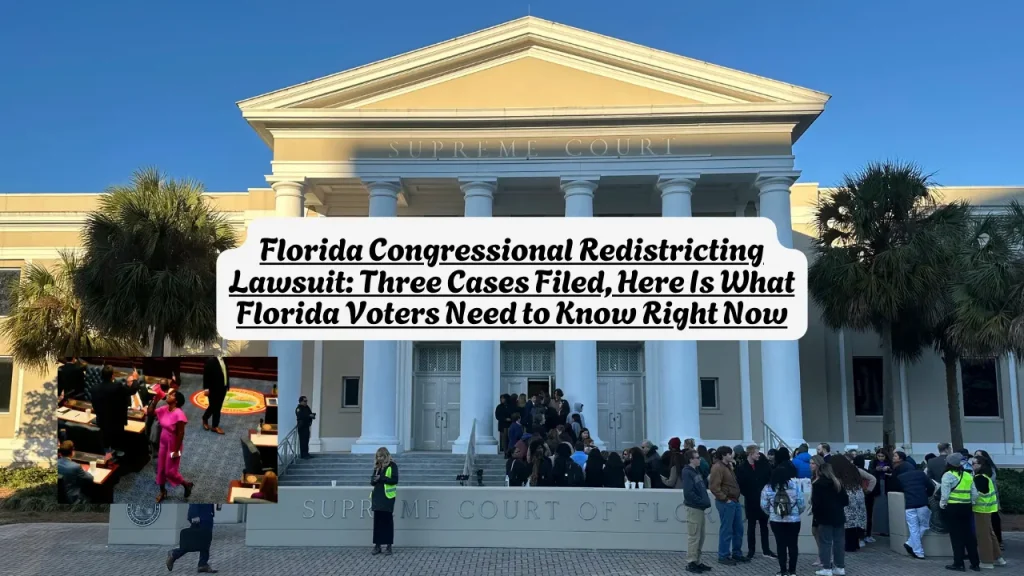
Florida voters and the Equal Ground Education Fund filed a lawsuit in state court challenging the Florida Legislature’s new congressional map, which adds four additional Republican-leaning seats ahead of the 2026 midterms. Gov. Ron DeSantis signed the redistricting bill into law on May 4, 2026. Within days, three separate lawsuits were filed to block the new map before it can be used in any 2026 election.
Florida Redistricting 2026 — Quick Facts
| Field | Detail |
| Lawsuit Filed | May 4, 2026 (first suit); May 5–6, 2026 (second and third suits) |
| Defendants | Florida Secretary of State Cord Byrd, Florida Senate, Florida House of Representatives |
| Alleged Violation | Florida Constitution, Article III — Fair Districts Amendment (2010) |
| Who Is Affected | Florida voters statewide, with concentrated impact in Tampa, Orlando, and South Florida |
| Current Court Stage | Temporary injunction sought — active litigation in Second Judicial Circuit, Leon County |
| Court & Jurisdiction | Second Judicial Circuit Court, Leon County, Florida |
| Lead Law Firms | Elias Law Group (Equal Ground); Campaign Legal Center / UCLA Voting Rights Project; Common Cause / League of Women Voters Florida / LULAC |
| Next Hearing Date | TBD — temporary injunction motion filed May 6, 2026 |
| Official Case Website | Democracy Docket: democracydocket.com |
| Last Updated | May 8, 2026 |
What Is the Florida Redistricting Lawsuit About?
Florida has 28 congressional seats. Heading into 2026, Republicans held 20 of them and Democrats held eight. Under the new 2026 map, Republicans expect to win 24 of Florida’s 28 congressional districts — meaning that even if Republicans receive 55% of the statewide vote, they would carry roughly 86% of the congressional seats.
The map was created by DeSantis’s office and pushed through the Republican-controlled Legislature in a special session. The lawsuit alleges that the governor’s map drawer, Jason Poreda, admitted before the Legislature that he used partisan data when drawing the new lines. Plaintiffs argue that using partisan data to draw district maps is exactly what Florida voters banned in 2010 when they passed the Fair Districts Amendment to the Florida Constitution — a voter-approved law that explicitly prohibits drawing districts to favor or disfavor a political party or incumbent.
Related article: SpaceX Starship Sonic Boom Lawsuit, South Texas Homeowners Sue for Property Damage Did the Blasts Reach Your Home?
The lawsuit says the new map “radically reshapes” Florida’s congressional lines by splitting the heavily Democratic city of Tampa into three separate districts, none of which contains a majority of Tampa’s population, pairing Tampa voters with rural areas far from the city. It also splits Democratic-leaning Orlando voters five ways, even though the city has the population for only two congressional districts. The defendants deny wrongdoing and have argued that the U.S. Supreme Court’s April 2026 ruling in Louisiana v. Callais effectively nullifies the Fair Districts Amendment’s protections. You can read the full background on that ruling in our coverage of the Louisiana v. Callais redistricting decision.
Are You Part of the Florida Redistricting Lawsuit?
This is not a class action lawsuit in the traditional sense — there is no claim form and no payment. But if you are a registered Florida voter, this case affects your ability to elect a representative of your choosing.
You may be directly affected if:
- You live in the Tampa Bay area — the plan splits Tampa into three districts, none of which contains a majority of the city’s population
- You live in the greater Orlando area — the new map divides Orlando voters across five separate congressional districts
- You live in South Florida — the lawsuit describes how the map carves up South Florida voters to make it harder for Democrats to win as “nothing less than shocking”
- You are a voter of color in any district where minority community boundaries have been redrawn
You are less directly affected if:
- You live in North Florida — the new plan makes no changes to congressional districts 1 through 7, all of which reliably elect Republicans, despite some of those districts having the fastest-growing populations in the state
- You are a registered Republican voter in a district that has not been significantly redrawn
If you want to understand the broader legal history of gerrymandering and voting rights in the United States, read our full explainer on whether gerrymandering is legal and what courts have ruled.
What Are the Plaintiffs Seeking in the Florida Redistricting Cases?
The plaintiffs are not seeking money. They want the courts to stop the new map from being used in any 2026 election.
The first complaint asks the court to declare the 2026 plan unconstitutional, enjoin its use in any congressional election, and order that the existing 2022 map be used for the 2026 elections instead. On May 6, 2026, plaintiffs filed a motion for a temporary injunction — asking the court to act immediately before candidate qualifying begins.
The urgency is real: qualifying for U.S. House races starts June 8 and ends June 12. If the courts do not act before then, candidates will file under the new districts, making it far more difficult to unwind the map even if it is later ruled unconstitutional.
Three separate lawsuits are now in play. The Elias Law Group filed on behalf of Equal Ground Education Fund and 18 individual Florida voters. Common Cause, the League of Women Voters Florida, and the League of United Latin American Citizens filed a second suit in Florida’s Second Circuit Court in Leon County. A third lawsuit, filed by the Campaign Legal Center and the UCLA Voting Rights Project, focuses specifically on districts in the Tampa Bay and Orlando areas.
What Should You Do If You Are a Florida Voter Right Now?
There is no claim form to file and no money available in this case. But your vote and your district representation are directly at stake. Here is what you can do:
- Monitor court updates at democracydocket.com — this site tracks every filing in real time and is the most reliable source for updates on the temporary injunction hearing and any court orders
- Check your district — use the Florida Division of Elections at dos.fl.gov to see whether your congressional district boundaries have changed under the new map
- Save your voter registration information — if district boundaries shift, your polling location or district number may change before November 2026
- Most voters do not need to take any legal action right now — you are automatically protected by any court order that blocks or modifies the map; no individual opt-in is required
- If you believe you have suffered specific, documented harm to your voting rights, consult a consumer rights lawyer or a voting rights organization directly
This case is moving fast. If a court grants the temporary injunction before June 8, the old map stays in place for 2026. If it does not, candidates file under the new map — and the legal fight continues on a longer timeline.
Florida Redistricting Lawsuit Timeline
| Milestone | Date |
| Special Session Called | January 7, 2026 |
| New Map Proposed by DeSantis Office | April 27, 2026 |
| Legislature Passes New Map | Late April 2026 |
| DeSantis Signs Map Into Law | May 4, 2026 |
| First Lawsuit Filed (Equal Ground / Elias Law Group) | May 4, 2026 |
| Second and Third Lawsuits Filed | May 5–6, 2026 |
| Temporary Injunction Motion Filed | May 6, 2026 |
| Candidate Qualifying Window | June 8–12, 2026 |
| Next Scheduled Hearing | TBD — pending court scheduling |
| Expected Resolution Timeline | TBD — courts must act before June 8 for map to be blocked before qualifying |
Frequently Asked Questions
Is there a class action lawsuit against Florida over redistricting?
These are civil lawsuits filed by voters and advocacy groups — not traditional class actions seeking money. The Elias Law Group filed the first complaint on May 4, 2026 in the Second Judicial Circuit in Leon County on behalf of Equal Ground Education Fund and 18 individual Florida voters. Two more lawsuits followed the next day.
Do I need to do anything right now to be included?
No. Florida voters do not need to join, sign up, or file anything. Any court order blocking the new map protects all Florida voters automatically. Monitor democracydocket.com for rulings.
When will a court decide whether to block the new Florida map?
TBD — a motion for temporary injunction was filed on May 6, 2026, and the court must act quickly given that candidate qualifying runs from June 8 to June 12, 2026. A ruling could come within weeks.
Why did DeSantis redraw the map mid-decade?
DeSantis said the influx of new Florida residents after the 2020 Census and the U.S. Supreme Court’s ruling in Louisiana v. Callais justified a new map. President Trump had also urged Republican-led states to redraw maps ahead of the 2026 midterm elections. Critics call the reasons pretextual.
Can I file my own voting rights lawsuit against Florida?
Individual voters can pursue voting rights claims, but this type of litigation is complex and expensive. The organizations already in court are doing so on behalf of Florida voters broadly. If you believe your specific voting rights have been violated, consult a voting rights attorney for an evaluation of your options.
How will I know if the Florida redistricting lawsuit succeeds?
Democracy Docket tracks every filing and ruling in this case in real time at democracydocket.com. You can also follow Florida Division of Elections updates at dos.fl.gov. If a court blocks the map, the 2022 congressional boundaries remain in effect for 2026 elections.
Is this related to the Texas redistricting lawsuit?
Yes, in the broader sense. Florida’s mid-decade redistricting is part of the same national effort. You can read the full background on the Texas redistricting lawsuit for context on how these cases have played out in other states.
Sources & References
- Democracy Docket — Florida Congressional Redistricting Challenge (Equal Ground): democracydocket.com/cases/florida-congressional-redistricting-challenge-equal-ground/
- Elias Law Group Press Release — Florida Voters Challenge DeSantis’s Unconstitutional Partisan Gerrymander (May 4, 2026): elias.law
- Florida Phoenix — DeSantis’ New Congressional Map Faces First Legal Challenge (May 4, 2026): floridaphoenix.com
- WUSF — DeSantis Signs New Congressional Map, Voting Rights Group Files Lawsuit (May 4, 2026): wusf.org
- ClickOrlando / WKMG News 6 — Three Lawsuits Now Filed to Block New Florida Congressional Map (May 5, 2026): clickorlando.com
Disclaimer: This article is for informational purposes only and does not constitute legal advice. Legal claims and outcomes depend on specific facts and applicable law. For advice regarding a particular situation, consult a qualified attorney.
About the Author
Israr Ahmad is a legal content researcher with 4+ years of experience covering class action settlements and consumer rights cases. He has researched and published coverage of 2,500+ settlements using verified court records, settlement administrator filings, and government sources. Learn more about Israr.