
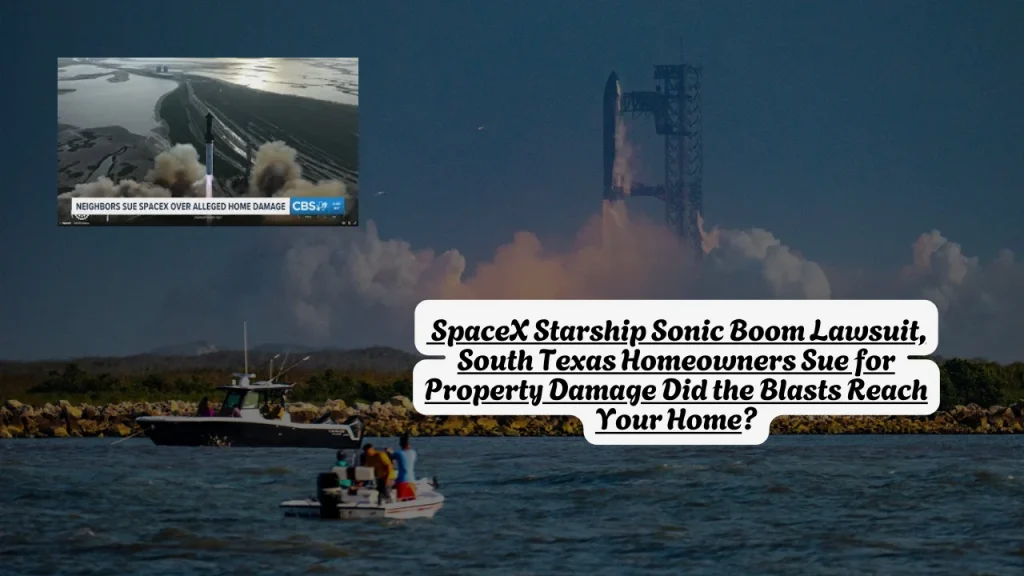
SpaceX Starship Sonic Boom Lawsuit, South Texas Homeowners Sue for Property Damage Did the Blasts Reach Your Home?
Prepared by the AllAboutLawyer.com Editorial Team and reviewed for factual accuracy against the court complaint in Aguilar v. Space Exploration Technologies Corp., No. 1:26-cv-00485 (S.D. Tex.), filed April 30, 2026, and reporting from the Texas Tribune and MyRGV. Last Updated: May 8, 2026
Eighty-one South Texas homeowners sued SpaceX in federal court in Brownsville on April 30, 2026, alleging that 11 Starship test flights between April 2023 and October 2025 repeatedly damaged their homes through noise, vibrations, and sonic booms. The case, captioned Aguilar v. Space Exploration Technologies Corp., No. 1:26-cv-00485, seeks more than $10 million in damages on theories of negligence, gross negligence, and trespass. SpaceX has not yet responded in court and no hearings are currently scheduled.
SpaceX Starship Sonic Boom Lawsuit — Quick Facts
| Field | Detail |
| Lawsuit Filed | April 30, 2026 |
| Defendant | Space Exploration Technologies Corp. (SpaceX) |
| Alleged Violation | Gross negligence and trespass — Texas common law |
| Who Is Affected | Homeowners in Port Isabel, South Padre Island, Laguna Vista, and Laguna Heights, Texas |
| Damages Sought | More than $10 million |
| Current Court Stage | Filed — SpaceX has not yet responded; no hearings scheduled |
| Court & Jurisdiction | U.S. District Court for the Southern District of Texas, Brownsville Division |
| Lead Law Firm | Martinez & Tijerina (lead counsel, Benigno Martinez); Guerra LLP; Paul LLP; Cristobal Galindo |
| Next Hearing Date | TBD — SpaceX’s response due approximately 21 days after service |
| Official Case Website | TBD — no official case site established |
| Last Updated | May 8, 2026 |
What Is the SpaceX Sonic Boom Lawsuit About? Aguilar v. Space Exploration Technologies Corp., No. 1:26-cv-00485
SpaceX operates the Starbase launch facility at Boca Chica Beach, in Cameron County, Texas. The Starship rocket — the most powerful ever built — stands 400 feet tall when fully stacked. Its Super Heavy booster relies on 33 Raptor 2 engines that burn liquid oxygen and methane propellants, collectively generating 16.7 million pounds of thrust. That is nearly twice the thrust of NASA’s Space Launch System and nearly ten times what SpaceX’s own Falcon 9 produces.
Residents say repeated exposure to “extraordinary amounts of acoustic energy, including noise, vibrations, and sonic booms” caused structural damage to their homes. The complaint covers 11 fully integrated Starship and Super Heavy test flights conducted between April 2023 and October 2025. Because some tests involve both rocket stages landing separately, residents’ homes were sometimes subjected to multiple prolonged periods of damaging noise from a single launch event.
During Starship’s very first integrated flight test in April 2023, the force of the 33-engine booster destroyed the launch pad itself and flung debris three quarters of a mile from the pad. The lawsuit points to that event as proof of the destructive power involved. The complaint also notes that the FAA has previously stated SpaceX would be responsible for resolving structural damage caused by sonic booms and is required to carry insurance covering third-party claims, including property damage.
The lawsuit alleges SpaceX acted with “conscious indifference” to the safety of local residents and their property — the legal standard in Texas for gross negligence. Plaintiffs are also pursuing a trespass claim, arguing the acoustic energy physically invaded their homes without consent. For broader context on how property damage and environmental nuisance cases work under U.S. law, our coverage of the Texas redistricting lawsuit shows how Texas courts handle high-stakes disputes between private rights and government or corporate power.
Related article: NOPD Overtime Fraud Investigation, New Payroll Policies Implemented After Officers Found at Home on the Clock
Are You Part of the SpaceX South Texas Lawsuit?
This is not a class action — it is a multi-plaintiff lawsuit filed by homeowners who joined together. The plaintiffs own homes in Port Isabel, South Padre Island, Laguna Vista, and Laguna Heights — Cameron County communities clustered between 5 and 13 miles from SpaceX’s Starbase launch complex.
You may be affected if:
- You own or rent a home in Port Isabel, South Padre Island, Laguna Vista, or Laguna Heights, Texas
- Your home experienced cracked walls, broken windows, roof movement, or structural shifting following any Starship or Super Heavy test flight between April 2023 and October 2025
- You live within 5 to 15 miles of Boca Chica Beach and noticed repeated shaking, rattling, or acoustic blasts during SpaceX test events
- You experienced recurring damage — not just from one launch but across multiple test flights during the two-year period covered in the complaint
You are likely NOT included in this specific lawsuit if:
- You live outside Cameron County and well beyond the 15-mile range of the Starbase facility
- Your only experience was mild noise without any structural impact to your home or property
- You live in the affected area but experienced no damage and have no documented evidence of harm
Brigham Young University researchers cited in the complaint studied the sonic boom from Test Flight 5 and found it generated a “greater risk of structural damage, such as glass breaking and falling bric-a-brac.” One researcher described the sonic boom at close range as sounding like a gunshot. If you experienced that and have a damaged home, you may want to consult a property damage attorney to understand your options.
What Are the Plaintiffs Seeking in the SpaceX Lawsuit?
The suit was brought by 81 plaintiffs who collectively own 53 homes, and it asks for a jury trial to seek damages, court costs, and attorney fees. The total damages sought exceed $10 million.
The complaint covers both economic and non-economic compensation for damages. Economic damages would include the cost of repairing cracked walls, broken windows, damaged roofs, and other structural harm. Non-economic damages reflect the repeated disruption to residents’ lives and their ability to peacefully use and enjoy their own homes.
Plaintiffs are not currently asking the court to stop SpaceX from launching rockets. In 2025, the Federal Aviation Administration authorized SpaceX to conduct up to 25 launches per year — five times more than was allowed the year before. That expansion of launch frequency makes this case more urgent, not less, for nearby homeowners. The more launches that occur, the more exposure residents face going forward. A property liability attorney familiar with Texas tort law and federal preemption would be best positioned to evaluate any individual claim.
What Should You Do If You Live Near Starbase Right Now?
There is no claim form to file and no settlement fund to draw from. The case is in its earliest stage. Here is what affected homeowners can do right now:
- Document your damage immediately. Take dated photographs of every crack, broken window, roof tile, or structural issue in your home. Date-stamped photos are the most persuasive evidence in a property damage lawsuit
- Keep a log of launch events. SpaceX announces test windows publicly. Match any damage you notice to a specific launch date and write it down while the details are fresh
- Save any prior repair records. If you had cracks or damage repaired in the past two years, keep those receipts — they help establish a pattern of recurring harm tied to the launches
- Most residents do not need to file anything right now — the existing lawsuit is proceeding on behalf of the plaintiffs who joined it. You are not automatically part of it unless you joined or file separately
- If you experienced documented damage, contact a consumer rights lawyer or a Texas property damage attorney to discuss whether joining a future action or filing separately makes sense for your situation
- Monitor updates at the U.S. District Court’s docket for the Southern District of Texas, Brownsville Division, under Case No. 1:26-cv-00485
SpaceX Starship Sonic Boom Lawsuit Timeline
| Milestone | Date |
| First Starship Integrated Test Flight | April 2023 |
| Test Flights Covered in Lawsuit | April 2023 – October 2025 (11 flights) |
| FAA Authorizes 25 Launches Per Year | 2025 |
| Lawsuit Filed in S.D. Texas | April 30, 2026 |
| SpaceX Response Due | TBD — approximately 21 days after service |
| Anticipated Motion to Dismiss Hearing | TBD — preemption challenge widely expected |
| Trial or Settlement Timeline | TBD — case is in earliest stages |
Frequently Asked Questions
Is there a class action lawsuit against SpaceX for sonic boom damage?
Despite early coverage calling it a class action, the JS-44 civil cover sheet in Aguilar v. Space Exploration Technologies Corp., No. 1:26-cv-00485, shows the Rule 23 class-action box is unchecked. It is a multi-plaintiff joinder, not a formal class action. That distinction matters for how damages get proven and how any future settlement would be structured.
Do I need to do anything right now to be included?
No — unless you were one of the 81 plaintiffs who joined the original filing, you are not currently part of this case. If you have documented damage from SpaceX launches, speak with a class action lawsuit attorney or property damage lawyer to discuss your options for joining future litigation or filing separately.
When will a settlement be reached in the SpaceX sonic boom case?
TBD — SpaceX has not yet responded to the lawsuit and no hearings are scheduled. A motion to dismiss on preemption grounds is widely anticipated as SpaceX’s first move, and the court’s ruling on that motion will signal whether private property damage claims arising from federally licensed launch activity can proceed at all.
Can I file my own lawsuit against SpaceX instead?
Yes. Individual Texas homeowners who suffered documented property damage from SpaceX launches may pursue their own claim under Texas common law negligence and trespass theories. This is a complex area — federal preemption by FAA licensing is a live legal question — so free legal consultation with a qualified attorney is strongly advised before filing.
How will I know if the SpaceX lawsuit settles?
Court filings are publicly available through PACER at pacer.gov under Case No. 1:26-cv-00485 in the Southern District of Texas. You can also follow Texas Tribune and Texas Public Radio for updates as this case develops.
Does FAA licensing protect SpaceX from liability?
That is the core legal question this case will test. The litigation is framed as a first formal test of whether federal launch licensing and local property rights can be reconciled on the Gulf Coast. SpaceX is expected to argue that FAA oversight preempts state tort claims. Plaintiffs counter that federal licensing does not extinguish private property rights under Texas law.
What damage did the sonic booms actually cause?
The lawsuit alleges the blasts generated powerful noise, vibrations, and overpressure waves that damaged walls, windows, roofs, and other structural elements of residents’ homes. The complaint includes peer-reviewed acoustic research from BYU scientists who recorded sound pressure data during multiple test flights.
Sources & References
- Court Complaint: Aguilar v. Space Exploration Technologies Corp., No. 1:26-cv-00485, U.S. District Court for the Southern District of Texas (filed April 30, 2026) — available via PACER
- Texas Tribune — SpaceX Sued for Alleged Home Damage in South Texas (May 1, 2026): texastribune.org
Disclaimer: This article is for informational purposes only and does not constitute legal advice. Legal claims and outcomes depend on specific facts and applicable law. For advice regarding a particular situation, consult a qualified attorney.
About the Author
Israr Ahmad is a legal content researcher with 4+ years of experience covering class action settlements and consumer rights cases. He has researched and published coverage of 2,500+ settlements using verified court records, settlement administrator filings, and government sources. Learn more about Israr.