
Lincoln Memorial Reflecting Pool Lawsuit, Preservationists Ask Federal Court to Stop Trump’s Blue Paint Job
The Lincoln Memorial Reflecting Pool lawsuit is a federal civil case in which a historic landscape nonprofit argues the Trump administration violated two federal laws — the National Historic Preservation Act and the National Environmental Policy Act — by repainting one of America’s most iconic landmarks “American Flag Blue” without completing mandatory public consultation or environmental review.
| Field | Detail |
| Case Name | The Cultural Landscape Foundation et al. v. Department of the Interior et al. |
| Case Number | 1:26-cv-01593 |
| Filed | May 11, 2026 |
| Court & Jurisdiction | U.S. District Court for the District of Columbia |
| Plaintiff | The Cultural Landscape Foundation (TCLF); Charles A. Birnbaum, President & CEO |
| Defendants | U.S. Department of the Interior; National Park Service |
| Judge Assigned | Judge Carl Nichols (Trump appointee) |
| Laws Allegedly Violated | Section 106, National Historic Preservation Act (NHPA); National Environmental Policy Act (NEPA) |
| Relief Sought | Temporary restraining order; preliminary injunction halting work immediately |
| Project Cost | $13.1 million (up from Trump’s initial claim of $1.8 million) |
| Contractor | Atlantic Industrial Coatings, LLC — Virginia; awarded no-bid contract |
| Status | Judge asked both sides to brief emergency hearing by Tuesday evening, May 12, 2026 |
| Last Updated | May 12, 2026 |
What the Lincoln Memorial Reflecting Pool Lawsuit Is About
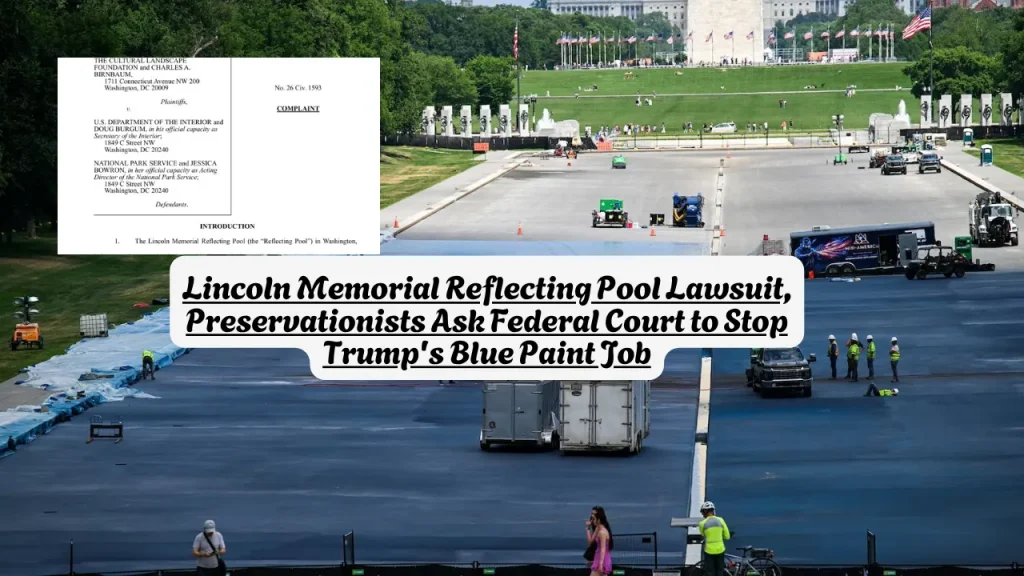
A nonprofit dedicated to “promoting informed stewardship” of historic landscapes asked a federal judge on Monday to halt the Trump administration’s painting of the Lincoln Memorial’s Reflecting Pool — which has long featured a gray basin — blue. The lawsuit filed in federal court in Washington, D.C., by The Cultural Landscape Foundation argues the project violates federal laws requiring the Interior Department to complete a consultation process that includes notifying the public of the plans and getting input from other federal agencies before beginning the work. The group also says the project runs afoul of a federal law requiring the department to issue an assessment of how the paint job would impact the environment.
“Defendants’ failure to follow the law before inserting a permanent blemish on the National Mall is causing serious and irreparable harm to the Plaintiffs and the public generally,” lawyers for the Cultural Landscape Foundation wrote in court papers. “Without immediate judicial intervention, defendants will deface an iconic American landmark, in open violation of Congressionally mandated procedures.”
The Reflecting Pool sits within the National Mall Historic District on the National Register of Historic Places. It was built between 1922 and 1923 and last underwent major renovations in 2012. This case closely parallels the legal fight over Trump’s White House East Wing demolition. For full background on that parallel lawsuit, see National Trust vs. Trump Ballroom Lawsuit: Full 2026 Update on AllAboutLawyer.com.
What Trump Did and Why Preservationists Say It Was Unlawful
The lawsuit asks a judge to immediately stop the work, which is being directed and overseen by President Trump, who chose the color himself. Trump has said he expects the work to be finished within the next two weeks.
The law at the center of the lawsuit is Section 106 of the National Historic Preservation Act of 1966. Section 106 of the NHPA requires agencies to engage in a process of consultation before making changes to historic properties. The Reflecting Pool is on the National Register of Historic Places as part of the National Mall Historic District. Accordingly, before making any changes to the Reflecting Pool, the defendants were obligated to follow the Section 106 procedures, which include consulting with various interested parties such as experts and nonprofit organizations with relevant expertise.
Related article: B.C. Female Police Officers’ Class Action Lawsuit, Appeal Court Asked to Keep Sex Discrimination Case Out of Arbitration
The public and consulting parties were not notified. No plans or documentation were disclosed to prospective consulting parties or the public before work began.
The preservationists also argue the blue color itself is not a minor cosmetic change — it is a fundamental alteration of the landmark’s design intent. The suit says the color is the main issue with the work being done on the 104-year-old pool. “The dark grey, achromatic basin was not incidental to the design. It was the design,” attorney Alexander Kristofcak wrote in the complaint. “The 1999 National Park Service Cultural Landscape Report for the Lincoln Memorial Grounds specifically identifies the dark-tiled basin as a character-defining feature of the historic landscape, noting that ‘the dark color of the tile created the illusion of greater depth and a more profound reflection.'”
“The design intent, to create a reflective surface that is subordinate, is fundamental to the solemn and hallowed visual and spatial connection between the Washington Monument and the Lincoln Memorial,” Charles Birnbaum said in a statement. “A blue-tinted basin is more appropriate to a resort or theme park.”
The Contract — $13 Million, No Bidding, and a Trump Golf Club Connection
The contract at the center of the project raises questions that go beyond the color of the paint. President Trump said that his handpicked contractor would charge only $1.8 million to repair the Lincoln Memorial Reflecting Pool and paint it blue. The actual cost is now more than seven times that, after the Interior Department nearly doubled the size of the contract late last week, bringing the total to $13.1 million paid to a Virginia firm called Atlantic Industrial Coatings.
The company was awarded a no-bid contract. Records show the company was awarded more than $6.8 million on April 3 to “PAINT LINCOLN MEMORIAL POOL.” Another payment of $6.2 million was awarded May 8 under a “supplemental agreement for work within scope.” Atlantic Industrial Coatings had never previously held a federal contract, according to records. The administration bypassed a typical competitive bid process by arguing that the need for renovations was so urgent that any delays would cause “serious injury” to the government, though it remains unclear what that injury entails.
Trump told reporters in the Oval Office last month: “I have a guy who’s unbelievable at doing swimming pools up the road. He looked at it. He called me up. He said, ‘Sir, we can do something on it.'” The firm previously performed work at Trump’s National Golf Club in Sterling, Virginia.
What the Interior Department Said
In a statement, a spokesperson for the Department of the Interior defended the renovations. “President Trump has done more to make our nation’s capital a shining beacon than any other president in the history of this country. The National Park Service chose the best company to expedite the repair of the iconic Reflecting Pool ahead of our 250 celebrations,” the statement said. The statement did not address whether the Trump administration sought any kind of approval for the project or if they plan to do so.
An Interior Department official said the pool leaks 16 million gallons a year and that the coating material being used is leak-proof. The department said the contract price “reflects the effort necessary to expedite the timeline of completing the leak prevention coating project — more people, more materials, more equipment and longer hours ahead of our 250th.”
Who Is Behind the Lawsuit and What They Are Asking the Court to Do
Plaintiff Charles A. Birnbaum spent fifteen years as coordinator of the National Park Service’s Historic Landscape Initiative, from 1992 to 2007, and during that time authored the Secretary of the Interior’s Standards for the Treatment of Historic Properties with Guidelines for the Treatment of Cultural Landscapes (1996) — the governing federal framework for the preservation and treatment of historic landscapes, including the Lincoln Memorial Grounds and the Reflecting Pool. He is a recognized national authority on the identification, documentation, and management of significant historic designed landscapes.
The lawsuit alleges: “This latest desecration of the reflecting pool is part of a pattern — epitomized most notably by the rush to destroy the East Wing of the White House — in which this Administration willfully disregards legal limits established by Congress.”
The suit names the Department of the Interior and National Park Service as defendants and seeks to immediately stop the resurfacing until the Trump administration complies with federal law, including the National Historic Preservation Act. “No consulting parties have been notified, engaged, or given an opportunity to participate,” attorneys from the Washington Litigation Group wrote in the 26-page complaint.
Where the Case Stands Right Now
The case was assigned to Judge Carl Nichols, a Trump appointee who has previously presided over challenges to the president’s efforts to remake the federal workforce. Nichols asked both sides to tell him by Tuesday evening whether he should hold a hearing over the foundation’s request for an emergency court order halting work on the Reflecting Pool.
Trump has said he wants the project finished within two weeks — a timeline that makes the emergency hearing request urgent. Work was still actively underway on the pool as of May 12, 2026, with National Guard soldiers visible on the National Mall as contractors applied the blue coating.
Lincoln Memorial Reflecting Pool Lawsuit Timeline
| Milestone | Date |
| Reflecting Pool constructed | 1922–1923 |
| Last major renovation | 2010–2012 |
| 1999 NPS Cultural Landscape Report identifies dark basin as character-defining feature | 1999 |
| Trump announces pool renovation plans on Truth Social | November 2025 |
| No-bid contract awarded to Atlantic Industrial Coatings (initial $6.8M) | April 3, 2026 |
| Trump drives across drained Reflecting Pool to survey work | Late April 2026 |
| Contract supplemental award adds $6.2M (total $13.1M) | May 8, 2026 |
| Cultural Landscape Foundation lawsuit filed — Case 1:26-cv-01593 | May 11, 2026 |
| Judge Nichols asks for briefing on emergency hearing | May 11, 2026 |
| Both sides must respond on emergency hearing | By evening, May 12, 2026 |
| Emergency hearing | TBD — pending Judge Nichols’s decision |
| Trump’s stated completion deadline | Within two weeks of late April 2026 — July 4, 2026 target |
Frequently Asked Questions
Is there a lawsuit to stop Trump’s Reflecting Pool paint job?
Yes. The Cultural Landscape Foundation and its president, Charles A. Birnbaum, filed a federal lawsuit on May 11, 2026 — Case 1:26-cv-01593 — in the U.S. District Court for the District of Columbia seeking an emergency order to immediately halt the ongoing blue repainting of the Lincoln Memorial Reflecting Pool.
What laws does the lawsuit say were violated?
The lawsuit alleges two violations. First, Section 106 of the National Historic Preservation Act of 1966, which requires the Interior Department to consult with the public and other federal agencies before altering a historic property on the National Register of Historic Places. Second, the National Environmental Policy Act, which requires an environmental assessment before federal agencies take major actions affecting the environment. The plaintiffs say neither process was followed.
Is the Lincoln Memorial Reflecting Pool a protected historic site?
Yes. The Reflecting Pool and its surrounding landscape are listed on the National Register of Historic Places as part of the National Mall Historic District. That protected status is the basis for the Section 106 consultation requirement the lawsuit says the Trump administration skipped entirely.
How much is the Reflecting Pool project actually costing taxpayers?
The federal government is paying $13.1 million to Atlantic Industrial Coatings through a no-bid contract — more than seven times Trump’s initial public estimate of $1.8 million. The contract was awarded in two payments: $6.8 million on April 3 and an additional $6.2 million on May 8, 2026.
Who got the contract and do they have ties to Trump?
Atlantic Industrial Coatings, LLC, a Virginia-based woman-owned coatings company, received the contract. The company previously performed work on swimming pools at Trump’s National Golf Club in Sterling, Virginia. The firm had no prior federal contracts before this award.
Could the court actually stop the paint job?
Potentially. The plaintiff is seeking a temporary restraining order — an emergency form of relief a judge can grant within days to pause an action while a case proceeds. Judge Carl Nichols asked both sides to brief the question of whether to hold an emergency hearing by Tuesday evening, May 12. If a hearing is scheduled and the court agrees irreparable harm is occurring, work could be halted while the underlying case is decided.
What does this case have in common with the White House ballroom lawsuit?
Both cases involve the Trump administration allegedly bypassing mandatory federal review processes — including NEPA environmental assessments and public consultation — before altering federally owned properties. The White House ballroom case was filed in December 2025 by the National Trust for Historic Preservation over the demolition of the White House East Wing.
Sources & References
- Court Filing — The Cultural Landscape Foundation et al. v. Department of the Interior et al., Case 1:26-cv-01593, U.S. District Court for the District of Columbia, May 11, 2026 (tclf.org)
Prepared by the AllAboutLawyer.com Editorial Team and reviewed for factual accuracy against the original court complaint (Case 1:26-cv-01593), AP, CNN, NBC News, CBS News, ABC News, The Hill, and the Washingtonian on May 12, 2026.
Last Updated: May 12, 2026
Disclaimer: This article is for informational purposes only and does not constitute legal advice. Legal claims and outcomes depend on specific facts and applicable law. For advice regarding a particular situation, consult a qualified attorney.
About the Author
Israr Ahmad is a legal content researcher with 4+ years of experience covering class action settlements and consumer rights cases. He has researched and published coverage of 2,500+ settlements using verified court records, settlement administrator filings, and government sources. Learn more about Israr.