
National Trust for Historic Preservation vs. Trump White House Ballroom Lawsuit, Case Breakdown and Latest Update
Prepared by the AllAboutLawyer.com Editorial Team and reviewed for factual accuracy against the National Trust for Historic Preservation’s official press release, the Clearinghouse.net case docket summary, and verified AP and Reuters reporting on April 28, 2026. Last Updated: April 28, 2026
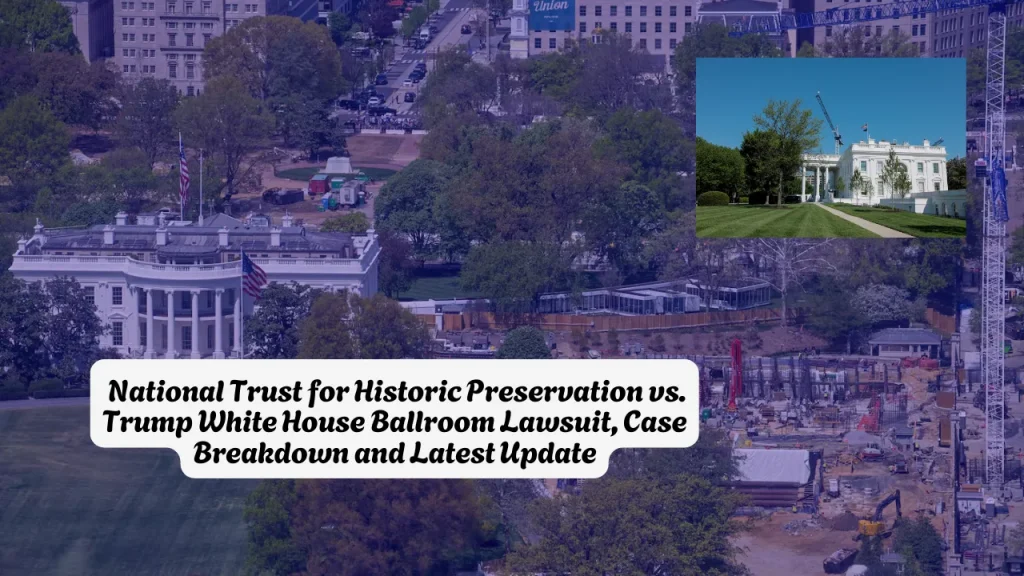
National Trust for Historic Preservation in the United States v. National Park Service et al. is a federal administrative and constitutional lawsuit filed December 12, 2025, in which the National Trust for Historic Preservation alleged that the Trump administration violated the Constitution and multiple federal statutes by demolishing the White House’s East Wing and beginning construction of a $400 million ballroom without obtaining congressional authorization, completing required environmental review, or submitting plans to federally mandated planning bodies.
The case took a sharp turn on April 27, 2026, when the National Trust publicly refused a Department of Justice demand to drop the lawsuit — a demand the DOJ made in the wake of a shooting at the White House Correspondents’ Dinner on April 26.
Quick Facts: National Trust vs. Trump White House Ballroom Lawsuit
| Field | Detail |
| Plaintiff | National Trust for Historic Preservation in the United States |
| Defendants | National Park Service; White House Office of Executive Readiness (OER); Executive Office of the President; related federal officials and agencies |
| Case Type | Federal Administrative Law / Constitutional — Separation of Powers; ultra vires executive action |
| Court | U.S. District Court for the District of Columbia |
| Presiding Judge | U.S. District Judge Richard J. Leon |
| Date Filed | December 12, 2025 |
| Legal Claims | Violations of the National Capital Planning Act; National Environmental Policy Act (NEPA); Administrative Procedure Act; ultra vires presidential action exceeding statutory authority; Separation of Powers (congressional authority over federal property) |
| Relief Sought | Declaratory judgment; injunction halting above-ground construction; order requiring congressional authorization and required federal agency reviews before work continues |
| Current Stage | Active — appellate proceedings underway; next scheduled hearing June 5, 2026 |
| Next Scheduled Date | June 5, 2026 — D.C. Circuit expedited review of preliminary injunction |
| Plaintiff’s Counsel | Gregory B. Craig, Foley Hoag LLP |
| Defendant’s Counsel | DOJ — Brett A. Shumate, Assistant Attorney General |
| Last Updated | April 28, 2026 |
Case Timeline: National Trust vs. Trump White House Ballroom
| Date | Event |
| July 2025 | Trump administration releases initial plans for a White House ballroom on the East Wing site |
| September 2025 | White House begins demolishing the East Wing; Trump fires all members of the Commission of Fine Arts |
| October 21, 2025 | National Trust sends formal letter to federal agencies urging cessation of demolition |
| Early December 2025 | White House completes demolition of the East Wing |
| December 12, 2025 | National Trust files complaint in U.S. District Court for D.C.; files motion for temporary restraining order and preliminary injunction |
| December 15, 2025 | DOJ files opposition arguing the lawsuit has no legal basis; NPS publishes Environmental Assessment and Finding of No Significant Impact — after demolition is already complete |
| December 17, 2025 | Judge Leon denies temporary restraining order; warns government to be prepared to demolish any above-grade construction if plaintiff prevails on the merits |
| February 26, 2026 | Judge Leon denies first motion for preliminary injunction; rules APA does not apply to OER; finds constitutional claims require ultra vires framing |
| March 2, 2026 | National Trust files second amended complaint adding three ultra vires claims alleging ballroom requires express congressional approval |
| March 5, 2026 | National Trust files second motion for preliminary injunction |
| April 2026 | Judge Leon issues order continuing to block above-ground construction; schedules June 5 hearing |
| April 25–26, 2026 | Shooting incident at the Washington Hilton during the White House Correspondents’ Dinner; Trump immediately invokes the incident to argue for the ballroom |
| April 26, 2026 | DOJ Assistant AG Brett Shumate sends letter to Gregory Craig demanding the National Trust dismiss the lawsuit by 9:00 a.m. April 27 or the government would seek dismissal |
| April 27, 2026 | National Trust publicly refuses; Craig responds in writing that the constitutional and statutory requirements are unchanged by Saturday’s events; DOJ says it will ask the court to dismiss |
| April 27, 2026 | D.C. Circuit Court of Appeals lifts Judge Leon’s injunction pending expedited review; above-ground construction resumes |
| June 5, 2026 | D.C. Circuit expedited hearing scheduled to review the preliminary injunction |
What Is the National Trust vs. Trump Ballroom Lawsuit About?
The core legal dispute in National Trust for Historic Preservation in the United States v. National Park Service et al. is not about whether a ballroom at the White House would be a good idea — it is about whether President Trump had the legal authority to tear down the East Wing and begin building one without going through the processes that federal law requires. According to the complaint filed in the U.S. District Court for the District of Columbia, the answer is no.
The National Trust argues that the National Capital Planning Act required the administration to submit plans to the National Capital Planning Commission (NCPC) before construction began — and it did not. The National Environmental Policy Act (NEPA) required an environmental assessment and, if warranted, an environmental impact statement — and while the National Park Service published an Environmental Assessment on December 15, 2025, the demolition of the East Wing was already finished by the time that document appeared.
A federal statute governing public grounds in the District of Columbia states that no building may be erected on any reservation, park, or public grounds of the federal government in D.C. “without express authority of Congress” — and, according to the complaint, Congress has never authorized this ballroom.
The Trump administration’s position is that the President possesses statutory authority to modify his own residence and that the project is supported by background principles of executive power. It also argues that the lawsuit — which at various stages challenged the NPS, the OER, and the EOP — lacks a valid legal hook because the OER is not a federal “agency” subject to the Administrative Procedure Act.
Judge Leon partially agreed on that point in February 2026, which is why the National Trust filed a second amended complaint on March 2 adding ultra vires claims — a legal doctrine that lets courts stop government officials from acting outside the specific powers Congress has granted them, even when the APA does not directly apply. The Trust’s attorney Gregory Craig has been direct about the legal position throughout: “No president is legally allowed to tear down portions of the White House without any review whatsoever — not President Trump, not President Biden, and not anyone else.” For the full history of how this case began when the East Wing demolition first started, see our original coverage of the National Trust White House ballroom lawsuit filed in December 2025.
Who Are the Parties in This Case?
The National Trust for Historic Preservation is a privately funded nonprofit organization chartered by Congress in 1949. Its congressionally assigned mission is to facilitate public participation in the preservation of sites of national significance — which gives it specific legal standing to challenge federal construction projects affecting historic properties. The White House is listed on the National Register of Historic Places and has been managed as a historic property, though it is explicitly exempt from the National Historic Preservation Act itself. The Trust’s president and CEO Carol Quillen has framed the case as a procedural fight about democratic participation: “Inviting comments from the American people signals respect and helps ensure a lasting legacy that befits a government of the people, by the people, for the people.” The Trust retained Foley Hoag LLP as outside counsel, with Gregory B. Craig — a veteran Washington lawyer who previously served as White House Counsel under President Obama — leading the legal team.
Related article: $53M Camden Property Trust Rent Price-Fixing Settlement, Are You Eligible for a Payment?
The defendants are the federal agencies and officials involved in administering the construction: the National Park Service, which manages the White House grounds as part of President’s Park; the White House Office of Executive Readiness; the Executive Office of the President; and related officials.
The Trump administration has been vocal and aggressive in its pushback. The White House previously called the Trust “a bunch of loser Democrats and liberal donors who are playing political games.” The DOJ has argued in filings that the lawsuit has no legal basis and that the president’s authority over his own residence is sufficient to proceed. The April 26, 2026 shooting at the White House Correspondents’ Dinner at the Washington Hilton provided the administration with a new political argument — that the pending lawsuit was literally endangering presidential security by delaying a safer on-site venue.
The National Trust flatly rejected that framing, with Craig writing to Shumate: “Your assertion that this lawsuit puts the President’s life at ‘grave risk’ is incorrect and irresponsible.” This case fits within the broader pattern of federal courts grappling with the limits of executive authority in 2025–2026 — a pattern our Trump Lawsuits 2026 tracker has been following across the more than 316 active cases currently challenging administration actions.
What Is at Stake in This Lawsuit?
The immediate relief the National Trust is seeking is an injunction that halts above-ground construction on the ballroom site until the administration completes the legally required review processes — specifically, NCPC approval, Commission of Fine Arts consultation, an environmental review, and, crucially, a congressional authorization for construction on federal public grounds. The Trust is also seeking declaratory relief — a court ruling stating that the administration’s conduct was unlawful — and attorneys’ fees and costs.
At a structural level, the case raises a question that goes beyond this specific building project. The federal statute at the center of the ultra vires claims states that no structure may be erected on public grounds of the federal government in D.C. without express congressional authorization. If the court ultimately rules that statute applies to the White House ballroom, it would establish that presidential authority over the White House is not unlimited and that Congress retains the power of the purse and the power of authorization even on the grounds of the executive residence. The administration’s counter-argument — that presidential authority over his own home is inherent and broad — is the inverse of that proposition. Judge Leon’s April 2026 order continuing to block above-ground construction, even as the D.C. Circuit lifted that injunction pending expedited review, shows the legal question is genuinely contested at the appellate level.
The ballroom project itself involves $400 million in proposed spending. Trump has stated the construction is funded by private donations, but public funds are confirmed to be paying for the below-ground bunker and security upgrades connected to the project. The proposed ballroom would cover roughly 90,000 square feet — larger than the White House mansion and East Wing combined — and accommodate up to 999 people.
What Happens Next in This Case?
The D.C. Circuit Court of Appeals lifted Judge Leon’s injunction on April 27, 2026, allowing above-ground construction to proceed while the appeals court conducts an expedited review. That review is scheduled for June 5, 2026. At that hearing, the D.C. Circuit will consider whether Judge Leon’s analysis of the preliminary injunction was correct and whether construction should be halted again while the case proceeds on the merits.
Simultaneously, the DOJ has said it will ask a court to dismiss the lawsuit. That motion, if filed, would go before Judge Leon first — and given his April 2026 order and his earlier statements that the government “should be prepared to take it down” if the plaintiff prevails on the merits, a quick dismissal is not guaranteed. The National Trust has made clear it intends to continue litigating. The full case is nowhere near resolution on the merits.
The June 5 appellate hearing will determine whether the injunction is reinstated — that ruling will signal how the D.C. Circuit reads the underlying constitutional and statutory claims. If the Trust prevails at the appellate level, construction above grade would pause again. If the government prevails, construction continues while the merits case proceeds before Judge Leon, likely through 2026 and potentially into 2027.
Frequently Asked Questions
Who filed the lawsuit and why?
The National Trust for Historic Preservation filed this lawsuit on December 12, 2025, in the U.S. District Court for the District of Columbia. According to the complaint, the Trump administration demolished the White House East Wing and began constructing a $400 million ballroom without first obtaining congressional authorization, completing a full environmental review under NEPA, or submitting plans to the National Capital Planning Commission as required by the National Capital Planning Act.
What court is handling this case?
The case is before U.S. District Judge Richard J. Leon of the U.S. District Court for the District of Columbia. The U.S. Court of Appeals for the D.C. Circuit is now also involved, having lifted Judge Leon’s preliminary injunction on April 27, 2026, pending an expedited review scheduled for June 5, 2026.
What is the current status of the case?
As of April 28, 2026, the D.C. Circuit has lifted Judge Leon’s injunction blocking above-ground construction, allowing building to continue temporarily while the appellate court conducts an expedited review. The National Trust has refused the DOJ’s demand to voluntarily dismiss the lawsuit. A June 5, 2026 hearing before the D.C. Circuit is the next major date. No merits ruling has been issued by either court.
Why did the DOJ demand the National Trust drop the lawsuit?
Following a shooting incident at the Washington Hilton during the White House Correspondents’ Dinner on April 26, 2026, DOJ Assistant Attorney General Brett Shumate wrote to the Trust’s attorney demanding dismissal of the lawsuit, arguing it “puts the lives of the President, his family, and his staff at great risk” by delaying construction of a more secure on-site venue. The National Trust rejected that characterization, calling it “incorrect and irresponsible” and stating in writing that the constitutional and statutory requirements are unchanged by the shooting.
How much money is involved in this project?
President Trump has described the project as a $400 million ballroom to be funded through private donations. Public money is confirmed to be paying for a below-ground bunker and security upgrades associated with the project. The Trump administration has not publicly provided a detailed breakdown of the private versus public funding split.
Can I read the court documents?
Yes. Case filings in National Trust for Historic Preservation in the United States v. National Park Service et al. are publicly available through the federal PACER system at pacer.uscourts.gov. The Clearinghouse.net case summary at clearinghouse.net/case/47494 also provides a detailed docket summary with case law citations from all major rulings to date.
Does this lawsuit affect the White House Correspondents’ Dinner shooting?
The shooting at the Washington Hilton on April 26, 2026, is a separate incident from this lawsuit. The Trump administration has argued the shooting strengthens the political and security case for building the ballroom — but the National Trust’s attorney has stated plainly that the legal questions in the case are unchanged. The lawsuit concerns statutory and constitutional requirements for construction on federal public property, not the merits of whether a White House ballroom would be safer than external venues.
What happens if the National Trust wins?
If the National Trust prevails on the merits, the court could issue a declaratory judgment finding the construction unlawful and an injunction requiring the administration to halt all work until it secures congressional authorization and completes the required federal agency reviews. Judge Leon has previously warned that if the plaintiff prevails, the government “should be prepared to take it down” — a statement that suggests above-grade construction could potentially be subject to a demolition order if the court rules in the Trust’s favor.
Sources & References
- National Trust for Historic Preservation Press Release (Dec. 12, 2025): savingplaces.org — National Trust Files Suit to Stop Ballroom Construction
- Case Docket Summary: clearinghouse.net/case/47494
- Court Docket via PACER: National Trust for Historic Preservation in the United States v. National Park Service et al., U.S. District Court for the District of Columbia — pacer.uscourts.gov
Disclaimer: This article is for informational purposes only and does not constitute legal advice. Information about ongoing legal cases is based on publicly available court records and verified reporting. Allegations described in this article have not been proven in court. All claims are attributed to filings and verified sources. For advice regarding a particular legal situation, consult a qualified attorney.
About the Author
Israr Ahmad is a legal content researcher with 4+ years of experience covering class action settlements and consumer rights cases. He has researched and published coverage of 2,500+ settlements using verified court records, settlement administrator filings, and government sources. Learn more about Israr.