
Kroger Sued Again Over Misleading Meat Labels — “Humane-Washing” Lawsuit Filed in California
This story broke this week. On March 20, 2026, the advocacy group Animal Outlook filed a complaint in Los Angeles County Superior Court (Case No. 26TRCV01040) against The Kroger Co. and its subsidiary Ralphs Grocery Company, alleging that the retailers have misled consumers through deceptive point-of-sale signage at Ralphs stores across Southern California. While a formal press announcement was issued on April 9, 2026, court records confirm the litigation commenced in late March.
The accusation in plain terms: Kroger is plastering feel-good phrases like “no antibiotics” and “well raised” above meat cases that are actually stocked with standard factory-farmed products from some of the country’s largest industrial processors — and charging a premium because of it. This is not the first instance of litigation between these parties. In 2014, Kroger settled a similar federal case in California brought by the same organization, then known as Compassion Over Killing. Kroger has been here before. It settled once. Now it’s being sued again.
Quick Case Snapshot
| Field | Details |
| Plaintiff | Animal Outlook (national animal protection advocacy organization) |
| Defendants | The Kroger Co. & Ralphs Grocery Company (Kroger subsidiary) |
| Court | Los Angeles County Superior Court |
| Case Number | 26TRCV01040 |
| Filed | March 20, 2026 |
| Publicly Announced | April 9, 2026 |
| Judge | Not yet assigned |
| Claims | False advertising; unfair competition |
| Laws Cited | California Business & Professions Code §§ 17200 and 17500 |
| Damages Sought | Injunctive relief; corrective advertising; attorneys’ fees |
| Kroger’s Response | No public comment as of April 18, 2026 |
| Current Status | Newly filed; early proceedings |
What Exactly Does the Lawsuit Allege?
The dispute is not about a product ingredient or a chemical found in food. It is about signage — large overhead displays hanging above meat counters in Ralphs stores across the Los Angeles area. And what those signs say versus what the products beneath them actually are.
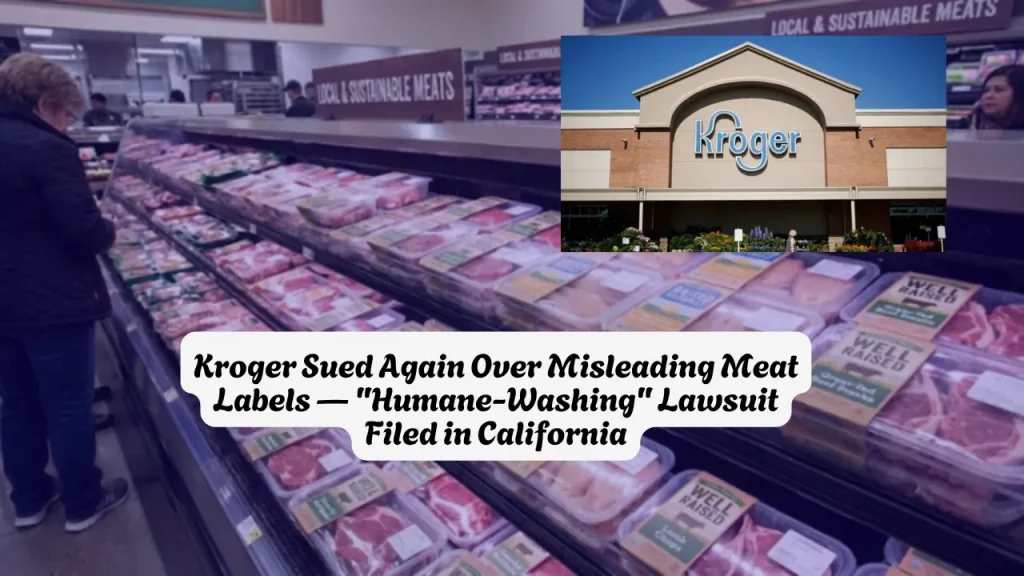
At the center of the lawsuit are the large, prominent signs displayed at Ralphs stores in Southern California. Investigators documented phrases such as “well-raised” above meat counters and “no antibiotics” over refrigerated and frozen sections. However, Animal Outlook argues that the products beneath those signs include conventional meat from major processors like Smithfield, Hormel, and Tyson — companies widely associated with industrial-scale farming.
According to the complaint, some locations use signage that says “raised naturally,” “no antibiotics” and “no added hormones.” Animal Outlook alleges that products sold under these signs do not meet the standards shoppers expect and are often products from normal commercial farming.
Related article: Kroger Had a Discount Prescription Club. Insured Customers Say They Never Got the Benefit — and Overpaid Every Time.
The most striking documented example came from a direct store investigation. In one location, Animal Outlook found pork products under a sign that said “no antibiotics,” which a third-party safety report says could contain antibiotics, the lawsuit alleges.
The “well raised” claims face a different but equally damaging argument. According to the complaint, meat counters displaying “well raised” signs include products from Kroger’s regular private labels, which fail to meet even Kroger’s own animal welfare standards. For example, Kroger’s policy for broiler chickens under its premium Simple Truth brand includes requirements for space, access to litter, proper lighting and humane slaughter methods. However, these standards do not apply to the regular private-label chicken products sold under “well raised” signs. For beef, Kroger reportedly has no animal welfare standards at all.
The organization’s executive director did not mince words. “This is textbook humane-washing,” said Ben Williamson, executive director of Animal Outlook. “Kroger is exploiting consumer concern about animal welfare and food safety by plastering reassuring language across their meat departments while doing absolutely nothing to ensure the products actually meet those claims.”
Related article: AFFF Firefighting Foam Lawsuit April 2026, 15,222 Cases Pending, Bellwether Trial Pulled, Global Settlement Expected
What Is “Humane-Washing” — And Why Does It Matter Legally?
“Humane-washing” is the food industry equivalent of greenwashing — using ethically reassuring language to charge a premium price for products that do not meaningfully differ from standard commercial alternatives.
From a legal standpoint, the concept becomes actionable under California’s consumer protection laws when a company makes a verifiable representation to consumers that is false or misleading. The lawsuit alleges Kroger and Ralphs violated California Business and Professions Code sections 17200 and 17500 by making false and misleading statements about their products. Bryan W. Pease, attorney for Animal Outlook, emphasized the implications: “California law is clear that corporations cannot make false or misleading statements about their products. When you put up a sign that says ‘no antibiotics’ or ‘well raised,’ consumers reasonably expect the products beneath those signs to match those claims. Kroger’s failure to ensure that is a violation of California law, and we’re asking the court to put a stop to it.”
Section 17200 of the California Business and Professions Code — commonly called the Unfair Competition Law (UCL) — broadly prohibits any “unlawful, unfair or fraudulent business act or practice.” Section 17500 prohibits false or misleading advertising. Both are potent tools in California courts, frequently used in consumer deception cases. They allow courts to award injunctive relief even without proving individual consumer harm, which is a critical advantage for advocacy groups like Animal Outlook.
There is also a broader regulatory backdrop that strengthens the plaintiffs’ position. The USDA recently reported finding antibiotic residues in approximately 20% of samples from the “Raised Without Antibiotics” market. While this finding does not prove the specific allegations against Ralphs or Kroger, it provides technical context that voluntary marketing claims may require more rigorous third-party substantiation.
Related article: Lagos Inc. Sues Coastal Caviar LLC Over “Caviar” Trademark — One Word, Federal Court, and a Small Business’s Survival at Stake
What Animal Outlook Is Asking the Court to Do
This case is not seeking money damages for individual consumers. It is seeking structural change.
Animal Outlook is seeking injunctive relief requiring Kroger and Ralphs to either stock products that meet the claims made by their signage or remove the misleading signs entirely. The organization is also requesting corrective advertising to inform consumers that the products in question may not be antibiotic-free or well-raised, along with attorneys’ fees and costs.
In practice, that means Kroger faces a binary choice if the court sides with plaintiffs: either overhaul its entire meat supply chain at Ralphs to actually source antibiotic-free and humanely raised products that match the signs — or take down every “no antibiotics” and “well raised” sign across its Southern California stores and publicly tell shoppers that those claims may not have been accurate.
Either outcome represents a significant operational and reputational consequence for one of the largest grocery chains in the country.
Kroger Has Been Here Before — A Pattern of Humane-Washing Allegations
This lawsuit does not emerge in a vacuum. Animal Outlook — previously known as Compassion Over Killing — has targeted Kroger on nearly identical grounds before, and won.
In 2014, a consumer of Simple Truth chicken filed a class action lawsuit in the Superior Court of California in the County of Los Angeles alleging that the grocery giant was falsely and deceptively touting its Simple Truth chicken as having been sourced from chickens raised “in a humane environment,” despite the fact that the birds were treated no differently than other mass-produced chickens on factory farms. Kroger settled the case, agreeing to remove the “raised in a humane environment” label claim from its Simple Truth chicken packaging.
That settlement forced Kroger to change its product label language. The 2026 lawsuit argues that Kroger essentially moved the misleading claims from product labels to overhead store signage — making the same false promises, just in a different format that may have seemed harder to hold accountable.
In 2024, Kroger was also sued by a consumer who alleged that its farm-fresh eggs did not come from hens that were uncaged and living on farms. That lawsuit was dismissed because the eggs did come from a farm, even though the hens were caged. A separate ongoing case also alleges that Kroger’s dog food is falsely advertised as premium and preservative-free when it contains artificial preservatives.
The pattern is consistent: Kroger, like most major grocers, has repeatedly faced legal pressure over the gap between aspirational marketing language and actual sourcing realities.
Related article: Kroger No-Hire Lawsuit, Were Former Quickway Drivers Illegally Blacklisted?
Kroger No-Hire Lawsuit, Were Former Quickway Drivers Illegally Blacklisted?
Kroger Has Not Responded — What Happens Next
Kroger did not respond to a request for comment.
As a newly filed case, the litigation is in its earliest procedural stages. Based on how California consumer protection cases like this typically proceed, the next steps are likely to include:
- Kroger’s formal legal response — an answer or motion to dismiss, typically due within 30 days of service
- Preliminary discovery — Animal Outlook will seek internal Kroger documents about its sourcing standards, signage decisions, and supplier vetting
- Motion practice — Kroger may argue the signage is non-specific “puffery” not legally actionable as false advertising, or challenge standing
- The “reasonable consumer” standard — the central legal question California courts will apply: would a reasonable consumer interpret Kroger’s signs as a binding product-level claim, or mere aspirational branding?
- Settlement talks — given that Kroger settled a nearly identical case brought by the same organization in 2014, a negotiated resolution is a realistic outcome here too
Given the 2014 settlement history between these two parties, a quiet resolution through negotiation remains a likely trajectory for this case.
What This Means for Grocery Shoppers
If you shop at Ralphs — or any Kroger-owned chain — this case should prompt a specific question: when a sign above a meat case says “no antibiotics” or “well raised,” does that apply to every product below it, or just some?
The Kroger sued for false advertising case underscores growing risks for supermarket operators as consumers demand greater transparency around food sourcing. Retailers have expanded premium and private-label offerings to capture demand for ethically produced food. However, inconsistent standards and unclear messaging can expose companies to legal challenges.
In practical terms for shoppers: overhead department signage in grocery stores is typically not a USDA-certified claim — it is marketing copy controlled by the retailer. A product carrying a USDA Organic seal, a “Certified Humane” third-party certification, or an “Animal Welfare Approved” stamp is verifiably backed by audited standards. An overhead sign that says “well raised” with no certification logo is not.
Frequently Asked Questions
Q: What exactly is Kroger being sued for?
Animal Outlook alleges that Kroger and its Ralphs subsidiary use in-store signs reading “no antibiotics,” “well raised,” and “raised naturally” above meat cases that are actually stocked with conventional, factory-farmed products — including pork from brands like Hormel and Jimmy Dean and chicken from large-scale commercial processors. The lawsuit calls this “humane-washing” and says it violates California’s False Advertising Law and Unfair Competition Law.
Q: Is this a class action lawsuit?
No. This is a civil enforcement lawsuit filed by Animal Outlook as an advocacy organization under California consumer protection statutes. It seeks injunctive relief and corrective advertising — not individual consumer payouts. Shoppers who feel they overpaid for meat based on misleading signs cannot currently join this case for compensation.
Q: Has Kroger faced this type of lawsuit before?
Yes — multiple times. In 2014, Kroger settled a nearly identical case brought by the same organization (then called Compassion Over Killing) over “raised in a humane environment” claims on its Simple Truth chicken. That settlement required Kroger to remove the language from packaging. The 2026 suit targets overhead store signage rather than product packaging, but the core allegation is identical.
Q: What does Animal Outlook want from the court?
The organization is asking a judge to order Kroger to either: (1) ensure every product sold under “no antibiotics” or “well raised” signage actually meets those standards, or (2) remove the signs entirely and run corrective advertising telling consumers the claims may not have been accurate. No monetary damages for consumers are being sought.
Q: Is Kroger’s “Simple Truth” line also implicated?
The 2026 lawsuit specifically targets Kroger’s standard private-label products sold under the misleading signs — not the Simple Truth premium brand, which has its own stated welfare standards. The complaint highlights the gap: Simple Truth standards require space, litter access, and humane slaughter methods, but those requirements do not apply to regular private-label products being sold under the same “well raised” signage.
Q: How do I know if a meat label claim is genuinely certified?
Look for third-party certification logos — not just store signage. Verified programs include USDA Organic, Certified Humane (certifiedhumane.org), Global Animal Partnership (G.A.P.), and Animal Welfare Approved. An overhead sign with no certification stamp is retailer marketing, not a federally audited claim.
Last Updated: April 18, 2026
This article is for informational purposes only and does not constitute legal advice. Allegations in a complaint are not findings of fact or liability. All parties are presumed innocent unless and until proven otherwise in a court of law.
About the Author
Israr Ahmad is a legal content researcher with 4+ years of experience covering class action settlements and consumer rights cases. He has researched and published coverage of 2,500+ settlements using verified court records, settlement administrator filings, and government sources. Learn more about Israr.