
Kroger No-Hire Lawsuit, Were Former Quickway Drivers Illegally Blacklisted?
Three former truck drivers filed a federal lawsuit on April 3, 2026, accusing Kroger and three major trucking companies of running an illegal no-hire agreement that blocked former Quickway Transportation drivers from finding work. The lawsuit, filed in the U.S. District Court for the Southern District of Ohio, seeks class action status that could cover more than 100 former Quickway drivers. The plaintiffs allege the agreement violated federal antitrust law and cost them jobs, wages, and career opportunities.
Quick Facts
| Field | Detail |
| Plaintiffs | Dan Cheatham, Brian Kuhn, Eric Cabler (former Quickway drivers) |
| Defendants | The Kroger Co., Swift Transportation Services LLC, U.S. Xpress Enterprises LLC, Werner Enterprises |
| Court | U.S. District Court, Southern District of Ohio |
| Filed | April 3, 2026 |
| Legal Claims | Antitrust violations under the Sherman Act |
| Potential Class Size | More than 100 former Quickway drivers |
| Settlement | None — litigation phase only |
| Kroger & Knight-Swift Response | No comment as of filing date |
| Werner Response | Denied allegations; said it hired 62% of former Quickway drivers at one site |
Where Things Stand Right Now
- The lawsuit was filed April 3, 2026. No class has been certified yet and no trial date has been set.
- Werner issued a denial and said it is exploring options to seek damages from the plaintiffs for bringing the case.
- Kroger and Knight-Swift (parent of Swift and U.S. Xpress) had not responded publicly as of the filing date.
- The case is in its earliest stage. Plaintiffs must first convince the court to certify it as a class action before more than 100 drivers can formally join.
Who Was Quickway Transportation and What Happened to It?
To understand this lawsuit, you need to understand what Quickway was and how it collapsed.
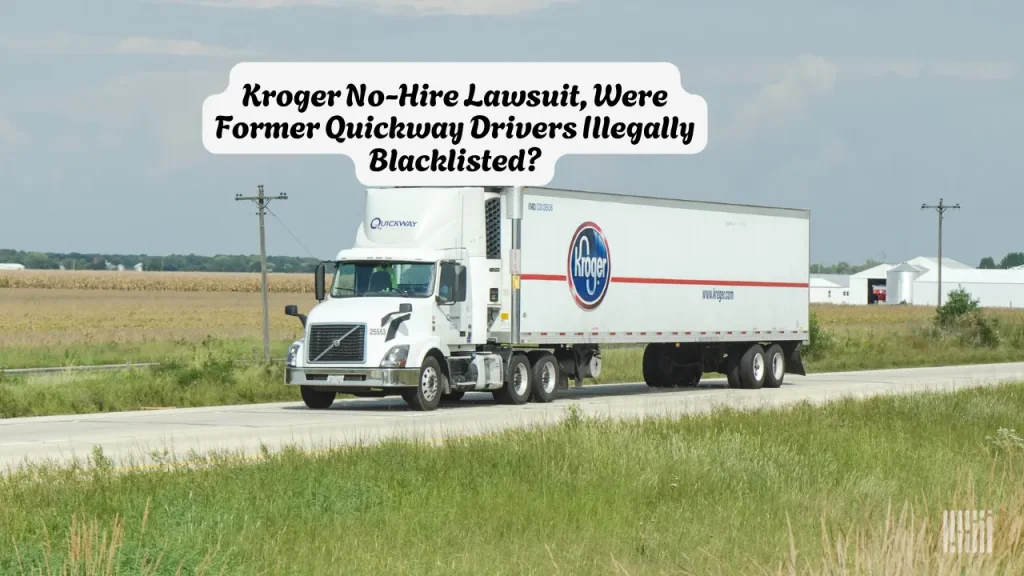
Quickway Transportation was a Nashville-based trucking company that served as a major carrier for Kroger. Kroger services generated most of the Quickway Group’s revenue, and nine terminals serviced Kroger directly. Quickway drivers were represented by local units of the Teamsters union — making them unionized workers in a supply chain otherwise dominated by non-union carriers.
Quickway’s relationship with Kroger was not without conflict. A prior legal dispute established that Quickway had previously shut down a Louisville, Kentucky, terminal servicing a Kroger Distribution Center — a move a court found was motivated by anti-union sentiment. A U.S. circuit court backed a National Labor Relations Board decision finding that the Quickway site shutdown was improper, needed to be reopened, and must reinstate fired employees. The Supreme Court refused to hear the case, solidifying the circuit court’s decision.
In early 2026, Quickway filed for Chapter 11 bankruptcy and then converted to a Chapter 7 liquidation. The company shut down entirely. That left hundreds of experienced, CDL-holding drivers suddenly out of work — and looking for jobs with the very carriers now taking over their old Kroger routes.
Related article: $4.4M Shannondell Entrance Fee Refund Settlement, Are You Eligible to Claim? Deadline to File is June 2
What Does the Lawsuit Actually Claim?
The three plaintiffs — all former Quickway drivers who applied for jobs with Swift, U.S. Xpress, and Werner — say they were rejected not because they lacked qualifications, but because Kroger told those carriers not to hire them.
According to the lawsuit, Kroger “instructed Werner, Swift, and U.S. Xpress not to hire, recruit, solicit, or employ former Quickway drivers, and Werner, Swift, and U.S. Xpress agreed not to hire, recruit, solicit, or employ these drivers.” Drivers learned about the alleged no-hire arrangement through representatives of the carriers, the lawsuit said.
The drivers say they were told directly about the arrangement when their applications were rejected. Representatives of Werner, Swift, and U.S. Xpress acknowledged to the drivers that they had been instructed by Kroger not to hire former Quickway drivers at the time they rejected their job applications. The drivers were told there was “a gentlemen’s agreement” and that it “came from the top.”
The lawsuit connects the alleged hiring ban to an anti-union motive. The Quickway drivers were Teamsters members. The three replacement carriers — Swift, U.S. Xpress, and Werner — are not unionized. The lawsuit states that “Kroger has impermissibly sought, directly and indirectly, to suppress wages and benefits as part of its anti-union strategy and through its no-hire agreements.”
The lawsuit argues that this amounts to an illegal restraint of trade under the Sherman Antitrust Act — a federal law that prohibits agreements between competitors or between buyers and sellers that unfairly suppress competition, including competition for workers’ labor.
How Did Kroger End Up Replacing Quickway’s Routes?
When Quickway collapsed, Kroger needed to replace the transportation services across multiple facilities. After Quickway closed in early March, Kroger labor representatives engaged in conversations with Teamsters representatives to supposedly find a solution to retain the Teamsters-represented Quickway drivers. At around the same time, Kroger sought to replace Quickway’s transportation services by entering into new dedicated carrier agreements with Werner, Swift, and U.S. Xpress.
The routes at the center of the lawsuit primarily ran out of two facilities — Shelbyville, Indiana and Lynchburg, Virginia — where the three plaintiff drivers had worked for Quickway. The carriers that took over these routes were the same companies that then allegedly refused to hire the drivers who had been running those exact routes.
The plaintiffs and the broader potential class are described in the lawsuit as workers who “met all necessary qualifications and, in fact, had been performing identical or near-identical jobs for Quickway.”
What Did the Carriers Say?
Only Werner issued a public response to the lawsuit.
Werner said: “Werner denies these baseless allegations and our data supports our position. In Newark, OH, we successfully onboarded 62% of the former Quickway drivers to a Kroger account and continue to welcome any qualified applicants who meet our qualification standards.”
Werner also directly disputed the geographic claims in the lawsuit. The company said it does not currently conduct business with Kroger in Shelbyville, Indiana, or Lynchburg, Virginia, and that should it expand into those markets, it would apply the same proactive, safety-first hiring approach. The company said it was exploring options to seek damages from the plaintiffs for bringing the claims against Werner.
Kroger and Knight-Swift — parent company of both Swift Transportation and U.S. Xpress — had not responded publicly as of the time of filing.
What Harm Do the Plaintiffs Say They Suffered?
The drivers are not just seeking jobs. The lawsuit says that as a direct result of the alleged unlawful agreements, the plaintiffs and the potential class of former Quickway drivers suffered substantial harm, including loss of employment, suppression of wages and earning potential, restriction of their ability to obtain comparable employment in the commercial transportation industry, and deprivation of the competitive bidding for their labor services to which they were entitled under federal antitrust law.
In plain terms: the drivers say the agreement did not just block them from one employer — it effectively removed them from an entire segment of the market. Because Kroger controls such a large portion of the dedicated trucking routes in the region, being blacklisted from Kroger’s carrier network meant being shut out of a significant portion of available CDL work in those areas.
Frequently Asked Questions
What is a no-hire agreement and why is it illegal?
A no-hire agreement — sometimes called a “no-poach” agreement — is an arrangement between companies not to hire each other’s employees or, in this case, workers from a specific source. When a powerful buyer like Kroger tells multiple carriers not to hire a specific group of workers, it can suppress wages and restrict workers’ job mobility. The Sherman Antitrust Act prohibits agreements that unreasonably restrain competition, including competition for labor.
Who are the defendants in this lawsuit?
The defendants are The Kroger Co. and three trucking carriers: Swift Transportation Services LLC and U.S. Xpress Enterprises LLC (both subsidiaries of Knight-Swift Transportation Holdings) and Werner Enterprises. The lawsuit alleges all four companies participated in or agreed to the no-hire arrangement.
Can I join this lawsuit if I was a former Quickway driver?
No class has been certified yet, so there is no formal process to join at this stage. If the court certifies the class, former Quickway drivers who were denied jobs at Swift, U.S. Xpress, or Werner while those companies were servicing Kroger routes could potentially be included. You should consult an employment or antitrust attorney if you believe you were affected.
Why would Kroger not want former Quickway drivers working for the new carriers?
The lawsuit alleges Kroger wanted to avoid expanding its unionized workforce. The Quickway drivers were represented by Teamsters local unions. The three replacement carriers — Swift, U.S. Xpress, and Werner — are not unionized. If the former Quickway drivers had been hired and brought union representation with them, it could have complicated Kroger’s labor arrangements with the new carriers.
What is the Sherman Antitrust Act?
The Sherman Act is a federal law passed in 1890 that prohibits anti-competitive business practices. It covers agreements between companies that unreasonably restrict competition — including in labor markets. Using it to challenge no-hire agreements in employment contexts is a growing area of antitrust enforcement, particularly following increased Department of Justice scrutiny of such arrangements over the past several years.
Has Kroger faced similar lawsuits before?
Yes. In February 2026, a separate federal lawsuit alleging that Kroger and Albertsons agreed not to hire each other’s striking workers — to undermine union bargaining power during a Colorado contract dispute — was dismissed under the non-statutory labor exemption, which shields certain collectively bargained agreements from antitrust scrutiny. That ruling does not directly affect this new case, which involves a different legal theory and different parties.
What happens next in this case?
The plaintiffs must file legal briefs, the defendants will file responses, and the court will eventually decide whether to certify the case as a class action. If the class is certified and the case moves forward, it could proceed to discovery and ultimately a trial or settlement. This process typically takes years.
Last Updated: April 9, 2026
Disclaimer: This article is for informational purposes only and does not constitute legal advice. The allegations described in this article have not been proven in court. Legal claims and outcomes depend on specific facts and applicable law. For advice regarding a particular situation, consult a qualified attorney.
About the Author
Israr Ahmad is a legal content researcher with 4+ years of experience covering class action settlements and consumer rights cases. He has researched and published coverage of 2,500+ settlements using verified court records, settlement administrator filings, and government sources. Learn more about Israr.