
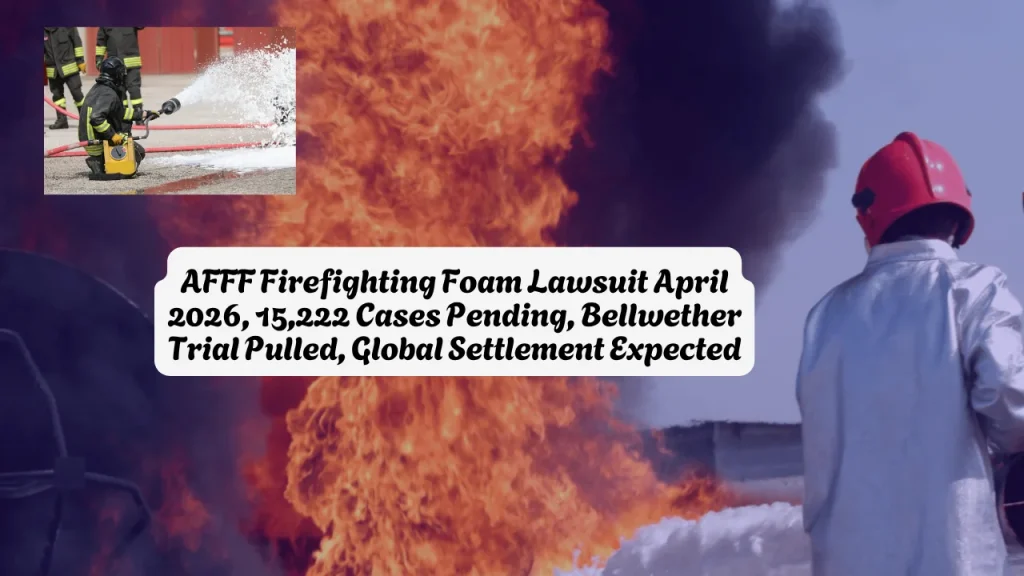
AFFF Firefighting Foam Lawsuit April 2026, 15,222 Cases Pending, Bellwether Trial Pulled, Global Settlement Expected
This is the largest active mass tort lawsuit in the United States right now. The AFFF firefighting foam lawsuit has 15,220 personal injury claims pending in federal court in South Carolina as of March 2026, all alleging that manufacturers of AFFF foam knew their product caused cancer and said nothing for decades. No global settlement exists yet. The planned first test trial was pulled from the calendar. But the science keeps strengthening for plaintiffs, and lawyers on both sides believe a resolution is coming in 2026.
If you are a firefighter, military veteran, airport worker, or someone who lived near a contaminated water supply — here is exactly where things stand right now.
Quick Case Snapshot
| Field | Details |
| Case Name | In Re: Aqueous Film-Forming Foams Products Liability Litigation |
| MDL Number | MDL No. 2873 |
| Court | U.S. District Court, District of South Carolina |
| Presiding Judge | Hon. Richard M. Gergel |
| Total Pending Cases | 15,222 as of April 1, 2026 |
| Primary Defendants | 3M, DuPont, Chemours, Corteva, BASF, Arkema, Kidde-Fenwal, Johnson Controls |
| Injuries Covered | Kidney cancer, testicular cancer, thyroid cancer, liver cancer, thyroid disease, ulcerative colitis |
| Bellwether Trial Status | October 2025 date pulled — new date not yet set |
| Water System Settlements | 3M: $10.3B; DuPont/Chemours/Corteva: $1.185B; BASF: $316.5M; Carrier Global: $730M |
| Personal Injury Settlement | None yet — negotiations ongoing |
| Global Settlement Expected | 2026–2027 (attorneys’ consensus) |
The Single Most Important Update Right Now — No Trial, No Settlement Yet
Here is the headline most people searching this topic need to understand immediately.
On August 15, 2025, the Court issued Case Management Order No. 35, which vacated the October 2025 kidney cancer bellwether setting and created a short filing and verification window to standardize proofs for new cases. The Court continues to vet the influx of filings and align expert and Daubert schedules before resetting personal injury trial dates.
Judge Gergel has not yet reset the trial calendar after pulling the October 2025 kidney cancer bellwether. The court is currently reviewing thousands of recently filed cases to ensure each has proper medical and exposure documentation before new trial dates are set. A new bellwether schedule is expected to be announced in 2026.
Why was it pulled? The trial was pulled because the court received a massive surge of new filings and wanted to verify that each claim had adequate medical and exposure documentation before proceeding. Judge Gergel specifically said the delay was about maintaining quality control in case management, not about the strength of the evidence.
The bottom line: the first test trial has not happened yet, which means no global personal injury settlement has been triggered. Both are expected — but neither has arrived.
What Is AFFF and Why Does It Cause Cancer?
AFFF — Aqueous Film-Forming Foam — is not a household name, but it has been used for decades everywhere flammable liquid fires are a risk: military air bases, commercial airports, oil refineries, and fire training facilities.
AFFF was developed in the 1960s for the U.S. Navy and became standard equipment at military bases, airports, and fire departments across the country. It works by smothering fuel fires with a thin film that cuts off oxygen. For decades, it was considered indispensable. The problem is that AFFF contains PFAS — per- and polyfluoroalkyl substances, commonly called “forever chemicals” because they do not break down in the environment or in the human body. When firefighters used AFFF during training exercises or emergency responses, they breathed in PFAS-laden vapor and absorbed it through their skin.
PFAS are called “forever chemicals” for a specific biological reason: the human body cannot metabolize or eliminate them effectively. They accumulate in blood, organs, and tissue over years and decades of exposure. Studies show firefighters have triple the PFAS levels in their blood compared to the general population.
Related article: Texas SB 731 Explained, Medicaid Payment Holds and What Providers Need to Know
A report published by The Guardian in January 2025, in cooperation with the environmental activist group Watershed Investigations, reveals that 3M Company has known about the environmental and health risks posed by the chemicals used in its AFFF since the late 1940s, but kept that information from the public and federal regulators. Despite knowing that these chemicals could accumulate in the human body and cause health issues, 3M chose to disregard warnings from its own scientists and withheld critical information from the public.
The Two Tracks — Water Contamination vs. Personal Injury
This is the single most important distinction to understand, and most media coverage blurs it entirely. The AFFF MDL has two completely separate legal tracks, and the billion-dollar settlements you may have already heard about did NOT pay individual cancer victims a cent.
Track 1 — Water System Contamination (Already Largely Settled)
Public water utilities, municipalities, and states sued AFFF manufacturers for contaminating public drinking water supplies with PFAS runoff from military bases and airports. These cases have produced massive settlements:
Former PFAS manufacturer 3M reached a $10.3 billion PFAS water settlement with multiple U.S. cities and towns in 2023. A judge approved a $1.185 billion settlement from DuPont, Chemours, and Corteva to resolve PFAS contamination claims. Carrier Global agreed to pay $730 million to Kidde-Fenwal and claimants who sued over toxic firefighting foam contaminating drinking water. None of that money went to individual cancer patients.
Track 2 — Personal Injury / Cancer Claims (Still Pending)
This is where the 15,222 currently active lawsuits live. These are individual firefighters, veterans, airport workers, and residents who developed cancer and are suing for personal compensation. AFFF firefighting foam cases often include firefighters and military personnel with cancer claims. That mix of personal injury, public health, and environmental liability makes settlement far more complex than writing checks to injured individuals.
No global settlement for personal injury cases has been reached. This track is what 2026 is about.
The Six Qualifying Medical Conditions — Do You Qualify?
The AFFF MDL 2873 officially recognizes six qualifying medical conditions: kidney cancer, testicular cancer, thyroid cancer, liver cancer, thyroid disease/hypothyroidism, and ulcerative colitis. These conditions were selected based on scientific evidence linking PFAS exposure to specific health outcomes. While earlier AFFF claims included over 200 different injury types, the court narrowed the focus to these six conditions in March 2025 to streamline litigation and prioritize cases with the strongest scientific support. Plaintiffs with other cancer types must meet additional requirements.
The science continues to strengthen plaintiff claims. Recent studies have reinforced the direct link between PFAS exposure and increased cancer risks, most notably kidney and testicular cancer. A critical study from the National Cancer Institute found a statistically significant association between PFAS exposure and testicular cancer among U.S. military personnel.
Key Defendants — Who Is Being Sued?
Reports allege that 3M was aware of the risks associated with its firefighting foam for decades, despite claiming otherwise publicly. As late as the 1990s, the company said its foam could be discharged directly into sewers. Hundreds of military sites are suspected of having discharged AFFF over the years. Key defendants also include DuPont and its spinoff company, Chemours. Other notable defendants include Arkema, Buckeye Fire Equipment, Carrier Global, Chemguard, Clariant, Corteva, Dynax, Kidde-Fenwal, National Foam, and United Technologies.
Where Is the MDL Right Now — The Procedural Status
In an update to the procedural side of the AFFF multidistrict litigation, plaintiffs’ and defense counsel jointly moved to reappoint existing lawyer leadership teams. This move means that existing Plaintiffs’ Executive Committee members and defense leaders will continue in their leadership positions in the AFFF lawsuit through May 2026, as their previous terms were set to expire.
A recent ruling in the MDL ordered that all claims related to AFFF, including those about exposure to firefighting foam and contaminated gear, will remain in the same multidistrict litigation. This order will streamline information sharing and expert testimony in the litigation. Depending on the bellwether trial outcomes, talks for a potential settlement might speed up.
Meanwhile, new plaintiffs continue to enter the MDL. A new AFFF lawsuit was filed in February 2026 in the U.S. District Court for the District of South Carolina by Bernice Solomon, alleging that for years she unknowingly ingested drinking water contaminated with PFAS chemicals, which caused her to develop kidney cancer. The complaint claims Solomon was forced to undergo partial kidney removal. Her case represents the ongoing wave of water contamination personal injury claims — people who did not directly handle foam but were poisoned through their taps.
Settlement Outlook — What Experts Are Predicting
Attorneys who track this MDL closely believe a global settlement for personal injury cases is likely in 2026 or 2027, following the first bellwether trial. After a settlement is announced, it typically takes additional months to process individual claims and distribute funds. Filing now positions you to be included when that process begins.
What would an individual plaintiff receive? Legal analysts estimate ranges based on injury type and exposure severity. Legal experts project individual firefighting foam lawsuit settlement values ranging from $20,000 to $600,000 based on factors including cancer type, exposure duration, and age at diagnosis. Kidney and testicular cancer cases — the strongest scientifically documented claims — are generally expected to command higher values.
One critical distinction every plaintiff needs to understand: the AFFF litigation is a multidistrict litigation, not a class action. In a class action, one settlement covers all plaintiffs equally. In an MDL, individual cases are grouped for pretrial efficiency but each plaintiff’s compensation is evaluated separately based on their specific exposure history, cancer type, age, and medical costs. Your payout depends on your individual facts, not a shared pool.
Who Can Still File — And What You Need
Based on the current MDL framework, you may qualify to file if all of the following apply:
✅ You were directly exposed to AFFF at a military base, airport, fire training facility, or industrial site — or you lived near a site where PFAS contaminated your drinking water supply
✅ You have been diagnosed with one of the six qualifying conditions: kidney cancer, testicular cancer, thyroid cancer, liver cancer, thyroid disease/hypothyroidism, or ulcerative colitis
✅ Your diagnosis was made after a period of documented AFFF or PFAS exposure
✅ You have medical records linking your diagnosis and, ideally, occupational or residential documentation connecting you to a contaminated site
⚠️ Statute of limitations warning: Deadlines to file vary by state, typically running 2–6 years from the date of diagnosis — not the date of exposure. If you were recently diagnosed, time may already be running. Consult an attorney immediately.
What Comes Next — The Road to Trial and Settlement
| Milestone | Status |
| MDL established | ✅ December 2018 |
| Water system settlements (3M, DuPont, BASF, Carrier) | ✅ Complete, 2023–2024 |
| October 2025 bellwether trial (kidney cancer) | ❌ Pulled — not rescheduled |
| New bellwether trial date announced | 🔄 Pending — expected 2026 |
| Leadership teams reappointed | ✅ Extended through May 2026 |
| Personal injury bellwether trial | ⏳ Not yet scheduled |
| Global personal injury settlement | ⏳ Expected 2026–2027 |
| Individual claim payouts | ⏳ Months after global settlement |
Frequently Asked Questions
Q: What is the very latest update on the AFFF lawsuit in April 2026?
As of April 2026, there are 15,222 active cases in MDL No. 2873. The October 2025 bellwether trial was pulled from the calendar after a surge of new filings requiring the court to verify documentation. A new trial date has not yet been set. Leadership teams on both sides have been extended through May 2026. No global personal injury settlement has been announced, though attorneys widely expect one in 2026 or 2027.
Q: Have any firefighters or veterans actually received money from the AFFF lawsuit yet?
The multi-billion dollar settlements you may have read about — from 3M ($10.3B), DuPont ($1.185B), BASF ($316.5M), and Carrier Global ($730M) — resolved water utility contamination claims only. None of that money has gone to individual cancer patients. The personal injury track, which is where individual firefighter and veteran claims live, has not yet produced a global settlement.
Q: Why was the bellwether trial cancelled?
Judge Gergel vacated the October 2025 kidney cancer trial date because the court received an enormous wave of new case filings and needed time to verify that each one had adequate medical documentation and exposure records. The judge was explicit that the cancellation was about case management quality, not weakness in the evidence against manufacturers.
Q: What cancers qualify for the AFFF lawsuit?
The MDL currently recognizes six qualifying conditions: kidney cancer, testicular cancer, thyroid cancer, liver cancer, thyroid disease/hypothyroidism, and ulcerative colitis. Other cancer types may be eligible but face higher evidentiary requirements under the court’s current case management orders.
Q: Who are the main defendants being sued?
3M and DuPont (along with its spinoffs Chemours and Corteva) are the primary defendants. Others include BASF, Arkema, Kidde-Fenwal, Johnson Controls, Chemguard, Clariant, Dynax, National Foam, and United Technologies, among others.
Q: How long does it take to get a settlement payout from the AFFF lawsuit?
No one knows precisely. Attorneys generally believe a global personal injury settlement could come 2026–2027 after the first bellwether trial. After a settlement fund is established, it typically takes additional months — sometimes a year or more — to process and distribute individual claims. Cases filed now will be in the queue.
Last Updated: April 18, 2026
This article is for informational and news reporting purposes only and does not constitute legal advice. Every case is different. Consult a licensed attorney to evaluate your specific circumstances. Statute of limitations deadlines vary by state — do not delay seeking legal advice.
About the Author
Israr Ahmad is a legal content researcher with 4+ years of experience covering class action settlements and consumer rights cases. He has researched and published coverage of 2,500+ settlements using verified court records, settlement administrator filings, and government sources. Learn more about Israr.