
Hyundai Recalls 37,901 Vehicles Over Airbag and Seat Belt Failure Risk, Kona Electric and Veloster N Recall List and Free Repair
Hyundai Motor America is recalling 37,901 vehicles in the United States because a software defect in the airbag control unit can disable both the airbags and the seat belt pretensioners during a crash, increasing the risk of serious injury to drivers and passengers.
The recall covers 29,058 model-year 2019–2023 Hyundai Kona Electric SUVs and 8,843 model-year 2019–2022 Hyundai Veloster N hatchbacks, according to the Part 573 Safety Recall Report filed with the National Highway Traffic Safety Administration (NHTSA) on November 2, 2026.
Important correction: Not all 37,901 vehicles are electric. Only the Kona Electric is fully electric. The Veloster N is a gasoline-powered performance hatchback.
Hyundai reports 331 potentially related incidents but no known U.S. crashes, fires or injuries tied to the defect as of its October 22, 2026 review. The repair is a free software update at an authorized Hyundai dealer. Owner letters are scheduled for January 1, 2027, but VIN lookups have been available since November 6, 2026, so you do not need to wait.
If your airbag warning light is on or stays on while driving, contact a Hyundai dealer promptly rather than waiting for the letter.
Quick Facts: Hyundai Airbag and Seat Belt Software Recall
| Detail | Official Information |
| Manufacturer | Hyundai Motor America |
| NHTSA campaign number | 26V728 (listed by NHTSA as 26V728000) |
| Hyundai recall number | 311 |
| Total vehicles recalled | 37,901 |
| Kona Electric | 29,058 vehicles, model years 2019–2023 (built Aug. 28, 2018 – July 26, 2023) |
| Veloster N | 8,843 vehicles, model years 2019–2022 (built Sept. 6, 2018 – Aug. 18, 2022) |
| Defect | Airbag Control Unit (ACU) software can be corrupted by a reset or power interruption during a memory write |
| Safety risk | Airbags and seat belt pretensioners may not deploy in a crash |
| Warning sign | Airbag malfunction indicator light may illuminate and stay on |
| Incidents reported | 331 potentially related reports (Oct. 3, 2019 – Sept. 24, 2026) |
| Known crashes, fires, injuries | None reported |
| Remedy | Free dealer software update, even if the factory warranty has expired |
| Reimbursement | Available for qualifying prior out-of-pocket repairs under Hyundai’s plan |
| VIN lookup live since | November 6, 2026 |
| Owner letters mail | January 1, 2027 |
| NHTSA recall lookup | nhtsa.gov/recalls |
| Hyundai recall lookup | autoservice.hyundaiusa.com/campaignhome |
| Hyundai customer service | 1-855-371-9460 (reference recall 311) |
| NHTSA Vehicle Safety Hotline | 1-888-327-4236 |
| “Do Not Drive” order? | No |
Which Hyundai Models Are Recalled?
| Model | Model Years | Vehicles | Powertrain |
| Hyundai Kona Electric | 2019, 2020, 2021, 2022, 2023 | 29,058 | Fully electric |
| Hyundai Veloster N | 2019, 2020, 2021, 2022 | 8,843 | Gasoline |
| Total | 37,901 |
Not every vehicle of these models and years is necessarily included. Your VIN is the only reliable way to confirm.
Not Included in This Recall
- The gasoline-powered Kona (non-electric)
- Ioniq 5 and Ioniq 6
- Tucson, Santa Fe, Palisade and other Hyundai models
Other Hyundai models have been recalled for different airbag or seat belt defects. Those are separate campaigns with different recall numbers, and completing one does not resolve another.
What Is Wrong With the Airbag System?
The airbag control unit (ACU), supplied by ZF Group, evaluates crash sensor data and commands both the airbags and the seat belt pretensioners. According to Hyundai’s report:
- Memory corruption: If the ACU experiences a system reset or power interruption while writing routine data to its internal memory, the stored software can become corrupted.
- System shutdown: The ACU then detects the fault, turns on the airbag warning light and switches off the restraint deployment circuit.
- Dual failure: Because one module controls both systems, a single fault can leave occupants without working airbags and without active pretensioners.
Hyundai estimates that roughly 1% of recalled vehicles may contain the defect. That is the manufacturer’s estimate, and all 37,901 vehicles require the update.
Will my seat belt stop working?
Not necessarily. A seat belt may still buckle and hold normally. The recall concerns the pretensioner, which tightens the belt during a crash. A driver may not notice the loss of this protection until a collision occurs.
Warning Signs and What to Do
The airbag indicator, typically a seated occupant with a circle, should light briefly at startup and turn off after the self-check. If it stays on or appears while driving, the restraint system may be disabled.
- Find a safe place to stop and check your owner’s manual.
- Contact an authorized Hyundai dealer and say your vehicle may be covered by recall 311.
- Ask whether the system needs immediate inspection and whether the remedy is available.
- If the dealer advises against driving, ask about towing or alternative transportation.
- Do not clear the fault code with an unofficial scan tool just to turn the light off. That leaves the underlying problem in place.
No warning light does not mean you are excluded. The condition could develop later, so complete the recall repair even if everything seems normal.
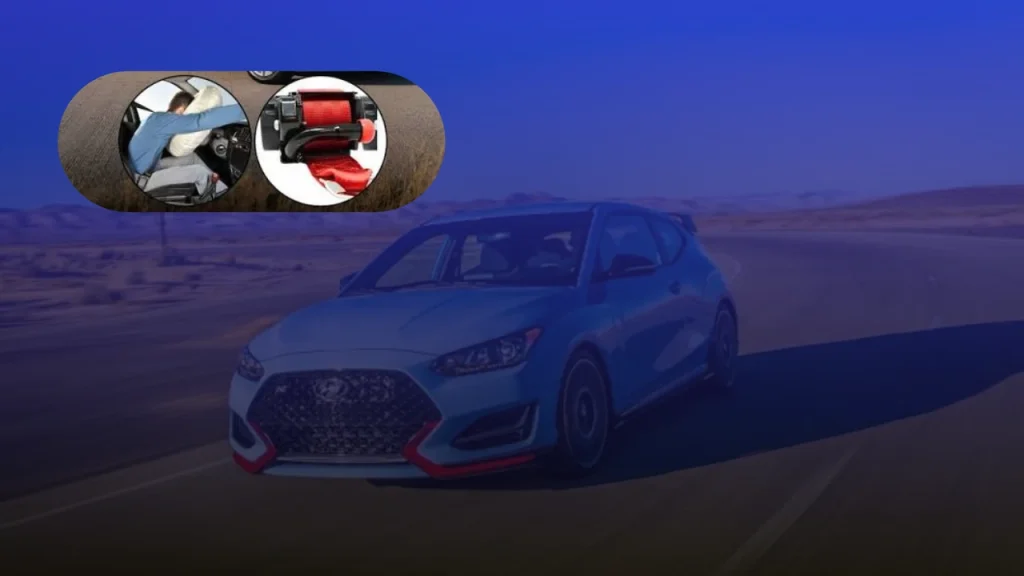
Can I Still Drive My Kona Electric or Veloster N?
NHTSA has not issued a “Do Not Drive” or “park outside” advisory for this recall. That does not mean the defect is harmless. If your airbag warning light is on, contact Hyundai or a dealer for vehicle-specific guidance and do not ignore it until January.
How to Check Your VIN
- Find your 17-character VIN on the driver’s side dashboard near the windshield, the driver’s door jamb, or your registration or insurance documents.
- Enter it at NHTSA’s recall lookup or Hyundai’s campaign lookup (listed in the Quick Facts table).
- Look for campaign 26V728 or Hyundai recall 311.
- Call your dealer to confirm the repair is available before you visit.
Used-car owners: Second and later owners may not receive a mailed letter if Hyundai lacks current contact details. Check your VIN yourself.
The Fix: Free Software Update
The remedy updates the ACU software so it preserves the last known valid data if a memory transfer is interrupted. This addresses the corruption scenario Hyundai identified.
- Cost: Free, regardless of whether the new-vehicle warranty has expired, and including used vehicles.
- Where: An authorized Hyundai dealership. The recall instructions direct owners to a dealer, so do not assume the fix will arrive as an over-the-air update.
- No new airbags or seat belts are required as a routine part of this campaign.
- Time: Hyundai’s report gives no standard duration. Ask your dealer.
Reimbursement for Prior Repairs
Hyundai says it will reimburse qualifying owners for out-of-pocket expenses to correct the recalled condition, under its reimbursement plan.
- Locate the repair invoice and proof of payment.
- Confirm your VIN is in recall 311.
- Submit the documentation to Hyundai through its official reimbursement process, or call 1-855-371-9460.
- Await Hyundai’s decision.
Repairs unrelated to this defect, such as other airbag components, sensors, buckles or collision damage, may not qualify.
When Are Recall Letters Coming?
Hyundai’s notification date is January 1, 2027. That is a notice date, not a deadline to schedule the repair or request reimbursement.
Why Did the Recall Take Until 2026?
Hyundai’s NHTSA filing describes this chronology:
| Date | Event |
| August 19, 2024 | Hyundai’s North America Safety Office opens an investigation after a rise in warranty claims involving airbag warning lights |
| Late 2024 – 2025 | Hyundai and ZF analyze returned ACUs, fault codes and electrical behavior |
| 2025 – 2026 | Supplier reproduces the fault on the bench but struggles to reproduce it in complete vehicles |
| September 2026 | Hyundai finds additional vehicle applications may use the same software and expands the review |
| October 22, 2026 | Hyundai’s safety decision authority approves the recall |
| November 2, 2026 | Part 573 report filed with NHTSA |
| November 4, 2026 | NHTSA acknowledges the filing |
| November 6, 2026 | Affected VINs searchable |
| January 1, 2027 | Owner and dealer notification |
The timeline explains the delay but does not, by itself, establish that Hyundai violated federal reporting deadlines. That question is for NHTSA and, in litigation, the courts.
How Many Failures Were Reported?
| Category | Count |
| Potentially related incidents | 331 |
| Known related crashes | 0 |
| Known related fires | 0 |
| Known related injuries | 0 |
The 331 reports are not 331 crashes or confirmed airbag failures in collisions. Many involved warning lights or system faults.
Your Legal Rights Under Federal Law
National Traffic and Motor Vehicle Safety Act, 49 U.S.C. Chapter 301
- § 30118: Requires a manufacturer that determines a vehicle contains a safety-related defect to notify NHTSA and owners and remedy it. NHTSA can also initiate and order recalls.
- § 30119: Governs the contents and timing of owner notification, which generally explains the defect, the risk and the remedy.
- § 30120: Requires the remedy (repair, replacement or, in some cases, refund) to be provided without charge, subject to statutory conditions, including a limit tied to the age of the vehicle. Hyundai has expressly committed to a free repair here.
- § 30165: Authorizes civil penalties for violations of the Act and its regulations, including failure to notify or remedy properly. Penalty amounts are adjusted periodically.
A recall does not automatically entitle every owner to a replacement vehicle, refund or cash compensation.
Federal Regulations
- 49 C.F.R. Part 573: Defect and noncompliance reports. Manufacturers must file within five working days of determining that a safety defect exists.
- 49 C.F.R. Part 577: Content and format of owner notification letters.
- 49 C.F.R. Part 579 (TREAD Act Early Warning Reporting): Manufacturers must submit periodic reports of claims, warranty data and field reports to NHTSA, which uses them to spot defect trends.
- FMVSS No. 208 and No. 209: Federal Motor Vehicle Safety Standards for occupant crash protection and seat belt assemblies, the safety framework these restraint systems operate within.
Warranty and Consumer Law
- Magnuson-Moss Warranty Act, 15 U.S.C. § 2301 et seq.: Federal law governing written and implied warranties on consumer products, which may be relevant if a defect caused economic loss.
- State lemon laws and implied warranty rules: Vary by state. Some may apply to repeated unsuccessful repairs or serious safety defects.
- State consumer protection statutes: Some may address concealment or misrepresentation of known defects.
Product Liability
If someone is injured in a crash where a restraint system failed, claims may arise under state product liability law (strict liability for design or manufacturing defects, negligence, and failure to warn). Statutes of limitations differ by state and can be short, so consult a licensed attorney promptly after an injury. A recall does not by itself prove liability.
Class Actions
Recalls are administrative safety actions. They are not class action settlements, and there is no objector or opt-out process. If owners file civil class actions for economic loss, such as diminished value, Federal Rule of Civil Procedure 23 would govern certification and any settlement review.
What If the Dealer Refuses or Delays the Repair?
- Ask for a written explanation of the refusal or delay.
- Call Hyundai Customer Service at 1-855-371-9460.
- File a complaint with NHTSA at nhtsa.gov/report-a-safety-problem or call 1-888-327-4236.
- Keep all invoices, emails, appointment records and notes of calls.
Is There a Class Action Settlement for This Recall?
No class action settlement or cash claim program for recall 26V728 was verified in the official materials reviewed. You do not need to join any lawsuit to get the free software update.
Hyundai and Kia are separately involved in an older airbag control unit settlement (In re ZF-TRW Airbag Control Units Products Liability Litigation, No. 2:19-ml-02905-JAK) concerning different alleged defects. Some model names overlap, but this new recall does not automatically make you eligible for that settlement. Its own VIN-based criteria control.
Do You Need a Lawyer?
- For the free repair or standard reimbursement: No. Go through the dealer or Hyundai.
- If you or a passenger were injured: Consult a product liability attorney. These cases are commonly handled on a contingency fee basis, meaning no fee unless there is a recovery. Fee percentages vary, so ask for the agreement in writing.
Tax Treatment
Free dealer repairs and reimbursements of out-of-pocket repair costs are generally treated as a restoration of your property or a purchase price adjustment, not income, unless you previously deducted the cost as a business expense. This is general information, not tax advice. Consult a tax professional.
Is This Related to Other Hyundai Recalls?
No. This is a distinct campaign. Hyundai has had other recalls involving seat belt anchors and third-row curtain airbags on different models. Check your VIN for all open recalls.
Frequently Asked Questions
Which Hyundai models are recalled?
Certain 2019–2023 Kona Electric SUVs and 2019–2022 Veloster N hatchbacks.
How many vehicles are affected?
37,901: 29,058 Kona Electric and 8,843 Veloster N.
Are all the vehicles electric?
No. The Veloster N is gasoline-powered.
What is the defect?
Airbag Control Unit software corruption that can switch off the airbags and seat belt pretensioners.
Can the airbags fail in a crash?
Yes, that is the safety risk identified in the recall.
What does the airbag warning light mean?
The system may have detected a fault. Contact a Hyundai dealer.
Has anyone been hurt?
Hyundai reported no known related U.S. crashes, fires or injuries as of October 22, 2026.
Can I keep driving?
There is no “Do Not Drive” order, but an active airbag warning needs prompt attention.
Is the fix free?
Yes, even if the warranty has expired.
Is a used car covered?
Yes. The recall follows the VIN, not the original buyer.
Can I check my VIN now?
Yes. VINs have been searchable since November 6, 2026.
When will I get a letter?
Hyundai plans to mail letters January 1, 2027.
Will Hyundai reimburse earlier repairs?
Potentially, if they were to correct this specific condition.
Can the update be done over the air?
The recall instructions direct owners to a dealer. Do not assume an over-the-air update.
Is there a settlement claim form?
No separate cash claim form has been verified for this recall.
Does a recall mean I can sue?
Not automatically. A recall is a safety remedy and does not by itself establish liability. If you were injured or suffered economic loss, speak with a licensed attorney.
Bottom Line
Hyundai’s recall of 37,901 Kona Electric and Veloster N vehicles addresses a software flaw that could disable airbags and seat belt pretensioners in a crash. No related crashes or injuries have been reported, but the risk is serious. Check your VIN now, contact a dealer if the airbag light is on, and schedule the free software update. Do not wait for the January 2027 letter.
This article provides general consumer safety and legal information, not legal advice, and no attorney-client relationship is created by reading it. Follow the latest NHTSA and Hyundai instructions for your vehicle.
Related Articles
- Hyundai and Kia Airbag Control Unit Settlement: Check If You Qualify
- Hyundai Recalls 294,128 Vehicles Over Seat Belt Anchor Detachment Risk
- Hyundai Palisade Airbag Lawsuit and Recall 2026: What 500K+ Owners Need to Know About the Third-Row Defect
Sources
- NHTSA, Safety Recall Report 26V728 (Part 573): https://static.nhtsa.gov/odi/rcl/2026/RCLRPT-26V728-4779.pdf
- NHTSA, Recall Acknowledgment, Nov. 4, 2026: https://static.nhtsa.gov/odi/rcl/2026/RCAK-26V728-3967.pdf
- NHTSA, Vehicle Recall Lookup: https://www.nhtsa.gov/recalls
- NHTSA, Report a Safety Problem: https://www.nhtsa.gov/report-a-safety-problem
- Hyundai, Safety Recall and Service Campaign VIN Lookup: https://autoservice.hyundaiusa.com/campaignhome
- Hyundai, Campaign Reimbursement: https://owners.hyundaiusa.com/us/en/resources/general-information/contact-us/campaign
- 49 U.S.C. § 30118: https://uscode.house.gov/us/usc/t49/s30118
- 49 U.S.C. § 30120: https://uscode.house.gov/us/usc/t49/s30120
- 49 U.S.C. §§ 30119, 30165; 49 C.F.R. Parts 573, 577, 579; 49 C.F.R. §§ 571.208, 571.209; 15 U.S.C. § 2301 et seq.; Fed. R. Civ. P. 23
About the Author
Israr Ahmad is a legal content researcher with 4+ years of experience covering class action settlements and consumer rights cases. He has researched and published coverage of 2,500+ settlements using verified court records, settlement administrator filings, and government sources. Learn more about Israr.