
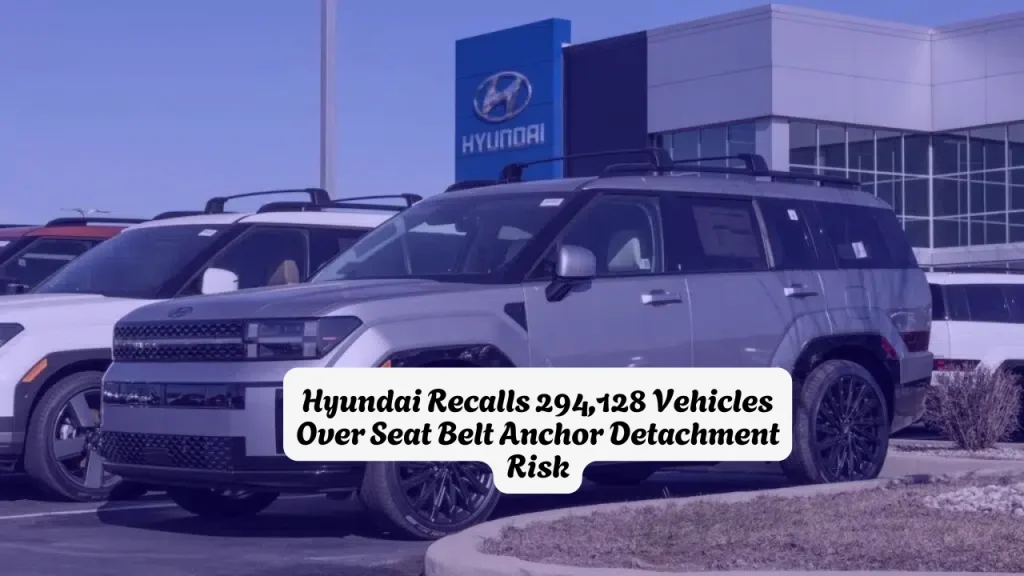
Hyundai Recalls 294,128 Vehicles Over Seat Belt Anchor Detachment Risk
Hyundai Motor America has recalled 294,128 vehicles — including the Hyundai Santa Fe, Santa Fe Hybrid, Ioniq 6, and Genesis G90 — because the front seat belt anchor assemblies may be damaged and could detach during a crash. Filed with the National Highway Traffic Safety Administration (NHTSA) on April 6, 2026, the recall targets a defect in the front seat belt anchor assembly that could leave occupants vulnerable in a crash. The recall applies to vehicles sold across the United States and covers model years 2023 through 2026. Dealers will inspect and repair or replace the affected anchors at no cost to owners.
Quick Facts
| Company / Brand | Hyundai Motor America; Genesis (luxury division) |
| Affected Products | 2024–2026 Hyundai Santa Fe; 2024–2026 Hyundai Santa Fe Hybrid; 2023–2025 Hyundai Ioniq 6; 2023–2026 Genesis G90 |
| Units Affected | 294,128 vehicles in the United States |
| NHTSA Campaign Number | 26V218 (Hyundai internal numbers: 298 and 032G) |
| Reason for Recall | Front seat belt snap-on anchor may be damaged during service or maintenance, preventing the belt from remaining attached to the seat frame in a crash |
| Date Filed with NHTSA | April 6, 2026 |
| Geographic Scope | United States nationwide |
| Owner Notification Date | June 5, 2026 (by mail) |
| Recommended Action | Check your VIN now at nhtsa.gov; schedule a free dealer inspection and repair |
| Hyundai Owner Hotline | 1-855-371-9460 |
| Genesis Owner Hotline | 1-844-340-9741 |
| NHTSA Safety Hotline | 1-888-327-4236 (TTY: 1-800-424-9153) |
| Official NHTSA Page | nhtsa.gov/recalls |
Detailed Recall Information
How the Defect Was Discovered
This recall traces back to September 30, 2025, when Hyundai’s North America Safety Office (NASO) received a Consumer Affairs case flagging the defect condition on a 2025 Santa Fe. NHTSA subsequently shared Vehicle Owner Questionnaires from consumers reporting detached front seat belt anchor clips following rear-end collisions, which prompted a formal investigation.
NASO visited Hyundai Motor Manufacturing Alabama (HMMA) in December 2025 to review installation processes and quality controls, and recovered parts from consumer vehicles that confirmed the presence of damaged anchor clips. The assembly line was cleared as a source. By January 2026, NASO had replicated the damage through forceful removal of the snap-on anchor, consistent with what happens when a technician removes or reinstalls the anchor incorrectly during a seat repair. Field inspections of auction vehicles through March 2026 found no spontaneous anchor failures, confirming the damage originates from service procedures rather than a manufacturing flaw.
On March 30, 2026, Hyundai’s North America Safety Decision Authority decided to conduct a recall. A redesigned snap-on anchor was implemented across all affected models in production by March 2026.
Related article: $990K Enroll Confidently Data Breach Settlement, Check If You Qualify for Up to $3,500
Which Vehicles Are Affected
The recall covers four vehicle lines across specific production date windows:
- 2024–2026 Hyundai Santa Fe — manufactured between December 28, 2023 and October 20, 2025
- 2024–2026 Hyundai Santa Fe Hybrid — manufactured between March 6, 2024 and October 14, 2025
- 2023–2025 Hyundai Ioniq 6 (electric sedan) — manufactured between December 14, 2022 and May 16, 2025
- 2023–2026 Genesis G90 (luxury sedan) — manufactured between April 21, 2022 and March 4, 2026
Hyundai estimates that only 1% of the recalled population may actually have the defect. However, because the defect is not visually detectable under normal driving conditions, NHTSA requires all potentially affected vehicles to be inspected.
The Safety Hazard
The front seat belts in these vehicles “may not be sufficiently attached to the seat frame due to a damaged snap-on anchor.” The automaker concluded that the seat belt anchors may have been damaged during installation, routine maintenance, or repair.
The critical risk is that the seat belt may still buckle, retract, and feel normal in day-to-day driving, but if the lower anchor is not secured correctly, it may not restrain the driver or front passenger in a crash. A detached anchor effectively renders the front seat belt non-functional at the moment it is needed most.
Incidents and Injuries
Hyundai says it is aware of six incidents and no reports of crashes, injuries, or fatalities related to this recall in the U.S.
Regulatory Authority
This recall is overseen by the National Highway Traffic Safety Administration (NHTSA) under campaign number 26V218. NHTSA is the federal agency responsible for vehicle safety standards and recall oversight. The Part 573 safety recall report was submitted to NHTSA on April 6, 2026, and VINs became searchable in the NHTSA recall database on April 8, 2026.
Important Note: This Is Not the 2025 Palisade Recall
This recall is separate and distinct from the Hyundai Palisade seat belt buckle recall issued in September 2025 (NHTSA 25V-607), which involved out-of-specification seat belt buckle components in more than 568,000 Palisade SUVs. That recall centered on a latching failure caused by defective buckle assembly parts from a sub-supplier. This newer 2026 recall addresses structural anchor integrity and arises from a service-related damage pattern rather than a manufacturing defect at the component level. Owners of multiple Hyundai or Genesis vehicles should check each VIN individually.
What Owners Should Do
- Check your VIN immediately. Do not wait for the mailed notification letter, which is not scheduled until June 5, 2026. Visit nhtsa.gov/recalls and enter your Vehicle Identification Number (VIN) to confirm whether your specific vehicle is included. Your VIN appears on your registration, insurance card, and the driver’s side dashboard at the base of the windshield.
- Schedule a dealer appointment. Contact your authorized Hyundai or Genesis dealership to book an inspection. Technicians will inspect the front seat belt anchor on affected vehicles and apply a reinforcement insert to the snap-on lower anchor. If the anchor cannot be adequately reinforced, the full seat belt assembly will be replaced.
- The repair is free — regardless of warranty status. Federal law requires that all safety recall repairs be provided free of charge, regardless of warranty status. Hyundai has also indicated it will reimburse owners who may have already paid out of pocket for expenses related to this defect condition. If you believe you previously paid for a repair related to this anchor issue, contact Hyundai directly to initiate a reimbursement request.
- Contact Hyundai or Genesis directly if you have questions, difficulty scheduling an appointment, or need confirmation of your recall status:
- Hyundai owners: 1-855-371-9460
- Genesis owners: 1-844-340-9741
- NHTSA Vehicle Safety Hotline: 1-888-327-4236 (TTY: 1-800-424-9153)
- No immediate “do not drive” order is in effect. The official filing does not include a “do not drive” or “park outside” warning. However, given that a defective anchor is not detectable during normal driving, owners of affected vehicles should prioritize scheduling the free inspection as soon as possible rather than waiting for the mailed notice.
- Report safety concerns to NHTSA. If you experience any issues with your seat belt before your repair appointment — including a belt that feels loose at the base or does not retract normally — report it to NHTSA at nhtsa.gov or by calling 1-888-327-4236.
Regulatory and Legal Context
This recall was self-initiated by Hyundai Motor America following its internal investigation and was filed with NHTSA on April 6, 2026. NHTSA is actively monitoring the recall to ensure owners receive timely, effective, and free remedies consistent with federal safety law.
As of publication, no class action lawsuits have been filed specifically related to NHTSA Campaign 26V218. Hyundai has faced separate class action litigation in prior years involving other vehicle safety components. Owners who believe they suffered harm related to the seat belt anchor defect before this recall was announced may wish to consult a consumer protection or product liability attorney to understand their options.
Frequently Asked Questions
Which vehicles are covered by this recall?
The recall covers four models: the 2024–2026 Hyundai Santa Fe (built December 28, 2023 – October 20, 2025), the 2024–2026 Hyundai Santa Fe Hybrid (built March 6, 2024 – October 14, 2025), the 2023–2025 Hyundai Ioniq 6 (built December 14, 2022 – May 16, 2025), and the 2023–2026 Genesis G90 (built April 21, 2022 – March 4, 2026). A total of 294,128 vehicles are included.
How do I know if my specific vehicle is affected?
Enter your VIN at nhtsa.gov/recalls. VINs became searchable in the NHTSA database on April 8, 2026. You can also call Hyundai at 1-855-371-9460 or Genesis at 1-844-340-9741. Official owner notification letters will be mailed by June 5, 2026.
What if I already used or drove the vehicle?
The defect is not visible during normal driving — the seat belt will buckle and feel normal even if the anchor is damaged. NHTSA has not issued a “do not drive” order. Schedule your free dealer inspection promptly, and contact NHTSA if you notice any unusual seat belt behavior before your appointment.
How do I get the free repair?
Take your vehicle to an authorized Hyundai or Genesis dealership. Technicians will inspect the seat belt anchor and either install a reinforcement insert or replace the entire seat belt assembly — at no charge to you, even if your warranty has expired. If you previously paid for a related repair out of pocket, contact Hyundai at 1-855-371-9460 to request reimbursement.
Who regulates this recall and where can I find official information?
This recall is regulated by the National Highway Traffic Safety Administration (NHTSA) under Campaign No. 26V218. Official recall information is available at nhtsa.gov/recalls. Hyundai’s official recall page is at hyundaiusa.com.
What are the specific risks from this defect?
If the front seat belt anchor detaches, the seat belt cannot properly restrain the driver or front passenger during a crash. The belt may feel and function normally during everyday driving, giving no warning that the anchor is compromised. The risk is a significant increase in occupant injury in a collision. As of April 6, 2026, Hyundai has identified six related incidents in the U.S. with no confirmed crashes, injuries, or deaths.
Is this the same as the Hyundai Palisade seat belt recall?
No. The Palisade recall (NHTSA 25V-607, September 2025) involved defective seat belt buckle components that could prevent proper latching. This 2026 recall (NHTSA 26V218) involves the seat belt anchor assembly on different models and stems from a different root cause — damage to the snap-on anchor during service or maintenance. The two recalls are completely separate.
What if my dealer says they can’t fix it right away?
Parts supply and dealer capacity may vary. If a dealership cannot immediately complete the repair, ask them to document your visit and confirm a follow-up appointment. You can also contact Hyundai’s Customer Care Center at 1-855-371-9460. If you feel Hyundai or the dealer has failed to provide a timely remedy, you may file a complaint with NHTSA at 1-888-327-4236 or at nhtsa.gov.
Disclaimer
Last Updated: May 1, 2026. This article is for informational purposes only and does not constitute legal advice. Always follow official recall guidance from Hyundai Motor America, Genesis, and the National Highway Traffic Safety Administration (NHTSA). For the most current information, visit nhtsa.gov/recalls or contact Hyundai at 1-855-371-9460 or Genesis at 1-844-340-9741.
About the Author
Israr Ahmad is a legal content researcher with 4+ years of experience covering class action settlements and consumer rights cases. He has researched and published coverage of 2,500+ settlements using verified court records, settlement administrator filings, and government sources. Learn more about Israr.