
How Late Are Polls Open Today? 2026 Election Day Closing Times by State, Voting in Line and Your Rights
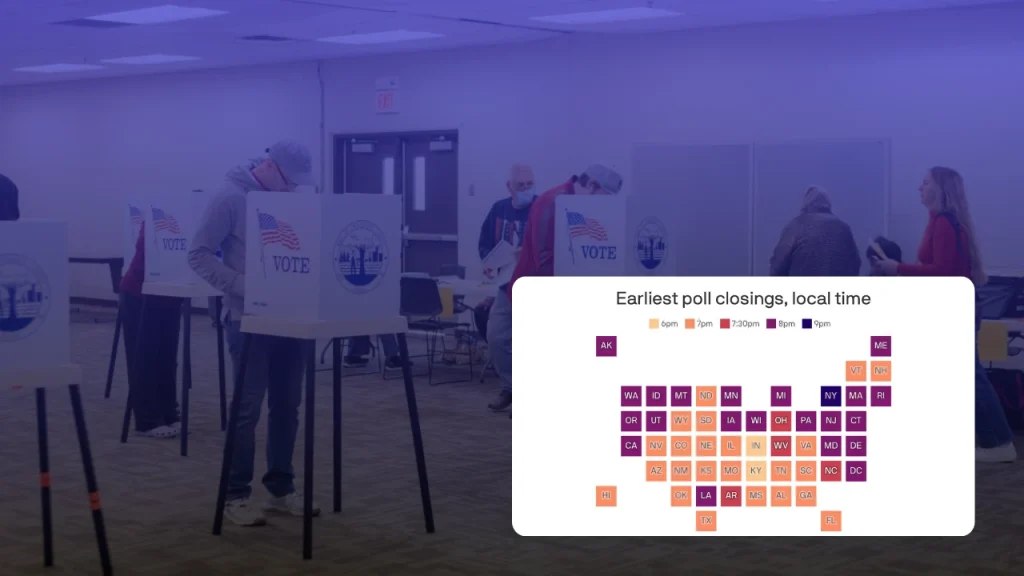
Most polling places close at 7 p.m. or 8 p.m. local time, but there is no national closing time. The earliest polls close at 6 p.m. in Indiana and Kentucky, and New York keeps polls open until 9 p.m. If you are already in line when your polling place closes, you generally have the right to stay and vote. Do not leave the line.
Voting hours are set by each state, and sometimes by counties or towns. New Hampshire and North Dakota let local officials choose closing times within limits, and states that cross time zones close at different clock times in different areas. This guide gives the closing time for every state in local time and Eastern Time, explains the in-line rule, covers what courts can and cannot do to extend hours, and tells you what to do if you are turned away.
Quick Facts: Poll Closing Times on November 3, 2026
| Question | Answer |
| Election Day | Tuesday, November 3, 2026 |
| Most common closing times | 7 p.m. and 8 p.m. local time |
| Earliest closing | 6 p.m. in Indiana and Kentucky (6 p.m. Eastern is the first closing nationwide) |
| Latest standard closing | 9 p.m. in New York; North Dakota counties may set 9 p.m. |
| Last polls in the nation | Western Aleutian Islands, Alaska, 1 a.m. Eastern on November 4 |
| Locally set closing times | New Hampshire (7 p.m. or later) and North Dakota (7 to 9 p.m.), among others |
| Can voters in line at closing still vote? | Generally yes |
| Is there one federal closing time? | No |
| Where to confirm your hours | Your state or county election office; USA.gov polling place finder |
Clocks went back on Sunday, November 1, so election night is on standard time. Eastern Time figures below are Eastern Standard Time.
Poll Closing Times in All 50 States and D.C.
Local time is what matters when you vote. The Eastern Time column is a reference for election-night results and shows when each state’s polls close on the East Coast clock. Individual counties and towns can differ, so confirm your own polling place.
| State | Polls close (local time) | Eastern Time equivalent | Notes |
| Alabama | 7 p.m. | 8 p.m. | Central Time |
| Alaska | 8 p.m. | Midnight (1 a.m. in the western Aleutians) | Last polls in the country |
| Arizona | 7 p.m. | 9 p.m. | Mountain Time |
| Arkansas | 7:30 p.m. | 8:30 p.m. | Central Time |
| California | 8 p.m. | 11 p.m. | Mail ballots and in-person voting |
| Colorado | 7 p.m. | 9 p.m. | Mail ballots and voting centers |
| Connecticut | 8 p.m. | 8 p.m. | |
| Delaware | 8 p.m. | 8 p.m. | |
| District of Columbia | 8 p.m. | 8 p.m. | |
| Florida | 7 p.m. | 7 p.m. (8 p.m. in the Central Time panhandle) | Two time zones |
| Georgia | 7 p.m. | 7 p.m. | |
| Hawaii | 7 p.m. | Midnight | |
| Idaho | 8 p.m. | 10 p.m. (11 p.m. in the Pacific Time north) | Two time zones |
| Illinois | 7 p.m. | 8 p.m. | Central Time |
| Indiana | 6 p.m. | 6 p.m. in Eastern counties; 7 p.m. in Central counties | Earliest closing in the nation |
| Iowa | 8 p.m. | 9 p.m. | Central Time |
| Kansas | 7 p.m. | 8 p.m. (9 p.m. in the Mountain Time west) | Two time zones |
| Kentucky | 6 p.m. | 6 p.m. in Eastern counties; 7 p.m. in Central counties | Earliest closing in the nation |
| Louisiana | 8 p.m. | 9 p.m. | Central Time |
| Maine | 8 p.m. | 8 p.m. | |
| Maryland | 8 p.m. | 8 p.m. | |
| Massachusetts | 8 p.m. | 8 p.m. | |
| Michigan | 8 p.m. | 8 p.m. (9 p.m. in the western Upper Peninsula) | Two time zones |
| Minnesota | 8 p.m. | 9 p.m. | Central Time |
| Mississippi | 7 p.m. | 8 p.m. | Central Time |
| Missouri | 7 p.m. | 8 p.m. | Central Time |
| Montana | 8 p.m. | 10 p.m. | Mountain Time |
| Nebraska | 8 p.m. Central / 7 p.m. Mountain | 9 p.m. | Two time zones |
| Nevada | 7 p.m. | 10 p.m. | Pacific Time |
| New Hampshire | 7 p.m. or later | 7 p.m. (some towns 8 p.m.) | Towns set hours; none may close before 7 p.m. |
| New Jersey | 8 p.m. | 8 p.m. | |
| New Mexico | 7 p.m. | 9 p.m. | Mountain Time |
| New York | 9 p.m. | 9 p.m. | Latest standard closing |
| North Carolina | 7:30 p.m. | 7:30 p.m. | |
| North Dakota | 7 p.m. to 9 p.m. | 8 p.m. to 11 p.m. | County officials set the time; two time zones |
| Ohio | 7:30 p.m. | 7:30 p.m. | |
| Oklahoma | 7 p.m. | 8 p.m. | Central Time |
| Oregon | 8 p.m. | 11 p.m. (10 p.m. in Malheur County) | Vote by mail; ballots must be received at drop sites by 8 p.m. |
| Pennsylvania | 8 p.m. | 8 p.m. | |
| Rhode Island | 8 p.m. | 8 p.m. | |
| South Carolina | 7 p.m. | 7 p.m. | |
| South Dakota | 7 p.m. | 8 p.m. (9 p.m. in the Mountain Time west) | Two time zones |
| Tennessee | 7 p.m. Central / 8 p.m. Eastern | 8 p.m. | Two time zones |
| Texas | 7 p.m. | 8 p.m. (9 p.m. in the El Paso area) | Two time zones |
| Utah | 8 p.m. | 10 p.m. | Mountain Time |
| Vermont | 7 p.m. | 7 p.m. | Towns set opening times |
| Virginia | 7 p.m. | 7 p.m. | |
| Washington | 8 p.m. | 11 p.m. | Vote by mail; official drop boxes close at 8 p.m. |
| West Virginia | 7:30 p.m. | 7:30 p.m. | |
| Wisconsin | 8 p.m. | 9 p.m. | Central Time |
| Wyoming | 7 p.m. | 9 p.m. | Mountain Time |
Important: This is a statewide general-election reference, not a substitute for your assigned polling place’s posted hours. Special elections, local elections and primaries can have different schedules, and some counties keep different hours.
Which States Keep Polls Open the Latest?
New York: 9 p.m.
New York Election Law § 8-100 generally keeps polling places open from 6 a.m. to 9 p.m. Voters waiting in line at 9 p.m. may stay and vote.
North Dakota: 7 p.m. to 9 p.m., set locally
North Dakota allows county officials to set closing times within statutory limits (N.D. Cent. Code § 16.1-01-03). Neighboring counties can close at different times, so check your county auditor’s notice.
Alaska, Hawaii and the last polls in the nation
Most of Alaska closes at 8 p.m. Alaska Time, which is midnight Eastern. The western Aleutian Islands, in the Hawaii-Aleutian time zone, close last at 1 a.m. Eastern on November 4. Hawaii closes at 7 p.m. Hawaii Time, which is midnight Eastern.
Oregon and Washington: mail-ballot deadlines
Oregon and Washington vote primarily by mail. The 8 p.m. Election Day deadline in each state applies to returning a completed ballot to an official drop site, not to a neighborhood polling place. Do not confuse a ballot drop-off deadline with a precinct closing time, and do not rely on postmarks unless your state’s rules say they count.
What If You Reach the Polling Place Just Before It Closes?
Suppose your polling place closes at 7 p.m. and you join the line at 6:58 p.m. If you were in line before the posted closing time, you generally have the right to stay and vote. Nearly all states follow this rule, but it comes from state law and election-administration practice, not from a single federal statute, so procedures vary.
What to do:
- Stay in line and do not leave expecting to return.
- Tell a poll worker that you were in line before closing.
- Follow the instructions of the poll workers, who typically mark the end of the line at closing time.
- Ask for the lead election official or judge if someone tells you to leave.
If you are turned away while in line, write down the polling place, the time you joined the line, the scheduled closing time, what you were told and any witnesses. Then call Election Protection at 866-OUR-VOTE (866-687-8683), or your state’s election office.
People who arrive after the posted closing time and were not in line generally cannot demand to vote unless a court order or other legal extension applies.
Can a Polling Place Stay Open Longer?
Sometimes, but not automatically. A polling place’s hours are set by state law. Extensions are typically considered when something serious interferes with voting, such as a late opening, equipment failure, a power outage, or a documented failure to give eligible voters access. A court may order extended hours under state law.
Federal law does not create a right to extra time whenever there is a delay. It does regulate what happens to votes cast during a court-ordered extension: under the Help America Vote Act (HAVA), 52 U.S.C. § 21082(c), in a federal election, ballots cast after the normal closing time under a court order must be treated as provisional ballots and kept separate while the validity of the order is decided. Whether such a ballot ultimately counts depends on the court and state law.
Is There a Federal Closing Time?
No. Federal law sets the date of federal general elections (for example, 2 U.S.C. § 7 for U.S. House elections), but states set polling hours. Examples:
| State | Statute | General polling hours |
| New York | Election Law § 8-100 | 6 a.m. to 9 p.m. |
| New Jersey | N.J.S.A. 19:15-2 | 6 a.m. to 8 p.m. |
| Virginia | Va. Code § 24.2-603 | 6 a.m. to 7 p.m. |
| Wisconsin | Wis. Stat. § 6.78 | 7 a.m. to 8 p.m. |
| North Dakota | N.D. Cent. Code § 16.1-01-03 | Set by county officials between 7 a.m. and 9 p.m. limits |
Pennsylvania’s election code provides 7 a.m. to 8 p.m. hours. A voter cannot rely on another state’s hours, and a primary, runoff or local election may have a different schedule than the general election.
Other Voter Protections on Election Day
| Protection | Source |
| Provisional ballot if your eligibility is questioned or you are not on the list, in federal elections | HAVA, 52 U.S.C. § 21082 |
| Assistance for voters with disabilities or who cannot read or write, from a person of their choice (not their employer or union representative) | Voting Rights Act § 208, 52 U.S.C. § 10508 |
| Accessible polling places and voting systems | ADA and HAVA |
| Protection from intimidation, threats or coercion | 52 U.S.C. § 10307(b) and state law |
| Limits on campaigning near polling places | State law; the distance varies by state |
Election Day is not a federal holiday, and employee leave to vote varies by state, so check your state’s law and your employer’s policy.
How to Confirm Your Exact Closing Time
- Find your assigned polling place with the USA.gov polling place finder or your state’s voter lookup.
- Check the hours posted by your state or county, not an old sample ballot or map app.
- Confirm the location has not changed since the last election.
- If you vote in Oregon or Washington, use the official drop-box or voting-center list, not a precinct address.
- Arrive with extra time. Being in line before closing protects you, but arriving early avoids transportation and queue problems.
What If You Cannot Reach the Polls in Time?
- Early voting: Most early voting periods have ended. Check your state election website for anything still authorized.
- Mail ballot already in hand: Check whether your state allows return to an official drop box or election office, and by what time. A ballot mailed on Election Day may not count.
- Registration or ID problem at the polls: Ask whether your state offers provisional, affidavit or same-day registration procedures.
- Help line: Election Protection offers English 866-687-8683, Spanish 888-839-8682, Asian languages 888-274-8683 and Arabic 844-925-5287.
For missing voter records, ID problems and provisional ballots, read Election Day Voting Rights 2026: What to Do If Your Name Is Missing, You Don’t Have ID, or You’re Turned Away at the Polls. For registration rules, see Register to Vote in 2026: Deadlines, Requirements, Voter ID Laws and California’s DOJ Noncitizen Voting Cases.
Do Results Come Right After the Polls Close?
No. When polls close, officials still must process voters who were in line, transport ballots, count mail and absentee ballots, review provisional ballots and complete canvassing. News organizations may project winners on election night, but projections are not official certification. Close races and states that count mail ballots slowly, including Oregon and Washington, can take days.
Frequently Asked Questions
How late are polls open today?
Most close between 7 p.m. and 8 p.m. local time. Some Indiana and Kentucky polls close at 6 p.m., and New York closes at 9 p.m.
What time do polls close in my state?
See the table above, then confirm with your county or state election office. Closing times are local to your polling place.
Can I vote if I am still in line when polls close?
Generally yes. Stay in line, tell the poll worker you were already waiting, and follow their instructions.
Can I arrive after closing and still vote?
Usually not, unless a court order or other legal extension applies.
Can polls close early because no one is waiting?
No. Officials cannot close before the legally set time because turnout is low.
Can a judge keep polls open?
Possibly, under state law, when there are serious problems such as a late opening or equipment failure. In federal elections, votes cast under such an order are provisional ballots under 52 U.S.C. § 21082(c).
What time do polls close in New York, California, Texas, Florida and New Jersey?
New York 9 p.m. local; California 8 p.m. Pacific; Texas 7 p.m. local (8 p.m. Eastern; El Paso area 9 p.m. Eastern); Florida 7 p.m. local; New Jersey 8 p.m. Eastern.
What time do polls close in New Hampshire?
At 7 p.m. or later, depending on the town. Check your town’s posted hours.
Does my employer have to give me time off to vote?
It depends on your state. Election Day is not a federal holiday.
Are election results final when polls close?
No. Results are unofficial until states certify them.
Bottom Line
For the November 3, 2026 election, most Americans can vote until 7 p.m. or 8 p.m. local time, New York until 9 p.m., and some Indiana and Kentucky voters only until 6 p.m. The key protection is simple: if you are in line when the polls close, stay in line and vote. Confirm your assigned location and its hours with your official election office, allow extra time, and call 866-OUR-VOTE if you are turned away.
Sources and Legal References
- National Conference of State Legislatures, Polling Place Hours.
- USA.gov, Find Your Polling Place; U.S. Election Assistance Commission.
- Midterm Results Live and 270toWin poll-closing-time tables for November 3, 2026 (Eastern Time conversions); CBS News, Newsweek and Al Jazeera election-night schedules.
- New York Election Law § 8-100; N.J.S.A. 19:15-2; Va. Code § 24.2-603; Wis. Stat. § 6.78; N.D. Cent. Code § 16.1-01-03.
- Help America Vote Act, 52 U.S.C. § 21082; Voting Rights Act, 52 U.S.C. § 10508 and § 10307(b); 2 U.S.C. § 7.
- Oregon Secretary of State and Washington Secretary of State, Election Day ballot return information.
- Election Protection, 866-OUR-VOTE.
Research date: November 3, 2026.
Disclaimer: This article provides general legal information, not legal advice. Polling hours, locations and procedures vary by state, county and municipality, and can change. Always verify your assigned polling place and closing time with your official election authority. AllAboutLawyer.com is an independent legal information website, not a law firm.
Last updated: November 3, 2026 | Researched and written by Israr Ahmad, legal content researcher, AllAboutLawyer.com
About the Author
Israr Ahmad is a legal content researcher with 4+ years of experience covering class action settlements and consumer rights cases. He has researched and published coverage of 2,500+ settlements using verified court records, settlement administrator filings, and government sources. Learn more about Israr.