
FIFA 2026 World Cup Ticket Deception With Fake Seat Maps, What Affected Fans Can Do Right Now
Thousands of fans who paid premium prices for 2026 FIFA World Cup tickets say FIFA misled them with color-coded stadium seat maps that did not reflect where they actually ended up sitting. A Washington, D.C., law firm launched a formal investigation in April 2026 into FIFA’s ticketing practices, citing potential false advertising and consumer protection violations. No lawsuit has been filed yet, but affected fans are already weighing their options — including a possible class action.
Quick Facts
| Field | Detail |
| Who Is Being Investigated | FIFA (Fédération Internationale de Football Association) |
| What Happened | Fans assigned worse seats than seat maps suggested at time of purchase |
| Who Is Affected | 2026 World Cup ticket buyers who purchased Category 1 or Category 2 tickets |
| Lawsuit Filed? | No — under active investigation as of April 2026 |
| Settlement Amount | TBD |
| Claim Deadline | TBD |
| Investigating Law Firm | Migliaccio & Rathod LLP (Washington, D.C.) |
| Contact | classlawdc.com or (202) 470-3520 |
Where Things Stand Right Now
- Migliaccio & Rathod LLP opened a formal investigation on April 9, 2026, and is actively collecting information from affected fans.
- No lawsuit has been filed in court yet — this is the pre-litigation investigation phase.
- FIFA has not publicly offered refunds or remedies to buyers assigned to lower-quality seats.
What Did FIFA Do That Has Fans So Angry?
When FIFA opened ticket sales for the 2026 World Cup — hosted across the United States, Canada, and Mexico — it sold tickets in four price categories. Category 1 was the most expensive tier, and FIFA’s ticketing platform displayed color-coded stadium maps that showed where each category of seat would be located inside the venue.
Those maps showed Category 1 buyers had a realistic chance at lower-bowl sideline seats at major venues like AT&T Stadium in Dallas and SoFi Stadium in Los Angeles. Fans paid hundreds, and in many cases thousands, of dollars based on what those maps showed.
Then FIFA assigned the actual seats — and for many buyers, the results did not match what the maps implied. Many fans discovered they ended up in less desirable areas, including corners, behind goals, or even sections that were previously labeled as lower categories. Making things worse, FIFA quietly altered stadium maps over time while removing key details such as supporter sections and not clearly accounting for large hospitality allocations.
When fans pushed back, FIFA’s response was that the maps were never a guarantee — just a general guide. FIFA’s ticket terms state that stadium maps are for guidance only and may not reflect the actual layout or boundaries of ticket categories, while also reserving FIFA’s right to determine or change seat locations so long as the final seat is in the same category or one of “comparable” quality.
Related article: $65 Million DuPont Ohio PFAS Settlement, Which Communities Get Help and What You Can Still Claim
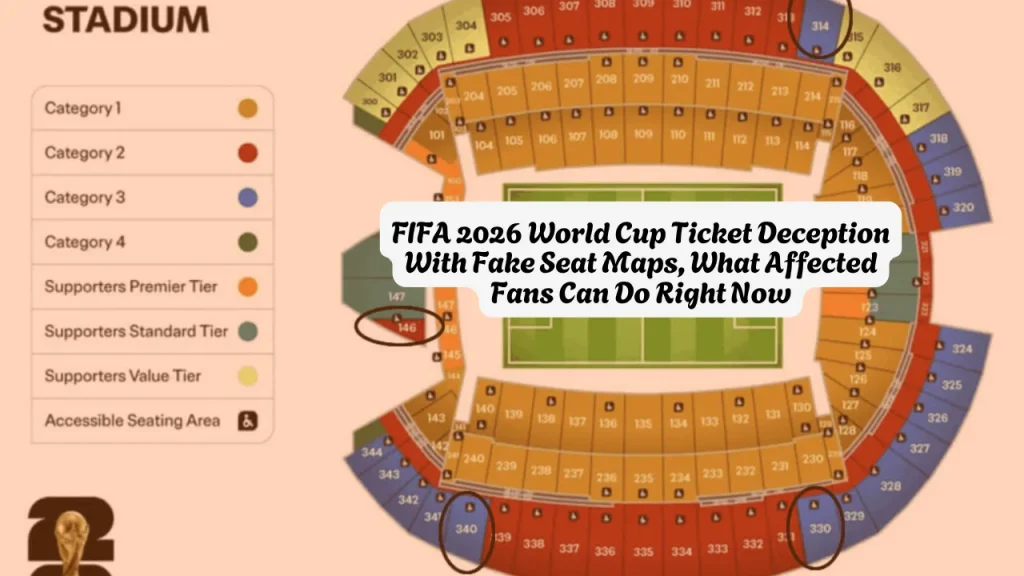
That legal fine print has done little to calm the anger. Some fans who thought they were getting Category 1 tickets discovered that the color-coded maps were altered along the way to annex sections that originally were in Category 2. The widespread suspicion among buyers is that prime sideline seats were never genuinely available through standard ticket sales — and were reserved all along for corporate hospitality packages and sponsors.
Who Is Affected and Do You Have a Potential Claim?
You may be affected if all of the following apply to you:
- You purchased tickets to a 2026 FIFA World Cup match through FIFA’s official ticketing platform
- You purchased Category 1 or Category 2 tickets — the higher-priced tiers
- You relied on FIFA’s stadium seat maps when deciding which ticket category to buy
- FIFA later assigned you seats in locations that differed from what the map showed at the time of purchase
- The seats you received were in corners, behind goals, upper sections, or areas you consider far less desirable than what the map suggested
- You believe the seats you actually received are worth significantly less than what you paid
Potential legal claims under investigation include economic loss, false or deceptive advertising, and violation of consumer protection laws.
What Are Fans Saying?
The backlash online has been swift and widespread. One fan identified only as Nick told The Athletic: “It’s just hard to not feel scammed and/or bamboozled,” and said he is considering a class action suit.
One supporter wrote online: “Hope someone has the smarts to sue them. If they’re selling front row now they shouldn’t have included front rows in the seat maps. Even if FIFA states it’s just guidance — how can it be legal to advertise the possibility of front row tickets when it was impossible for any random draw Category 1 fan to get a front row ticket?”
Another buyer put it even more bluntly, calling the situation a swindle and saying they felt defrauded. The pattern of complaints is consistent: fans paid top-tier prices with a reasonable expectation of top-tier seating, and many feel that expectation was never realistic from the start.
What Can You Do Right Now?
If you believe FIFA misled you when you purchased your 2026 World Cup tickets, here are the concrete steps you can take today.
- Document everything — Save screenshots of the seat maps as they appeared when you purchased your tickets, your purchase confirmation, the category you paid for, and the seat assignment you ultimately received
- Compare your seat to the original map — Note specifically whether your assigned section fell outside what Category 1 or Category 2 indicated at the time of sale
- Contact the investigating law firm — Migliaccio & Rathod LLP is actively collecting information from affected fans at classlawdc.com or by calling (202) 470-3520. There is no cost to contact them or share your experience
- File a consumer complaint — You can file a complaint with the Federal Trade Commission (FTC) at ftc.gov/complaint and with your state attorney general’s consumer protection office
- Contact your credit card company — If you believe you did not receive what you paid for, ask your card issuer about a chargeback or dispute. Act quickly, as most card issuers have time limits on disputes
- Monitor this case — No lawsuit has been filed yet. Check back as this investigation develops, as a formal class action could follow
Note: Consulting a lawyer is free at the investigation stage and carries no obligation.
Key Dates & Milestones
| Milestone | Date |
| FIFA 2026 World Cup Ticket Sales Begin | TBD (prior to 2026) |
| Seat Assignments Issued to Buyers | TBD |
| Investigation Opened by Migliaccio & Rathod LLP | April 9, 2026 |
| Lawsuit Filed | Not yet filed |
| Class Certification | TBD |
| Settlement or Trial | TBD |
Frequently Asked Questions
Is there a class action lawsuit against FIFA over 2026 World Cup tickets?
Not yet. As of April 2026, no lawsuit has been filed in court. Migliaccio & Rathod LLP opened a formal investigation and is gathering information from affected fans. A class action could follow if the investigation supports it.
Do I need a lawyer to report what happened to me?
No. You can file a consumer complaint directly with the FTC at ftc.gov/complaint or contact your state attorney general’s office at no cost. If you want to explore legal options, contacting the investigating law firm is also free and carries no obligation.
What does FIFA say about the seat map complaints?
FIFA states that its stadium maps were intended as a general guide only and that exact seat locations were never guaranteed. Its ticket terms and conditions give FIFA the right to assign or change seats within the same category or a comparable one.
When will I receive a payment or refund?
No settlement exists yet, so there is no payment timeline. If a class action lawsuit is filed and eventually settled, eligible buyers would receive notice at that time. This process typically takes one to several years.
Will a potential settlement payment affect my taxes?
Possibly. Payments from consumer protection settlements can be taxable depending on how they are classified. Consult a tax professional once any settlement is finalized.
What consumer protection laws might apply to my situation?
Depending on where you live, potential claims could fall under the FTC Act, your state’s consumer protection or unfair and deceptive acts and practices (UDAP) laws, or false advertising statutes. These laws generally prohibit misleading representations made to consumers when they make a purchase.
What if FIFA’s fine print says the maps were just a guide — does that mean I have no case?
Not necessarily. Disclaimers in terms and conditions do not automatically eliminate legal liability if the overall marketing of a product is found to be misleading. Whether those disclaimers hold up is exactly what courts evaluate in consumer protection cases. An attorney can assess your specific situation.
Last Updated: April 10, 2026
Disclaimer: This article is for informational purposes only and does not constitute legal advice. Legal claims and outcomes depend on specific facts and applicable law. For advice regarding a particular situation, consult a qualified attorney.
About the Author
Israr Ahmad is a legal content researcher with 4+ years of experience covering class action settlements and consumer rights cases. He has researched and published coverage of 2,500+ settlements using verified court records, settlement administrator filings, and government sources. Learn more about Israr.