
$65 Million DuPont Ohio PFAS Settlement, Which Communities Get Help and What You Can Still Claim
Ohio is distributing $65,000,000 in settlement money from a lawsuit against DuPont over PFAS chemical contamination of the Ohio River and surrounding communities. Governor Mike DeWine announced the funding on April 6, 2026, following years of legal appeals that delayed the payout. The money goes directly to drinking water infrastructure in six Ohio counties — not to individual residents. However, if you live in the affected area and developed a serious illness linked to PFAS exposure, separate personal injury claims may still be available to you.
Quick Facts
| Field | Detail |
| Settlement Amount | $65,000,000 (portion of $110M total Ohio settlement) |
| Who Settled | DuPont, Chemours, and Corteva with the State of Ohio |
| Original Lawsuit Filed | 2018 by then-Ohio AG Mike DeWine |
| Settlement Reached | December 2023 |
| Funds Released | April 6, 2026 |
| Counties Receiving Funds | Belmont, Gallia, Lawrence, Meigs, Morgan, Washington |
| Individual Claims Available? | Yes — separate personal injury pathway exists |
| Chemical at Issue | PFOA (perfluorooctanoic acid) — a type of PFAS “forever chemical” |
Where Things Stand Right Now
- The Ohio Controlling Board granted final approval on April 6, 2026, releasing the $65,000,000 after years of delays caused by legal appeals.
- Ohio EPA Director John Logue confirmed the agency already identified shovel-ready water infrastructure projects across the six affected counties.
- Individual Ohio residents who developed health conditions linked to PFOA exposure may still pursue personal injury claims through separate legal channels.
What Did DuPont Do and Why Did Ohio Sue?
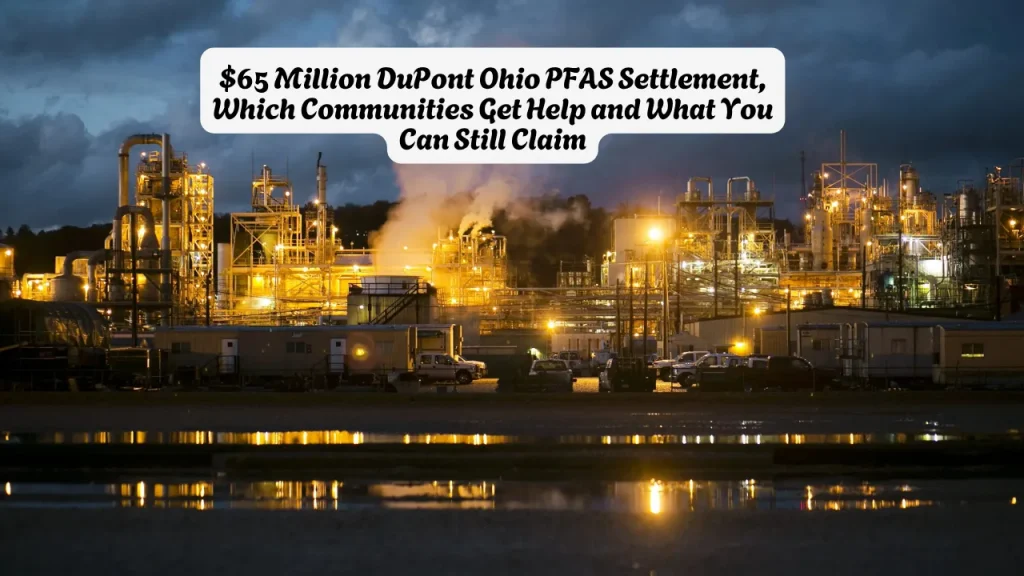
DuPont operated a chemical manufacturing facility called Washington Works in Parkersburg, West Virginia — just across the border from southeastern Ohio. From the 1950s until 2013, DuPont manufactured Teflon products using PFOA, which persists in water and soil and resists the typical environmental degradation process.
Ohio alleged that over six decades, DuPont released at least 500,000 pounds of PFOA into the Ohio River and the air, causing significant damage to human health and the environment. The contamination spread far beyond the plant’s fence line. A 2017 study indicated PFOA concentrations downstream from the DuPont plant were found as far as 413 miles away, resulting in higher-than-normal levels of PFOA in residents’ bloodstreams — mainly through drinking water.
The complaint alleged that DuPont intentionally concealed the dangers of PFOA from governmental entities and the public in order to protect its profits and avoid responsibility for resulting injuries. In 2018, then-Attorney General Mike DeWine made Ohio the first state in the nation to take DuPont to court over PFOA contamination. The case settled in December 2023 for a total of $110,000,000, with $65,000,000 specifically allocated for environmental restoration of communities near the Ohio River.
Related article: 15M Volkswagen Emissions Settlement, How Connecticut Is Spending $15 Million and What It Means for You June 11 Is Deadline
What Is PFOA and Why Should You Be Concerned?
PFOA — also called C8 — is a synthetic chemical in the PFAS family, commonly referred to as “forever chemicals” because they do not break down naturally in the environment or in the human body. PFOA has been connected to kidney and testicular cancer, thyroid disease, low birth weight, and high cholesterol.
The name “forever chemical” is not an exaggeration. Once PFOA enters your drinking water, your soil, or your bloodstream, it accumulates and stays. Residents near the Ohio River in southeastern Ohio were drinking PFAS-contaminated water for decades before the full extent of the danger became public knowledge.
Which Ohio Communities Receive the $65 Million?
The settlement money funds drinking water infrastructure improvements — not direct cash payments to residents. The $65 million will fund projects that develop new drinking water sources, connect smaller water systems to larger regional systems, install treatment infrastructure to remove PFAS from public water systems, and connect private wells with PFAS detections to nearby public water systems.
The six counties receiving funds are Belmont, Gallia, Lawrence, Meigs, Morgan, and Washington. Specific confirmed projects include:
- $5,000,000 to Gallipolis (Gallia County) — adds PFAS treatment to the existing water treatment plant, benefiting approximately 7,134 people
- $5,500,000 to Gallia Rural Water (Gallia County) — adds PFAS treatment to the existing plant, benefiting approximately 21,000 people
- $5,500,000 to South Point (Lawrence County) — PFAS water treatment improvements
Many of the projects are expected to be fully funded through the settlement, helping communities address contamination without additional costs to local utilities.
Can Individual Residents Still File a Personal Injury Claim?
Yes — and this is the most important point for affected residents to understand.
The $65 million going to Ohio counties covers environmental restoration and water infrastructure. It does not compensate individual people for personal health harm caused by PFOA exposure. That is a separate legal pathway entirely.
You may have a personal injury claim if:
- You lived or worked near the DuPont Washington Works facility or along the Ohio River in southeastern Ohio
- You consumed contaminated drinking water from a private well or public system in Belmont, Gallia, Lawrence, Meigs, Morgan, or Washington counties
- You were diagnosed with a PFOA-linked condition, including kidney cancer, testicular cancer, thyroid disease, ulcerative colitis, or high cholesterol
- Your exposure occurred while DuPont operated or previously operated the Washington Works facility (1950s–2013)
In 2017, DuPont and Chemours agreed to settle approximately 3,500 personal injury lawsuits over illnesses linked to PFOA pollution for $671,000,000 — including more than 1,300 claims of thyroid disease, 270 claims of kidney or testicular cancer, and around 30 wrongful death claims. Additional personal injury litigation has continued since then. If you have not yet pursued a claim and believe you were harmed, consult a personal injury attorney who handles PFAS cases as soon as possible, as statute of limitations deadlines vary by state.
Key Dates & Timeline
| Milestone | Date |
| DuPont Begins Using PFOA at Washington Works | 1950s |
| DuPont Stops Using PFOA | 2013 |
| Ohio AG DeWine Files Lawsuit Against DuPont | February 2018 |
| DuPont/Chemours Personal Injury Settlement | 2017 ($671M) |
| Ohio $110M Settlement Reached | December 2023 |
| Legal Appeals Delay Payment | 2023–2026 |
| Ohio Controlling Board Final Approval | April 6, 2026 |
| $65M Distribution Announced | April 6, 2026 |
| Water Projects Begin | TBD — 2026 onward |
Frequently Asked Questions
Will I receive a personal check from this $65 million settlement?
No. This settlement money goes entirely to drinking water infrastructure projects in six Ohio counties. It funds treatment plants, new water sources, and well connections — not payments to individual residents. If you want personal compensation, that requires a separate personal injury claim.
Do I need a lawyer to pursue a personal injury claim against DuPont?
Yes, for a personal injury claim you should consult an attorney who handles PFAS or environmental contamination cases. These cases are complex, involve medical evidence, and are subject to strict filing deadlines. Initial consultations are typically free.
Is this settlement legitimate?
Yes. Ohio Governor Mike DeWine announced this settlement through an official state press release on April 6, 2026. The Ohio Controlling Board formally approved the release of funds the same day. The underlying lawsuit was filed in Washington County Common Pleas Court in 2018.
When will my community’s water actually be fixed?
Ohio EPA has identified shovel-ready projects in all six counties. Construction timelines will vary by project, but the state has prioritized projects that can begin quickly. Check with your local water authority or county officials for project-specific timelines.
What health conditions are linked to PFOA exposure?
Research has linked PFOA exposure to kidney cancer, testicular cancer, thyroid disease, ulcerative colitis, high cholesterol, and low birth weight in children. If you developed any of these conditions and lived in the affected area, speak with both your doctor and an attorney.
What if I have a private well — does this settlement help me?
Potentially yes. One use of the settlement funds is to connect private wells with PFAS detections to nearby public water systems. Contact your county water authority or Ohio EPA to find out whether your private well qualifies for connection assistance under the funded projects.
What are PFAS “forever chemicals” and are they still a danger?
PFAS chemicals are a large group of synthetic compounds, including PFOA, that do not break down in the environment or in the human body. DuPont stopped using PFOA in 2013, but contamination already in the soil, water, and bodies of affected residents persists indefinitely — hence the name “forever chemicals.”
Sources & References
- Ohio Governor’s Official Press Release — April 6, 2026
- DuPont Official Settlement Announcement — December 2023
Last Updated: April 10, 2026
Disclaimer: This article is for informational purposes only and does not constitute legal advice. Legal claims and outcomes depend on specific facts and applicable law. For advice regarding a particular situation, consult a qualified attorney.
About the Author
Israr Ahmad is a legal content researcher with 4+ years of experience covering class action settlements and consumer rights cases. He has researched and published coverage of 2,500+ settlements using verified court records, settlement administrator filings, and government sources. Learn more about Israr.