
FabFitFun Class Action Lawsuit, Did You Get a ‘Free Gift’ Email That Required a Purchase?
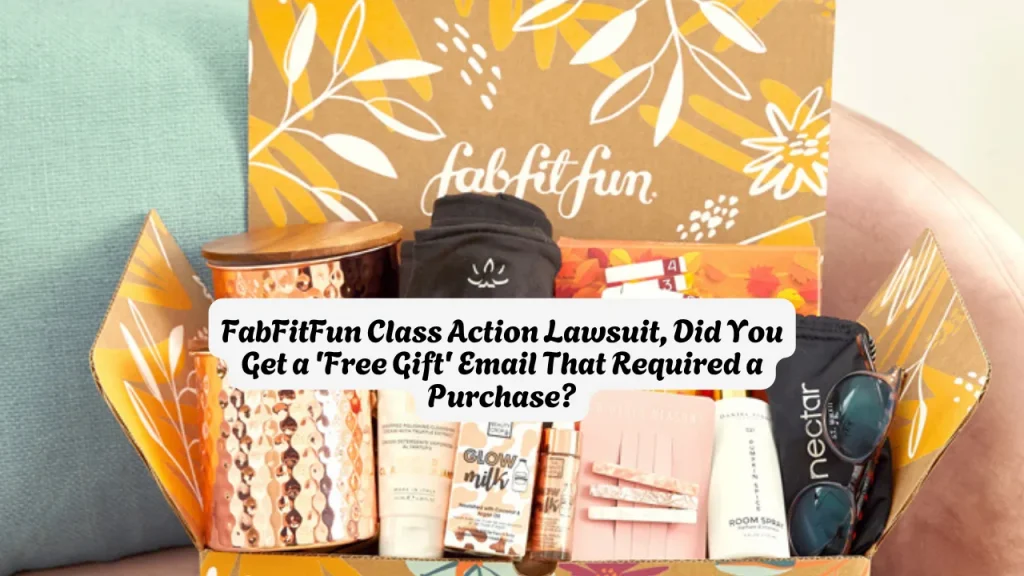
A class action lawsuit filed in Washington state court accuses FabFitFun Inc. of sending consumers marketing emails with subject lines promising free gifts — while hiding in the fine print that receiving the gift requires buying a subscription or product. The lawsuit claims these emails violate Washington’s anti-spam law and consumer protection statute. No settlement has been reached. This case is in early litigation.
Quick Facts
| Field | Detail |
| Defendant | FabFitFun Inc. |
| Plaintiff | Melissa Woytko |
| What Is Alleged | Sending commercial emails with misleading subject lines that promise “free” gifts requiring a purchase to obtain |
| Laws Cited | Washington Commercial Electronic Mail Act (CEMA); Washington Consumer Protection Act (CPA) |
| Who May Be Affected | Washington state residents who received commercial emails from FabFitFun containing misleading “free” offers |
| Court | Superior Court of the State of Washington, Snohomish County |
| Case Number | 25-2-11519-31 |
| Plaintiff’s Attorneys | Wright A. Noel of Carson Noel PLLC; L. Timothy Fisher, Julia K. Venditti and Joshua B. Glatt of Bursor & Fisher P.A. |
| Settlement | None — no claim form available at this time |
Where This Case Stands
- This lawsuit is in early litigation. No hearing dates, class certification schedule, or settlement discussions have been publicly announced.
- FabFitFun has not filed a public response to the complaint.
- No claim form exists. Washington residents cannot file for compensation at this time. This article will be updated if a settlement is reached.
What Is FabFitFun?
FabFitFun is a direct-to-consumer subscription company founded in 2010 and headquartered in Los Angeles. The company is best known for its seasonal curated boxes, which ship four times a year and typically contain six to eight full-size products across beauty, wellness, fashion, fitness, and home categories. The company markets itself as a lifestyle brand and has grown to over one million subscribers across the United States and Canada.
Subscriptions currently cost $219.99 per year for the annual plan (four boxes) or $49.99 per quarter for the seasonal plan. FabFitFun sends marketing emails to a large subscriber and prospective subscriber base — a practice that sits at the heart of the lawsuit filed against it.
Related article: $1.6M Mubi Subscription Auto-Renewal Settlement, Are You Eligible to Claim? Deadline is June 9, 2026
What Exactly Does the Lawsuit Allege?
Plaintiff Melissa Woytko filed the class action complaint in Washington state court, alleging that FabFitFun’s marketing emails routinely use subject lines that promise consumers something for free — when the actual offer buried inside the email requires paying for a subscription or product first.
The complaint gives a specific example. Woytko says she received an email from FabFitFun with the subject line: “Don’t Wait! Get a FREE 2nd Winter Box Before It’s Gone!” When she opened the email and read the fine print, she discovered the “free” second box was only available to consumers who first signed up for an annual membership. The gift was never free — it was conditional on a paid purchase.
The lawsuit further claims FabFitFun’s emails deliberately engineered a false sense of urgency to pressure consumers into acting quickly without reading the full terms. Woytko says she received multiple emails warning her that this was her “last call” to claim the free box — language the complaint characterizes as a calculated tactic to get consumers to click before they noticed the catch.
According to the complaint, FabFitFun sends thousands of these commercial emails to Washington residents every single day — making the potential scope of the violation substantial given that each email carrying a misleading subject line counts as a separate violation under Washington law.
What Law Did FabFitFun Allegedly Break?
Washington State’s Commercial Electronic Mail Act, known as CEMA, has been on the books since 1998. It prohibits sending Washington residents commercial emails that contain false or misleading information in the subject line. The law is straightforward: if the subject line of a marketing email says something that isn’t true — or creates a materially false impression about what the email contains — that is a violation.
CEMA’s scope matters here. The Washington Supreme Court clarified in 2025, in Brown v. Old Navy, that CEMA’s prohibition is not narrow. It covers any materially false or misleading statement in a subject line — including misleading urgency claims, inaccurate promotional offers, and conditional “free” offers framed as unconditional ones.
Federal courts in Washington have also confirmed that the federal CAN-SPAM Act does not override CEMA. A January 2026 ruling by a federal judge in the Western District of Washington held that Washington state’s stricter email standards apply independently of federal law — removing one of the main defenses companies in these lawsuits have tried to use.
The financial exposure is real. CEMA sets statutory damages of $500 per violation — and receiving a single unlawful email is itself the injury, with no need to prove actual financial harm. CEMA violations are also automatically treated as violations of Washington’s Consumer Protection Act, which allows for treble damages — meaning courts can multiply the award by up to three times the base amount for willful violations.
For a company sending thousands of emails per day to Washington residents, the math adds up fast.
Who May Be Affected?
The lawsuit seeks to represent a class of Washington state residents who received one or more commercial emails from FabFitFun stating or implying an offer of a free membership, free gift, free product, or free service — where that offer was only available upon purchasing a subscription or product from the company.
No specific date range for the class period has been publicly confirmed. The exact class definition and time period will be determined by the court if the case proceeds to class certification.
You do not need to take any action right now. If a settlement is eventually reached, Washington residents who qualify will typically receive direct notice and have the opportunity to file a claim. This article will be updated with claim details if that happens.
The Bigger Picture: A Wave of CEMA Lawsuits Against Retailers
The FabFitFun lawsuit is part of a much larger surge of CEMA-based class actions targeting retailers and consumer brands over misleading email subject lines. Washington’s law has become one of the most frequently invoked email marketing statutes in the country, with plaintiffs’ attorneys filing similar complaints against dozens of companies in recent months.
Brands recently hit with comparable lawsuits under CEMA include Kylie Cosmetics, L’Oreal, Ulta Beauty, Fabletics, Crocs, Vistaprint, Dooney & Bourke, Cotton On, and Overstock — all accused of using subject lines that overstated discounts, fabricated deadlines, or promised “free” items that were not actually free. The Béis travel brand alone faced three separate CEMA class actions in early 2026.
The same law firm behind the FabFitFun lawsuit — Bursor & Fisher P.A. — has been actively litigating CEMA cases and was also the firm that brought the Empire Hotel drip pricing class action filed in February 2026. That firm’s involvement signals coordinated, well-resourced enforcement in this area.
Retailers in every consumer category now face meaningful legal risk from their standard email marketing practices — particularly subject lines that imply unconditional discounts or gifts when conditions apply.
Frequently Asked Questions
Is there a settlement I can claim from the FabFitFun lawsuit?
No. This lawsuit was recently filed in Washington state court and is in early litigation. No settlement has been proposed or approved, and no claim form exists at this time. If a class-wide settlement is reached, this article will be updated with instructions for how to file.
What is CEMA and why does it matter for this lawsuit?
CEMA — Washington’s Commercial Electronic Mail Act — prohibits sending Washington residents commercial emails with false or misleading subject lines. Each unlawful email is its own violation carrying $500 in statutory damages. You don’t need to prove you lost money; receiving the email is sufficient to establish harm under the law.
I live outside of Washington. Does this lawsuit affect me?
The current lawsuit covers Washington state residents only. However, if you live in another state and received similar “free gift” emails from FabFitFun that required a purchase, your state may have its own consumer protection laws that could apply. Consult a consumer protection attorney in your state if you want to explore that.
Do I need a lawyer to participate if a settlement is reached?
No. In most class action settlements, class members can file claims directly without hiring an attorney. If a settlement is approved, class members typically receive direct notice by email or mail explaining how to file.
What does the lawsuit mean for my current FabFitFun subscription?
Nothing changes about your subscription as a result of this filing. This is a lawsuit about how FabFitFun markets to consumers — not about the subscription terms or product quality. Your subscription continues under the same terms.
What damages are the plaintiffs seeking?
The complaint requests statutory damages under CEMA ($500 per violation), treble damages under the Consumer Protection Act for willful violations, declaratory relief establishing that FabFitFun’s email practices are unlawful, injunctive relief requiring FabFitFun to change its subject line practices, and attorneys’ fees and costs.
Can I monitor this case myself?
Yes. The case — Woytko v. FabFitFun Inc., Case No. 25-2-11519-31 — is filed in the Superior Court of Washington for Snohomish County. Washington court records are publicly accessible through the Washington Courts Case Search portal at dockets.courts.wa.gov.
Last Updated: April 10, 2026
Disclaimer: This article is for informational purposes only and does not constitute legal advice. Legal claims and outcomes depend on specific facts and applicable law. For advice regarding a particular situation, consult a qualified attorney.
About the Author
Israr Ahmad is a legal content researcher with 4+ years of experience covering class action settlements and consumer rights cases. He has researched and published coverage of 2,500+ settlements using verified court records, settlement administrator filings, and government sources. Learn more about Israr.