
Wisconsin Sheriff Dale Schmidt Sues Illinois Woman and Cook County Commissioner for $1 Million Over Alleged ICE Detention Hoax
Dodge County Sheriff Dale Schmidt filed a federal defamation lawsuit on April 10, 2026, against Skokie, Illinois resident Sundas “Sunny” Naqvi and Cook County Commissioner Kevin Morrison, alleging they publicly spread false claims that Naqvi was illegally detained at the Dodge County Jail in Wisconsin by federal immigration authorities. Schmidt is seeking over $1 million in damages per defendant, plus punitive damages, attorneys’ fees, and injunctive relief. The case — captioned Schmidt v. Naqvi — is pending in the U.S. District Court for the Eastern District of Wisconsin before Judge Brett Ludwig.
Quick Case Snapshot
| Detail | Information |
| Plaintiff | Dale Schmidt, Dodge County Sheriff (in his individual capacity) |
| Defendants | Sundas “Sunny” Naqvi; Cook County Commissioner Kevin Morrison; 10 unnamed “John Doe” defendants |
| Court | U.S. District Court, Eastern District of Wisconsin |
| Case Name | Schmidt v. Naqvi (E.D. Wis.) |
| Case Number | Not yet publicly confirmed in available filings |
| Filing Date | April 10, 2026 |
| Judge | Hon. Brett Ludwig |
| Claims Alleged | Defamation (civil); reputational harm to a public official |
| Damages Sought | Over $1 million per defendant in compensatory damages; punitive damages; attorneys’ fees; injunctive relief; jury trial requested |
| Current Status | Active — expedited discovery granted April 13, 2026; no defendants have yet filed formal responses |
What Started It: A Viral Detention Story
In early March 2026, Naqvi, 28, of Skokie, Illinois, claimed that she and her coworkers had been detained by federal immigration authorities at O’Hare International Airport in Chicago after returning from a work trip abroad. Naqvi’s family and Morrison said she had been taken to the Broadview Detention Facility and was then transferred across state lines to the Dodge County Jail, then released without aid or transportation in the pre-dawn hours.
Morrison showed what appeared to be screenshots of time-stamped location maps with Naqvi’s phone showing her at the Broadview Detention Center in Chicago and later at the Dodge County detention center in Wisconsin. The story drew national and international coverage, fueling protests and generating significant public outcry during a period of heightened concern over immigration enforcement.
The Department of Homeland Security confirmed Naqvi was pulled aside for a secondary screening on March 5 after returning from Turkey “based on law enforcement checks.” But the government’s account diverged sharply from there. DHS stated that surveillance footage from O’Hare clearly showed her entering secondary inspection at 10:46 a.m. and leaving the secondary area at 11:42 a.m., directly contradicting her claim of spending 43 hours in custody.
What the Lawsuit Alleges
According to the complaint, Schmidt maintains that Naqvi was never booked or detained at the Dodge County Jail. He alleges that Naqvi arrived at O’Hare on March 5, 2026, checked into a Hampton Inn & Suites in Rosemont, Illinois, and in the early morning hours of March 7, 2026, was dropped off at a Holiday Inn Hotel in Beaver Dam, Wisconsin.
The complaint further alleges that on or about March 8, 2026, Morrison — then a candidate for the U.S. House of Representatives — stated during a press conference that Naqvi and five other individuals were transported from Illinois to Wisconsin by immigration agents, and made allegations of an illegal detention of a U.S. citizen and a “cover-up” by the Dodge County Sheriff’s Office.
Related article: Venmo Lawsuit Settlement 2026, Are You Eligible to Claim?
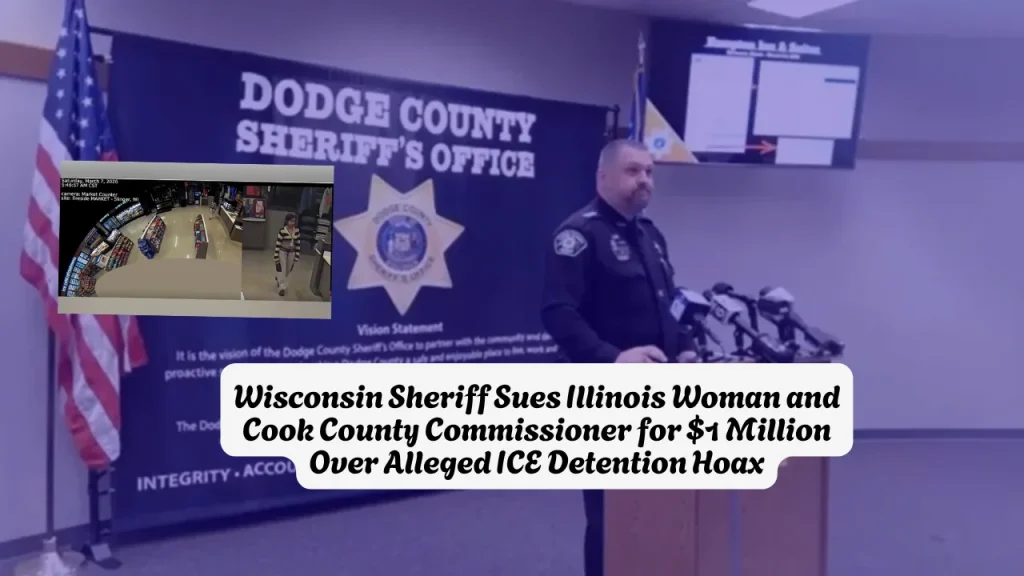
The physical evidence the sheriff’s office presented at its April 10 press conference is detailed in the complaint. Security footage shows Naqvi and a companion at a Slinger gas station around 5:30 a.m. on March 7 — she was wearing the same striped sweater as in a family “reunion” photo Morrison posted to Facebook. Flock cameras, which capture license plates, tracked the route toward Beaver Dam, and surveillance video shows Naqvi arriving at the hotel shortly before her sister picked her up.
Investigators also pointed to WhatsApp messages from the same timeframe showing Naqvi actively communicating from a hotel, discussing food, work, and daily activities — at one point asking to use a card to order food. Schmidt noted pointedly that no spa services exist at either the Broadview facility or the Dodge County Jail.
Schmidt characterized the initial claims as “coordinated messaging designed to generate outrage and media attention,” and stated there is “no record of booking, there is no record of detention, there is no record of release, no contact with the individual, no transfer to any federal agency.”
The lawsuit also names 10 unnamed “John Doe” defendants — unknown people living outside Wisconsin who are accused of participating in the publication or republication of the false claims, whose real names will be added when identified.
The Defendants’ Responses
Neither Naqvi nor Morrison has filed a formal response to the complaint in court. Morrison stated he is aware of the lawsuit but said he cannot comment on pending litigation. The Dodge County Sheriff’s Office also contacted the attorney who represented Naqvi at the original press conference, but no comment was forthcoming from that office, and the attorney confirmed he is not representing her in this lawsuit.
Why This Case Is Legally Unusual
Defamation lawsuits brought by law enforcement officials against private individuals are rare, and those involving elected public officials face a higher legal bar. Wisconsin attorney Julius Kim noted the case appears to be the first time a county sheriff, in their individual capacity, has filed a defamation suit over claims made against them. He explained that because Schmidt is a public figure, he carries an added burden: proving the defendants acted with “actual malice” — meaning they knew the statements were false or acted with reckless disregard for the truth.
That standard comes from the landmark U.S. Supreme Court decision New York Times Co. v. Sullivan (1964), which requires public officials alleging defamation to clear a higher evidentiary bar than private citizens. Schmidt’s lawsuit will need to demonstrate not just that the statements were false, but that Morrison and Naqvi either knew they were false or showed reckless disregard for whether they were true.
A federal judge has since ordered a trial to determine damages. The sheriff’s office also referred the criminal aspects of the case to the FBI and Illinois State Police, though no criminal charges have been filed to date.
What Happened in Court: Expedited Discovery Granted
On April 13, 2026, Judge Brett Ludwig granted Schmidt limited expedited discovery, authorizing subpoenas for Naqvi’s cellphone records and hotel surveillance footage to help verify her whereabouts during the period she claimed to be in immigration custody, and to identify the 10 “John Doe” defendants accused of republishing the claims. The judge’s ruling was procedural — it did not resolve the underlying merits of the case or make any finding about who is telling the truth.
Current Status and What Comes Next
As of April 19, 2026, the case is in its early stages. No answers or motions to dismiss have been filed by the defendants. The expedited discovery phase will focus on preserving and obtaining digital records — cellphone data, hotel logs, and surveillance footage — before they could be overwritten. Following discovery, the parties would likely face motions on the merits before any trial date is set.
Schmidt has said it is not really about the money but about accountability. Separately, a parallel criminal investigation remains open, with the matter referred to both the FBI and Illinois State Police, though no arrests have been announced.
Frequently Asked Questions
Who is suing whom in the Morrison-Naqvi lawsuit?
Dodge County Sheriff Dale Schmidt is the plaintiff. He is suing Sundas “Sunny” Naqvi, Cook County Commissioner Kevin Morrison, and 10 unnamed defendants for defamation in federal court in Wisconsin.
How much is the sheriff seeking in damages?
Schmidt is seeking over $1 million in compensatory damages from each named defendant, plus punitive damages, attorneys’ fees, and injunctive relief.
Has anyone been criminally charged?
No criminal charges have been filed. Schmidt has said Wisconsin law does not provide a criminal avenue to pursue in Dodge County. The matter has been referred to the FBI and Illinois State Police, whose investigations remain ongoing.
What is the biggest legal hurdle for Schmidt to win this case?
As an elected public official, Schmidt must prove “actual malice” — that the defendants knew their statements were false or acted with reckless disregard for the truth. That is a higher standard than what private citizens must meet in defamation cases.
Have Naqvi or Morrison responded to the lawsuit?
As of the latest reporting, neither has filed a formal legal response. Morrison has stated only that he cannot comment on pending litigation.
What evidence does the sheriff say proves the detention story was false?
The sheriff’s office presented hotel check-in records, surveillance video from a gas station and hotel, license plate reader data, WhatsApp messages sent from a hotel during the alleged custody period, and statements from a cooperating witness.
Last Updated: April 19, 2026
This article is for informational purposes only and does not constitute legal advice. Allegations contained in a civil complaint are not findings of fact. All parties are presumed innocent unless and until proven otherwise in a court of law.
About the Author
Israr Ahmad is a legal content researcher with 4+ years of experience covering class action settlements and consumer rights cases. He has researched and published coverage of 2,500+ settlements using verified court records, settlement administrator filings, and government sources. Learn more about Israr.