
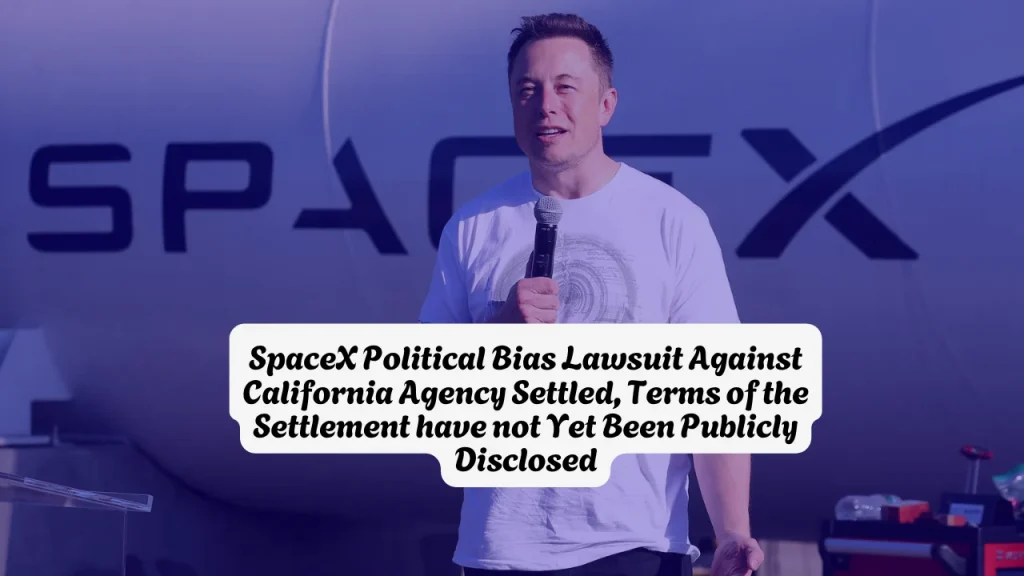
SpaceX Political Bias Lawsuit Against California Agency Settled, Terms of the Settlement have not Yet Been Publicly Disclosed
SpaceX and California Just Settled — But Terms Are Secret
SpaceX and the California Coastal Commission reached a conditional settlement on April 17, 2026, ending an 18-month lawsuit that accused the state agency of “naked political discrimination” against the company because of CEO Elon Musk’s political views. The deal was filed under seal in federal court. Terms will only become public if Judge Stanley Blumenfeld Jr. of the U.S. District Court for the Central District of California agrees to retain jurisdiction over the agreement. No money amount, no policy change, and no admission of wrongdoing has been disclosed.
Quick Facts Table
| Field | Detail |
| Case Name | Space Exploration Technologies Corp. v. California Coastal Commission |
| Case Number | C.D. Cal., No. 2:24-cv-08893 |
| Court | U.S. District Court, Central District of California |
| Judge | Hon. Stanley Blumenfeld Jr. |
| Settlement Executed | April 9, 2026 |
| Settlement Announced | April 17, 2026 |
| Settlement Amount | Confidential — filed under seal |
| Commission Admitted Liability? | No |
| SpaceX Admitted Wrongdoing? | N/A — plaintiff |
| Settlement Status | Conditional — requires court jurisdiction agreement |
| Terms Made Public? | Only if judge retains jurisdiction |
| SpaceX Attorney | Venable LLP |
| What Was Disputed | 14 additional annual rocket launches at Vandenberg Space Force Base |
Current Status & What Happens Next
- The parties executed the settlement agreement on April 9, 2026, and filed jointly to notify the court on April 17, 2026.
- The deal is sealed pending Judge Blumenfeld’s decision on whether to retain jurisdiction. If he agrees, the terms become public and the case is dismissed. If he declines, the agreement is void and litigation resumes.
- A spokesperson for the California Coastal Commission declined to comment until the settlement terms are made public. SpaceX did not respond to requests for comment.
What Is the SpaceX Lawsuit About?
In September 2024, the U.S. Space Force proposed increasing the number of annual SpaceX Falcon 9 rocket launches from Vandenberg Space Force Base — located on California’s Central Coast near Santa Barbara — from 36 to 50. SpaceX uses Vandenberg for both commercial launches, including its Starlink satellite missions, and national security launches in partnership with the U.S. government.
On October 10, 2024, the California Coastal Commission voted 6 to 4 against the proposal. The commission, which oversees land and water use along California’s more than 1,000 miles of coastline, asserted for the first time that SpaceX’s commercial launches required a state coastal development permit — a requirement the company says was never applied before.
SpaceX filed its lawsuit six days later, on October 16, 2024. The company alleged the commission’s vote had nothing to do with coastal resource protection and everything to do with the political views of Elon Musk. The 18-month legal dispute became one of the most politically charged regulatory cases in the aerospace industry.
What Did Commissioners Actually Say?
SpaceX built its case around specific statements made by commissioners during the October 10, 2024 public meeting. Those statements became the centerpiece of the litigation.
Commission Chair Caryl Hart said the concern with increased launches is “we’re dealing with a company … the head of which has aggressively injected himself into the presidential race and made it clear what his point of view is.”
Commissioner Gretchen Newsom — not related to California Governor Gavin Newsom — referenced Musk “hopping about the country, spewing and tweeting political falsehoods and attacking FEMA while claiming his desire to help the hurricane victims with free Starlink access to the internet.”
Related article: Swae Lee Paternity Lawsuit, Swae Lee Reaches Settlement With Woman Who Alleged He Was the Father of Her Child
SpaceX also cited statements by Commissioners Mike Wilson and Justin Cummings, characterizing the full record as “overt, and shocking, political bias.” The company further alleged that commissioners referenced SpaceX’s employment practices and the use of Starlink in global geopolitical conflicts — concerns unrelated to coastal environmental impact.
As additional evidence, SpaceX noted that the commission had recently approved up to 60 launches per year from a different operator at the same Vandenberg base — without the same scrutiny — while blocking SpaceX’s request to go from 36 to 50.
What Did the Court Decide Before the Settlement?
The case went through several key rulings before both sides agreed to settle.
March 2025 — Initial Dismissal with Leave to Amend. Judge Blumenfeld initially dismissed SpaceX’s complaint but expressed concern about the commissioners’ statements. “The concern is legitimate when a local body injects politics in its decision-making,” the judge said during the hearing. He allowed SpaceX to amend its complaint to better specify the harm it suffered.
July 2025 — Partial Survival. After SpaceX filed an amended complaint, the judge declined to dismiss the case entirely. He threw out certain claims — including First Amendment violations against commissioners in their individual capacities, due to lack of standing — but preserved counts against commissioners in their official capacities alleging biased regulatory conduct. The judge found SpaceX had presented sufficient evidence to show the commission’s vote may have targeted the company over its CEO’s political views, even if that evidence was not yet “compelling.”
Discovery Phase — Late 2025. Following the July 2025 ruling, the case entered discovery. Both sides began producing evidence and the judge set scheduling deadlines. Settlement talks apparently intensified during this period, with the parties reaching a written agreement by April 9, 2026.
Who Is Affected by This Case?
This is not a class action. There is no claim form for the public. The dispute is a direct corporate litigation between SpaceX and a California state regulatory agency.
The practical impact, however, extends beyond the two parties. The outcome affects:
SpaceX and its launch operations. The company’s ability to scale commercial and national security launches from Vandenberg directly depends on how many flights per year regulators permit. The difference between 36 and 50 annual launches represents meaningful commercial capacity for Starlink and other payloads.
The California Coastal Commission’s authority. The case raised unresolved questions about whether a state coastal agency has jurisdiction over federally-hosted commercial space launches at a U.S. military base. That legal question was not fully adjudicated before settlement — meaning it could resurface in future disputes.
Other aerospace companies. Any company launching from Vandenberg or similar coastal installations faces the same jurisdictional uncertainty. The settlement, because it is confidential, does not establish binding legal precedent either way.
The broader question of regulatory political bias. Federal courts have not established a clear standard for when a regulatory agency’s stated political concerns cross the line into unconstitutional viewpoint discrimination. This case was shaping up to test that question — the settlement means it will not.
Important Dates & Timeline
| Milestone | Date |
| Space Force proposes 36→50 launch increase | September 2024 |
| Coastal Commission votes 6-4 against | October 10, 2024 |
| SpaceX files lawsuit | October 16, 2024 |
| Commission files motion to dismiss | January 2025 |
| Judge dismisses complaint with leave to amend | March 2025 |
| SpaceX files amended complaint | Spring 2025 |
| Judge allows case to proceed (partial) | July 2025 |
| Case enters discovery phase | Late 2025 |
| Settlement agreement executed | April 9, 2026 |
| Joint settlement filing in court | April 17, 2026 |
| Judge rules on jurisdiction / unsealing | TBD |
| Case dismissed (if approved) | TBD |
Frequently Asked Questions
Can I file a claim against the California Coastal Commission or SpaceX?
No. This is a direct lawsuit between two institutional parties — SpaceX and a California state agency. There is no class action, no settlement fund, and no claim form open to the public. Members of the public are not eligible for any payment from this case.
Is the SpaceX settlement legitimate?
Yes. The case is filed in the U.S. District Court for the Central District of California, Case No. 2:24-cv-08893, and the joint settlement notice was filed April 17, 2026, by both parties. Judge Stanley Blumenfeld Jr. presides over the case and must approve the jurisdictional terms before the settlement takes effect.
When will the settlement terms become public?
Only if Judge Blumenfeld agrees to retain jurisdiction over the agreement. If he does, the commission has stated the terms will be unsealed and made public. If he declines, the agreement becomes void and litigation resumes. No date for the judge’s ruling has been announced.
Did the Coastal Commission admit it acted out of political bias?
No. The commission has not admitted any liability or wrongdoing. Both parties entered a confidential agreement, the terms of which remain unknown. The commission has consistently maintained it followed proper regulatory authority under California’s Coastal Zone Management Act.
What happens if the judge rejects the settlement agreement?
The settlement becomes void and the case resumes. SpaceX would continue its lawsuit against the commission, and the parties would return to the discovery schedule set before the settlement was announced. The case would likely proceed toward trial in 2027 or later.
Does this settlement set a legal precedent?
No. Because the case settled before trial, the court issued no final ruling on the core constitutional question — whether a state regulatory agency violated a company’s First Amendment rights by factoring in its CEO’s political views. The law in this area remains unsettled. Future cases involving similar allegations will need to be litigated from scratch.
Why does this case matter beyond SpaceX?
The lawsuit raised a significant jurisdictional question: does a state coastal commission have authority to regulate launches from a federal military installation? That question was never fully decided. It could affect any aerospace company using Vandenberg Space Force Base or similar coastal federal facilities. The confidential settlement means this legal gap remains unresolved.
What is the California Coastal Commission?
The California Coastal Commission is a state agency that oversees land and water use along California’s roughly 1,100 miles of coastline. It was established under the California Coastal Act of 1976 and has authority to issue coastal development permits. Its commissioners are appointed by the governor and state legislature, not elected. The commission approved up to 60 launches per year from another operator at Vandenberg — a fact SpaceX cited as evidence of selective treatment.
Sources & References
- Space Exploration Technologies Corp. v. California Coastal Commission, C.D. Cal., No. 2:24-cv-08893 (PACER docket)
- Bloomberg Law, Isaiah Poritz — “SpaceX Settles Political Bias Lawsuit Against California Agency,” April 17, 2026
- Santa Maria Times / Lompoc Record — Settlement filing coverage, April 16–17, 2026
Last Updated: April 20, 2026
Disclaimer: This article is for informational purposes only and does not constitute legal advice. Legal claims and outcomes depend on specific facts and applicable law. For advice regarding a particular situation, consult a qualified attorney.
About the Author
Israr Ahmad is a legal content researcher with 4+ years of experience covering class action settlements and consumer rights cases. He has researched and published coverage of 2,500+ settlements using verified court records, settlement administrator filings, and government sources. Learn more about Israr.