
Can a President Refuse to Leave Office in 2029? What the 20th Amendment and Succession Laws Say
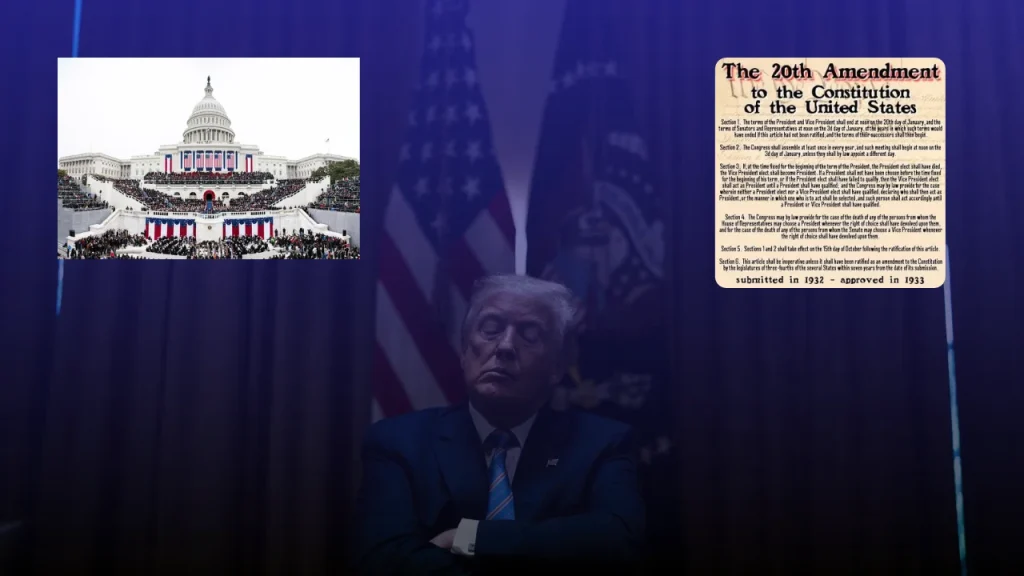
No. Under the 20th Amendment, the current presidential term ends automatically at noon on January 20, 2029 (Eastern Time in Washington, D.C.). Refusing to concede, disputing an election, skipping the inauguration, declaring an emergency or refusing to leave the White House would not legally extend a president’s term.
The constitutional transfer of authority is automatic. How a refusal to physically vacate the White House would be handled is a separate practical and legal matter.
If a qualified successor has been chosen, that person’s term begins when the old one ends. If the election is unresolved or the president-elect cannot qualify, the 20th Amendment and federal succession law provide for an acting president. They do not extend the outgoing president’s term.
Donald Trump won in 2016 and 2024, and the 22nd Amendment bars a third election under the current Constitution. Refusing to leave office is a different question from eligibility to run again. There is no verified plan by Trump or anyone else to refuse to leave in 2029. This article explains the law for hypothetical scenarios.
Quick Facts
| Question | Legal answer |
| When does the current term end? | Noon, January 20, 2029 (20th Amendment, Section 1) |
| Can a president refuse to concede? | Yes, but it does not extend the term |
| Can an executive order extend the term? | No |
| Can a national emergency or war extend it? | No |
| Is an oath or ceremony needed for the old term to end? | No, the term ends at noon regardless |
| What if no president-elect has qualified? | A qualified vice president-elect acts as president |
| What if neither has qualified? | Presidential Succession Act, 3 U.S.C. § 19 |
| Does the outgoing vice president stay on? | No, the vice-presidential term also ends at noon |
| Can the Constitution be changed? | Yes, through Article V |
What the 20th Amendment Says
Section 1 provides that the terms of the President and Vice President “shall end at noon on the 20th day of January,” and that their successors’ terms “shall then begin.”
The Amendment was ratified on January 23, 1933. It moved the start of presidential terms from March 4 to January 20 to shorten the “lame duck” period after November elections.
Trump began his second term on January 20, 2025, so it expires at noon on January 20, 2029. That date falls on a Saturday. The deadline does not depend on:
- whether he attends an inauguration,
- whether he concedes,
- whether a successor has yet taken the oath, or
- whether he signs a resignation letter.
The oath does not transfer power. The clock does. Article II requires a new president to take the oath before exercising the powers of the office, but the outgoing term ends at noon either way.
Source: National Archives, 20th Amendment
What If a President Physically Refuses to Leave the White House?
Occupying a building is not the same as holding constitutional authority. After noon, a former president has no power to issue lawful presidential orders, and the executive branch answers to the lawful successor.
Two points need care:
- Legal authority transfers automatically. The military operates under the lawful constitutional chain of command, so orders from a former president would not carry presidential authority.
- Physical removal is a separate matter. The Constitution does not prescribe a procedure for removing someone who will not leave. The Secret Service protects current and certain former presidents (18 U.S.C. § 3056), but protection does not confer authority to remain president. Any enforcement action would involve separate legal and operational decisions, and it would be inaccurate to say the Secret Service would automatically arrest a former president at 12:01 p.m.
A former officeholder staying in a restricted federal building could raise other legal issues, such as federal restricted-grounds laws (for example 18 U.S.C. § 1752), and courts could be asked to resolve disputes. Whether any such statute would apply would depend on the facts.
What If a President Refuses to Concede?
Conceding is a political tradition, not a legal requirement. A refusal does not invalidate lawfully certified electoral votes. The process runs through state certification, Electoral College voting, congressional counting and, if needed, the courts, under Article II, the 12th and 20th Amendments and Title 3 of the U.S. Code.
If that process identifies a qualified president-elect, the new term begins at noon on January 20. Disagreeing with a result is not a mechanism for staying in office.
What If the Election Is Still Disputed on January 20, 2029?
Section 3 of the 20th Amendment covers a president-elect who has not been chosen or has failed to qualify. The outgoing president’s term is not extended in either case.
| Situation at noon, January 20, 2029 | Rule | Who holds executive power |
| President-elect and vice president-elect qualified | 20th Amendment, § 1 | The new president takes over at noon |
| President-elect dies before noon | 20th Amendment, § 3 | The vice president-elect becomes president |
| No president chosen, or president-elect fails to qualify, but vice president-elect qualified | 20th Amendment, § 3 | The vice president-elect acts as president until a president qualifies |
| Neither has qualified | 20th Amendment, § 3 and Presidential Succession Act, 3 U.S.C. § 19 | An eligible official named by statute acts as president |
Becoming president and temporarily acting as president are not legally identical.
Who Would Act as President If Neither Has Qualified?
Under 3 U.S.C. § 19, the Speaker of the House is first in line, then the President pro tempore of the Senate, then Cabinet officers. The Speaker must be eligible and must resign the Speakership and House seat before acting.
| Order | Office |
| 1 | Speaker of the House |
| 2 | President pro tempore of the Senate |
| 3 | Secretary of State |
| 4 | Secretary of the Treasury |
| 5 | Secretary of Defense |
| 6 | Attorney General |
| 7 onward | Other eligible Cabinet officers in statutory order |
These officials serve as an Acting President, not a newly elected one, and the arrangement can end when a president or vice president qualifies. Who will be Speaker in January 2029 is unknown, since the new Congress is seated on January 3, 2029.
Source: 3 U.S.C. § 19
Would JD Vance Automatically Become President?
No. Vance’s term also ends at noon on January 20, 2029, so he does not stay on because of a dispute or because Trump refuses to leave. Vance could become president earlier only if Trump died, resigned or was removed during the current term, which falls under the 25th Amendment. See If Trump Resigns or Is Removed, Does JD Vance Automatically Become President?
How the Electoral Count Reform Act of 2022 Helps
Congress passed the Electoral Count Reform Act in December 2022 (Public Law 117-328), amending Title 3 of the U.S. Code. Its main changes:
- Governors’ certification: A state’s certificate of ascertainment is due no later than six days before the electors meet, with expedited court review of certain disputes (3 U.S.C. § 5).
- Vice president’s role: The vice president’s job at the joint session is purely ministerial, with no power to accept, reject or delay electoral votes (3 U.S.C. § 15).
- Objections: Objecting to a state’s electoral votes now requires written support from at least one-fifth of the House and one-fifth of the Senate, and grounds for objection are limited by statute.
None of this gives an outgoing president power to pick the winner. Source: 3 U.S.C. § 15
What If No Candidate Wins an Electoral College Majority?
Under the 12th Amendment, the election goes to the House of Representatives as a contingent election. The House chooses among the top three electoral-vote recipients, each state delegation casts one vote, and a majority of states (currently 26) is needed. The Senate chooses the vice president from the top two vice-presidential candidates.
If the House has not chosen a president by January 20, the 20th Amendment’s acting-president rules apply. A contingent election cannot be used to extend the outgoing term.
Can a National Emergency, War or Martial Law Extend the Term?
No provision of the Constitution lets a president extend a four-year term by declaring an emergency, war or martial law. The National Emergencies Act (50 U.S.C. § 1601 et seq.) and the Insurrection Act (10 U.S.C. §§ 251–255) authorize specific actions when their conditions are met. They do not override the 20th Amendment.
The Congressional Research Service has noted that neither the Constitution nor Congress gives the president power to postpone a federal election. Election dates are set by federal and state law, and the end of the term is fixed by the Constitution. Changing it would take an amendment.
Does the 22nd Amendment Also Matter Here?
The two amendments do different jobs. The 22nd Amendment limits how many times someone can be elected president. The 20th Amendment fixes when a term ends. Even a president eligible for another election cannot stay past noon on January 20 without winning a new term or being lawfully placed in office under the succession rules.
Related reading: 22nd Amendment Explained: Can Trump Run in 2028? · Can the 22nd Amendment Be Repealed? · California AB 1539 and the 2028 Ballot
Are Impeachment or the 25th Amendment Needed to Remove a President After Noon?
No. Impeachment and the 25th Amendment deal with removing or sidelining a president during a term. An expired term ends automatically under the 20th Amendment. The absence of an impeachment conviction or 25th Amendment declaration gives a former president no basis to keep exercising power. See Can Democrats Remove Trump as President in 2027?
Does the New President Have to Be Sworn In at Exactly Noon?
Article II requires the oath before the new president exercises the powers of the office, but it need not be a public ceremony. Presidential oaths have been administered privately and in unusual circumstances. The 20th Amendment sets when the new term begins, so a delay in the oath does not extend the outgoing term. An outgoing president’s absence from the ceremony does not stop the new president from taking the oath.
Key Dates for the 2028–2029 Transition
| Date | Event |
| November 7, 2028 | Presidential election |
| December 18, 2028 | Electors meet in their states (first Monday after the second Wednesday in December) |
| January 3, 2029 | New Congress seated at noon |
| January 6, 2029 | Statutory date for the joint session to count electoral votes, unless changed by law |
| January 20, 2029, noon | Current presidential and vice-presidential terms end; new terms begin |
Congress can change certain statutory procedures. An ordinary law cannot override the constitutional January 20 endpoint.
Frequently Asked Questions
Can Trump refuse to leave the White House in 2029? He could physically refuse, but that would not extend his presidential authority. His term ends at noon on January 20, 2029.
What happens at 12:01 p.m. on January 20, 2029? The old term has ended. A qualified successor, or an acting president under the 20th Amendment and 3 U.S.C. § 19, holds executive power.
Can a president cancel the next election to stay in office? No. A president cannot unilaterally cancel a federal election to extend a term. Election timing is set by law, and the end of the term is fixed by the Constitution.
What if nobody wins the Electoral College? The 12th Amendment sends the election to the House, voting by state delegation.
Would the Speaker automatically become president? Not in every dispute. The Speaker can act as president only if the conditions in 3 U.S.C. § 19 are met and the Speaker is eligible and resigns first.
Does an outgoing president need to sign a resignation letter? No. A completed term ends automatically. Resignation matters only when leaving before the term ends.
Can a war or emergency extend the term? No. It does not extend the constitutional term.
Can the Supreme Court extend a presidential term? No. Courts can resolve election and constitutional disputes within their jurisdiction, but they cannot amend the 20th Amendment or create a new term.
The Bottom Line
The Constitution fixes a deadline for presidential power. The current term ends at noon on January 20, 2029, and refusing to concede, refusing to leave or declaring an emergency does not extend it. If a qualified successor exists, authority passes to the new administration. If not, the 20th Amendment and the Presidential Succession Act provide for an acting president.
How a physical standoff would be handled is a separate question the Constitution does not answer in detail, but the transfer of legal authority itself is automatic.
Next update triggers: a concrete dispute over 2028 certification, a change to the Electoral Count procedures, or an actual inauguration-related legal controversy.
Primary Sources and Legal References
- National Archives: 20th Amendment
- 3 U.S.C. § 19, Presidential Succession (Office of the Law Revision Counsel)
- 3 U.S.C. § 15, Counting Electoral Votes in Congress
- National Archives: Electoral College FAQ
- National Archives: Legal Provisions Relevant to the Electoral College
- CRS Legal Sidebar LSB10425: Postponing Federal Elections and the COVID-19 Pandemic
- CRS Report R40864: Presidential Terms and Tenure
- National Archives: Constitutional Amendment Process
- Public Law 117-328 (Electoral Count Reform and Presidential Transition Improvement Act of 2022); 18 U.S.C. §§ 1752, 3056
Editorial note: This article explains existing constitutional law and hypothetical transition scenarios. It does not assert that anyone has announced or planned to refuse to leave office in 2029.
Disclaimer: AllAboutLawyer.com provides independent legal information and research, not legal advice. For advice on a specific situation, consult a licensed attorney.
By AllAboutLawyer.com Legal Content Research | Published and updated November 19, 2026
About the Author
Israr Ahmad is a legal content researcher with 4+ years of experience covering class action settlements and consumer rights cases. He has researched and published coverage of 2,500+ settlements using verified court records, settlement administrator filings, and government sources. Learn more about Israr.