
Can the 22nd Amendment Be Repealed? What It Would Take to Allow a Third Presidential Term
Yes, the 22nd Amendment can legally be repealed or changed, but only by another constitutional amendment under Article V. A president cannot do it by executive order, Congress cannot do it with an ordinary law, and the Supreme Court cannot simply strike it out.
A new amendment would need a two-thirds vote in both chambers of Congress (290 House votes and 67 Senate votes if every member votes), followed by ratification by 38 of the 50 states. Alternatively, 34 state legislatures could force a constitutional convention to propose amendments, which would still need ratification by 38 states.
Donald Trump won the presidency in 2016 and 2024, so under the current Constitution he cannot be elected a third time. One proposal in Congress, H.J.Res. 29, would change that, but it has only been introduced and referred to committee. Nothing has been approved by Congress or sent to the states.
Can the 22nd Amendment Be Repealed? Quick Facts
| Question | Answer |
| Can it be repealed? | Yes, by another constitutional amendment |
| Procedure | Article V of the Constitution |
| House votes needed | 290 (two-thirds, if all 435 members vote) |
| Senate votes needed | 67 (two-thirds, if all 100 senators vote) |
| States needed to ratify | 38 of 50 |
| States needed to call a convention | 34 of 50 |
| States that can block ratification | 13 |
| Can the president repeal it by executive order? | No |
| Can the president veto an amendment? | No |
| Can the Supreme Court repeal it? | No |
| Current proposal | H.J.Res. 29, introduced January 23, 2025 |
| Has repeal been approved? | No |
| Could repeal affect 2028? | Only if a valid amendment is ratified in time and its wording allows it |
What Is the 22nd Amendment and Why Does It Exist?
Section 1 says: “No person shall be elected to the office of the President more than twice.”
It also has a rule for successors. Someone who takes over mid-term and serves more than two years of the term to which another person was elected may be elected president only once. A successor who serves two years or less may be elected twice.
How it came about:
- Washington’s precedent. For about 150 years the Constitution had no written term limit. Presidents followed the two-term tradition George Washington set when he stepped down in 1796.
- Franklin D. Roosevelt. FDR broke the tradition and won four elections (1932, 1936, 1940 and 1944). He died in office in April 1945.
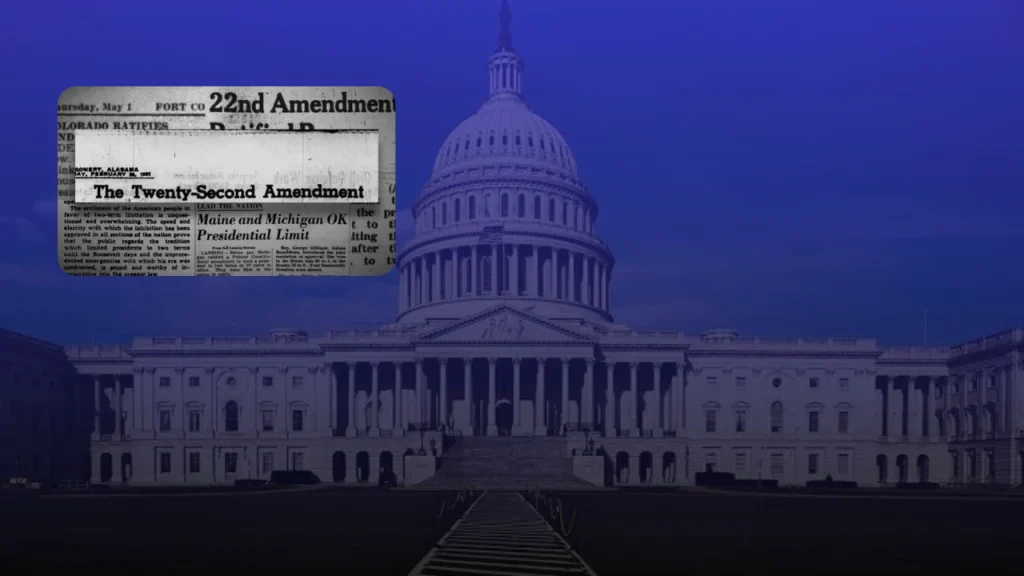
- Congress acts. The Republican-controlled 80th Congress proposed the amendment on March 21, 1947, with bipartisan support, including 47 House Democrats and 16 Senate Democrats.
- Ratification. Minnesota became the 36th of 48 states to ratify on February 27, 1951. A grandfather clause exempted sitting President Harry Truman, who chose not to run in 1952.
The amendment turned a tradition into an enforceable constitutional limit. Congress attached a seven-year ratification deadline to it, as it often does.
Official text of the 22nd Amendment, National Archives
How Congress Could Repeal the 22nd Amendment: Step by Step
Article V offers two routes. The standard one, used for all 27 amendments, runs through Congress.
| Stage | Route 1: Congress (used for every amendment) | Route 2: Convention (never used to propose) |
| Proposal | Two-thirds of both chambers: 290 House votes and 67 Senate votes | Legislatures of two-thirds of states (34) apply, and Congress calls a convention |
| Ratification | Three-fourths of states (38), by legislatures or conventions, as Congress chooses | Three-fourths of states (38) |
Step 1: Introduce a joint resolution
A member of Congress introduces a joint resolution proposing the change. It might repeal term limits entirely or replace the two-election limit with a different rule. Introduction changes nothing by itself.
Step 2: Two-thirds of the House
With all 435 members voting, 290 votes are needed. The exact number depends on how many members are present and voting, subject to quorum rules.
Step 3: Two-thirds of the Senate
With all 100 senators voting, 67 votes are needed. Both chambers must approve identical language. The proposal does not go to the president.
Step 4: Send to the states
The proposed amendment goes to the states through the National Archives. Congress specifies whether ratification is by state legislatures or by state ratifying conventions.
Step 5: Ratification by 38 states
Three-fourths of the states must ratify. Once the requirement is met, the Archivist of the United States certifies the amendment.
Passing Congress is not enough. State ratification is essential.
Could the States Do It Without Congress?
Article V’s second route lets two-thirds of state legislatures (34) petition Congress to call a convention to propose amendments. Any proposal would still need ratification by 38 states.
No amendment has ever been proposed this way, so questions about a convention’s rules and limits are unresolved. The convention route is also not the same as states repealing federal term limits themselves. States cannot do that.
Does the President Have Any Role?
No. The president has no formal role in the amendment process. The Supreme Court recognized this in Hollingsworth v. Virginia, 3 U.S. (3 Dall.) 378 (1798), and the National Archives treats amendment resolutions as going straight to the states without a presidential signature.
Trump could publicly support a repeal, but he could not sign, veto or enact one. An executive order cannot change the Constitution. Related: Can Trump Govern Without Congress? Presidential Powers Explained
What Is Rep. Andy Ogles’ Proposal (H.J.Res. 29)?
On January 23, 2025, Rep. Andy Ogles (R-Tennessee) introduced H.J.Res. 29 in the 119th Congress. Its title is: “Proposing an amendment to the Constitution of the United States to provide that no person shall be elected to the office of the President more than three times.” Ogles said publicly that the aim was to let Trump serve a third term.
The text is narrower than the title suggests. As introduced, it would:
- bar anyone from being elected president more than three times;
- bar anyone from being elected to an additional term after two consecutive terms; and
- keep a successor rule for people who served more than two years of another president’s term.
Why that matters: Trump’s two wins were nonconsecutive (2016, then 2024 after a 2020 loss), so the wording would not automatically bar a third election. Presidents elected to two consecutive terms, such as Barack Obama (2008, 2012) and George W. Bush (2000, 2004), would be treated differently.
Status of H.J.Res. 29
| Detail | Status |
| Sponsor | Rep. Andy Ogles (R-Tenn.) |
| Introduced | January 23, 2025 |
| Committee | House Judiciary |
| Latest recorded action | Referred to committee |
| Passed House? | No |
| Passed Senate? | No |
| Sent to states? | No |
| Ratified? | No |
If it were ever submitted to the states, it provides a seven-year ratification window starting from submission. It is an introduced proposal, not a constitutional amendment.
H.J.Res. 29, official text (GovInfo)
Is Repeal the Same as Allowing a Third Term?
Not necessarily. The exact wording of any amendment decides who becomes eligible.
| Proposed change | Effect |
| Repeal the 22nd Amendment entirely | Removes the existing limit on presidential elections |
| Replace two elections with three | Allows up to three, subject to the new wording |
| Allow three only if nonconsecutive | Treats consecutive and nonconsecutive histories differently (the H.J.Res. 29 approach) |
| Create a single six-year term | Changes tenure rather than adding a third election |
A repeal would not automatically elect anyone, extend a current term, or end regular elections.
Has the U.S. Ever Repealed an Amendment?
Once. The 21st Amendment, ratified on December 5, 1933, repealed the 18th Amendment (Prohibition). It is also the only amendment ratified by state conventions rather than state legislatures.
It shows the Constitution can be changed to undo an earlier amendment, but the repeal still followed Article V. It did not come from an executive order, an ordinary law or a court ruling.
Have There Been Earlier Attempts to Repeal Term Limits?
Yes, and from both parties.
- Rep. José Serrano (D-N.Y.) introduced a repeal resolution in every Congress from 1997 to 2013, arguing voters should be free to re-elect a popular president.
- Other proposals over the decades sought to repeal the limit or replace it with a single longer term. Congressional Research Service report R40864 surveys them.
- Rep. Ogles’ H.J.Res. 29 is the most recent.
None has advanced out of committee.
Why the Political Math Is So Hard
- The blocking threshold is low. Because 38 states are needed, 13 states declining to ratify are enough to defeat an amendment.
- Speed. The fastest modern ratification, the 26th Amendment (voting age 18, 1971), took about 100 days and had near-unanimous support.
- Consensus. Without broad bipartisan agreement across roughly three-fourths of the states, passage before the next election is very difficult.
That is a political assessment, not a legal bar. Article V sets no minimum time for an amendment to be proposed and ratified.
Could Repeal Happen Before the 2028 Election?
Legally, yes. An amendment ratified before candidate-qualification and election deadlines could affect eligibility, depending on its wording and effective date. The presidential election is scheduled for November 7, 2028.
Debating or introducing a proposal changes nothing. An amendment ratified after Election Day would not automatically rewrite certified results, and its effect would depend on its text.
Article V has no general seven-year limit. That deadline comes from the specific resolution Congress sends out, as with the 22nd Amendment and H.J.Res. 29.
Would Repeal Let a President Stay Past January 20, 2029?
No. The 20th Amendment ends presidential terms at noon on January 20. Repealing the 22nd Amendment would not extend a current term. A president made eligible would still have to win an election. Term limits and term extensions are different things.
Succession is governed by separate provisions. See If Trump Resigns or Is Removed, Does JD Vance Automatically Become President?
Could the Supreme Court Remove Term Limits?
No. Courts interpret the Constitution but cannot delete or replace an amendment outside Article V. Litigation could arise over ballot access or eligibility, but that is different from repeal.
The theory that a twice-elected president could return through the vice presidency raises separate questions about the 12th and 22nd Amendments. The Supreme Court has not approved it. See 22nd Amendment Explained: Can Trump Run in 2028?
California has also enacted a ballot-certification law aimed at the 22nd Amendment. See our guide to California AB 1539 and the 2028 ballot.
Arguments For and Against Repeal
Supporters argue voters should be free to re-elect an effective president, particularly during an emergency, and that elections already allow voters to remove an unpopular one.
Opponents argue term limits guard against concentrated executive power, encourage turnover, and prevent a president from staying in office over many years.
The Constitution currently resolves this policy dispute with a two-election limit. Changing it would take the broad national agreement Article V requires.
Frequently Asked Questions
Can the 22nd Amendment legally be repealed? Yes. Another constitutional amendment could repeal it or change its term-limit provisions.
How many states must approve? At least 38 of 50.
How many votes does Congress need? With every member voting, 290 in the House and 67 in the Senate. The exact figure depends on who is present and voting.
Can 13 states stop a repeal? Yes. If 13 states do not ratify, at most 37 can approve, which is below the 38 required.
Can the president repeal it by executive order? No. The president has no formal role in the Article V process.
Has Trump already changed the 22nd Amendment? No. No amendment allowing a third election has been ratified.
What is H.J.Res. 29? A proposal introduced January 23, 2025 by Rep. Andy Ogles. It would allow up to three elections but bar another election after two consecutive terms. It has not passed either chamber.
Is there a wartime or emergency exception? No. The 22nd Amendment has no emergency exception.
Would repeal let Barack Obama run again? A complete repeal with no replacement limit would remove the 22nd Amendment barrier for any twice-elected former president. A narrower amendment such as H.J.Res. 29 would not, because it bars another election after two consecutive terms. The wording of any amendment controls.
The Bottom Line
The 22nd Amendment can be repealed, but not by a president acting alone, an ordinary congressional majority, or a court. It takes two-thirds of Congress (or a convention called by 34 states) plus ratification by 38 states.
H.J.Res. 29 would change term limits but remains in the House Judiciary Committee and has not been sent to the states. Until a new amendment is validly ratified, Trump’s victories in 2016 and 2024 prevent him from being elected president a third time.
Repeal is legally possible. Whether the necessary national support exists is a political question.
Next update triggers: a committee hearing, vote or revised text for H.J.Res. 29, or any new amendment proposal.
Primary Sources and Legal References
- National Archives: Article V, U.S. Constitution
- National Archives: The Constitutional Amendment Process
- National Archives: 22nd Amendment, official text
- GovInfo: H.J.Res. 29, 119th Congress (introduced text)
- Congress.gov: H.J.Res. 29 bill page
- Congressional Research Service: Presidential Terms and Tenure, R40864
- National Archives: 21st Amendment and Repeal of Prohibition
- National Archives: 22nd Amendment historical background
- National Archives: Questions and Answers About the Constitution
- Hollingsworth v. Virginia, 3 U.S. (3 Dall.) 378 (1798)
Editorial note: This article explains the constitutional amendment process and a pending congressional proposal. Proposed amendments have no legal effect until validly ratified. We update this article as developments occur.
Disclaimer: AllAboutLawyer.com provides independent legal information and constitutional research, not legal advice. For advice on a specific situation, consult a licensed attorney.
By AllAboutLawyer.com Legal Content Research | Published and updated November 19, 2026
About the Author
Israr Ahmad is a legal content researcher with 4+ years of experience covering class action settlements and consumer rights cases. He has researched and published coverage of 2,500+ settlements using verified court records, settlement administrator filings, and government sources. Learn more about Israr.