
22nd Amendment Explained, Can Trump Run in 2028? Judge Nominee James Sullivan’s Hearing Answer and the Third-Term Debate
At a Senate Judiciary Committee confirmation hearing on Wednesday, November 18, 2026, Texas Supreme Court Justice James P. Sullivan declined to say whether President Donald Trump may run for a third term. Sullivan is President Trump’s nominee for a lifetime seat on the U.S. District Court for the Western District of Texas. He cited Canon 5 of the Code of Conduct for United States Judges.
The constitutional text on the central point is clear: under the 22nd Amendment, no person may be elected president more than twice. Trump was elected in 2016 and 2024. The unsettled debate is narrower: whether a twice-elected president could return to office by some route other than winning a third election, such as vice-presidential succession. No court has resolved that question.
22nd Amendment and the 2028 Election: Key Facts
| Question | Answer |
| What does the 22nd Amendment limit? | The number of times a person can be elected president: twice |
| When was it ratified? | February 27, 1951 |
| Does it cover nonconsecutive terms? | Yes |
| Has Trump been elected twice? | Yes, in 2016 and 2024 |
| Can Trump be elected president again in 2028 under the current Constitution? | No |
| Can an executive order or ordinary law override it? | No; only a constitutional amendment under Article V |
| Could a twice-elected president become vice president? | Disputed; the 12th Amendment is the main obstacle; no Supreme Court ruling |
| When does Trump’s current term end? | Noon, January 20, 2029 |
| What did California enact? | AB 1539, signed September 30, 2026, requiring 22nd Amendment eligibility certifications for presidential tickets |
What Does the 22nd Amendment Say?
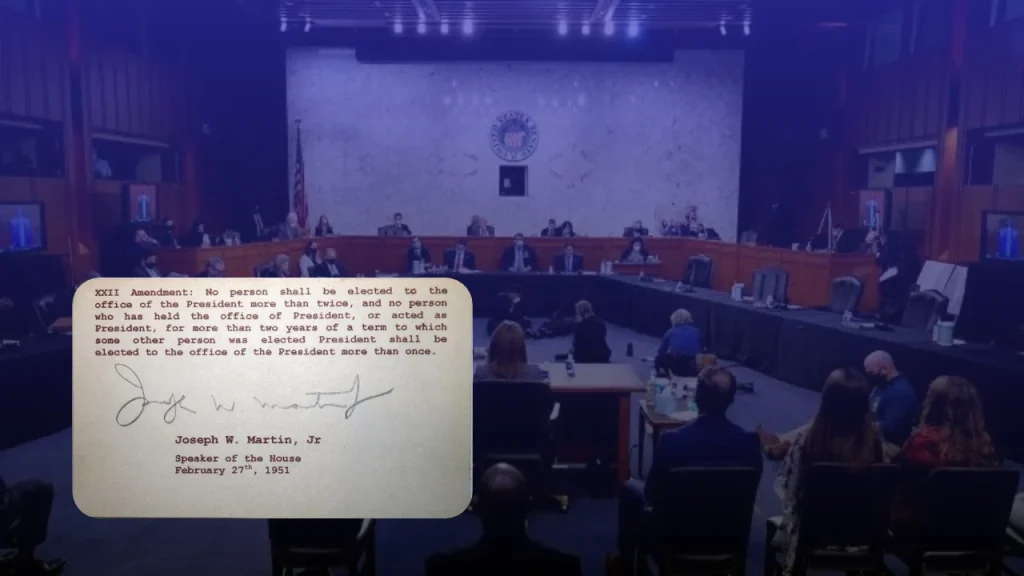
Section 1 of the amendment begins: “No person shall be elected to the office of the President more than twice.” A second clause covers people who succeed to the presidency: someone who held the office, or acted as president, for more than two years of a term to which another person was elected may be elected only once.
A vice president who takes over and serves two years or less of the predecessor’s term can therefore still be elected twice, for a maximum of nearly ten years. That succession rule does not help someone who has already been elected twice. Read the text at the National Archives.
What Happened at Sullivan’s November 18 Senate Hearing?
Sen. Chris Coons (D-Del.) asked Sullivan to say what the 22nd Amendment provides. According to news reports of the hearing, Sullivan said it would violate Canon 5 for a district court nominee to opine on that, and did not initially recite the amendment’s text. Coons then asked about Trump’s two election wins and whether he can run again. Sullivan again declined, saying it would be inappropriate for a nominee to comment. Coons said he respected a Canon 5 answer on a question that was “unsettled” or the subject of “vigorous political debate,” but did not think this was one.
Coons put similar questions to another nominee at the same hearing, William Lambert, nominated to the District of South Carolina. Lambert said the text “seems clear that no one may serve a third term,” and agreed that includes President Trump.
Sullivan was nominated on November 10, a week after he lost his seat on the Texas Supreme Court at the November 3 election. His nomination has not been voted on.
Does Canon 5 Stop a Judicial Nominee From Explaining the 22nd Amendment?
Canon 5 of the Code of Conduct for United States Judges addresses political activity: judges should not endorse candidates or take part in partisan campaigns. It does not on its face bar a judge from explaining what a constitutional provision says. Nominees also commonly decline to prejudge matters that could come before them. Read the Code of Conduct.
The two sides of the dispute are:
- Critics’ view: the amendment’s ban on a third election is explicit text, so confirming what it says is not prejudging anything, and failing to state it undermines confidence in a nominee’s constitutional knowledge.
- Nominee’s view: a question about a sitting president’s future candidacy is politically charged and could end up in ballot-access litigation, so a nominee should avoid commenting.
Neither position is a ruling on Trump’s eligibility. The hearing was a confirmation proceeding, not a court case.
Can Donald Trump Run for President Again in 2028?
Under the current Constitution, he cannot be elected president a third time. He won in 2016 and served until January 20, 2021, and won again in 2024. The amendment counts elections won, so the four-year gap and the 2020 loss do not reset the count. A public announcement of candidacy does not amend the Constitution or create eligibility. Whether a candidate could appear on any particular state’s ballot would depend on that state’s election law and any court challenges.
What Is the Vice President “Loophole” Theory Under the 22nd and 12th Amendments?
Commentators have floated a workaround: a twice-elected president runs as vice president, and the president resigns after the election. The theory leans on the 22nd Amendment’s wording, which bars being elected president more than twice.
The main obstacle is the 12th Amendment, which says no person constitutionally ineligible to the office of president shall be eligible to that of vice president. Many scholars read that as closing the route. Others argue the 22nd Amendment limits election, not eligibility to hold the office. No Supreme Court decision has approved this theory. A theory being debated does not make it a working legal path.
Succession through another office in the Presidential Succession Act raises the same unresolved questions: whether a twice-elected president could hold the position and then assume the presidency. It is not an established method of getting around the amendment.
What Did California Change With AB 1539?
California Gov. Gavin Newsom signed AB 1539 on September 30, 2026. It requires a representative of each qualified party, and of each independent or write-in presidential ticket, to certify to the Secretary of State, under penalty of perjury, that the presidential nominee is eligible to be elected under the 22nd Amendment and that the vice-presidential nominee is eligible under the 12th Amendment.
For party and independent candidates the certification is due by the 75th day before the general election, and for write-in candidates by the 14th day before. Without it, the nominees’ names cannot be placed on California’s general election ballot. The law governs California’s ballot only, and it could be challenged in court. See the bill record.
Can Congress Repeal the 22nd Amendment Before 2028?
Not by ordinary legislation. Article V requires a proposed amendment to pass two-thirds of both houses of Congress, or be proposed by a convention called by two-thirds of the state legislatures (34 states), and then be ratified by three-fourths of the states (38). The president has no formal role. Rep. Andy Ogles has introduced a measure to change term limits, but introducing a proposal does not amend the Constitution.
For how Congress’s powers could change in 2027, see What Happens If Democrats Win the House, the Senate or Both in the 2026 Midterms? Impeachment, Investigations, Nominations and the Legal Powers of Congress Over President Trump.
Why Was the 22nd Amendment Added to the Constitution?
For most of U.S. history the two-term limit was a custom set by George Washington. Franklin D. Roosevelt won four elections (1932, 1936, 1940 and 1944), and after his death in 1945 Congress proposed the amendment on March 21, 1947. It was ratified on February 27, 1951.
Could the Supreme Court Decide Whether Trump Can Serve a Third Term?
Only if a real case reached it, for example a challenge to a state ballot decision, an attempted candidacy or an attempt to assume office through succession. Federal courts do not issue advisory opinions on hypothetical candidacies, and any case would face questions of standing, ripeness and available relief. The Supreme Court has not approved a third elected term or the succession workaround.
Why Is the Sullivan Hearing Happening During the Senate Lame-Duck Session?
Democrats won control of the Senate at the November 3, 2026 midterms, and the new Congress convenes in January 2027. Senate Republicans, led by Majority Leader John Thune, are trying to confirm roughly two dozen pending judicial nominees before the change in control. Democrats argue the pace skips normal vetting, and some Texas nominations have drawn friction among Republican senators too. Because federal district judges hold lifetime tenure, nominees confirmed now will serve long after the current Congress.
Judges at that level handle the first round of many election, civil-rights and executive-power cases. For more on presidential power under a divided Congress, see Can Trump Govern Without Congress? Presidential Powers Under a Divided Government Explained.
What Happens When Trump’s Term Ends in January 2029?
Under the 20th Amendment, presidential terms end at noon on January 20. Trump’s current term is scheduled to end at noon on January 20, 2029. An executive order cannot extend a term, and an unresolved dispute does not keep a president in office. For the difference between term expiration, resignation, removal and inability to serve, see Can Democrats Remove Trump as President in 2027? Impeachment, the 25th Amendment and Who Would Replace Him.
Frequently Asked Questions About the 22nd Amendment and Trump’s Eligibility
Can Trump run again in 2028?
Not as a candidate for election to a third term under the current 22nd Amendment. Announcing a candidacy would not change that.
Did James Sullivan say Trump can serve a third term?
No. Sullivan declined to say whether the amendment applies to Trump, citing Canon 5. He did not say Trump is eligible.
Can Trump become vice president in 2028?
That route is disputed because of the 12th Amendment. No binding court decision has settled it.
Can the president repeal the 22nd Amendment by executive order?
No. Amendments are governed by Article V.
What does California’s AB 1539 do?
It requires parties and independent or write-in tickets to certify, under penalty of perjury, that their presidential and vice-presidential nominees are eligible under the 22nd and 12th Amendments, or their names stay off California’s ballot.
Is there a lawsuit over Trump’s third-term eligibility?
None has been verified as of November 19, 2026. The Sullivan hearing was a confirmation proceeding, not a lawsuit.
The Bottom Line: What the Constitution Says About a Trump Third Term
A twice-elected president cannot be elected a third time under the 22nd Amendment. The remaining arguments concern succession theories that the Supreme Court has never approved. Sullivan’s answer at his November 18 hearing, and Coons’s criticism of it, have made the issue a national story, but neither was a legal ruling. As of November 19, 2026, the Constitution has not been amended to allow a third Trump election.
Sources and Legal References
- National Archives: Constitutional Amendments 11–27 (12th, 20th, 22nd Amendments)
- National Archives: Article V and the amendment process
- Code of Conduct for United States Judges
- California AB 1539, Presidential elections: qualifications for office
- Governor Newsom’s September 30, 2026 legislative update
- The Texas Tribune: Sullivan nominated to the federal bench, November 10, 2026
- The New Republic report on the November 18 hearing
- Congressional Research Service: Presidential Terms and Tenure
Disclaimer: AllAboutLawyer.com provides independent legal information, not legal advice. The Senate hearing was a judicial confirmation proceeding, and no court has issued a ruling on third-term eligibility.
Researched and written by Israr Ahmad, legal content researcher and founder of AllAboutLawyer.com. All facts verified against the U.S. Constitution, the Code of Conduct for United States Judges, California’s AB 1539 record and Governor’s office, and news reports of the November 18 hearing, as of November 19, 2026. Last Updated: November 19, 2026.
About the Author
Israr Ahmad is a legal content researcher with 4+ years of experience covering class action settlements and consumer rights cases. He has researched and published coverage of 2,500+ settlements using verified court records, settlement administrator filings, and government sources. Learn more about Israr.