
California Minimum Wage 2027, New $17.40 Hourly Rate, Local Wages, Overtime and Employee Rights
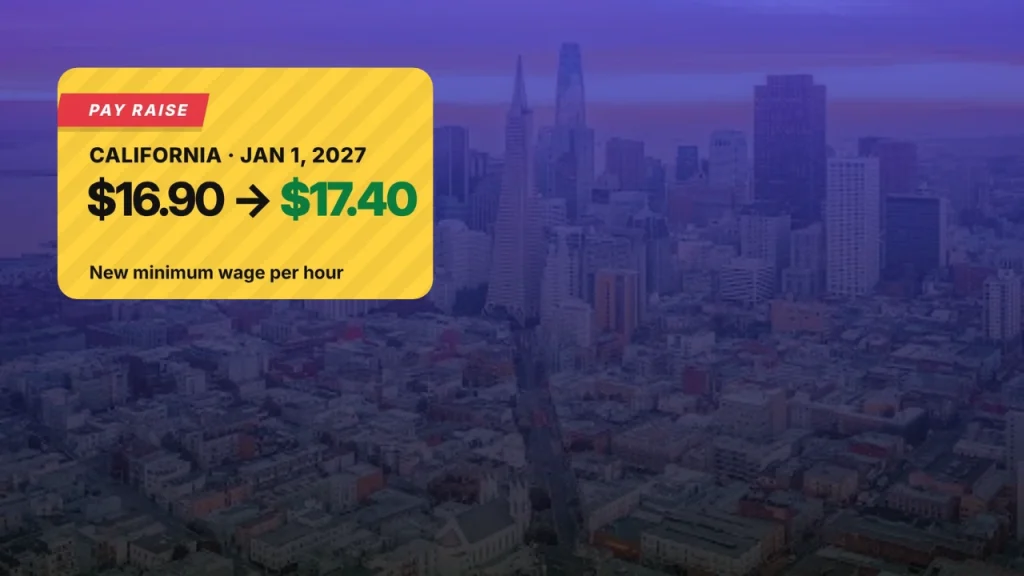
California’s statewide minimum wage rises from $16.90 to $17.40 per hour on January 1, 2027, for employers of every size. The increase also lifts the minimum salary for most overtime-exempt executive, administrative and professional employees to 72,384ayear(6,032 a month).
A full-time employee at the new minimum could earn about $1,040 more per year before taxes. Many California cities set higher local minimums, and separate wage floors apply to covered fast-food and healthcare workers. The highest applicable rate controls.
This is an annual statutory adjustment enforced by the Labor Commissioner’s Office. It is not a class-action settlement, and there is no public claim form.
Quick Facts
| Detail | Information |
| New statewide minimum wage | $17.40 per hour |
| Previous minimum wage | $16.90 per hour |
| Effective date | January 1, 2027 |
| Increase | $0.50 per hour (about 3%) |
| Full-time annual gross pay (40 hours, 52 weeks) | $36,192 |
| Exempt salary threshold (ordinary) | 72,384peryear(1,392 weekly, $6,032 monthly) |
| Time-and-a-half at minimum wage | $26.10 |
| Double time at minimum wage | $34.80 |
| Covered fast-food minimum wage | $20 per hour (currently) |
| Fast-food exempt salary threshold | $83,200 per year |
| Small-business exemption | None for the statewide rate |
| Governing statute | Labor Code § 1182.12 |
| Enforcement agency | California Labor Commissioner’s Office |
| Worker hotline | 833-526-4636 |
Official announcement: California Department of Industrial Relations, News Release 2026-66
Why Is the Rate Increasing?
Under Labor Code § 1182.12, the Department of Finance calculates an annual inflation adjustment. The Department certified the 2027 increase on July 31, 2026, and the Department of Industrial Relations announced it on August 13, 2026. It is not a new law passed in November 2026.
Statewide minimum wage history
| Effective date | Rate |
| January 1, 2023 | $15.50 |
| January 1, 2024 | $16.00 |
| January 1, 2025 | $16.50 |
| January 1, 2026 | $16.90 |
| January 1, 2027 | $17.40 |
For background on employment law changes, see US Labor and Employment Law in 2026.
Who Is Covered?
| Category | General treatment |
| Full-time, part-time, seasonal and temporary workers | Covered |
| Restaurant servers and retail employees | Covered |
| Agricultural workers | Generally covered, with separate rules |
| Commission and piece-rate workers | Generally protected |
| Salaried nonexempt employees | Covered |
| Workers regardless of immigration status | Protected by state wage laws |
| Genuine independent contractors | Generally outside the minimum wage |
| Qualifying exempt employees | Separate exemption requirements |
Limited exceptions exist, including a learner rate (generally 85% of minimum wage for the first 160 hours in an occupation for workers with no related experience) and certain family employment arrangements. An employer cannot avoid minimum wage by renaming a job or calling an employee a contractor.
What $17.40 an Hour Means
Assumes 52 weeks and no overtime or unpaid time off.
| Weekly hours | Weekly gross | Monthly (average) | Annual gross |
| 20 | $348 | $1,508 | $18,096 |
| 30 | $522 | $2,262 | $27,144 |
| 35 | $609 | $2,639 | $31,668 |
| 40 | $696 | $3,016 | $36,192 |
2026 versus 2027 for a full-time worker
| Period | 2026 | 2027 | Increase |
| Hourly | $16.90 | $17.40 | $0.50 |
| Weekly | $676 | $696 | $20 |
| Annual | $35,152 | $36,192 | $1,040 |
These are gross figures. Employees already earning more than the new minimum are not automatically entitled to a $0.50 raise.
Related article: Washington State Minimum Wage 2027, New $17.73 Pay Rate, Local Wages and Overtime Rules
Local Minimum Wages Above $17.40
Employers must pay the highest applicable state, local or industry rate. Examples of local rates taking effect January 1, 2027, as reported in employer compliance updates:
| City | January 1, 2027 rate |
| Mountain View | $20.25 |
| Belmont | $19.60 |
| Redwood City | $19.30 |
| Cupertino, Los Altos, Palo Alto | $19.25 |
| El Cerrito | $19.36 |
| Petaluma | $18.93 |
| Half Moon Bay | $18.52 |
| Burlingame | $18.47 |
| Hayward (26 or more employees) | $18.39 |
| Foster City | $18.36 |
| Daly City | $18.10 |
| Menlo Park | $18.05 |
Some ordinances vary by employer size. In Hayward, for example, employers with 25 or fewer employees pay the state rate. San Diego and San Jose are also reported to increase on January 1, 2027, to $18.35 and $19.00. Rates for other cities may differ, so check the city’s official notice before relying on any figure.
Some cities adjust on July 1 instead. San Francisco (19.61),Berkeley(19.61), Los Angeles (18.42)andAlameda(17.76) set rates effective July 1, 2026, with the next ordinary adjustment on July 1, 2027. Final July 2027 rates are not yet confirmed.
Remote and traveling workers may be covered by the ordinance of the city where they work. Los Angeles generally covers employees who perform at least two hours of work in the city in a week, and San Diego uses a similar rule.
Resources: Los Angeles Office of Wage Standards and San Diego Office of Labor Standards and Enforcement
Fast-Food Workers: Still $20?
Under AB 1228, covered fast-food employees have a separate $20 hourly minimum, which the statewide increase does not replace. Coverage generally applies to limited-service restaurants in national chains with at least 60 establishments. The Fast Food Council has authority to set later increases. No confirmed 2027 increase above $20 has been located, so watch the council’s announcements.
| Fast-food pay at $20 | Amount |
| Weekly (40 hours) | $800 |
| Annual (full-time) | $41,600 |
| Time-and-a-half | $30 |
| Double time | $40 |
| Ordinary exempt salary threshold | $83,200 |
Official guidance: Fast Food Minimum Wage FAQs
Healthcare Workers
California’s healthcare minimum wage law (SB 525) sets scheduled wage floors that vary by facility type, generally ranging from about $19 to $25 per hour. It covers many roles, not only clinical staff, such as nursing assistants, caregivers, housekeepers, janitors, security guards, billing staff, food service and laundry workers, and some contractor employees. Coverage depends on both the facility and the work performed. Check the current schedule for your facility. See Healthcare Worker Minimum Wage FAQs.
Exempt Salary Threshold: $72,384
Under Labor Code § 515, most executive, administrative and professional employees must earn at least twice the state minimum wage for full-time work:
$17.40 × 2 × 40 hours × 52 weeks = $72,384
| Period | 2027 minimum |
| Weekly | $1,392 |
| Biweekly | $2,784 |
| Monthly | $6,032 |
| Annual | $72,384 |
The 2026 threshold was $70,304.
Salary alone does not make an employee exempt. The employee must also be paid a fixed salary basis and primarily perform exempt duties, generally spending more than half of working time on them and exercising discretion and independent judgment. A manager or supervisor title does not decide it. Only cash wages count toward the salary level. If an exempt employee is paid less than the minimum in a pay period, they may be treated as nonexempt for that period.
A salaried employee earning $70,000 in 2027 generally falls below the ordinary threshold. Unless another exemption applies, the employer must treat them as nonexempt and pay overtime and provide meal and rest breaks. California does not require paying every salaried employee $72,384, only those classified as exempt.
Local minimum wages do not change the exempt salary threshold. Healthcare employees use a separate calculation, and fast-food managers need $83,200. Computer software employees under Labor Code § 515.5 have separate, higher annually adjusted thresholds; check the Department of Industrial Relations’ 2027 figures. See DIR Computer Software Exemption.
California Overtime Rules
Under Labor Code § 510, nonexempt employees receive overtime on a daily and weekly basis.
| Hours worked | Required pay |
| First 8 hours in a workday | Regular rate |
| Over 8 through 12 hours in a workday | 1.5 times regular rate |
| Over 12 hours in a workday | 2 times regular rate |
| Over 40 hours in a workweek | 1.5 times regular rate |
| First 8 hours on the seventh consecutive workday in a workweek | 1.5 times regular rate |
| Over 8 hours on that seventh day | 2 times regular rate |
Alternative workweek schedules, certain occupations and qualifying union agreements can change these rules. The same hours are not paid multiple overtime premiums.
| Regular rate | Time-and-a-half | Double time |
| $17.40 | $26.10 | $34.80 |
| $20.00 | $30.00 | $40.00 |
| $25.00 | $37.50 | $50.00 |
| $30.00 | $45.00 | $60.00 |
The regular rate can include certain nondiscretionary bonuses, so it is not always the base wage.
Example, 14-hour shift at $17.40: 8 hours × $17.40 = $139.20, plus 4 hours × $26.10 = $104.40, plus 2 hours × $34.80 = $69.60, for a total of $313.20, excluding unpaid meal periods and separate premiums.
Official guidance: Labor Commissioner Overtime FAQs
Tipped Workers
California does not allow a tip credit. Servers, bartenders and other tipped employees must receive the full applicable minimum wage before tips. At the state rate, an eight-hour shift must pay at least $139.20 in wages. Labor Code § 351 also bars employers from taking employee tips.
Training, Meetings and Off-the-Clock Work
Employers must generally pay for compensable time, which can include required training and meetings, opening and closing duties, required computer startup, work before or after a shift, certain employer-controlled waiting time and some work-related travel. Directing employees to clock out before finishing tasks does not avoid the obligation. For a separate California wage case, see Ebara Technologies $1.2 Million California Wage Settlement. It is unrelated to the 2027 increase.
Meal and Rest Breaks
| Break | General rule |
| First meal period | At least 30 minutes when working more than five hours |
| Second meal period | At least 30 minutes when working more than ten hours |
| Paid rest period | Generally 10 minutes per four hours worked or major fraction |
Waivers and occupation-specific rules may apply. Under Labor Code § 226.7, a missed required meal or rest period can mean one extra hour of pay at the regular rate for each violation type in a workday.
Immigration Status
State wage protections generally apply regardless of immigration status. The Labor Commissioner does not ask about immigration status when handling wage claims or retaliation complaints, and employers cannot lawfully withhold earned wages because of a lack of documentation.
Can You Sue for Unpaid Minimum Wage?
Yes. Labor Code § 1194 lets employees recover unpaid minimum wages and overtime in court or through a Labor Commissioner claim.
| Remedy | Authority |
| Unpaid minimum wages | § 1194 |
| Unpaid overtime | §§ 510, 1194 |
| Liquidated damages for minimum wage violations | § 1194.2 |
| Waiting-time penalties | § 203 |
| Wage statement penalties | § 226 |
| Meal and rest break premiums | § 226.7 |
| Retaliation remedies | § 98.6 |
| Attorney fees and costs | § 1194 and others |
Liquidated damages can equal the unpaid minimum wages plus interest, but may be reduced if the employer proves good faith and reasonable grounds. They do not generally apply to overtime alone.
Hypothetical: An employee continues to be paid $16.90 for 2,080 hours in 2027 despite being entitled to $17.40. Unpaid wages are $1,040, with potentially matching liquidated damages of $1,040, or $2,080 before interest and other remedies. This is an illustration, not a guaranteed recovery, and could be larger where a higher local or industry wage applies.
For another example of a wage dispute, see LAZ Parking $2.5 Million Settlement. Its allegations are disputed.
Filing Deadlines
| Claim | General period |
| Unpaid minimum wage or overtime | Three years |
| Meal and rest break premiums | Three years |
| Oral contract | Generally two years |
| Written contract | Generally four years |
| Unfair competition restitution claims | Potentially four years |
| Many retaliation complaints to the Labor Commissioner | Generally one year, with exceptions |
Deadlines vary by claim and accrual rules, so do not assume every claim has three years.
How to File a Wage Claim
- Confirm your rate: statewide, local or industry minimum.
- Gather records: pay stubs, bank deposits, schedules, timesheets, contracts, messages, dates worked and your workplace address. You can file even if records are incomplete.
- Estimate the shortfall for each pay period.
- File with the Labor Commissioner: see How to File a Wage Claim or call 833-526-4636.
- Take part in the process: a settlement conference or hearing may follow.
- Enforce the decision through the appeal and enforcement procedures.
You may also bring a civil lawsuit under § 1194, and workers with significant underpayment, misclassification or retaliation may want to consult a California employment attorney.
| Authority | Resource |
| Labor Commissioner’s Office | 833-526-4636 |
| Los Angeles | Office of Wage Standards complaint portal |
| San Diego | Office of Labor Standards and Enforcement |
| Federal violations | U.S. DOL Wage and Hour Division |
Retaliation
Labor Code § 98.6 prohibits retaliation for exercising wage rights, including termination, demotion, suspension or reduced hours. You cannot lawfully be fired for asking for minimum wage or filing a protected complaint. Remedies can include reinstatement and lost wages. Keep records and report promptly.
Employer Checklist Before January 1, 2027
- Raise pay to at least $17.40, or the higher local or industry rate.
- Raise exempt salaries to at least $72,384 or reclassify employees.
- Update overtime and double-time calculations.
- Review classifications and actual duties.
- Update wage notices (Labor Code § 2810.5) where rates change.
- Post current state and local wage notices. See DIR Workplace Postings.
- Check wage statements, tipped pay and piece-rate pay.
- Keep accurate time records, including for remote workers in different cities.
Legal Authorities
| Authority | Purpose |
| Labor Code § 1182.12 | Statewide minimum wage and adjustments |
| § 1197 | Prohibits paying below minimum wage |
| § 1194, § 1194.2 | Recovery and liquidated damages |
| § 510 | Overtime and double time |
| § 515, § 515.5 | Exemptions, including computer software employees |
| § 226, § 226.7 | Wage statements, meal and rest premiums |
| § 512 | Meal periods |
| § 351 | Gratuities |
| § 98.6 | Retaliation |
| §§ 1474-1475 | Fast-food wage |
| §§ 1182.14-1182.16 | Healthcare wage |
| 29 U.S.C. §§ 206-207 | Federal minimum wage and overtime |
IWC wage orders and city ordinances can provide additional protection.
Frequently Asked Questions
What is California’s minimum wage in 2027? $17.40 per hour from January 1, 2027.
Is it $20 for everyone? No. $20 applies to covered fast-food workers, and some local and healthcare rates are higher.
What is the exempt salary minimum? $72,384 for most white-collar exemptions, plus the duties tests.
What is $17.40 a year? $36,192 for 40 hours a week for 52 weeks, before taxes.
Will everyone get a $0.50 raise? No, only those paid below the new minimum or covered by another requirement.
What are overtime rates at minimum wage? $26.10 time-and-a-half and $34.80 double time.
Is there a lower wage for teenagers? No age-based rate, though limited learner and other exceptions exist.
Do part-time workers get it? Yes.
Can employers pay servers less because of tips? No.
What if my employer keeps paying $16.90? You may be owed unpaid wages and possibly additional damages or penalties.
Can former employees file a claim? Yes, within the applicable period.
Is there a class action settlement? No. The increase is a statutory adjustment.
Official Sources
- DIR Official 2027 Minimum Wage Announcement
- Governor’s July 31, 2026 announcement
- DIR Minimum Wage FAQs
- Fast Food Minimum Wage FAQs
- Healthcare Minimum Wage FAQs
- Computer Software Exemption
- Overtime FAQs
- File a Wage Claim
- Los Angeles Office of Wage Standards
- City of San Diego Minimum Wage
Bottom line: California’s statewide minimum wage rises to $17.40 on January 1, 2027, and the ordinary exempt salary threshold rises to $72,384. Check your pay stubs, your local and industry rate and your overtime classification. Employers that do not comply may face wage claims, damages and penalties.
Legal disclaimer: AllAboutLawyer.com is an independent legal information website, not a law firm. This article provides general employment law information and is not legal advice. Wage eligibility, exemption status and potential compensation depend on individual circumstances, statutes, local ordinances and later regulatory changes. Consult the Labor Commissioner’s Office or a qualified attorney about your situation.