
Washington Noncompete Ban 2027, Can Your Employer Still Stop You From Joining a Competitor?
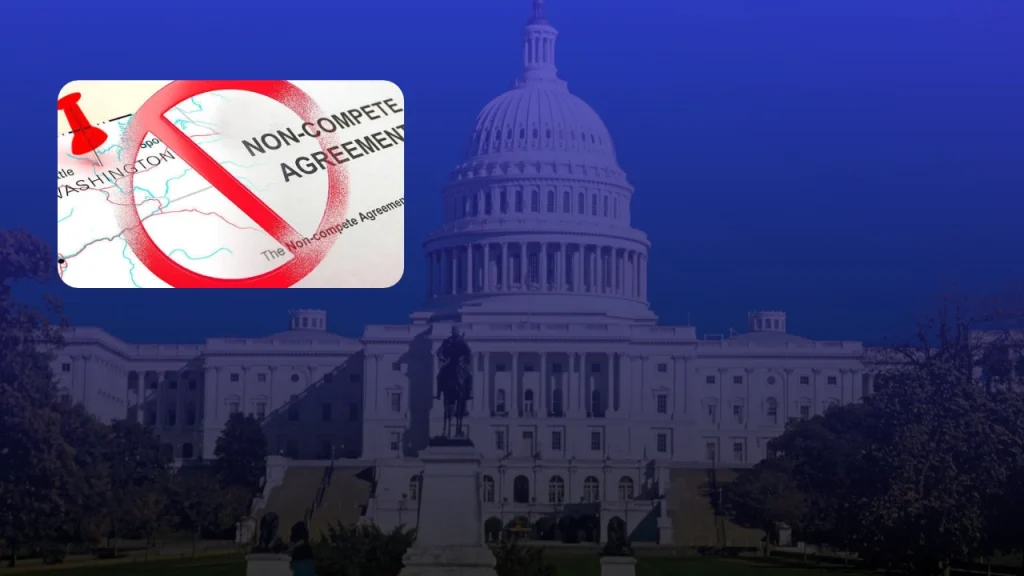
Starting June 30, 2027, Washington employers generally cannot enforce a traditional noncompete against an employee or independent contractor, whatever the worker’s salary and whenever the agreement was signed. Employers can still enforce legitimate confidentiality terms, trade secret protections, narrow nonsolicitation clauses, and qualifying business-sale covenants.
Governor Bob Ferguson signed Engrossed Substitute House Bill 1155 (ESHB 1155) on March 23, 2026. It amends Washington’s Noncompetition Covenants Act, Chapter 49.62 RCW, and turns a salary-threshold system into a near-total ban. Employers may no longer enforce, threaten to enforce, or try to enter into a prohibited noncompete. They must also make reasonable efforts to tell affected current and former workers, in writing, that those restrictions are void by October 1, 2027.
A worker who proves a qualifying violation can recover the greater of actual damages or $5,000, plus reasonable attorney fees, expenses, and costs. This is a state employment statute, not a class action settlement. There is no claim form and no automatic payment.
Washington Noncompete Ban 2027: Quick Facts
| Detail | Information |
| Legislation | Engrossed Substitute House Bill 1155 (Chapter 149, Laws of 2026) |
| Governing statute | Chapter 49.62 RCW |
| Signed | March 23, 2026, by Gov. Bob Ferguson |
| Effective date | June 30, 2027 (not July 1) |
| Previously signed agreements | Covered, regardless of signing date |
| Independent contractors | Covered |
| High earners and executives | No general exception |
| What is void | Noncompetes, forfeiture-for-competition clauses, customer nonacceptance bars |
| Employer notice deadline | October 1, 2027 (reasonable efforts, in writing) |
| Statutory remedy | Greater of actual damages or $5,000, plus attorney fees and costs |
| Customer nonsolicit limit | Up to 18 months after employment ends |
| Business-sale exception | Qualifying transaction of at least 1% ownership |
| Pending lawsuits | Filed before June 30, 2027 stay under the prior law |
Official legislation: ESHB 1155, Chapter 149, Laws of 2026.
Why Did Washington Ban Noncompete Agreements?
How the earlier law worked
Washington adopted its first comprehensive noncompete restrictions in 2019, effective January 1, 2020. That law mainly limited noncompetes for workers earning below annually adjusted thresholds. Employers could still use them for higher earners if other requirements were met.
What lawmakers found
The legislative findings behind HB 1155 point to several concerns:
- Barriers to changing jobs
- Reduced bargaining power and possible wage suppression
- Obstacles to starting new businesses
- Less competition for skilled professionals
- Effects on healthcare costs and patient access
- Agreements imposed without real negotiation
Businesses have long argued that noncompetes protect training investments, confidential information, and customer relationships. The Legislature concluded that narrower tools can protect those interests without broadly restricting a worker’s next job. The bill passed the Senate 30–19 on March 5, 2026, and the House 62–33 on March 9, 2026.
Related article: NYC Click-to-Cancel Law 2026, Can Gyms and Subscription Companies Refuse to Cancel Your Membership?
What Counts as a Noncompete Under Washington Law?
Common examples
A noncompetition covenant is a restriction that keeps someone from working in a competing profession or business. Typical examples include:
- Barring a job with a competitor for 12 months after resigning
- Barring a competing business within a geographic area
- Barring services to named competitors
- Barring any work in the same industry
- Barring acceptance of business from former customers
- Requiring repayment or forfeiture of pay or benefits if the worker competes
Substance over labels
Washington looks at what a clause actually does, not what it is called. A provision titled “confidentiality,” “repayment,” or “compensation” can still be a prohibited noncompete if it works as a restraint on lawful competition.
When Does the Ban Take Effect? Key Dates
| Date | Development |
| January 1, 2020 | Original Washington noncompete law takes effect |
| June 6, 2024 | Earlier amendments take effect |
| March 5, 2026 | Senate passes HB 1155 |
| March 9, 2026 | House passes final bill |
| March 23, 2026 | Governor signs HB 1155 |
| January 1, 2027 | Updated interim earnings thresholds begin |
| June 30, 2027 | New prohibition takes effect |
| October 1, 2027 | Employer notification deadline |
Is the ban in force today?
No. Signing the bill did not void every noncompete. Until June 30, 2027, agreements are judged under the law in force at that time. Anyone planning a job change before then should have their agreement reviewed under those current rules.
Are Previously Signed Noncompetes Still Enforceable in Washington?
Retroactive effect
From June 30, 2027, covered noncompetes are void and unenforceable no matter when they were signed. Workers do not need to sign anything or get the employer’s permission for the prohibition to apply.
For example, someone who signed an 18-month noncompete in 2025 and resigned in early 2027 would no longer be bound by it from June 30, 2027, even if the contract term ran into 2028.
What happens to existing lawsuits?
Amended RCW 49.62.100 draws the line by when the proceeding began:
| When the proceeding began | Governing framework |
| Before June 30, 2027 | Previous version of the law |
| On or after June 30, 2027 | Amended provisions, regardless of when the dispute arose |
A pending lawsuit or arbitration does not automatically disappear on June 30, 2027. Anyone under an injunction or court order should get legal advice before acting in a way that conflicts with it.
Washington Noncompete Salary Thresholds for 2026 and 2027
The current earnings test
The Department of Labor & Industries published adjusted thresholds on September 30, 2026:
| Worker category | 2026 threshold | 2027 interim threshold |
| Employees | $126,858.83 | $131,326.59 |
| Independent contractors | $317,147.09 | $328,316.49 |
The 2027 figures apply only before June 30, 2027. After that date, earnings no longer create an ordinary exception.
Other protections before June 30, 2027
Meeting the threshold does not make a noncompete enforceable. Existing protections include:
- Written disclosure of the restriction before the worker accepts the offer
- Independent consideration if the restriction is imposed after employment begins
- Compensation requirements when enforcing certain noncompetes after a layoff
- A rebuttable presumption against employee noncompetes longer than 18 months
Official source: Washington State Register 26-20-044, 2027 thresholds.
Who Is Protected by the New Law?
Covered workers
The law protects Washington-based employees and independent contractors, including hourly, salaried, and part-time workers, software engineers, technology executives, sales staff, healthcare professionals, physicians, financial professionals, and covered performers. It also reaches former workers who are still subject to an existing restriction.
No executive exception
There is no general carve-out for highly paid employees or senior executives. The exceptions that do exist (business sales, franchises, and similar) are narrow and fact specific.
Can Amazon, Microsoft, or Other Washington Tech Employees Join Competitors?
What changes
From June 30, 2027, a Washington tech worker generally cannot be blocked from joining another company by an ordinary employment noncompete. A hypothetical engineer leaving one Seattle-area company for another would generally be protected. The same goes for product managers, researchers, sales staff, and executives working in Washington.
This article uses major employers only to illustrate how the statute applies. It does not suggest that any named company has violated the law.
What does not change
Workers must still:
- Protect trade secrets
- Return company property
- Respect intellectual property ownership
- Avoid unauthorized disclosure of confidential information
- Follow valid nonsolicitation limits
The law does not allow anyone to copy source code, customer databases, proprietary research, or confidential plans.
Can Employers Take Away Stock Options if You Join a Competitor?
Forfeiture clauses now count as noncompetes
HB 1155 expands the definition of a noncompete to include financial penalties triggered by lawful competition. Clauses that make a worker return, repay, or forfeit pay or benefits for competing can be covered.
| Arrangement | Likely treatment |
| Bonus repayment because the employee joins a competitor | Potentially prohibited |
| Equity forfeiture triggered by competitive employment | Potentially prohibited |
| Stock option clawback based on lawful competition | Potentially prohibited |
| Deferred compensation lost solely for competitive employment | Potentially prohibited |
| Ordinary vesting schedule unrelated to competition | Not automatically prohibited |
| Repayment term unrelated to competition | Needs separate analysis |
Limits of the protection
The law does not accelerate vesting or guarantee pay that was never earned under a lawful plan. The trigger in the contract and its real-world effect decide the outcome. This matters most for RSUs, stock options, retention bonuses, and deferred compensation.
Noncompete vs. Nonsolicitation vs. NDA: What Can Employers Still Enforce?
Side-by-side comparison
| Agreement type | Treatment after June 30, 2027 |
| Traditional employment noncompete | Prohibited |
| Bar on accepting customer business | Prohibited as a noncompete |
| Compensation forfeiture for lawful competition | Prohibited as a noncompete |
| Qualifying employee nonsolicitation | May remain enforceable |
| Qualifying customer nonsolicitation | May remain enforceable |
| Legitimate nondisclosure agreement | May remain enforceable |
| Trade secret protection agreement | May remain enforceable |
| Qualifying business-sale restriction | Excluded from the definition |
| Qualifying educational expense repayment | Excluded if conditions are met |
How courts read the law
Worker protections are read broadly and exceptions narrowly. Being excluded from the definition does not make a clause enforceable. Contract, employment, and antitrust law can still limit it.
Are Customer Nonsolicitation Agreements Still Legal in Washington?
Requirements
Yes, if they meet the amended definition. A qualifying clause can bar a former employee from actively soliciting current or prospective customers, clients, or patients. To qualify:
- The worker must have established or substantially developed a direct relationship with that customer through the job.
- The restriction must end no later than 18 months after employment ends.
- It cannot directly or indirectly bar the worker from accepting or doing business with customers, clients, or patients.
What if a former customer contacts you first?
A clause that bars accepting unsolicited business is a prohibited noncompete. A clause that bars only active solicitation is different. The facts of the contact, the contract language, and any misuse of confidential information still matter.
Can employers stop former workers from recruiting colleagues?
Qualifying employee nonsolicitation agreements are still recognized. The 18-month cap in the amended definition is written for customer, patient, and client restrictions, not expressly for employee-recruitment clauses. Those clauses must still meet other enforceability requirements.
Can Employers Require Repayment of Training Costs?
The statutory exclusion
Potentially, but only within a narrow exclusion. The agreement must:
- Be in writing and cover actual out-of-pocket educational expenses.
- Expire within 18 months of the employee’s start date.
- Limit repayment to a prorated share of the time left in that 18-month period.
- Release the employee from repayment if employment ends for good cause under RCW 50.20.050.
Example
Assume $3,600 in qualifying expenses and a compliant 18-month agreement:
| Time employed | Illustrative remaining repayment |
| 6 months | $2,400 |
| 9 months | $1,800 |
| 12 months | $1,200 |
| 15 months | $600 |
| 18 months | $0 |
This shows proration only. Sign-on bonus repayment and other retention terms need their own analysis. HB 1155 does not invalidate every repayment obligation.
Which Agreements Are Excluded From the Ban?
The six exclusions
Amended RCW 49.62.010 excludes:
| Exclusion | Condition |
| Nonsolicitation agreements | Must meet the statutory definition |
| Confidentiality agreements | Must genuinely protect confidential information |
| Trade secret and invention restrictions | Must concern lawful protection of those interests |
| Business purchase or sale restrictions | Qualifying transaction of at least 1% of the business |
| Franchisee agreements | Qualifying franchise sale under RCW 19.100.020(1) |
| Educational expense repayment | Written, 18-month, prorated, good-cause release |
Business owners selling a company
A restriction tied to buying or selling goodwill or an ownership interest can stay outside the ban if the person signing takes part in a transaction involving at least 1% of the business. Simply owning shares is not enough, and the scope of the covenant can still be tested for reasonableness.
Washington Noncompete Ban for Doctors, Nurses, and Healthcare Workers
General rule
Physicians, nurses, dentists, therapists, veterinarians, and other healthcare workers are covered. Employment-based restrictions on joining another practice generally fall within the ban. Qualifying patient nonsolicitation clauses may survive, but bars on accepting patient business are treated as noncompetes.
November 2026 dialysis lawsuit
On November 10, 2026, Attorney General Nick Brown announced a lawsuit against DaVita and Fresenius over restrictions on dialysis medical directors. The state alleges the limits kept kidney specialists from working at competing facilities and harmed competition. The case was filed in Thurston County Superior Court.
These are allegations, not court findings. The case is brought under existing law and is separate from the ban taking effect in June 2027. It shows the state is already challenging noncompetes. See the Attorney General’s announcement.
Does the Ban Protect Independent Contractors and Performers?
Independent contractors
Yes. The definition expressly includes independent contractors, so a company cannot avoid the ban by relabeling a worker as a contractor. Before June 30, 2027, contractors face a separate earnings threshold of $328,316.49 for 2027. After that, high earnings are no longer a general exception.
Contractors should not assume every nonsolicitation clause is treated like an employee’s. The amended nonsolicitation definition refers specifically to agreements between employers and employees.
Performers
The definition also covers qualifying agreements involving performers, performance spaces, and third parties who schedule performances. A clause stopping a performer from taking other lawful gigs can be a noncompete. Ordinary duties to show up and perform agreed services are not automatically affected.
Does the Law Apply to Remote Workers and Out-of-State Employers?
Washington-based workers
Potentially, yes. Protection follows the worker’s Washington base, not the employer’s headquarters.
| Arrangement | General treatment |
| Lives and works in Seattle for a California company | Generally protected |
| Works remotely in Bellevue for a Texas company | Generally protected |
| Works in Spokane for an Idaho company | Generally protected |
| Works entirely outside Washington for a Seattle company | Needs separate jurisdictional analysis |
| Splits time across states | Depends on the facts |
Choice-of-law clauses
RCW 49.62.050 already protects Washington-based workers from contract terms that force out-of-state courts, impose another state’s law, or strip Washington protections. A Texas or Delaware clause does not automatically defeat the ban, though interstate disputes can raise added jurisdiction and federal questions.
Can Employers Stop You From Having a Second Job?
Existing rule under RCW 49.62.070
HB 1155 does not repeal this provision. Employers generally cannot bar employees earning less than twice the state minimum wage from holding another job or being self-employed.
| Year | State minimum wage | Twice the minimum |
| 2026 | $17.13 | $34.26 |
| 2027 | $17.73 | $35.46 |
Exceptions exist for safety, reasonable scheduling, loyalty, and conflicts of interest. Holding a second job while employed is a different question from joining a competitor after you leave.
Related settlements
These separately reported cases involve disputed claims under existing law. They were not created by HB 1155:
- Swire Coca-Cola $2 Million Labor Class Action Settlement, Check If You Qualify
- FedEx Agrees to $30.8 Million Wage Settlement in Washington Class Action
- $924K Ecoshield Noncompete Covenant Settlement, Are You Eligible for $1,255?
Employer Notice: What Must Happen by October 1, 2027?
The requirement
Amended RCW 49.62.020 requires employers to make reasonable efforts to give written notice to affected current employees, former employees, and independent contractors whose noncompete is still within its contract term. The notice must say the covenant is void and unenforceable. The statute does not set one mandatory delivery method or official template.
Is a noncompete enforceable until October 1?
No. The prohibition starts June 30, 2027. October 1 is only the notice deadline. An employer cannot keep enforcing a prohibited agreement because it has not yet sent the notice.
Can You Sue Over an Illegal Noncompete in Washington?
Prohibited conduct
Yes. Amended RCW 49.62.080 lets aggrieved individuals pursue remedies. After June 30, 2027, prohibited conduct includes:
- Enforcing a covered noncompete
- Attempting or threatening enforcement
- Representing that a worker is bound by one
- Entering into or attempting to enter into one
A threat alone can be a violation, so workers need not wait for a lawsuit to be filed against them.
How much can workers recover?
If a court or arbitrator finds a violation, the violator pays the greater of actual damages or $5,000, plus reasonable attorney fees, expenses, and costs.
| Proven actual damages | Base statutory remedy |
| $0 | $5,000 |
| $2,500 | $5,000 |
| $5,000 | $5,000 |
| $15,000 | $15,000 |
| $50,000 | $50,000 |
Actual damages might include lost pay from a withdrawn job offer or other proven harm. The worker must prove the elements, including causation. The statute does not award $5,000 for every email or clause, and the treatment of multiple violations depends on the facts and future court decisions.
Is Washington sending $5,000 to every worker?
No. HB 1155 creates no automatic payment, settlement fund, or government compensation program. The $5,000 is a remedy available through a qualifying legal proceeding.
How to Report an Illegal Noncompete in Washington
Step 1: Gather your documents
Collect employment contracts, offer letters, equity plans, separation agreements, and restrictive covenant policies.
Step 2: Identify the exact restriction
Determine whether it bars competitive employment, customer acceptance, employee solicitation, or disclosure of confidential information.
Step 3: Preserve evidence
Save emails, demand letters, threatened lawsuits, and records of lost job opportunities.
Step 4: Contact the Attorney General
The Attorney General lists [email protected] as a contact for suspected noncompete violations. Official information is in the Workplace Rights Guide.
Step 5: Consider an employment attorney
A lawyer can assess enforceability, damages, declaratory relief, and whether to go to court or arbitration. An administrative complaint does not necessarily pause a private lawsuit deadline. If you receive court papers or a demand for immediate compliance, get legal help promptly.
Statute of Limitations for Noncompete Claims
No single deadline
Chapter 49.62 RCW does not set one express limitations period for every noncompete claim. Depending on the claim, general statutes such as RCW 4.16.040 and RCW 4.16.080, contract terms, and other rules may apply.
Do not rely on October 1
October 1, 2027 is the employer notice deadline, not a lawsuit filing deadline. Workers should not assume they have until that date, or a fixed number of years after it, to file every possible claim.
Washington’s Ban vs. the Federal FTC Noncompete Rule
What happened to the federal rule
The FTC adopted a nationwide noncompete rule in April 2024, but federal courts blocked it. On September 5, 2025, the FTC voted to dismiss its appeals and accept the invalidation. In February 2026, it issued a final rule removing the noncompete rule from the Code of Federal Regulations.
| Framework | Current position |
| FTC nationwide noncompete rule | Invalidated and removed |
| Washington HB 1155 | Enacted; effective June 30, 2027 |
| Federal antitrust enforcement | Still potentially applicable |
| Washington antitrust enforcement | Still available |
Why Washington’s law is unaffected
Washington’s statute is independent. The failure of the federal rule does not touch it. See the FTC noncompete rule page.
Which Washington and Federal Laws Govern Noncompetes?
Key authorities
| Authority | Purpose |
| Chapter 149, Laws of 2026 | Creates the expanded prohibition |
| RCW 49.62.010 | Definitions and exclusions |
| RCW 49.62.020 | Prohibition and employer notice |
| RCW 49.62.050 | Out-of-state law and venue limits |
| RCW 49.62.070 | Additional employment protections |
| RCW 49.62.080 | Enforcement, damages, attorney fees |
| RCW 49.62.100 | Application to legal proceedings |
| RCW 50.20.050 | Good-cause separation |
| RCW 19.108 | Washington Uniform Trade Secrets Act |
| RCW 19.86 | Consumer Protection Act |
| 18 U.S.C. § 1836 | Defend Trade Secrets Act |
| 15 U.S.C. §§ 1, 45 | Sherman Act; FTC Act |
Repealed provisions
Beginning June 30, 2027, HB 1155 repeals RCW 49.62.030, RCW 49.62.040, and RCW 49.44.190. These covered the separate contractor threshold, annual threshold adjustments, and the broadcasting-industry noncompete rule. The Uniform Trade Secrets Act is expressly preserved.
Action Checklist Before June 30, 2027
For employees and independent contractors
- Gather your agreement, equity and bonus documents, and any nonsolicitation clauses.
- Do not download or transfer company files or client lists when changing jobs.
- Do not act against an existing court order without legal advice.
- Talk to a Washington employment attorney before signing new agreements or if an employer threatens enforcement.
For employers and business owners
- Identify and audit all noncompetes in employment, contractor, equity, and bonus templates.
- Remove customer nonacceptance and competition-triggered clawback language.
- Narrow customer nonsolicitation clauses to 18 months and direct relationships.
- Review educational repayment agreements against the four conditions.
- Tighten trade secret access controls and device return procedures.
- Prepare written notices and keep records of your reasonable efforts to deliver them by October 1, 2027.
- Train managers and HR. Renaming a prohibited clause does not make it compliant.
Frequently Asked Questions About Washington’s Noncompete Ban
When are noncompete agreements banned in Washington?
The expanded prohibition takes effect June 30, 2027.
Does the ban apply to agreements signed before 2027?
Yes. Covered agreements become unenforceable regardless of signing date, subject to the transition rule for proceedings already commenced.
Can my employer stop me from joining a competitor?
After June 30, 2027, an ordinary employment noncompete cannot lawfully prevent covered competitive employment. Confidentiality, trade secret, and valid nonsolicitation duties can still apply.
Are high-income tech executives exempt?
No. There is no general exception based on executive status or pay.
Can employers take away stock options for joining a competitor?
Competition-triggered forfeiture falls within the expanded definition. Ordinary vesting and compensation conditions need separate analysis.
Are NDAs still enforceable?
Legitimate confidentiality agreements remain excluded. An NDA that works as a disguised noncompete may be treated differently.
Can employers stop me from accepting business from former customers?
No. Direct or indirect customer nonacceptance restrictions are within the noncompete definition. Qualifying nonsolicitation of customers is different.
Can I receive $5,000 for an illegal noncompete?
Potentially. If a qualifying violation is established, the remedy is the greater of actual damages or $5,000, plus reasonable attorney fees, expenses, and costs.
What if my employer never sends a notice?
The missing notice does not keep a prohibited noncompete alive. The employer separately risks noncompliance with its notice duty.
Does the ban cover independent contractors?
Yes. They are expressly included.
Can a business owner sign a noncompete when selling a company?
Potentially, if the transaction involves at least a 1% ownership interest and meets other legal requirements.
Is the FTC’s nationwide noncompete ban in effect?
No. The federal rule was invalidated and removed. Washington’s law operates independently.
Official Sources and Legal References
Primary sources
- ESHB 1155, Chapter 149, Laws of 2026
- HB 1155 legislative history
- Chapter 49.62 RCW
- RCW 49.62.020
- RCW 49.62.050
- RCW 49.62.070
- Washington State Register 26-20-044, 2027 thresholds
Government guidance
- Washington Attorney General, Labor and Antitrust
- Washington Attorney General, Workplace Rights Guide
- FTC, Noncompete Rule
- Federal Register, FTC noncompete rule removal
Bottom Line
Washington’s noncompete ban takes effect June 30, 2027 and voids covered employment noncompetes regardless of when they were signed or how much the worker earns. Workers gain broader freedom to change jobs, compete, and seek remedies for unlawful restrictions. Employers keep protection for confidential information, trade secrets, narrow nonsolicitation clauses, and qualifying business-sale and repayment agreements.
Legal disclaimer: AllAboutLawyer.com is an independent legal information website, not a law firm, and its authors are not attorneys. This article offers general information and is not legal advice. Whether a contract is enforceable, what compensation may be available, and which deadlines apply all depend on your facts and the law in force. Consult a licensed Washington employment attorney before acting on a disputed restriction.