
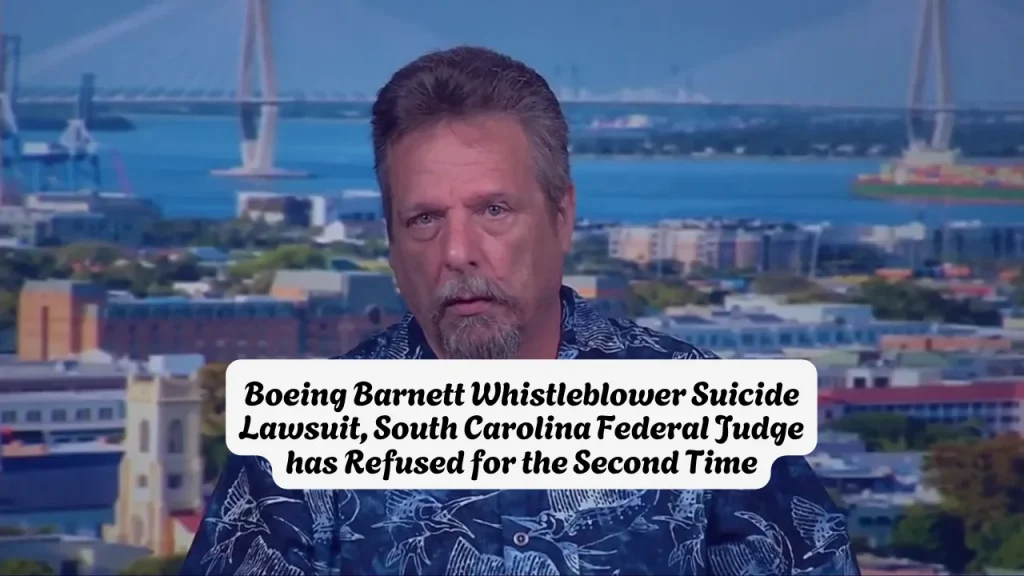
Boeing Barnett Whistleblower Suicide Lawsuit, South Carolina Federal Judge has Refused for the Second Time
A Judge Has Rejected Boeing’s Settlement — Twice
A South Carolina federal judge has refused — for the second time — to approve a $50,000 wrongful death settlement between Boeing and the family of John Barnett, the 787 whistleblower who died by suicide in March 2024. The most recent rejection came on April 17, 2026. The judge says she cannot determine whether the deal is fair without seeing the full financial terms of a related but confidential settlement. No payment has reached Barnett’s family. The case remains open.
Quick Facts Table
| Field | Detail |
| Case Name | Stokes et al. v. The Boeing Company |
| Court | U.S. District Court for the District of South Carolina |
| Judge | Hon. Bruce Howe Hendricks |
| Wrongful Death Settlement Amount | $50,000 |
| Settlement Status | Rejected — not yet approved |
| Payout to Family (If Approved) | $30,000 to Barnett’s mother; $20,000 to attorneys |
| Related Whistleblower Settlement | Confidential — approved Aug. 26, 2025 (amount sealed) |
| Boeing Admitted Liability? | No |
| Claim Form Open? | No — this is a private wrongful death case, not a class action |
| Next Hearing | TBD — third hearing not yet scheduled as of April 2026 |
| Official Case Status | Pending judicial approval |
Current Status & What Happens Next
- A South Carolina federal judge rejected the $50,000 settlement for the second time on April 17, 2026, citing her inability to evaluate fairness without seeing the confidential terms of the related whistleblower case.
- Boeing settled the separate Department of Labor whistleblower complaint on August 26, 2025, before a Labor Department judge in Virginia — but those terms were permanently sealed, citing competitive sensitivity.
- A third settlement hearing has not yet been scheduled. The judge has stated she will not rush the process.
What Is the Boeing Whistleblower Lawsuit About?
John Mitchell Barnett spent 32 years at Boeing, including seven as a first-level quality control manager at the 787 Dreamliner factory in North Charleston, South Carolina. Starting around 2013, he raised repeated safety concerns about substandard parts, malfunctioning emergency oxygen systems, and metal shavings left inside aircraft. Boeing’s own internal investigations corroborated several of his complaints, and the FAA ordered corrective action in 2017 related to his reports about non-conforming parts.
Despite those findings, Barnett alleged that Boeing management retaliated against him — demoting him, reassigning him, and subjecting him to a sustained “campaign of harassment, abuse and intimidation.” He filed a formal whistleblower complaint with OSHA in 2017 under the FAA’s AIR21 Whistleblower Protection Program. OSHA initially closed the case in Boeing’s favor in 2021 after a four-year investigation, but Barnett and his attorneys appealed and continued pursuing the case.
On March 9, 2024, Barnett failed to appear for his third day of deposition testimony in Charleston. Police found him dead inside his Dodge Ram pickup truck in the parking lot of a Holiday Inn on Savannah Highway. The Charleston County Coroner ruled his death a suicide by self-inflicted gunshot wound. A notebook found in the truck contained messages to his family and a direct appeal to God: “I pray Boeing pays.”
His mother, Vicky Stokes, and two brothers filed a wrongful death lawsuit against Boeing on March 19, 2025 — one year after his death. Their attorneys, including Robert Turkewitz, Brian Knowles, and high-profile litigator David Boies, argue Boeing’s sustained retaliation caused Barnett to develop PTSD, anxiety, panic attacks, and depression that ultimately led to his death. “Boeing had threatened to break John,” the lawsuit stated, “and break him it did.”
Related article: SpaceX Political Bias Lawsuit Against California Agency Settled, Terms of the Settlement have not Yet Been Publicly Disclosed
Who Is Affected By This Case?
This is a private wrongful death lawsuit, not a class action. There is no claim form for the public to file. The parties directly involved are:
- Vicky Stokes — Barnett’s mother and named plaintiff
- Barnett’s brothers — named in the suit and attending hearings remotely from Louisiana
- The Boeing Company — the defendant, which has denied that any of its actions contributed to Barnett’s death or injury
If you are a current or former Boeing employee who has faced similar whistleblower retaliation, this case does not provide a direct mechanism for you to receive compensation. However, it does establish a significant legal and public record. Former Boeing employees with retaliation claims should consult an employment attorney about individual options under the AIR21 Whistleblower Protection Program.
Why Has the Judge Rejected the Settlement — Twice?
This is the critical question the public wants answered, and the answer is unusually complicated.
Boeing and Barnett’s family reached not one but two settlements — packaged together as a “global settlement.” The first is the $50,000 wrongful death settlement that requires court approval. The second is the resolution of Barnett’s original Department of Labor whistleblower complaint, which a Labor Department judge in Virginia approved on August 26, 2025 — with all financial terms permanently sealed.
When both deals were presented together to Judge Hendricks on October 17, 2025, she refused to approve the wrongful death portion. Her reason: she could not evaluate whether $50,000 was a fair outcome for a wrongful death claim without knowing what Boeing agreed to pay in the related whistleblower case. The two cases, she found, were “inextricably intertwined.”
Boeing sought to keep the whistleblower settlement terms confidential, arguing disclosure would create a “competitive disadvantage.” The judge said that confidentiality was fine for the other court — but it left her unable to do her job in her own courtroom.
A second hearing in January 2026 produced a new wrinkle. Judge Hendricks found that Boeing was withholding the whistleblower settlement funds from the family — waiting for her to finalize the wrongful death deal first — even though another judge had already approved payment four months earlier. Boeing’s attorney said she believed the company would release the funds, but needed to confer with company officials before confirming. The judge cut the hearing short. “It’s, logistically, been unusual,” she said. “We’ve gone to this much trouble and this much time … I’m not going to rush.”
The April 17, 2026 rejection marks the third time the court has declined to close the case.
How Much Would the Family Receive If the Settlement Is Approved?
The wrongful death settlement totals $50,000, structured as follows:
- $30,000 to Vicky Stokes, Barnett’s mother
- $20,000 to her attorneys for legal fees and costs
Boeing admitted no liability in the agreement. The company stated it was “saddened by Mr. Barnett’s death” and denied that any act or omission on its part contributed to his injury or death.
The terms of the related whistleblower settlement — which may involve a substantially larger sum — remain permanently sealed by court order in Virginia. The total combined value of what Boeing ultimately pays the family will not become public unless litigation reopens or a court orders disclosure.
Important Dates & Timeline
| Milestone | Date |
| Barnett files AIR21 whistleblower complaint | January 2017 |
| Barnett retires from Boeing | March 2017 |
| OSHA closes case in Boeing’s favor | 2021 |
| Barnett & attorneys appeal OSHA ruling | 2021 |
| Barnett dies by suicide in Charleston | March 9, 2024 |
| Family files wrongful death lawsuit | March 19, 2025 |
| Initial settlement reached (undisclosed) | May 2025 |
| Whistleblower case settled (terms sealed) | August 26, 2025 |
| $50,000 wrongful death settlement filed with court | September 2025 |
| First settlement rejection by Judge Hendricks | October 17, 2025 |
| Second hearing — Boeing withholds funds issue raised | January 8, 2026 |
| Second rejection by Judge Hendricks | April 17, 2026 |
| Third hearing scheduled | TBD |
| Expected resolution | TBD |
Frequently Asked Questions
Do I need a lawyer to participate in the Boeing Barnett case?
This is not a class action — there is no public claim form. The case involves only Barnett’s family as plaintiffs. If you are a Boeing employee with a retaliation or whistleblower claim, you need to consult a licensed employment attorney about filing separately under the AIR21 Whistleblower Protection Program or other applicable law.
Is this lawsuit legitimate?
Yes. Stokes et al. v. The Boeing Company is a real federal civil case filed in the U.S. District Court for the District of South Carolina, presided over by Judge Bruce Howe Hendricks. Barnett’s whistleblower history, safety reports, and Boeing’s internal corroboration of some complaints are thoroughly documented in court filings, FAA records, and the 2022 Netflix documentary Downfall: The Case Against Boeing.
When will the Boeing settlement be finalized and paid?
No date is confirmed. The judge has declined to rush the process. A third hearing has not been scheduled as of April 2026. The case could resolve quickly if Boeing agrees to disclose the whistleblower settlement terms to the court, or it could continue for months if the confidentiality dispute is not resolved.
What if the settlement is never approved — will this go to trial?
Potentially. If the parties cannot resolve the confidentiality impasse to the judge’s satisfaction, they may need to renegotiate the settlement terms, seek a higher court ruling on the confidentiality issue, or allow the wrongful death case to proceed toward trial. Attorney David Boies has previously stated he believes Boeing will fight hard to prevent a jury from hearing the wrongful death claims.
Will the settlement payment affect taxes?
Wrongful death settlement proceeds are generally not taxable under federal law when they compensate for physical injury or death. However, any portion allocated to emotional distress or punitive damages may be treated differently. The Barnett family should consult a tax professional once payment is received.
Why is $50,000 considered low for a wrongful death case?
Wrongful death damages vary enormously based on the decedent’s age, income, dependents, and circumstances. Barnett was 62 at his death, retired, and living in Louisiana. The $50,000 wrongful death figure in the public filing may not represent the total value of the global settlement — the confidential whistleblower resolution may include substantially more. The judge’s reluctance to approve the deal without seeing the full picture suggests she shares that concern.
What safety concerns did Barnett raise about Boeing?
Barnett documented and reported multiple issues at Boeing’s 787 factory in North Charleston, including improperly installed parts, metal shavings found inside aircraft that could damage wiring or fuel lines, and malfunctioning emergency oxygen systems. Boeing’s own internal investigations confirmed some of his findings, and the FAA ordered corrective action in 2017 related to his reports. He also alleged that management pressured workers not to document defects — prioritizing production speed over safety.
What happened to Boeing’s broader safety troubles after Barnett’s death?
At the time of Barnett’s death in March 2024, Boeing was already under federal scrutiny following a January 2024 incident in which a door-plug panel blew out of an Alaska Airlines 737 Max 9 mid-flight. The FAA launched investigations into Boeing’s quality control processes across multiple facilities. Barnett’s death intensified public and congressional attention on Boeing’s safety culture.
Sources & References
- Stokes et al. v. The Boeing Company — U.S. District Court for the District of South Carolina (PACER docket)
- Law360, Jonathan Capriel — “Judge Again Rejects Boeing Whistleblower Suicide Settlement,” April 17, 2026
- Post and Courier, John McDermott — Settlement hearing coverage, October 2025 and January 2026
- NPR — “Whistleblower John Barnett’s Family Files Wrongful Death Suit Against Boeing,” March 21, 2025: npr.org
- FAA AIR21 Whistleblower Protection Program — Official information: osha.gov
If you or someone you know is struggling, call or text 988 to reach the Suicide & Crisis Lifeline, available 24/7.
Last Updated: April 20, 2026
Disclaimer: This article is for informational purposes only and does not constitute legal advice. Legal claims and outcomes depend on specific facts and applicable law. For advice regarding a particular situation, consult a qualified attorney.
About the Author
Israr Ahmad is a legal content researcher with 4+ years of experience covering class action settlements and consumer rights cases. He has researched and published coverage of 2,500+ settlements using verified court records, settlement administrator filings, and government sources. Learn more about Israr.