
South Central Bank $2.8M Improper Overdraft Fee Settlement, No Claim Form Required Here Is How to Get Your Payment
The South Central Bank overdraft fee settlement is a $2,800,000 class action resolution where current and former account holders charged certain improper overdraft or nonsufficient funds fees between October 4, 2009 and December 31, 2025 will receive automatic payments — no claim form required. South Central Bank, a Kentucky community bank with 26 branches across the state, denied any wrongdoing but agreed to settle claims that it violated its own account terms, the duty of good faith and fair dealing, and the Kentucky Consumer Protection Act.
Quick Facts — South Central Bank Overdraft Fee Settlement
| Field | Detail |
| Settlement Amount | $2,800,000 |
| Claim Deadline | None — payments are automatic. No claim form required. |
| Who Qualifies | South Central Bank account holders charged APSN overdraft fees (Oct. 4, 2009 – Oct. 8, 2018) or retry NSF fees (Oct. 4, 2009 – Dec. 31, 2025) |
| Payout Per Person | Pro-rata — based on total improper fees you paid vs. all class members combined |
| Proof Required | No — the administrator uses bank records to identify and pay you automatically |
| Settlement Status | Preliminarily Approved — pending final court approval July 7, 2026 |
| Administrator | Verita Global |
| Case Number | 19-CI-01559 |
| Official Website | johnsonoverdraftclassaction.com |
| Last Updated | May 19, 2026 |
Current Status and What Happens Next
- The settlement has received preliminary approval and is awaiting the final fairness hearing on July 7, 2026.
- If you are eligible, you do not need to file anything. Verita Global will identify class members directly from South Central Bank’s records and pay you automatically.
- Your opt-out deadline is 30 days after you receive the notice from South Central Bank — check your mailed notice for the exact date. If you do nothing, you will receive your payment and give up the right to sue the bank separately for these specific claims.
What Is the South Central Bank Lawsuit About? Johnson v. South Central Bank, Case No. 19-CI-01559
If you banked with South Central Bank at any point over the past decade and a half, you may have been hit with fees that the lawsuit says should never have been charged in the first place.
The case centers on two specific types of overdraft and NSF fees. The first is what the lawsuit calls an APSN fee — an overdraft fee charged on a debit card purchase that the bank already approved when your balance was sufficient, but later charged a fee on when the transaction actually settled. The problem, the lawsuit argues, is that the bank already said “yes” to the transaction when your account had money. Charging a fee after the fact breaks the bank’s own contractual promises. The second type is a retry fee — an NSF fee charged the second or third time the bank attempts to process the same item that was previously returned for insufficient funds. The lawsuit says charging multiple fees on one item violates both the account agreement and basic consumer protection standards.
Related article: $5.55M Teva, Granules & Heritage Metformin NDMA Settlement, Do You Qualify for a Payment? File Your Claim by July 10
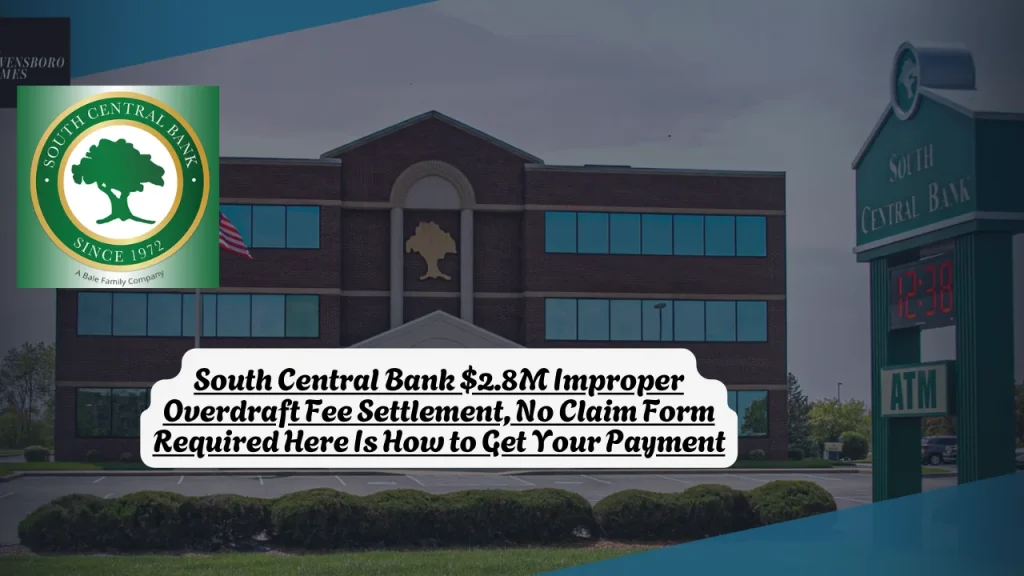
South Central Bank is a family-owned Kentucky community bank that has served customers across the state for over 50 years, with 26 locations primarily in South Central and Western Kentucky. The lawsuit was filed in Kentucky state court and alleges violations of the Kentucky Consumer Protection Act, as well as breach of contract and breach of the duty of good faith and fair dealing. The bank denied these allegations but agreed to pay $2,800,000 to resolve the case rather than proceed to trial. For context on how banks have faced similar consumer law claims across the country, see our guide to overdraft fee class action lawsuits and how they work at AllAboutLawyer.com.
Are You Part of the South Central Bank Class Action?
This settlement covers a long time period — over 16 years for retry fees — so even if you closed your account years ago, you may still be included.
You may be part of this class if:
- You held a checking account at South Central Bank at any point and were charged an APSN overdraft fee on a signature-based debit card transaction between October 4, 2009 and October 8, 2018
- You were charged an overdraft or NSF fee on the second or third presentation of an item that was previously returned for insufficient funds (a retry fee) between October 4, 2009 and December 31, 2025
- You are a current or former account holder anywhere in South Central Bank’s Kentucky branch network
You are likely NOT included if:
- You were never charged either of these specific fee types during the relevant date ranges
- You choose to opt out by your individual opt-out deadline (30 days from receiving the notice)
Not sure if you were charged these fees? Contact Verita Global at 888-808-9516 or email [email protected] — they have South Central Bank’s records and can confirm your status. Former account holders who have moved should update their mailing address immediately so a check reaches them.
If you believe your individual losses from improper bank fees were unusually large and you want to explore independent legal options, a free legal consultation with a consumer rights lawyer can help you understand whether opting out makes sense for your situation.
How Much Can You Get from the South Central Bank Settlement?
Your payment depends entirely on how much you personally paid in APSN or retry fees during the class period — and how that compares to every other eligible class member.
The pro-rata formula works like this: your share of challenged fees divided by all class members’ total challenged fees, multiplied by the net settlement fund. The more fees the bank improperly charged you, the larger your payment.
From the $2,800,000 total fund, the following will be deducted first: attorneys’ fees and expenses up to $933,333.33, a service award of $10,000 to the class representative Jean Johnson, and settlement administration costs. Whatever remains after those deductions is your pool.
There is no cap on individual payments — you cannot receive more than the total fees you were actually charged, but there is no artificial ceiling below that. If funds remain after the first round of payments and the average second distribution would be more than $5, a second payment round goes out. Any leftover funds that cannot be meaningfully distributed go to the Community Foundation of South Central Kentucky.
How You Receive Your South Central Bank Settlement Payment
You do not need to file a claim form. This is one of the simplest settlements you will encounter — your bank did the record-keeping, and Verita Global is using those records to pay you.
- Current South Central Bank account holders will have the payment credited directly to their account
- Former account holders will receive a paper check mailed to the address on file — you must cash it within 120 days or the funds may be redistributed
- If your address has changed since closing your account, contact Verita Global at 888-808-9516 or write to: Johnson v. South Central Bank Settlement Administrator, P.O. Box 301130, Los Angeles, CA 90030-1130
Do not wait to update your address. Checks sent to an old address that go uncashed after 120 days are gone.
South Central Bank Settlement Key Dates
| Milestone | Date |
| Lawsuit Filed | 2019 (Case No. 19-CI-01559) |
| Opt-Out Deadline | 30 days after receiving your individual notice |
| Final Fairness Hearing | July 7, 2026 |
| Expected Payment Date | TBD — after final court approval and resolution of any appeals |
Frequently Asked Questions
Is there a class action lawsuit against South Central Bank?
Yes. Johnson v. South Central Bank, Case No. 19-CI-01559, is a class action lawsuit alleging the bank charged improper APSN overdraft fees and retry NSF fees spanning as far back as October 2009. The bank agreed to a $2,800,000 settlement, which is now pending final court approval at the July 7, 2026 hearing.
Do I need to file a claim form to get paid?
No. This is an automatic payment settlement. Verita Global identifies eligible class members using South Central Bank’s own records and sends payments without any action required from you. Former account holders should update their mailing address to ensure their check arrives.
When will I receive my South Central Bank settlement payment?
Payments will go out after the court grants final approval at the July 7, 2026 hearing and any appeals are resolved. If no appeals are filed, payments could begin in late 2026. Patience is required — the timeline depends on the court.
Do I need to do anything right now to be included?
If your address with South Central Bank is current, you need to do nothing. If you are a former account holder who has moved, contact Verita Global at 888-808-9516 or [email protected] to update your address before checks are mailed.
Can I file my own lawsuit against South Central Bank instead?
Yes, but only if you opt out of this settlement. To opt out, you must send a written request by the deadline stated in your individual notice — which is 30 days from the date you receive it. If you stay in the class, you cannot separately sue the bank for these specific fee claims.
How will I know if the South Central Bank lawsuit settles?
The settlement has already been reached and received preliminary court approval. Monitor johnsonoverdraftclassaction.com for final approval updates and payment timing announcements.
Will my settlement payment be taxable?
Possibly. Payments that compensate you for economic loss on a bank account — like improperly charged fees being returned — may be taxable depending on your individual tax situation. Consult a tax professional after receiving your payment for guidance specific to your circumstances.
What happens if the check sent to me goes uncashed?
Former account holders who receive a check must cash it within 120 days. If the check goes uncashed after that window, the settlement administrator may redistribute those funds. Contact Verita Global immediately if you do not receive a check after final approval and payments begin.
Sources & References
- Official Settlement Website: johnsonoverdraftclassaction.com
- Settlement Agreement: johnsonoverdraftclassaction.com/media/6942454/scbj_settlement_agreement.pdf
- Important Dates & Deadlines: johnsonoverdraftclassaction.com/important-dates-deadlines.aspx
- Case filed in Kentucky state court as Johnson v. South Central Bank, Case No. 19-CI-01559
Prepared by the AllAboutLawyer.com Editorial Team and reviewed for factual accuracy against official court records and the settlement administrator website on May 19, 2026. Last Updated: May 19, 2026
Disclaimer: This article is for informational purposes only and does not constitute legal advice. Legal claims and outcomes depend on specific facts and applicable law. For advice regarding a particular situation, consult a qualified attorney.
About the Author
Israr Ahmad is a legal content researcher with 4+ years of experience covering class action settlements and consumer rights cases. He has researched and published coverage of 2,500+ settlements using verified court records, settlement administrator filings, and government sources. Learn more about Israr.