
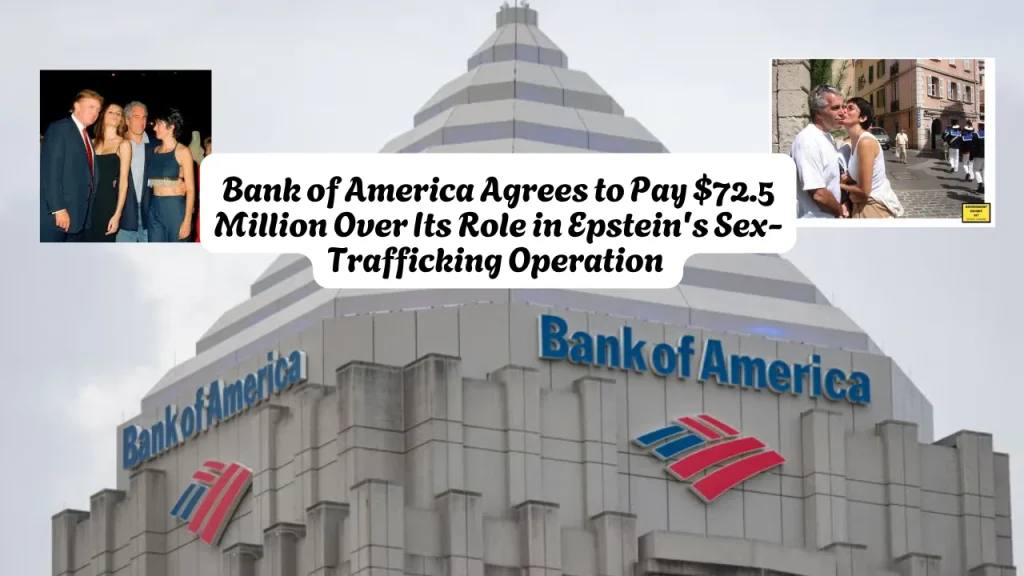
Bank of America Agrees to Pay $72.5 Million Over Its Role in Epstein’s Sex-Trafficking Operation
Bank of America agreed to pay $72.5 million to settle a civil lawsuit brought by women who accused the bank of facilitating their sexual abuse by Jeffrey Epstein. The settlement — the fourth of its kind against a major U.S. bank — still requires approval from U.S. District Judge Jed Rakoff, who scheduled a hearing to consider the deal. It closes one of the last major financial institution cases tied to Epstein’s trafficking network.
| Field | Detail |
| Settlement Amount | $72,500,000 |
| Defendant | Bank of America Corp. |
| Plaintiff | Jane Doe and all others similarly situated |
| Case Number | 25-cv-08520 |
| Court | U.S. District Court, Southern District of New York |
| Presiding Judge | Judge Jed S. Rakoff |
| Law | Federal Trafficking Victims Protection Act |
| Settlement Status | Pending judicial approval |
| Approval Hearing | Scheduled (March 2026) |
| Attorneys for Plaintiffs | David Boies and Bradley Edwards |
Where things stand right now:
- The settlement details were presented to Judge Rakoff on March 27, 2026, after the parties had earlier announced only a “settlement in principle” on March 16 without disclosing financial terms.
- The deal still requires Rakoff’s formal approval before it becomes final and binding.
- The same legal team is also appealing Rakoff’s January dismissal of a similar lawsuit they brought against Bank of New York Mellon.
What Bank of America Was Actually Accused of Doing
The lawsuit accused Bank of America of ignoring numerous red flags of improper financial dealings and going far beyond what a non-complicit bank would have done — instead allegedly helping Epstein set up the financial structure necessary to operate his sex-trafficking venture.
At the center of the allegations is a pattern of financial transactions the plaintiffs say the bank should have flagged and reported to federal authorities. Banks are required by law to file Suspicious Activity Reports — known as SARs — with federal regulators when customer transactions suggest potential criminal activity such as money laundering or fraud. The lawsuit alleged that Bank of America failed to file those reports until after Epstein’s death in 2019.
Unlike the earlier JPMorgan Chase and Deutsche Bank cases, which focused primarily on Epstein’s own banking relationships, the Bank of America lawsuit mainly targeted accounts allegedly used by his co-conspirators, associates, and victims. The bank maintained throughout the litigation that it provided only routine banking services and called the accusations “threadbare and meritless.”
Related article: Goldman Sachs, JPMorgan, and BofA to Pay $125 Million Over Zymergen’s Collapsed IPO
The Leon Black Connection and the $170 Million Thread
The most financially significant allegation in the case ties directly to Leon Black, the billionaire co-founder of Apollo Global Management.
The lawsuit said that Black transferred $170 million to Epstein from a Bank of America account, purportedly for “tax and estate planning advice,” and alleged those transfers were the primary means by which Epstein’s sex-trafficking venture was funded, with no apparent business or lawful purpose.
Though not named as a defendant in the lawsuit, Black was described as a “critical witness” by Sigrid McCawley, a lawyer for Epstein’s victims. Black was originally scheduled to sit for an eight-hour closed-door deposition on March 26, 2026 — the day before settlement terms were disclosed. His lawyer persuaded Judge Rakoff to delay that deposition on the grounds that the parties were close to settling, and the settlement agreement effectively allowed Black to avoid testifying.
Black in 2023 separately agreed to pay the U.S. Virgin Islands $62.5 million, which released him from potential legal claims related to Epstein by that government. He has consistently denied wrongdoing.
How Jane Doe’s Story Anchors the Case
The lawsuit was brought on behalf of a woman identified in court papers only as Jane Doe and “all others similarly situated.” The filing describes how she was living in Russia when she met Epstein in 2011 and was coerced into what the lawsuit calls a “cult-like life.”
According to the lawsuit, Epstein sexually abused her on at least 100 occasions — including rape — over a period spanning from 2011 through 2019. Epstein paid her rent and a salary from a phony job through a Bank of America account, and held her immigration status over her head until his death freed her from his control.
The suit also alleged that Epstein’s former girlfriend Ghislaine Maxwell used accounts at Bank of America. Maxwell was convicted of sex-trafficking in 2021 and is currently serving a 20-year prison sentence. Lawyers in the case stated they are aware of at least 60 women victimized by Epstein during the class period.
Where Bank of America’s $72.5 Million Fits in the Broader Epstein Bank Litigation
This settlement does not stand alone — it is the final chapter in a years-long legal effort to hold Epstein’s financial enablers accountable.
It is the fourth settlement by a major bank over claims related to Epstein’s sex-trafficking operation. In 2023, JPMorgan Chase agreed to pay Epstein victims $290 million and separately paid the U.S. Virgin Islands $75 million. Deutsche Bank that same year agreed to pay victims $75 million.
The same plaintiffs’ attorneys — David Boies and Bradley Edwards — secured all four settlements. In a joint court filing, Boies and Edwards said the settlement represented the best option for their clients “given that many class members suffered harm many years ago and are in need of financial relief now.”
In January 2026, Judge Rakoff had already narrowed the case by dismissing several claims but allowed the core allegations to proceed — that Bank of America knowingly benefited from Epstein’s conduct and obstructed enforcement of the federal Trafficking Victims Protection Act. That ruling put real trial risk on the table for the bank, making settlement the more pragmatic path.
Bank of America issued a statement saying: “While we stand by our prior statements made in the filings in this case, including that Bank of America did not facilitate sex trafficking crimes, this resolution allows us to put this matter behind us and provides further closure for the plaintiffs.”
What Happens Next in the Bank of America Epstein Case
The settlement is not yet final. Judge Rakoff must formally approve it, evaluate whether the terms are fair and adequate for all class members, and determine whether the settlement fund distribution plan is reasonable.
If approved, the $72.5 million will be distributed among the class of women identified as having been victimized by Epstein and connected to Bank of America’s alleged financial facilitation. Distribution terms and any remaining litigation involving Bank of New York Mellon — whose dismissal the same legal team is currently appealing — will continue to unfold separately.
Frequently Asked Questions
What did Bank of America actually do that led to this lawsuit?
The lawsuit alleged Bank of America knowingly processed suspicious financial transactions tied to Epstein’s trafficking network without filing legally required Suspicious Activity Reports with federal regulators. The bank allegedly failed to file those reports until after Epstein’s death in 2019, allowing his operation to continue undetected.
Who filed the lawsuit against Bank of America?
The lawsuit was filed in October 2025 on behalf of a woman identified only as Jane Doe and “all others similarly situated” — women who were victimized by Epstein and whose abuse was allegedly facilitated through Bank of America accounts.
Why is Leon Black significant to this case?
Black, co-founder of Apollo Global Management, was described as a critical witness. The lawsuit alleged he transferred $170 million to Epstein from a Bank of America account with no apparent lawful business purpose — transactions the bank allegedly should have flagged and reported to federal authorities.
Did Bank of America admit wrongdoing?
No. Bank of America stated it stands by its prior court filings, including its position that it did not facilitate sex trafficking crimes, but agreed to settle to put the matter behind it and provide closure to plaintiffs.
How does this settlement compare to other Epstein bank settlements?
JPMorgan Chase paid $290 million to Epstein victims in 2023 and separately paid the U.S. Virgin Islands $75 million. Deutsche Bank paid victims $75 million the same year. Bank of America’s $72.5 million brings the total recovered from major banks to over $500 million.
Is the settlement final?
Not yet. The deal still requires approval from U.S. District Judge Jed Rakoff in Manhattan. A hearing was scheduled to review the agreement in late March 2026.
What happened to Epstein?
Epstein died in a federal jail cell in August 2019 while awaiting trial on sex trafficking charges. New York City’s medical examiner ruled his death a suicide.
Sources & References
- Bloomberg Law (March 27, 2026): BofA to Pay $72.5 Million to Settle Epstein Victim Lawsuit
- CBS News (March 27, 2026): Bank of America reaches $72.5 million settlement in Epstein lawsuit
- CNBC (March 27, 2026): Epstein victims to get $72.5M from Bank of America settlement
- PBS NewsHour (March 17, 2026): Bank of America settles lawsuit brought on behalf of Jeffrey Epstein victims
- Court docket: Doe v. Bank of America, Case No. 25-cv-08520, U.S. District Court, Southern District of New York
Last Updated: March 28, 2026
Disclaimer: This article is for informational purposes only and does not constitute legal advice. Legal claims and outcomes depend on specific facts and applicable law. For advice regarding a particular situation, consult a qualified attorney.
About the Author
Israr Ahmad is a legal content researcher with 4+ years of experience covering class action settlements and consumer rights cases. He has researched and published coverage of 2,500+ settlements using verified court records, settlement administrator filings, and government sources. Learn more about Israr.