
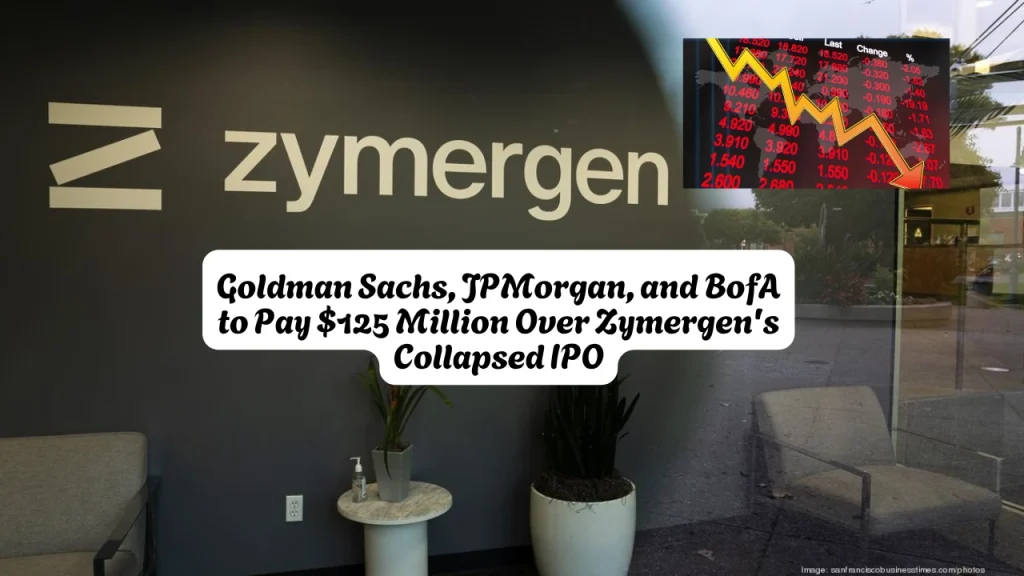
Goldman Sachs, JPMorgan, and BofA to Pay $125 Million Over Zymergen’s Collapsed IPO
Goldman Sachs & Co. LLC, BofA Securities Inc., JP Morgan Securities LLC, and the other architects of bankrupted biotech company Zymergen Inc.’s short-lived market debut agreed to pay $125 million to settle an investor class action. The deal, proposed to U.S. District Judge P. Casey Pitts in the Northern District of California on March 26, 2026, closes a nearly five-year legal battle over one of the most dramatic IPO collapses in recent biotech history — a company that raised $530 million from investors and went bankrupt less than three years later.
| Field | Detail |
| Settlement Amount | $125,000,000 |
| Case Name | Wang v. Zymergen Inc., et al. |
| Case Number | 5:21-cv-06028-PCP |
| Court | U.S. District Court, Northern District of California |
| Presiding Judge | Judge P. Casey Pitts |
| Lead Plaintiff | Biao Wang (on behalf of all Zymergen IPO investors) |
| Lead Counsel | Robbins Geller Rudman & Dowd LLP |
| Settlement Status | Proposed — pending judicial approval |
| Date Proposed | March 26, 2026 |
| Settlement Website | zymergensecuritieslitigation.com |
Where things stand right now:
- The settlement was proposed to Judge Pitts on March 26, 2026, and still requires court approval before it becomes final and binding.
- The parties had filed a joint stipulation to stay proceedings in November 2025, signaling that settlement talks were underway before the formal proposal.
- A preliminary approval hearing date has not yet been publicly confirmed — check zymergensecuritieslitigation.com for updates.
How Zymergen Raised $530 Million and Collapsed Within Four Months
To understand why this settlement is so significant, you have to understand just how fast Zymergen fell apart after its IPO.
Zymergen raised approximately $530 million through its IPO in April 2021, touting its “biofacturing” process and its only commercially available product — an electronics optical film called Hyaline — as the gateway to a $1 billion display market. The IPO was led by JPMorgan and Goldman Sachs, priced at $31 per share, and initially surged as high as $52.
Less than four months after its IPO, Zymergen revealed “issues with its commercial product pipeline” that would impact the company’s delivery timeline and revenue projections. The company said it no longer expected product revenue in 2021 and expected only immaterial revenue in 2022. The CEO also stepped down the same day. The stock collapsed from $26.58 to $8.25 overnight — a plunge of nearly 70%. News reports at the time compared the company to Theranos.
The SEC later found that Zymergen’s claimed $1 billion market opportunity for Hyaline was based on flawed and unreasonable assumptions, and that the company provided misleading revenue forecasts to research analysts that far exceeded its own internal estimates. The company agreed to pay a $30 million civil penalty to resolve the SEC’s charges — without admitting or denying wrongdoing. By October 2023, the company filed for Chapter 11 bankruptcy, and Zymergen shareholders received Ginkgo Bioworks shares at a rate that valued their holdings at less than one-tenth of the original IPO price.
Who the Investors Are Suing — and Why the Banks Are on the Hook
The Zymergen case is unusual because it targets not just the company itself — which is now bankrupt — but the entire network of banks, venture capital firms, and executives who put the IPO together and signed off on its registration statement.
The settling defendants include the bank underwriters, Zymergen executives and directors, and three major early investors with their related funds that had the right to place board members: SoftBank’s SB Investment Advisers (US) Inc., DCVC Management Co., and True Venture Management LLC.
The full underwriter group for Zymergen’s IPO consisted of JP Morgan, Goldman Sachs, BofA Securities, Cowen and Company, UBS Securities, and Lazard Capital Markets. Under Section 11 of the Securities Act, underwriters who sign or are associated with a misleading registration statement can be held strictly liable to investors who purchased shares — even if they did not personally create the false statements.
Related article: MAPFRE Waited Too Long to Sue the Man Who Posed as an Adjuster for a $48M Hurricane Maria Claim
Lead plaintiff Biao Wang, representing investors who bought Zymergen stock, claimed that the registration statement for Zymergen’s public offering was inaccurate and misleading. He sought damages from the company, its underwriters, and the board members and executives who signed the statement. He also asserted that SoftBank, DCVC, and True Ventures are liable because they controlled Zymergen and the three board members they each appointed.
The SoftBank, DCVC, and True Ventures Control Person Claims
One of the most legally complex threads in this case involves whether Zymergen’s three largest pre-IPO investors are liable as “control persons” under federal securities law — a question that generated years of motions and appeals before settlement.
SoftBank was Zymergen’s largest pre-IPO investor, having put in around $404 million and receiving the right to appoint a board member who would sit on every board committee. DCVC invested around $44 million and received the right to appoint one board member. True Ventures invested around $75 million and also received the right to appoint a board member. Together, these three investors owned more than half of Zymergen’s outstanding shares before the public offering and nearly 60% of its preferred shares.
Zymergen’s governance documents required that the company obtain approval from at least two of these three investors for most business matters — including adopting any budget or business plan and hiring executives. That level of structural control became the foundation of the Section 15 “control person” claims investors pressed against the venture firms, which all three disputed aggressively through multiple rounds of motions to dismiss.
The court ultimately allowed those claims to proceed, and the pressure of going to trial — with discovery already deep into the venture firms’ internal communications — appears to have driven the settlement.
What the Zymergen Collapse Reveals About IPO Due Diligence
According to the SEC, Zymergen’s finance team developed revenue forecasts for the IPO without consulting with its own sales team, and in one instance jawboned the sales team to significantly increase its internal estimates — in some cases more than doubling them — before presenting those figures to research analysts and investors.
The registration statement omitted that key customers had encountered serious technical issues during the qualification process for Hyaline, including product shrinkage and incompatibility with customers’ manufacturing processes, and that Zymergen lacked visibility into that qualification process entirely. In short, the company knew its flagship product had serious real-world problems before it went public — and those problems never made it into the IPO prospectus that Goldman, JPMorgan, BofA, and the other underwriters put their names on.
The case has drawn comparisons to Theranos not just in how quickly it unraveled, but in what it says about the gap between Silicon Valley’s culture of speculative hype and the legal obligations companies and their bankers take on when they access public capital markets.
Key Dates in the Zymergen Securities Litigation
| Milestone | Date |
| Zymergen IPO (at $31/share) | April 26, 2021 |
| Zymergen discloses pipeline failure, CEO resigns | August 2021 |
| Stock collapses ~70% overnight | August 2021 |
| First investor lawsuit filed | August 4, 2021 |
| Biao Wang appointed lead plaintiff | December 20, 2021 |
| Court denies motions to dismiss (Section 11 claims) | November 29, 2022 |
| Class certified | August 11, 2023 |
| Zymergen files Chapter 11 bankruptcy | October 3, 2023 |
| SEC charges Zymergen, imposes $30M penalty | September 13, 2024 |
| Parties stipulate to stay proceedings | November 25, 2025 |
| $125M settlement proposed to Judge Pitts | March 26, 2026 |
| Preliminary approval hearing | TBD |
| Final approval hearing | TBD |
Frequently Asked Questions
Who can recover money from the Zymergen IPO settlement?
The class consists of investors who purchased Zymergen shares in or traceable to the April 2021 IPO, before the company disclosed its product pipeline failures in August 2021. If you bought Zymergen stock at or around the IPO price and suffered losses when the stock collapsed, you may be part of the class. Check zymergensecuritieslitigation.com for eligibility details once the settlement is formally approved.
Why are Goldman Sachs, JPMorgan, and BofA paying — they didn’t make the product?
Under Section 11 of the Securities Act, investment banks that underwrite an IPO are legally responsible for the accuracy of the registration statement they help bring to market. If the prospectus contained materially false or misleading statements, investors can sue the underwriters directly — regardless of whether the banks personally drafted the misstatements.
Did any of the defendants admit wrongdoing?
No. As is standard in securities class action settlements, all defendants denied any wrongdoing. The settlement was agreed to avoid the cost, risk, and uncertainty of continuing to trial.
What happened to Zymergen’s executives?
CEO Josh Hoffman stepped down when Zymergen disclosed its product failures in August 2021. Cofounder Jed Dean also left the company. Both were named as defendants in the lawsuit along with CFO Enakshi Singh and other board members and executives who signed the registration statement.
Is this the end of the Zymergen litigation?
This $125 million settlement resolves the main investor class action against the underwriters, executives, and venture capital investors. The SEC already separately settled with Zymergen itself for a $30 million civil penalty. The settlement still needs Judge Pitts’s approval before it becomes final.
Do I need a lawyer to participate in the Zymergen settlement?
Individual class members typically do not need to hire personal attorneys. Once the settlement is approved, a claims administrator will notify class members and provide instructions for filing a claim. Lead counsel, Robbins Geller Rudman & Dowd LLP, represents the class collectively.
When will Zymergen settlement payments go out?
Payments will not go out until after Judge Pitts grants final approval and any appeal period runs. Given the settlement was only proposed in late March 2026, the earliest realistic payment window is likely late 2026 at the earliest — and potentially into 2027 if there are objections or appeals.
Sources & References
- Court Docket: Wang v. Zymergen Inc., et al., Case No. 5:21-cv-06028-PCP, U.S. District Court, N.D. California
- Official settlement website: zymergensecuritieslitigation.com
Last Updated: March 28, 2026
Disclaimer: This article is for informational purposes only and does not constitute legal advice. Legal claims and outcomes depend on specific facts and applicable law. For advice regarding a particular situation, consult a qualified attorney.
About the Author
Israr Ahmad is a legal content researcher with 4+ years of experience covering class action settlements and consumer rights cases. He has researched and published coverage of 2,500+ settlements using verified court records, settlement administrator filings, and government sources. Learn more about Israr.