
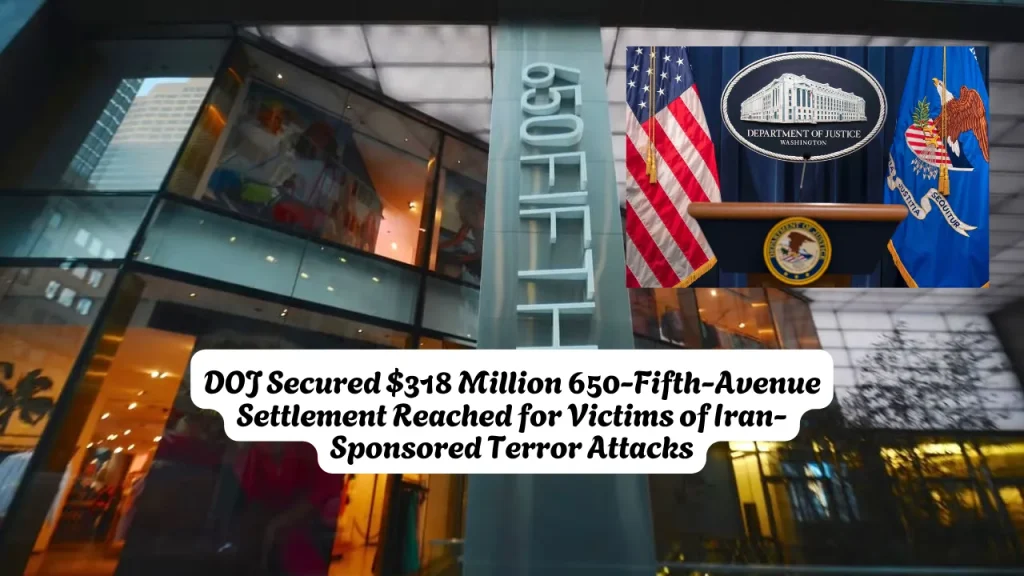
DOJ Secured $318 Million 650-Fifth-Avenue Settlement Reached for Victims of Iran-Sponsored Terror Attacks
After 17 years of federal litigation, the U.S. Attorney’s Office for the Southern District of New York announced a $318 million settlement compensating hundreds of victims of Iranian state-sponsored terrorism. The funds come from the sale of 650 Fifth Avenue, a 36-story Manhattan office tower that secretly concealed Iranian government financial interests for decades. The case finally closed in January 2025, with the first payments issued March 20, 2026.
Quick Facts
| Field | Detail |
| Settlement Amount | $318,000,000 |
| First Payment Issued | March 20, 2026 |
| Remaining Payment | $189 million over three years, plus interest |
| Who Qualifies | Existing judgment creditors against the Government of Iran for terrorism-related injuries |
| New Claims Open? | No — eligibility limited to existing court judgment holders |
| Settlement Status | Finally approved (January 2025) |
| Presiding Court | SDNY, Case No. 1:08-cv-10934-LAP |
| U.S. Attorney | Jay Clayton, Southern District of New York |
Where the Money Stands Right Now
- The initial $129 million installment was completed on March 20, with the remaining $189 million to be paid over three years with interest.
- To fund the settlement, the new building ownership took on a $200 million mortgage secured by the Fifth Avenue property, carrying a 7% annual interest rate for a three-year term.
- The Alavi Foundation is transferring its entire asset portfolio, including its 60% stake in the tower, to a new Delaware charitable corporation called the Amir Kabir Foundation.
How a Manhattan Skyscraper Became Iran’s Hidden Cash Machine
The building at 650 Fifth Avenue was originally constructed by a charitable foundation controlled by the former Shah of Iran. After the 1979 revolution, the Islamic Republic seized control of the foundation and created a partnership with Bank Melli Iran — an Iranian government-owned bank sanctioned by the U.S. for financing Iran’s weapons programs.
Bank Melli allegedly used front companies to maintain its stake in the building and bypass U.S. sanctions, allowing Iran to generate income from the property while concealing ownership. The arrangement funneled tens of millions in rental income from Midtown Manhattan back to Tehran for years.
The U.S. Attorney’s office filed a forfeiture complaint against Bank Melli Iran’s interest in the building in October 2008 and amended the complaint in 2009. Numerous groups of victims holding judgments against Iran then filed claims against the building and its owners. The case went all the way to the Supreme Court before Iran’s side ultimately lost.
Related article: Colony Ridge Predatory Lending 68 Million Settlement, Zero Cash for Borrowers, Here’s What You Actually Get
Who the Settlement Covers — and Who It Does Not
This settlement does not work like a typical consumer class action where new people can sign up to file a claim. The compensation goes exclusively to people who already hold federal court judgments against the Government of Iran for terrorism-related harm. If you do not already have such a judgment, you cannot participate in this specific settlement.
Those covered include:
- Victims of attacks attributed to Iranian-backed groups, including the 1984 bombing of U.S. military facilities in Beirut and the September 11 attacks
- Families and estates of victims of the 2001 Sbarro restaurant bombing in Jerusalem, multiple 1990s suicide bombings targeting Israeli civilians, and the family of Rabbi Meir Kahane, assassinated in 1990
- Holders of more than $5 billion in terrorism-related judgments against Iran were involved in the litigation, including estates of victims killed in the September 11, 2001 attacks
What Each Victim Actually Receives
Individual payout amounts are not publicly set at a flat per-person figure. The $318 million gets distributed among hundreds of judgment creditors proportionally, based on the size and nature of each existing court judgment.
The settlement consists of an initial payment of $129 million and a deferred payment of $189 million to be paid in three years, plus interest. Victims who already received conditional payments through the separate U.S. Victims of State Sponsored Terrorism Fund may have had to make an election between the two programs. Exact individual amounts remain TBD pending distribution among claimants.
Key Dates in the Case
| Milestone | Date |
| U.S. Forfeiture Complaint Filed | October 2008 |
| Earlier Partial Settlements | 2014, 2017 |
| Final Settlement Agreement Signed | January 2025 |
| First Payment ($129M) Issued | March 20, 2026 |
| Remaining Payment ($189M) Due | Within three years of March 2026 |
| New Claims Open to Public | No |
Frequently Asked Questions
Can I still file a claim for this settlement?
No. This settlement compensates victims who already obtained federal court judgments against the Government of Iran before the case resolved. It is not open to new public claims. If you believe you have a qualifying terrorism-related injury, you would need to pursue a separate legal action to obtain a judgment first.
Is this settlement legitimate?
Yes. The U.S. Attorney’s Office for the Southern District of New York announced the settlement, and it was reached through 17 years of federal litigation overseen by Judge Loretta Preska. The funds come from a court-supervised forfeiture of Iranian government-linked real estate assets.
When will victims receive their money?
The initial $129 million was paid out on March 20, 2026, with the remaining $189 million scheduled over the following three years with interest. Individual payment timing depends on the claims administrator distributing among hundreds of judgment holders.
Do victims need a lawyer to receive payment under this settlement? Existing judgment holders are already represented through the litigation process. Anyone who believes they may have an unresolved claim against Iran for terrorism-related harm should consult a qualified attorney, as pursuing such cases requires specialized legal expertise.
Will this settlement payment affect recipients’ taxes?
Taxation of terrorism-related legal settlements can be complex and varies based on individual circumstances, including how the original judgment was classified. Victims should consult a tax professional before assuming the funds are non-taxable.
Why did it take 17 years to reach this outcome?
Iran fought the litigation relentlessly for years, taking the case all the way to the Supreme Court, before ultimately losing. The complexity of tracing hidden assets through front companies in multiple jurisdictions, and coordinating hundreds of separate judgment creditors, extended the process significantly.
What happens to 650 Fifth Avenue now?
The building transfers to a new entity called 650 Fifth Avenue Real Estate Holdings, LLC, which will own 100% of the tower. The Alavi Foundation dissolves and its assets pass to the newly formed Amir Kabir Foundation, monitored by U.S. officials. The building continues to operate as a commercial office tower.
What does this mean for other Iran terror victims who haven’t been compensated?
This settlement resolves claims tied specifically to 650 Fifth Avenue. Hundreds of terrorism victims obtained default judgments against Iran over decades that went unsatisfied, forcing continued legal efforts to recover Iranian assets inside the United States. Other victims may still pursue separate actions to enforce their own judgments against Iranian-linked assets.
Sources & References
- U.S. District Court, SDNY — Case No. 1:08-cv-10934-LAP (In re: 650 Fifth Avenue and Related Properties)
- U.S. Attorney’s Office, Southern District of New York — official announcement, March 24, 2026
- Iran International — iranintl.com
- Jerusalem Post — jpost.com
Last Updated: March 26, 2026
Disclaimer: This article is for informational purposes only and does not constitute legal advice. Legal claims and outcomes depend on specific facts and applicable law. For advice regarding a particular situation, consult a qualified attorney.
About the Author
Israr Ahmad is a legal content researcher with 4+ years of experience covering class action settlements and consumer rights cases. He has researched and published coverage of 2,500+ settlements using verified court records, settlement administrator filings, and government sources. Learn more about Israr.