
Colony Ridge Predatory Lending 68 Million Settlement, Zero Cash for Borrowers, Here’s What You Actually Get
The Department of Justice announced that Colony Ridge Land LLC and its affiliates agreed to pay $68,000,000 to resolve a lawsuit alleging that the company targeted Hispanic borrowers with a predatory land sales and lending scheme that led to a cycle of foreclosures and financial hardship. Despite the headline number, individual borrowers will not receive monetary payments under the settlement. Nor will Colony Ridge pay any civil monetary penalties. If you bought land from Colony Ridge and got hurt, here is what actually exists for you.
Quick Facts
| Field | Detail |
| Settlement Amount | $68,000,000 |
| Cash to Harmed Borrowers | $0 — no direct restitution |
| Infrastructure Investment | $48 million (flooding, roads, sewer) |
| Law Enforcement Funding | $20 million |
| Who May Seek Relief | Current Colony Ridge borrowers facing default or foreclosure |
| How to Seek Relief | Contact Colony Ridge via Default Avoidance Plan (see below) |
| Complaint Filing | CFPB at consumerfinance.gov/complaint or (855) 411-2372 |
| Settlement Status | Filed February 10, 2026; Court approval hearing March 6, 2026 |
| Case | U.S. District Court, Southern District of Texas |
| Defendants | Colony Ridge Land LLC and affiliates |
Where Things Stand Right Now
- A U.S. district court considered whether to approve the settlement on March 6, 2026, resolving parallel lawsuits filed by the Texas Attorney General and the federal government.
- Eight civil rights nonprofits, led by the National Fair Housing Alliance, filed an amicus brief urging the court to reject the settlement, calling it a “sham” that undermines civil rights enforcement by funneling $20 million to immigration enforcement rather than compensating harmed borrowers.
- Colony Ridge told the Texas federal court that the allegations underlying the settlement would have faced “serious headwinds” at trial, pushing back on housing nonprofits’ criticism of the deal.
How Colony Ridge Trapped Thousands of Hispanic Families in a Foreclosure Cycle
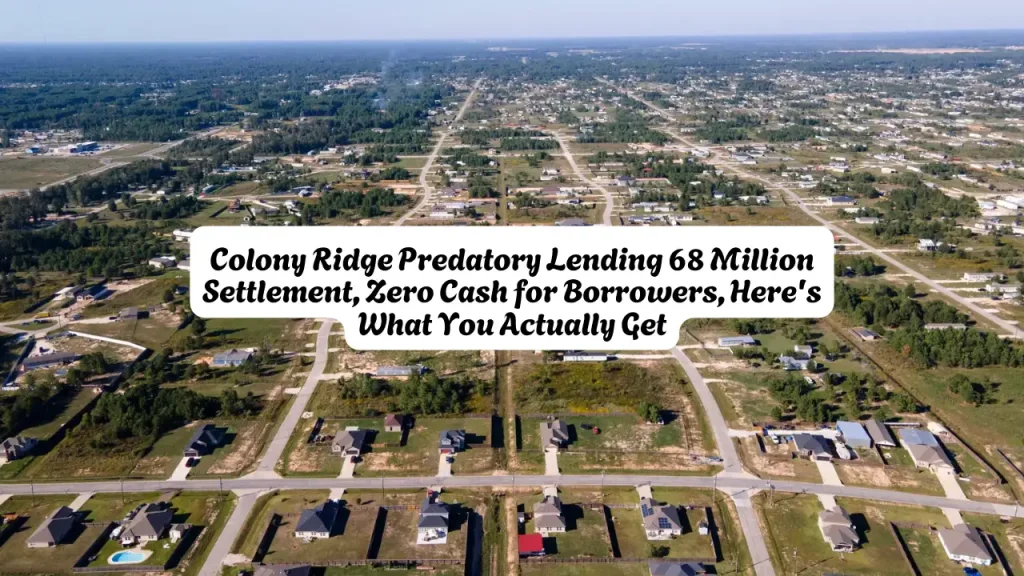
Colony Ridge allegedly lured tens of thousands of Hispanic consumers into purchasing residential lots in the Terrenos Houston subdivision using high-cost, seller-financed loans. The company targeted marketing to Hispanic consumers by advertising almost exclusively in Spanish to consumers with limited English proficiency and limited access to traditional mortgage credit.
Colony Ridge charged interest rates of 10.9–12.9% when market rates were 2.35–4.05% — roughly triple the going rate. The DOJ and CFPB described a business model built around inevitable default: properties were repurchased after foreclosure and resold, with 8,237 lots flipped twice, 3,267 flipped three times, and 2,067 flipped four or more times.
The underlying litigation, filed in 2023, was the DOJ’s first case to allege “reverse redlining” under the Fair Housing Act and Equal Credit Opportunity Act — a practice where lenders target minority communities not by denying them loans, but by steering them into predatory ones designed to fail.
No Cash Is Coming — But Here’s the Relief That Does Exist
This is the part most affected borrowers need to understand clearly. None of the money under the settlement is specifically earmarked for restitution to harmed customers. Instead, to obtain relief, borrowers must meet requirements of a default avoidance plan.
Here is what the settlement actually requires Colony Ridge to provide:
- Default Avoidance Plan: Colony Ridge must implement a Default Avoidance Plan that provides individualized assessments and specified relief options for borrowers facing foreclosure, such as forbearance, short-term interest-free assistance, refinancing, or transfer of notes.
- Credit Repair: The settlement directs Colony Ridge owners to protect loan borrowers by developing a plan that will address harms to their credit.
- Rescission Right (New Buyers): Future borrowers may rescind a purchase up to the due date of the second payment, receive a refund of amounts paid, and face no negative credit reporting for exercising that option.
- Infrastructure: Colony Ridge must invest $48 million in infrastructure improvements, with $18 million specifically invested in drainage infrastructure to address severe and costly flooding damage to homes, and $30 million toward other general infrastructure improvements.
- Honest Advertising Going Forward: Colony Ridge must ensure all Spanish-language marketing accurately describes property conditions, loan terms, and associated costs.
Related article; Genesis Healthcare Bankruptcy $259M+, Nursing Home Residents May Get Nothing While Executives Collect Bonuses
If You Bought Land from Colony Ridge, Here Is What You Can Do
There is no claims portal, no claim deadline, and no check arriving in the mail. Your options depend on your current situation.
Step 1 — If you are currently behind on payments or facing foreclosure: Contact Colony Ridge directly and request a review under the Default Avoidance Plan. The settlement requires them to evaluate you for forbearance, refinancing, or other relief before proceeding with any foreclosure.
Step 2 — If Colony Ridge damaged your credit through a default: The settlement requires the company to develop a plan addressing past credit reporting harm. Contact Colony Ridge in writing requesting an explanation of what steps they are taking for your account specifically.
Step 3 — File a complaint with the CFPB: You can file a complaint with the Consumer Financial Protection Bureau at consumerfinance.gov/complaint or call (855) 411-2372. A CFPB complaint creates an official record and requires the company to respond.
Step 4 — Contact the DOJ Civil Rights Division: If you believe Colony Ridge discriminated against you based on race or national origin, you can submit a complaint to the DOJ Civil Rights Division at justice.gov/crt.
Step 5 — Consult a consumer rights attorney: The settlement does not prevent individual borrowers from pursuing separate legal claims. A consumer rights or fair lending attorney can assess whether you have additional remedies outside this agreement.
Estimated time to complete Steps 1–4: 30–45 minutes
Key Dates
| Milestone | Date |
| Original DOJ/CFPB Lawsuit Filed | December 2023 |
| Texas AG Lawsuit Filed | 2024 |
| Settlement Agreement Filed | February 10, 2026 |
| Court Approval Hearing | March 6, 2026 |
| New Residential Platting Freeze | 3 years from approval |
| Infrastructure Completion Deadline | Up to 10 years from approval |
| Law Enforcement Funding Deadline | Up to 10 years from approval |
| Direct Claim Deadline for Consumers | N/A — no public claims process |
Frequently Asked Questions
Is there a claims form I can fill out to get money from this settlement?
No. Individual borrowers will not receive monetary payments under the settlement. The $68 million goes toward infrastructure and law enforcement in Liberty County, not to affected consumers. If you need relief, your options are the Default Avoidance Plan, a CFPB complaint, or a private legal claim.
Is this settlement legitimate?
Yes. The DOJ and CFPB alleged violations of the Equal Credit Opportunity Act, the Fair Housing Act, the Consumer Financial Protection Act, and the Interstate Land Sales Full Disclosure Act. The settlement was filed in federal court on February 10, 2026, and is subject to judicial approval.
When will I receive my payment?
There are no individual payments. The settlement does not include a distribution fund for harmed borrowers. If you are a current borrower in default, the Default Avoidance Plan is the only structured relief pathway within this agreement.
What if I missed a claim deadline?
There is no claim deadline because there is no public claims process. Borrowers seeking relief should contact Colony Ridge directly or file a CFPB complaint regardless of timing.
Why are civil rights groups saying this settlement is unfair?
Eight civil rights nonprofits, led by the National Fair Housing Alliance, argued the deal is a sham that undermines civil rights enforcement by funneling $20 million to immigration enforcement, which could lead to surveillance, detention, and deportation of the very borrowers the lawsuit was meant to protect.
Will any settlement-related payment affect my taxes?
Since no direct payments go to individual borrowers under this settlement, there is no tax issue for most affected consumers. If you receive individual relief through a separate legal claim, consult a tax professional about how that income is classified.
Do I need a lawyer to seek relief?
You do not need a lawyer to file a CFPB complaint or contact Colony Ridge’s Default Avoidance Plan. However, if you want to pursue a separate legal claim for damages beyond this settlement, consulting a consumer rights attorney is strongly recommended.
Can Colony Ridge keep selling land?
The settlement restricts Colony Ridge from developing new residential plats for three years. Existing properties can still be sold, but buyers must now present a Texas ID, driver’s license, passport, or visa to complete a purchase.
Sources & References
- U.S. Department of Justice — Official Press Release, February 10, 2026
- U.S. District Court, Southern District of Texas — United States v. Colony Ridge Development LLC
- American Banker — Colony Ridge Settlement Coverage
- Texas Tribune — Colony Ridge Settlement Report, February 10, 2026
Last Updated: March 26, 2026
Disclaimer: This article is for informational purposes only and does not constitute legal advice. Legal claims and outcomes depend on specific facts and applicable law. For advice regarding a particular situation, consult a qualified attorney.
About the Author
Israr Ahmad is a legal content researcher with 4+ years of experience covering class action settlements and consumer rights cases. He has researched and published coverage of 2,500+ settlements using verified court records, settlement administrator filings, and government sources. Learn more about Israr.