
Willow School New Orleans Disability Lawsuit, What the Federal Court Ruled
A New Orleans family sued The Willow School — one of the city’s most competitive public charter schools — after it refused to waive its admissions test for their 9-year-old son, Oscar, who has profound intellectual and physical disabilities. A federal judge dismissed the lawsuit in March 2026, ruling that individual charter schools in New Orleans are not legally obligated to admit all students. The family has appealed. The case raises a question that goes far beyond one school: can a publicly funded charter school use entrance exams to effectively screen out students with disabilities?
Case at a Glance
| Field | Detail |
| Case Name | Edmunds v. The Willow School (New Orleans) |
| Court | U.S. District Court, Eastern District of Louisiana |
| Judge | U.S. District Court Judge Darrel James Papillion |
| Filed | May 2025 |
| Ruling | Dismissed — March 2026 |
| Current Status | On Appeal |
| Plaintiff | Oscar Edmunds, 9, represented by his parents |
| Defendant | The Willow School (formerly Lusher Charter School) |
| Case Type | Civil rights / disability discrimination (individual lawsuit — not a class action) |
| Laws Cited | Americans with Disabilities Act; Section 504 of the Rehabilitation Act; Louisiana state law |
Who Is Oscar Edmunds and What Happened?
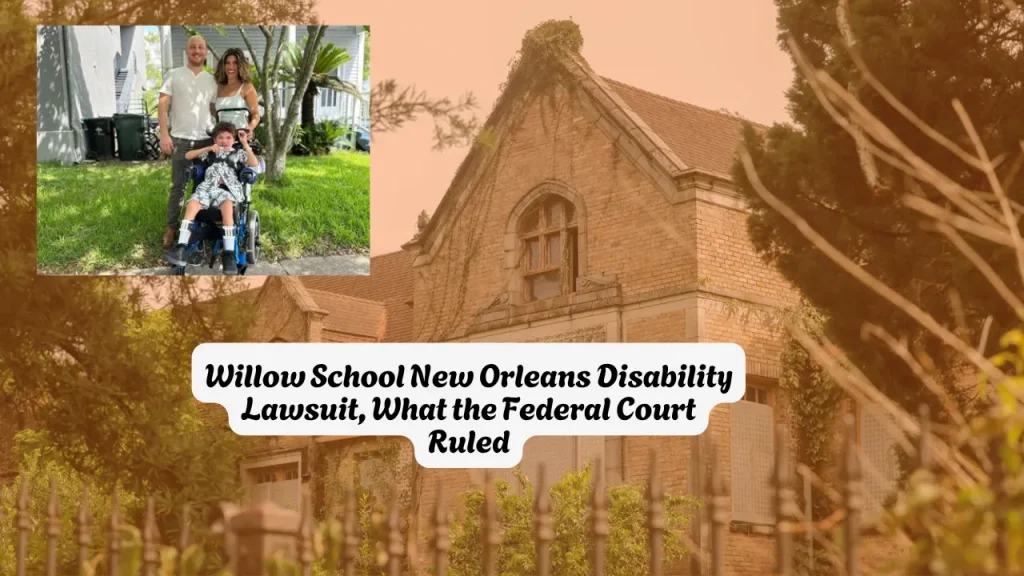
Oscar Edmunds is a 9-year-old boy from New Orleans who was born with 21Q Partial Deletion Syndrome — a rare chromosomal condition that causes profound intellectual and physical disabilities. Because of his intellectual disabilities, Oscar requires a special education curriculum — that is, a curriculum specially tailored to his needs. According to his parents, Oscar has the cognitive ability of a 1- or 2-year-old.
Oscar’s father, Chris Edmunds, is a New Orleans disability rights attorney who has won notable civil rights cases before — he is the lawyer who previously forced the New Orleans streetcar system to become wheelchair accessible.
In 2024, the family applied for Oscar to attend The Willow School for the 2025–2026 school year. Edmunds asked school officials to waive the entrance test for Oscar, but the school denied the request. Oscar took the test at the middle school campus but failed to earn the minimum required score. The family then filed a federal civil rights lawsuit in May 2025.
Related article: Florida Spotted Seatrout Fishing Regulations 2026, What Every Angler Needs to Know
What Is The Willow School?
The Willow School — formerly known as Lusher Charter School — is a K–12 public charter school in Uptown New Orleans. It consistently earns an “A” rating from the Louisiana Department of Education and serves more than 2,200 students across three campuses. It is one of the most sought-after public schools in the city and regularly receives far more applicants than it has seats available.
The school participates in the NOLA Public Schools centralized application system but maintains its own academic eligibility requirements. Students must earn a minimum math and reading score on an entrance exam to be admitted. The school also considers a student’s grade point average and artwork if they choose to submit it.
The school’s selective admissions policy traces back before Hurricane Katrina. Although Louisiana law requires charter schools to open their doors to all students, it makes exceptions for public schools that had selective admissions before Hurricane Katrina. The Willow School is one of only a small number of New Orleans public schools that currently uses an academic entrance exam.
What Did the Lawsuit Claim?
The Edmunds family’s lawsuit argued that The Willow School’s admissions test functioned as a tool of disability discrimination, violating federal and state law. Their core arguments were:
The school receives millions of dollars in public funding — including funds specifically designated to educate students with disabilities. The school is pocketing the money without complying with its legal obligations. The family’s legal team called the admissions exam “essentially a 3-hour IQ test” that “is specifically designed to weed out students with intellectual disabilities.”
The lawsuit alleged the school violated the Americans with Disabilities Act, Section 504 of the Rehabilitation Act, and Louisiana state law — all of which generally prohibit public institutions from excluding people based on disability. It sought both monetary damages and an injunction that would have forced the school to stop using its admissions process in a way the family argued was discriminatory.
What Did the Judge Rule — and Why?
U.S. District Court Judge Darrel James Papillion dismissed the case in March 2026. His ruling turned on a legal argument specific to how New Orleans runs its school system.
Judge Papillion wrote that, unlike traditional school districts that assign students to schools based on where they live, New Orleans’ unique system allows students to apply to charter schools across the city. Because students are not required to attend their nearest school, he wrote, schools are only obligated to meet the education needs of the students they enroll.
In other words, the judge found that the legal duty to serve all students falls on the school system as a whole — on the Orleans Parish School Board — not on each individual charter school. Because Oscar had access to other schools in the New Orleans system (he currently attends the Leah Chase School), the judge concluded The Willow School had not denied Oscar a free and appropriate education.
The judge also said that Edmunds did not prove that the school intentionally used the test to discriminate against students, that the test would have excluded Oscar based on his disability, or that his son was otherwise qualified to attend the school.
What Does the Family Say About the Ruling?
The Edmunds family and their legal team pushed back sharply on the decision.
Edmunds said the ruling is “the first time that any federal court in the country has ever allowed a public school to exclude students with intellectual disabilities.” He called the ruling deeply troubling for disability rights law nationally.
The family has argued that federal law as interpreted by the Supreme Court does not forbid only “intentional” discrimination against students with disabilities — and so it is beside the point to require evidence that the school deliberately targeted disabled students. They argue that a test which students with intellectual disabilities structurally cannot pass produces discriminatory outcomes regardless of the school’s intent.
The family has filed an appeal. As of April 2026, the case is pending before the Fifth Circuit Court of Appeals.
Why Does This Case Matter Beyond One Family?
The Willow School case sits at the intersection of two national debates: the rights of students with disabilities under federal law, and the question of how far charter school autonomy extends when schools accept public funding.
New Orleans has a unique school district in the country — only one of their schools is directly run by the board, while the rest are charter schools operated by charter management organizations. That structure, which emerged after Hurricane Katrina, creates a legal grey zone that Judge Papillion’s ruling now formally defines — at least at the district court level.
If the Fifth Circuit upholds the dismissal, it would cement a precedent that publicly funded charter schools in New Orleans — and potentially elsewhere — can use academic entrance exams even when those exams functionally exclude students whose disabilities prevent them from passing. If the appeals court reverses, it could force selective-admissions charter schools across the city to rethink their policies.
The Willow School issued a statement saying it appreciates the ruling and “remains focused on providing a high-quality, supportive learning environment for its students and families.” The school’s website notes it does provide testing accommodations to enrolled students with documented disabilities under IDEA — but the family’s argument is that the admissions process never gives those students a chance to enroll in the first place.
Frequently Asked Questions
Is this a class action lawsuit?
No. This is an individual civil rights lawsuit filed by the family of one child, Oscar Edmunds, against The Willow School. It does not involve a settlement fund or any claims process open to other families. However, the legal questions it raises about charter school admissions and disability rights could affect many students across New Orleans and nationally if the appeal succeeds.
Was the lawsuit dismissed for good?
At the district court level, yes — Judge Papillion dismissed the case in March 2026. However, the Edmunds family has filed an appeal with the Fifth Circuit Court of Appeals. The dismissal is not final until all appeals are resolved.
Does The Willow School currently serve any students with disabilities?
Yes. The school has stated it serves students with disabilities who are currently enrolled. The lawsuit’s argument was not that the school mistreats enrolled students, but that the admissions exam prevents students with intellectual disabilities from ever enrolling in the first place.
What is 21Q Partial Deletion Syndrome?
21Q Partial Deletion Syndrome is a rare chromosomal disorder in which part of chromosome 21 is missing. It can cause significant intellectual disabilities, developmental delays, and physical challenges. Every case is different, but the condition typically requires specialized educational support, including an Individualized Education Program (IEP).
What law was The Willow School accused of breaking?
The family cited the Americans with Disabilities Act (ADA), Section 504 of the Rehabilitation Act of 1973, and Louisiana state law — all of which generally prohibit publicly funded institutions from discriminating against individuals based on disability. The core dispute was whether these laws apply to individual charter schools or only to school districts as a whole.
What happens next?
The case is now before the Fifth Circuit Court of Appeals. There is no set timeline for a ruling. If the Fifth Circuit reverses the dismissal, the case would return to the district court for further proceedings. If it upholds the dismissal, the family could seek review from the U.S. Supreme Court, though the Court accepts only a small fraction of petitions.
Last Updated: April 11, 2026
Disclaimer: This article is for informational purposes only and does not constitute legal advice. Legal claims and outcomes depend on specific facts and applicable law. For advice regarding a particular situation, consult a qualified attorney.
About the Author
Israr Ahmad is a legal content researcher with 4+ years of experience covering class action settlements and consumer rights cases. He has researched and published coverage of 2,500+ settlements using verified court records, settlement administrator filings, and government sources. Learn more about Israr.