
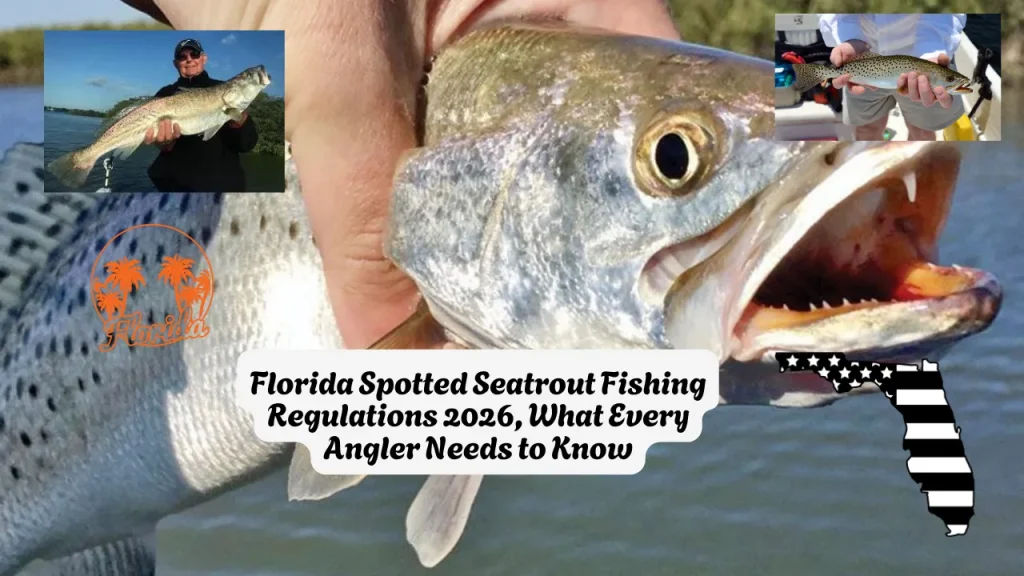
Florida Spotted Seatrout Fishing Regulations 2026, What Every Angler Needs to Know
Florida’s spotted seatrout rules changed significantly on April 1, 2026. The Florida Fish and Wildlife Conservation Commission (FWC) replaced the old statewide system with nine separate regional management zones — each with its own bag limits, slot limits, and closed seasons. If you fish for trout anywhere in Florida, your rules are almost certainly different from what they were before April 1. This guide breaks down every region so you know exactly what you can keep, when you can fish, and what the size rules are right now.
What Changed
| What Changed | Old System | New System (from April 1, 2026) |
| Number of Regions | 5 | 9 |
| Slot Limit | 15–19 inches statewide | 15–19 inches (most regions); 15–24 inches (IRL and Northeast commercial) |
| Bag Limits | Varied by zone | Varies by region (2–5 fish per person) |
| Over-Slot Allowance | Vessel limit of 1 fish over slot in some zones | 1 fish over slot per vessel (or per person from shore) in most recreational regions |
| Closed Seasons | Limited closures | Regional closures added for Central East, Indian River Lagoon, and Northeast |
| Effective Date | — | April 1, 2026 |
Why Did Florida Change the Spotted Seatrout Rules?
At its February meeting, the Florida Fish and Wildlife Conservation Commission approved new management regions and regulations for spotted seatrout as part of FWC’s holistic regional management approach. The regulations took effect April 1, 2026.
The core idea is simple: spotted seatrout populations, fishing pressure, and environmental conditions are not the same in Pensacola as they are in the Indian River Lagoon or Jacksonville. A single statewide rule cannot respond to those local differences effectively. The proposed new regions allow the FWC to better capture local differences in the fishery using an adaptive holistic management approach.
FWC Chairman Rodney Barreto said: “Taking an adaptive holistic approach to spotted seatrout management will continue the success FWC has seen with Florida’s redfish and snook fisheries.” Commissioner Preston Farrior added that the approach allows FWC to “be fluid and reactive to the unique needs of each region.”
This same regional approach already applies to redfish and snook in Florida, and it has broadly been well received by anglers and conservationists. Spotted seatrout is now managed the same way.
The Nine Spotted Seatrout Management Regions
Florida’s waters are now divided into nine spotted seatrout regions. Here is where each one begins and ends, based on the official FWC boundary definitions.
Western Panhandle — Escambia County through portions of Gulf County west of longitude 85°13.76′, not including Indian Pass/Indian Lagoon.
Big Bend — Remaining portion of Gulf County plus Indian Lagoon and Franklin County, through Fred Howard Park Causeway in Pinellas County near the Pasco County line.
Tampa Bay — Fred Howard Park Causeway south to State Road 64 in Manatee County.
Sarasota Bay — State Road 64 in Manatee County south to near the Venice Municipal Airport.
Charlotte Harbor — Near Venice Municipal Airport south to near Vanderbilt Beach Road in Collier County.
Southwest — Near Vanderbilt Beach Road in Collier County, around the Florida Keys to the Monroe/Miami-Dade County line.
Southeast — Monroe/Miami-Dade County line north through Broward County.
Indian River Lagoon — A distinct east-coast estuary region covering portions of the east coast (including Brevard County).
Northeast — Flagler through Nassau counties (Florida-Georgia border area).
Related article: Is the KTM Freeride E Street Legal? Here Is the Full Answer for 2026
2026 Recreational Regulations — Region by Region
These rules apply to recreational anglers as of April 1, 2026. All recreational regions allow anglers to keep one fish over the slot limit per vessel — or one per person when fishing from shore — unless noted otherwise.
Western Panhandle
Season: Year-round. Bag limit: 3 fish per person. Slot limit: 15–19 inches. Over-slot allowance: 1 fish over 19 inches per vessel (or per person from shore), included in bag limit.
Big Bend
Season: Year-round. Bag limit: 5 fish per person. Slot limit: 15–19 inches. Over-slot allowance: 1 fish over 19 inches per vessel (or per person from shore), included in bag limit.
Tampa Bay, Sarasota Bay, Charlotte Harbor, Southwest, Southeast
Season: Year-round. Bag limit: 3 fish per person. Slot limit: 15–19 inches. Over-slot allowance: 1 fish over 19 inches per vessel (or per person from shore), included in bag limit.
Central East (Palm Beach through Volusia counties)
Open season: January 1 – October 31. Closed season: November 1 – December 31. Bag limit: 2 fish per person. Slot limit: 15–19 inches. Over-slot allowance: None.
Indian River Lagoon
Open season: May 1 – September 30. Closed season: October 1 – April 30. Bag limit: 2 fish per person (recreational). Slot limit: 15–19 inches. Over-slot allowance: None.
The Indian River Lagoon region carries the most conservative rules in the state. FWC officials say the stricter limits for the Indian River Lagoon reflect the unique challenges facing the estuary system, including periodic fish kills, water quality issues, seagrass loss, and fluctuating freshwater conditions.
Northeast (Flagler through Nassau counties)
Open season: Year-round. Bag limit: 5 fish per person. Slot limit: 15–19 inches. Over-slot allowance: 1 fish over 19 inches per vessel (or per person from shore), included in bag limit.
2026 Recreational Regulations — Quick Reference Table
| Region | Open Season | Closed Season | Bag Limit | Slot Limit | Over-Slot |
| Western Panhandle | Year-round | None | 3/person | 15–19 in | 1/vessel or 1/person from shore |
| Big Bend | Year-round | None | 5/person | 15–19 in | 1/vessel or 1/person from shore |
| Tampa Bay | Year-round | None | 3/person | 15–19 in | 1/vessel or 1/person from shore |
| Sarasota Bay | Year-round | None | 3/person | 15–19 in | 1/vessel or 1/person from shore |
| Charlotte Harbor | Year-round | None | 3/person | 15–19 in | 1/vessel or 1/person from shore |
| Southwest | Year-round | None | 3/person | 15–19 in | 1/vessel or 1/person from shore |
| Southeast | Year-round | None | 3/person | 15–19 in | 1/vessel or 1/person from shore |
| Central East | Jan 1–Oct 31 | Nov 1–Dec 31 | 2/person | 15–19 in | None |
| Indian River Lagoon | May 1–Sept 30 | Oct 1–Apr 30 | 2/person | 15–19 in | None |
| Northeast | Year-round | None | 5/person | 15–19 in | 1/vessel or 1/person from shore |
What About Commercial Fishing?
Commercial spotted seatrout regulations also changed on April 1, 2026. The new commercial rules use the same nine-region structure. Commercial open season for the Indian River Lagoon runs June 1 – October 31, with a closed season from November 1 – May 31. The commercial bag limit is 50 fish with one saltwater products license (SPL) or 100 fish with two or more SPLs, with a slot limit of 15–24 inches and no over-slot allowance.
The Northeast region commercial season runs May 1 – September 30, with a closed season of October 1 – April 30. The bag limit is 50 fish with one SPL or 100 fish with two or more SPLs, with a slot limit of 15–24 inches.
Commercial anglers should also note: sale and possession of seatrout inventory is allowed for 30 days after a regional season closes. After 30 days following a regional closure, no spotted seatrout may be possessed in a closed region.
Always verify commercial rules directly with FWC before fishing, as commercial regulations carry specific SPL and reporting requirements.
What Gear Rules Apply Statewide?
Regardless of which region you fish, these rules apply everywhere in Florida for spotted seatrout. You cannot harvest spotted seatrout using any multiple hook in conjunction with live or dead natural bait. Snatching is prohibited in all regions. Charter boat captains and crew members have a zero bag limit statewide — they cannot keep trout on for-hire trips.
A valid Florida saltwater fishing license is required for most anglers. Certain exemptions apply — for example, Florida residents fishing from a pier, residents 65 and older, and children under 16 generally do not need a license. Confirm your license status at myfwc.com.
Why the Indian River Lagoon Gets Special Treatment
Of all nine regions, the Indian River Lagoon drew the most attention from anglers — and for good reason. It now has the shortest open season (just five months, May through September) and no over-slot allowance, making it the most restrictive region in the state.
For example, Big Bend anglers may keep five fish per person year-round, and many Gulf Coast and South Florida regions will allow three fish per person year-round. The IRL region is one of the few with a closed recreational season and no over-slot allowance.
The restrictions reflect years of documented stress on the lagoon’s ecosystem. The Indian River Lagoon has experienced major fish kills tied to harmful algae blooms, accelerated seagrass loss, and water quality degradation. FWC took those conditions into account when setting the tightest rules for this region.
Frequently Asked Questions
When did the new Florida spotted seatrout rules take effect?
The new nine-region spotted seatrout regulations took effect on April 1, 2026. They were approved at the FWC’s February 2026 Commission meeting. Any fishing trip taken before April 1 followed the old rules. Any trip from April 1, 2026 forward must follow the new regional system.
How do I know which region I am fishing in?
Your region depends on the physical location of the water you are fishing — not your home county or launch point. The official FWC boundary maps are available at myfwc.com/fishing/saltwater/recreational/maps. When in doubt, identify the closest major geographic landmark listed in each region’s boundary description and confirm your location before keeping fish.
Can I keep a fish over 19 inches?
In most recreational regions, yes — you can keep one fish over 19 inches per vessel, or one per person if fishing from shore, as long as it counts toward your bag limit. However, the Central East and Indian River Lagoon regions do not allow any over-slot fish to be kept.
Do these rules apply in federal waters too?
Yes. Spotted seatrout regulations extend into federal waters adjacent to each management region. You cannot cross into federal waters to avoid the rules that apply in your region.
What happens if I fish during a closed season?
Harvesting spotted seatrout during a closed season is a violation of Florida law and can result in fines, license suspension, and confiscation of fish and gear. The closed seasons exist to protect spawning fish. FWC officers actively patrol Florida’s coastal waters.
Will these rules change again?
FWC conducts annual reviews of each region’s spotted seatrout population metrics. FWC will continue to publish annual spotted seatrout reviews that summarize management metrics for each region. If data shows a region is recovering or declining, the FWC can adjust rules without overhauling the entire statewide system — which is exactly the flexibility this new approach is designed to provide.
Where can I find the most current rules before I fish?
Always check the official FWC website at myfwc.com/fishing/saltwater/recreational/spotted-seatrout before your trip. Regulations can change, and the official FWC page is the authoritative source. You can also call the FWC at 850-487-0554.
Sources & References
- FWC official spotted seatrout regulation announcement (February 4, 2026): myfwc.com
Last Updated: April 11, 2026
Disclaimer: This article is for informational purposes only and does not constitute legal advice. Fishing regulations change frequently. Always verify current rules directly with the Florida Fish and Wildlife Conservation Commission at myfwc.com before heading out on the water. Violations of fishing regulations can result in fines and penalties.
About the Author
Israr Ahmad is a legal content researcher with 4+ years of experience covering class action settlements and consumer rights cases. He has researched and published coverage of 2,500+ settlements using verified court records, settlement administrator filings, and government sources. Learn more about Israr.