
Who Investigates Supreme Court Justices for Misconduct?
The short answer might surprise you: nobody, really — at least not in any formal, enforceable way. There is no independent agency, no inspector general, and no court above the Supreme Court that can open a case, subpoena records, and hold a Justice accountable. What exists instead is a loose collection of congressional oversight tools, financial disclosure laws, a self-enforced code of ethics, and the threat of impeachment. Understanding how each piece works — and where every piece falls short — tells you more about how American democracy actually functions than almost any other legal question.
Why No Single Body Has the Power to Investigate a Sitting Supreme Court Justice
The gap is structural, not accidental. Neither the Judges’ Code of Conduct nor the Judicial Conduct and Disability Act of 1980 applies to the Justices of the Supreme Court.
That one sentence explains everything. The Judicial Conduct and Disability Act of 1980, codified at 28 U.S.C. §§ 351–364, establishes a process by which any person can file a complaint alleging a federal judge has engaged in “conduct prejudicial to the effective and expeditious administration of the business of the courts” or has become unable to discharge all the duties of the judicial office. That law covers circuit judges, district court judges, bankruptcy judges, and magistrate judges. It does not cover the nine Justices sitting on the Supreme Court.
According to Chief Justice Roberts, the Supreme Court Justices also consult the “Code of Conduct for United States Judges,” which does not formally apply to the Justices but governs the conduct of judges in lower federal courts. Episodes over the last two decades have made clear that the Supreme Court’s informal consultation of the code is not sufficient.
The result is what legal reform advocates have called a structural blind spot — the most powerful court in the country is also the one with the least external oversight over its members’ personal conduct.
If you believe your legal rights have been violated by the conduct of a public official or court officer, speaking with a civil rights lawyer is the right first step — most offer a free legal consultation.
The Judicial Conference of the United States — What It Can and Cannot Do
The Judicial Conference is the policymaking body for the entire federal court system. It is chaired by the Chief Justice of the United States and includes the chief judges of each federal circuit. On paper, it sounds like it could investigate a Supreme Court Justice. In practice, its authority stops short.
The Judicial Conference of the United States has authority under the Ethics in Government Act to administer the financial disclosure requirements for judicial officers and employees. Covered judicial officers and employees file their reports with the Judicial Conference, which then reviews filings for compliance.
That means the Judicial Conference can flag a Justice for failing to properly file financial disclosures — and can refer the matter to the Attorney General for civil or criminal penalties under the Ethics in Government Act of 1978. But it cannot investigate broader misconduct, cannot sanction a Justice, and cannot discipline one.
In 2023, Chief Justice Roberts deferred any possible investigation into Justice Clarence Thomas’s extensive billionaire-funded luxury travel and other outstanding allegations of misconduct to the Judicial Conference, which in turn referred the matter to the Judicial Conference Committee on Financial Disclosure. Critics noted that this referral went nowhere — because the Judicial Conference’s authority over sitting Supreme Court Justices is limited to financial disclosure paperwork, not misconduct investigations.
The Ethics in Government Act of 1978 — The One Law That Does Apply
While oversight mechanisms are weak, one federal statute does bind Supreme Court Justices directly. The Ethics in Government Act of 1978 requires certain government officials, including judges and justices, to complete financial disclosures each year. The Act includes limited exceptions to these disclosures and allows each branch to define those exemptions more completely.
Supreme Court Justices must file publicly available financial disclosure statements that report certain financial transactions. On May 13, 2022, President Biden signed the Courthouse Ethics and Transparency Act, which requires online publication of financial disclosure reports of judicial officers including Supreme Court Justices, bankruptcy judges, and magistrate judges. While the Ethics in Government Act always mandated public access to judicial officer financial disclosure reports, there was no central database to access the filings before 2022.
The Ethics in Government Act of 1978 requires all federal judges, including Supreme Court Justices, to submit annual financial disclosures. To enforce this requirement, the Judicial Conference can refer to the Attorney General anyone who is suspected of willfully failing to file required information or falsifying their disclosure. There are civil and criminal penalties for these violations.
In plain terms: a Justice who fails to report a financial gift can face civil and criminal penalties under federal law. But the enforcement mechanism is weak in practice — no Justice has ever been prosecuted for a financial disclosure violation.
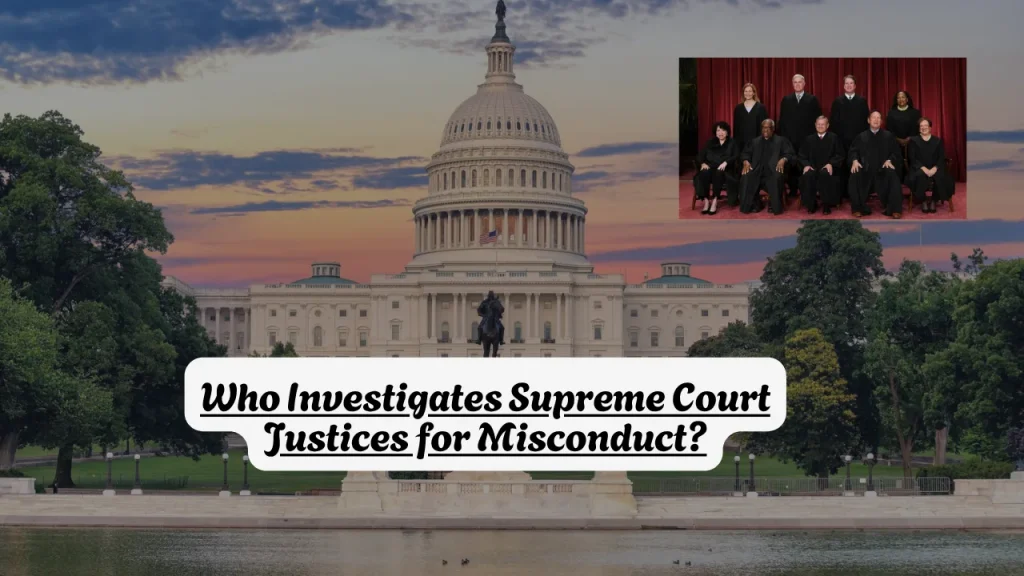
The Supreme Court’s Own Code of Conduct — And Why Critics Say It Falls Short
For most of its history, the Supreme Court operated with no written ethics code at all. That changed in November 2023. The Supreme Court formally adopted a code of conduct following allegations of ethics lapses, although its impact is likely to be limited because the Justices are left to enforce it themselves. The court issued a 14-page document that included five canons of conduct on issues such as when Justices should recuse themselves and what kind of outside activities they can engage in.
The Justices’ Code of Conduct is organized into five canons: Canon 1 — a Justice should uphold the integrity and independence of the judiciary. Canon 2 — a Justice should avoid impropriety and the appearance of impropriety in all activities. Canon 3 — a Justice should perform the duties of office fairly, impartially, and diligently. Canon 4 — a Justice may engage in extrajudicial activities consistent with the obligations of the judicial office. Canon 5 — a Justice should refrain from political activity.
The core problem: alleged violations of the lower court Judges’ Code can be the basis for a misconduct complaint under the Judicial Conduct and Disability Act. The Justices’ Code cannot serve as the basis for a similar process because the Act does not apply to Supreme Court Justices.
A Justice who violates their own code of conduct faces no automatic consequence. No outside body reviews the violation. No complaint process exists to trigger an investigation. The code is essentially a statement of principles — not an enforcement mechanism.
A consumer rights attorney or civil rights lawyer can help you understand what remedies exist when you believe any government official has acted outside the law and affected your legal rights.
The Senate Judiciary Committee — Congress’s Most Active Oversight Tool
While no agency can formally investigate a Supreme Court Justice, Congress can. The Senate Judiciary Committee has used its oversight authority more aggressively over the past several years than at any other time in modern history.
The Senate Judiciary Committee, under the leadership of Senate Majority Whip Dick Durbin, investigated reports that several Supreme Court Justices — including Justice Clarence Thomas and Justice Samuel Alito — failed to report lavish vacations and other gifts on their annual financial disclosures. Some of the undisclosed gifts were paid for by prominent conservative figures, some of whom later had business before the high court.
In December 2024, the Committee released the findings of its 20-month investigation, entitled “An Investigation of the Ethics Challenge at the Supreme Court.” The majority staff report shed light on a Supreme Court facing record-low levels of public trust, a consistent stream of ethical lapses, and repeated failures by the Justices under the leadership of Chief Justice John Roberts to address the court’s ethical challenges.
The committee’s specific findings included that Justice Thomas chose to ignore legal obligations to disclose lavish gifts after media scrutiny in 2004, in violation of federal law. Justice Alito misused the “personal hospitality exemption” when he did not disclose gifts of transportation and lodging he received for a luxury fishing trip to Alaska in 2008, in violation of federal law. Justice Thomas also failed to disclose a July 2021 private jet trip to Saranac, New York, and an October 2021 private jet and yacht trip to New York City — both paid for by Harlan Crow — that were never previously known to the public.
The Senate Judiciary Committee can investigate, issue subpoenas, hold hearings, and publish reports. What it cannot do unilaterally is punish, sanction, or remove a Justice. That still requires the full impeachment process.
The House Judiciary Committee — The Starting Point for Formal Removal
If the Senate Judiciary Committee is the investigative body, the House Judiciary Committee is the gateway to formal accountability. A significant function of the Committee on the Judiciary is its authority over impeachment proceedings, having investigated and drafted articles of impeachment against federal officials.
Any House member can introduce articles of impeachment against a Justice, which get referred to the Judiciary Committee. The committee can then investigate, call witnesses, and decide whether to recommend a full House vote. With respect to federal judges, the Judicial Conduct and Disability Act of 1980 established a process within the judicial branch for responding to complaints. Findings from those investigations could result in the Judicial Conference of the United States informing the House that the impeachment of a judge may be warranted — and a letter reporting that determination would be referred to the Judiciary Committee.
Most impeachment resolutions against Supreme Court Justices die in committee without a vote. That has been the outcome for every attempt in recent years, including the 2024 articles introduced against Justices Thomas and Alito.
What Happens When the Public or the Press Uncovers Misconduct
One of the most effective accountability mechanisms in practice has not been any government body — it has been investigative journalism. The Senate Judiciary Committee’s 20-month investigation was sparked in large part by media reporting. The committee’s report acknowledged the role that ProPublica played in advancing the inquiry, having published several major exposés revealing extensive allegations of apparent ethical misconduct by sitting and former Justices — the first of which addressed Thomas’s relationship with Harlan Crow.
Members of the public can also contact their congressional representatives directly to raise concerns about judicial conduct. While there is no formal complaint portal for Supreme Court Justices equivalent to the Judicial Conduct system for lower court judges, constituent pressure on members of Congress can trigger committee investigations, media attention, and legislative action.
If judicial misconduct directly affected your case or your rights, a civil rights attorney can help you assess whether you have grounds for a legal claim, and what the right path looks like given your specific situation.
Frequently Asked Questions About Supreme Court Justice Misconduct Investigations
Is there any federal agency that can independently investigate a Supreme Court Justice for misconduct right now?
No. Neither the Judges’ Code of Conduct nor the Judicial Conduct and Disability Act of 1980 applies to the Justices of the Supreme Court. The Judicial Conference can review financial disclosures. Congress can investigate through its Judiciary Committees. But no independent agency has standing to open a formal misconduct investigation against a sitting Justice.
What is the deadline to bring a misconduct complaint about a Supreme Court Justice through Congress?
There is no fixed statute of limitations for congressional oversight or impeachment proceedings. Congress can investigate and introduce articles of impeachment at any time while the Justice holds office. For financial disclosure violations under the Ethics in Government Act of 1978, civil and criminal penalties can be triggered by willful noncompliance, but the enforcement timeline is not fixed by statute.
How long does a Senate Judiciary Committee investigation of a Supreme Court Justice typically take?
It varies significantly based on the complexity of the misconduct and political cooperation. The 2023–2024 Senate Judiciary Committee probe into ethics lapses at the Supreme Court ran for 20 months. Investigations can stall when subpoenas are blocked or witnesses refuse to cooperate, which happened during that inquiry.
Can the public file a formal misconduct complaint against a Supreme Court Justice?
Not through the Judicial Conduct system, which only covers lower federal court judges. Any person can contact their U.S. representative or senator to ask for a congressional investigation. A citizen can also file a complaint with the Department of Justice if they believe a Justice has committed a federal crime, though prosecution of a sitting Justice raises unresolved constitutional questions.
Does the Supreme Court’s 2023 Code of Conduct give anyone the power to punish a Justice who violates it?
No. The Justices’ Code cannot serve as the basis for a misconduct complaint process because the Judicial Conduct and Disability Act does not apply to Supreme Court Justices. The code sets standards — it does not create enforcement authority. A Justice who violates it faces no automatic legal consequence under that code alone.
Do I need a lawyer to raise concerns about a federal judge who handled my case?
For lower federal court judges, you do not need a lawyer to file a complaint under the Judicial Conduct and Disability Act — any person can do so through the relevant federal circuit’s clerk. For Supreme Court Justices, there is no equivalent complaint process. If judicial conduct directly affected your legal rights in any court, a civil rights attorney can assess whether you have grounds for an appeal or a legal claim for compensation for damages.
What is the single most significant gap in oversight of Supreme Court Justices compared to every other court in the country?
Every state — all fifty plus the District of Columbia — has a process for receiving, investigating, and resolving complaints about their highest court’s judges. Most of these procedures have been in place since the 1960s or 1970s. The U.S. Supreme Court has no equivalent external complaint and investigation process. It is the only high court in America where Justices investigate themselves.
Legal Terms Used in Supreme Court Misconduct Oversight
Judicial Conduct and Disability Act of 1980 (28 U.S.C. §§ 351–364): The federal law that allows anyone to file a misconduct complaint against a federal judge. Covers circuit judges, district judges, bankruptcy judges, and magistrate judges. Does not cover Supreme Court Justices.
Ethics in Government Act of 1978: The federal law that requires senior government officials — including all Supreme Court Justices — to file annual financial disclosure reports. Violations can result in referral to the Attorney General and civil or criminal penalties.
Judicial Conference of the United States: The policymaking body for the federal court system, chaired by the Chief Justice. Reviews financial disclosures of judges and Justices for compliance, but has no authority to investigate or discipline Supreme Court Justices for broader misconduct.
Code of Conduct for Justices (2023): The Supreme Court’s self-adopted ethics code, effective November 13, 2023. Sets five canons of conduct but contains no external enforcement mechanism. Violations do not trigger any formal complaint or sanction process.
Senate Judiciary Committee: The Senate committee with primary oversight authority over the federal judiciary. Can investigate, subpoena witnesses, hold hearings, and publish reports on Supreme Court conduct. Cannot sanction or remove a Justice unilaterally — that requires the full impeachment process.
SCERT Act (Supreme Court Ethics, Recusal, and Transparency Act): Proposed federal legislation that would require a binding, enforceable code of conduct for Justices, create an external complaint and investigation process, and improve financial disclosure requirements. As of May 2026, it has not passed.
Financial Disclosure Report: The annual public filing that all federal judges and Justices must submit under the Ethics in Government Act of 1978. Reports outside income, gifts, investments, and financial transactions above certain thresholds. Available publicly online since November 2022 under the Courthouse Ethics and Transparency Act.
You now know that no single body has formal investigative authority over a Supreme Court Justice for misconduct — the Judicial Conduct and Disability Act does not apply to them, the 2023 Code of Conduct has no enforcement mechanism, and the only formal accountability path runs through Congress via the Ethics in Government Act of 1978, Senate Judiciary Committee oversight, and ultimately impeachment under Article II, Section 4 of the U.S. Constitution. If you believe a public official’s conduct has violated your legal rights or affected a court proceeding involving you, visit AllAboutLawyer.com to connect with a civil rights attorney who can review your situation and explain your options.
Can a Supreme Court Justice Be Removed From Office? — AllAboutLawyer.com, Can a Supreme Court Justice Be Fired for Conflict of Interest? — AllAboutLawyer.com, How Is a Supreme Court Justice Impeached? Step by Step — AllAboutLawyer.com
Sources:
- U.S. Constitution, Article II, Section 4; Article III, Section 1
- Judicial Conduct and Disability Act of 1980, 28 U.S.C. §§ 351–364 — uscourts.gov
- Ethics in Government Act of 1978 — congress.gov
- Courthouse Ethics and Transparency Act (2022) — congress.gov
- Code of Conduct for Justices of the Supreme Court of the United States (November 13, 2023) — supremecourt.gov
- Congress.gov Legal Sidebar: The Supreme Court Adopts a Code of Conduct (November 2023) — congress.gov
- Congress.gov Legal Sidebar: Financial Disclosure and the Supreme Court (November 2023) — congress.gov
- Senate Judiciary Committee: An Investigation of the Ethics Challenge at the Supreme Court (December 2024) — judiciary.senate.gov
- Senator Whitehouse: Judicial Misconduct Procedures in All Fifty States Report (November 2024) — whitehouse.senate.gov
- Project on Government Oversight: Promoting Judicial Ethics (October 2025) — pogo.org
- U.S. Courts: Judicial Conduct and Disability — uscourts.gov
Prepared by the AllAboutLawyer.com Editorial Team and reviewed for factual accuracy against official government, congressional, and court sources. Last Updated: May 25, 2026.
This article is for informational purposes only and does not constitute legal advice. Laws and procedures vary by circumstance. Consult a qualified attorney licensed in your state for advice about your specific situation.
About the Author
Israr Ahmad is a legal content researcher with 4+ years of experience covering class action settlements and consumer rights cases. He has researched and published coverage of 2,500+ settlements using verified court records, settlement administrator filings, and government sources. Learn more about Israr.