
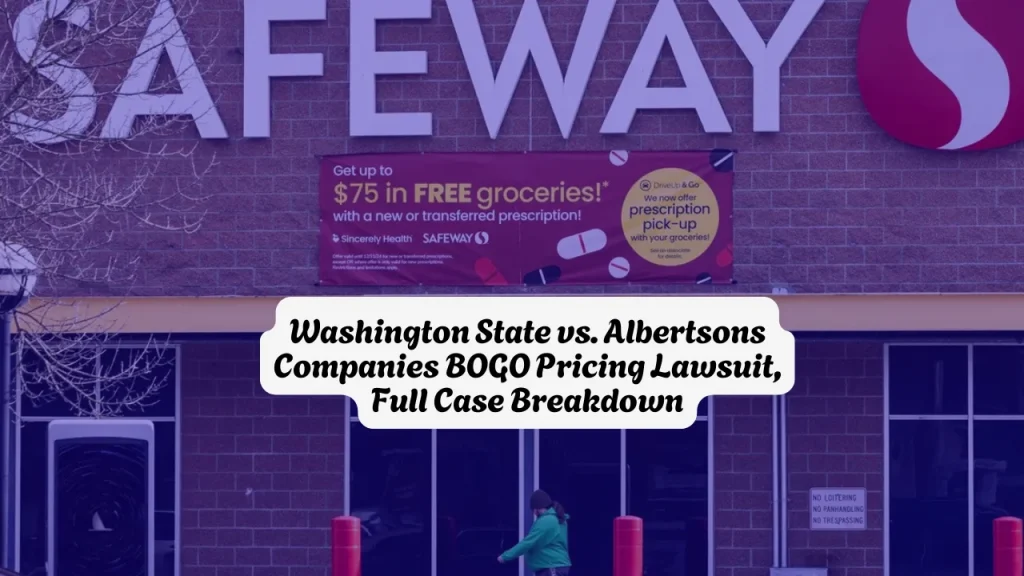
Washington State vs. Albertsons Companies BOGO Pricing Lawsuit, Full Case Breakdown
Prepared by the AllAboutLawyer.com Editorial Team and reviewed for factual accuracy against the Washington State Attorney General’s press release and verified reporting from the Associated Press and Washington State Standard on April 28, 2026. Last Updated: April 28, 2026
This article covers a recently filed lawsuit. Information is limited to the complaint as filed and verified public statements. This page will be updated as the case develops.
Washington State vs. Albertsons Companies is a consumer protection lawsuit filed April 27, 2026, in which Washington Attorney General Nick Brown alleged that Albertsons Companies, Inc. — the parent company of Safeway, Albertsons, and Haggen — artificially inflated grocery prices before “buy one, get one free” promotions to create an illusion of savings, overcharging Washington shoppers on more than 3 million transactions and generating as much as $19.7 million in excess revenue between October 2019 and May 2024. Albertsons denies the allegations and called the state’s analysis “flawed.” The case is now pending in King County Superior Court.
Quick Facts: Washington vs. Albertsons BOGO Pricing Lawsuit
| Field | Detail |
| Plaintiff | State of Washington, by Attorney General Nick Brown |
| Defendant | Albertsons Companies, Inc. (dba Safeway, Albertsons, and Haggen in Washington) |
| Case Type | Consumer Protection — Deceptive Pricing / Unfair Business Practices |
| Court | King County Superior Court, Washington State |
| Date Filed | April 27, 2026 |
| Legal Claim | Violations of Washington’s Consumer Protection Act — unfair and deceptive acts or practices; misrepresentation of prices |
| Damages Sought | Injunctive relief to halt deceptive BOGO promotions; consumer restitution; civil penalties per violation; pre-judgment interest |
| Alleged Overcharge | As much as $19.7 million across more than 3.1 million transactions |
| Current Stage | Active — complaint just filed; no hearing dates yet scheduled |
| Next Scheduled Date | TBD — no hearing date has been set as of April 28, 2026 |
| Defendant’s Counsel | TBD — not yet confirmed in public record |
| Plaintiff’s Office | Washington State Attorney General’s Office, Seattle, WA |
| Last Updated | April 28, 2026 |
Case Timeline: Washington vs. Albertsons
| Date | Event |
| October 2019 | Alleged deceptive BOGO pricing scheme begins, according to the complaint |
| May 2024 | Alleged scheme ends, per the complaint’s stated time period |
| 2024 | Albertsons separately settles a private class action filed by Washington consumers over similar BOGO allegations — terms not disclosed |
| April 27, 2026 | Washington AG Nick Brown files suit in King County Superior Court |
| April 27, 2026 | Albertsons issues statement denying claims, citing “flawed analysis and data errors” |
| Next hearing date | TBD — no court date has been set as of April 28, 2026 |
What Is the Washington vs. Albertsons Lawsuit About? State of Washington v. Albertsons Companies, Inc., King County Superior Court (Filed Apr. 27, 2026)
Washington Attorney General Nick Brown filed this lawsuit under the Washington Consumer Protection Act (RCW 19.86), which prohibits unfair methods of competition and unfair or deceptive acts or practices in commerce. The complaint alleges that Albertsons Companies, which operates all 225 Safeway, Albertsons, and Haggen stores in Washington State, ran a systematic scheme across its Washington locations: it raised the regular price of everyday grocery items weeks or months before announcing a “buy one, get one free” promotion — then quietly dropped the price back down within about 30 days after the promotion ended. The AG’s office argues that this pricing pattern created an illusion of value that consumers had no way to see through at the register.
The complaint documents specific examples with exact numbers. According to the filing, a Gig Harbor Albertsons raised the price of a 16.9-ounce bottle of O Organics Extra Virgin Olive Oil from $6.99 to $10.99 — a 57% increase — immediately before a BOGO promotion, then dropped it back to $6.99 once the deal ended. At a Tacoma Albertsons, Oroweat Premium Italian Bread jumped from $3.69 to $4.29 before a BOGO promotion.
A Safeway in Colville allegedly raised the price of mini watermelon by 50%, a Renton Albertsons raised pimiento-stuffed olives by 84%, and a Battle Ground store raised Signature Select Sourdough Hoagie Rolls from $3.39 to $4.29 before a BOGO deal, then dropped the price to $2.49 afterward. These are not isolated incidents according to the AG’s office — the complaint alleges the pattern repeated across locations and product categories including bread, cereal, fresh produce, and olive oil for nearly five years.
The legal theory is straightforward: a true “buy one, get one free” promotion means the consumer pays the ordinary price for one item and receives a second at no charge. According to the complaint, Albertsons’ promotions did not work that way — customers paid the inflated BOGO-period price for the first item, which effectively built in the cost of the “free” second item. The AG’s office says this constitutes both an unfair and deceptive trade practice and a misrepresentation of prices under the Washington Consumer Protection Act.
Related article: National Trust for Historic Preservation vs. Trump White House Ballroom Lawsuit, Case Breakdown and Latest Update
For context on how similar deceptive discount pricing cases have played out against other major retailers, see our coverage of the Lowe’s fake discount pricing lawsuit, where state enforcement actions alleged comparable reference-price manipulation. The same regulatory playbook — state AG enforcement under consumer protection statutes, seeking restitution plus civil penalties — applies directly to this case.
Who Are Washington State and Albertsons Companies?
Washington Attorney General Nick Brown filed this lawsuit on behalf of the State of Washington and its consumers. Brown was elected Washington’s AG in 2024 and has focused his office on consumer protection and corporate accountability issues. The AG’s office has authority under the Washington Consumer Protection Act to bring civil enforcement actions against companies engaging in deceptive trade practices — seeking not just restitution for consumers but civil penalties and injunctive relief that can change business behavior going forward. Brown said at an April 27 press conference, according to the Washington State Standard: “Consumers walk into these stores, think that they’re getting a bargain” — and that his office will not stand for deceptive pricing practices affecting everyday household budgets.
Albertsons Companies, Inc., based in Boise, Idaho, is one of the largest grocery chains in the United States, operating more than 2,200 stores across 35 states under approximately 20 different banners. In Washington State specifically, Albertsons operates all 225 Safeway, Albertsons, and Haggen locations — giving the company dominant market presence throughout the state. Albertsons disputes the AG’s claims entirely. In its statement, the company said it “engaged in good-faith discussions with the Attorney General’s Office and strongly disagree with its claims, which are based on flawed analysis and data errors that we identified and raised.”
Albertsons added that it “is committed to complying with the law and to offering customers clear value through our promotions.” This is not the first time Albertsons has faced accusations of this kind. The company paid $107 million to settle a 2016 class action lawsuit in Oregon over nearly identical BOGO pricing allegations — one of the largest consumer protection settlements in Oregon’s history. For a look at how the Menards false advertising case shows the multistate enforcement pattern that often precedes or follows AG actions like this one, see our coverage of the $4.25 million Menards rebate false advertising settlement.
What Is at Stake in Washington vs. Albertsons BOGO Pricing Lawsuit?
Attorney General Brown is asking the King County Superior Court for four forms of relief. First, a court order declaring that Albertsons’ BOGO pricing conduct violates the Washington Consumer Protection Act. Second, an injunction permanently barring Albertsons from using unfair or deceptive BOGO promotions in its Washington stores — which would directly change how the company advertises deals going forward. Third, restitution paid to Washington consumers who were overcharged during the October 2019 through May 2024 period. Fourth, civil penalties for each violation of state law, plus pre-judgment interest.
The civil penalty component is particularly significant. The Washington Consumer Protection Act allows the court to impose a civil penalty of up to $7,500 per violation. If each of the more than 3.1 million allegedly affected transactions qualifies as a separate violation, the theoretical exposure would far exceed the $19.7 million in alleged excess revenue — though in practice, courts in consumer protection cases typically assess penalties on a more aggregate basis. The restitution component would go directly to Washington consumers harmed during the five-year period covered by the complaint, though the exact distribution mechanism has not been determined at this stage of litigation.
Albertsons faces a company that carries relevant legal history on this precise issue — having already paid $107 million in the Oregon BOGO settlement — and a state AG’s office that built its case on detailed transaction data covering more than 3 million purchases across dozens of specific store locations. Albertsons has stated it will contest the claims through the legal process.
What Happens Next in Washington vs. Albertsons BOGO Pricing Lawsuit?
This lawsuit was filed just one day ago. The next steps in a standard Washington Superior Court consumer protection case of this type follow a predictable sequence. Albertsons will be formally served with the complaint and will have a set number of days to file an answer or a motion to dismiss. Both sides will then likely engage in extensive discovery — the AG’s office will request Albertsons’ internal pricing data, promotional planning documents, and records showing when prices changed relative to BOGO promotions across all 225 Washington locations. Albertsons has already signaled it believes the state’s analysis contains errors, suggesting the battle over data methodology will be a central front in this litigation.
Given the Oregon precedent — where Albertsons settled a comparable BOGO case for $107 million in 2016, and where a separate Washington consumer class action over similar allegations settled in 2024 on undisclosed terms — settlement negotiations are a realistic outcome here as well. However, Brown’s office filed this as a state enforcement action, not a class action, which means the AG controls the litigation strategy and any settlement terms would require the AG’s approval. No trial date, hearing date, or pre-trial scheduling order has been issued yet. All specific future court dates are TBD pending the initial case management process in King County Superior Court.
Frequently Asked Questions
Who filed this lawsuit and why?
Washington Attorney General Nick Brown filed this lawsuit on April 27, 2026, in King County Superior Court on behalf of Washington State consumers. According to the complaint, Albertsons allegedly inflated grocery prices before BOGO promotions at its Safeway, Albertsons, and Haggen stores across Washington, overcharging shoppers on more than 3.1 million transactions and generating as much as $19.7 million in excess revenue between October 2019 and May 2024.
What court is handling this case?
The case is pending in King County Superior Court in Washington State. King County Superior Court handles major civil litigation in the Seattle metropolitan region and has jurisdiction over Washington Consumer Protection Act enforcement actions brought by the state’s Attorney General.
What is the current status of the case?
The lawsuit was filed on April 27, 2026. As of April 28, 2026, the case is in its earliest stage — the complaint has been filed but no hearing dates, response deadlines, or scheduling orders have been publicly confirmed. Albertsons has issued a statement disputing the allegations and says it will contest them through the legal process.
How much money is Washington seeking from Albertsons?
The state has not specified a total dollar demand. The complaint seeks consumer restitution for the alleged $19.7 million in overcharges, civil penalties of up to $7,500 per violation under the Washington Consumer Protection Act, and pre-judgment interest. The total potential liability depends on how the court defines “violation” and how many of the 3.1 million alleged transactions it treats as separate violations.
Has Albertsons faced this type of accusation before?
Yes. Albertsons paid $107 million to settle a 2016 class action lawsuit in Oregon over nearly identical BOGO pricing allegations. The company also separately settled a private Washington consumer class action filed in 2023 over similar BOGO practices — those settlement terms were not publicly disclosed. Albertsons denies it violated the law in the current Washington state case.
Can I read the court documents?
The complaint and any future filings in this case are public records available through Washington State’s court system. You can access filings in King County Superior Court through the Washington Courts public access portal at dja.wa.gov or by visiting the King County Superior Court clerk’s office in Seattle. As a state court case, this action is not on the federal PACER system.
Does this lawsuit affect shoppers who bought groceries at Safeway, Albertsons, or Haggen in Washington?
The complaint covers transactions at all three banners — Safeway, Albertsons, and Haggen — operated by Albertsons Companies in Washington between October 2019 and May 2024. If the state prevails and the court awards restitution, Washington consumers who made purchases subject to the alleged deceptive BOGO scheme could potentially receive a portion of any recovery. No claims process exists at this stage — this is an active state enforcement action, not a settlement.
What is Albertsons’ position on the lawsuit?
Albertsons Companies issued a statement saying it “strongly disagrees” with the AG’s claims and described them as “based on flawed analysis and data errors that we identified and raised” during pre-suit discussions with the AG’s office. The company stated it is “committed to complying with the law and to offering customers clear value through our promotions” and will address the matter through the legal process.
Sources & References
- Washington State Attorney General Press Release: atg.wa.gov — AG Brown Sues Albertsons, Safeway, and Haggen for Deceptive BOGO Deals
- Washington State Standard: washingtonstatestandard.com — WA Sues Albertsons Over Deceptive BOGO Deals
- Court Docket: State of Washington v. Albertsons Companies, Inc. — King County Superior Court — dja.wa.gov
Disclaimer: This article is for informational purposes only and does not constitute legal advice. Information about ongoing legal cases is based on publicly available records and verified reporting. Allegations described in this article have not been proven in court — all claims are attributed to the complaint as filed by the Washington Attorney General’s Office. For advice regarding a particular legal situation, consult a qualified attorney.
About the Author
Israr Ahmad is a legal content researcher with 4+ years of experience covering class action settlements and consumer rights cases. He has researched and published coverage of 2,500+ settlements using verified court records, settlement administrator filings, and government sources. Learn more about Israr.