
UFW v. U.S. Department of Labor, Trump’s Farm Worker Wage Cut Stays in Effect While Lawsuit Continues Here Is What Farmworkers Need to Know
On May 14, 2026, a U.S. federal district court denied farm workers’ motion for a preliminary injunction against the Trump administration’s wage cut rule — a rule that drastically cuts wages for H-2A workers and undercuts U.S. farm worker wages — meaning the rule can continue to be in effect while the United Farm Workers and UFW Foundation lawsuit challenging its legality continues. If you work on a farm in the United States — whether you are a U.S. citizen, a legal permanent resident, or an H-2A visa holder — this decision affects your paycheck right now.
UFW v. U.S. Department of Labor — Quick Facts
| Field | Detail |
| Lawsuit Filed | November 21, 2025 |
| Defendants | U.S. Department of Labor; Labor Secretary Lori Chavez-Deremer; Lori Frazier Bearden, Acting Assistant Secretary for Employment and Training |
| Alleged Violation | Administrative Procedure Act (5 U.S.C. §§ 551 et seq.); Immigration and Nationality Act (INA) requirement that H-2A program not adversely affect U.S. worker wages |
| Who Is Affected | H-2A agricultural guest workers; U.S. citizen and legal permanent resident farmworkers sharing job sites with H-2A workers |
| Current Court Stage | Active litigation — preliminary injunction denied May 14, 2026; merits not yet decided |
| Court & Jurisdiction | U.S. District Court, Eastern District of California (Fresno) |
| Judge | Hon. Kirk E. Sherriff (Biden appointee) |
| Plaintiffs | United Farm Workers (UFW); UFW Foundation; 18 individual farmworkers from California, Washington, Texas, and other states |
| Plaintiffs’ Counsel | Covington & Burling; Farmworker Justice; Martinez Aguilasocho Law; California Rural Legal Assistance Foundation |
| Next Hearing Date | TBD — case proceeds to discovery and merits |
| Official Case Resource | ufw.org |
| Last Updated | May 16, 2026 |
What Is the UFW Farmworker Wage Lawsuit About?
This case starts with one decision made quietly in October 2025 — and the ripple effects hit farmworkers across every state almost immediately.
The Labor Department announced in October that it was implementing a new methodology for calculating H-2A adverse effect wage rates, changing the basis for the rate from USDA’s Farm Labor Survey to the Occupational Employment and Wage Statistics survey from the Bureau of Labor Statistics. That sounds technical. Here is what it means in practice.
The interim final rule drastically cuts the minimum wages employers must pay temporary foreign farmworkers through several mechanisms: a two-tier classification system where most positions fall into “Skill Level I” with wages set at only the 17th percentile; a housing deduction that can reduce wages by up to 30%; reliance on survey data that doesn’t cover farm establishments; and a “primary duty” test that depresses wages for complex work.
The Economic Policy Institute estimates the minimum wage for many affected farmworkers would fall to $13.70 per hour. Their average minimum wage last year was $17.43. California’s statewide minimum wage is $16.90 — above what the new federal rule would require for these workers.
The UFW’s lawsuit argues this violates a core requirement of federal law. The lawsuit says the U.S. Department of Labor violated a statute requiring that any changes to the H-2A work visa program not adversely affect wages and working conditions of people similarly employed in the United States. In plain terms: federal law says the H-2A program cannot be used to drag down what American farm workers earn. The UFW says this rule does exactly that.
The complaint asserts three causes of action under the Administrative Procedure Act, claiming the rule violates statutory requirements to prevent adverse effects on U.S. worker wages, is arbitrary and capricious, and was improperly issued without required public notice and comment. That last point is significant — the rule was released without giving the public an opportunity to provide feedback, as required by the Administrative Procedure Act.
This is not the first time this fight has been fought. The first Trump administration attempted to implement a similar rule in 2020 but was stopped by a UFW and UFW Foundation lawsuit. A federal court found the 2020 rule adversely affected the wages and working conditions of American workers, a violation of federal law. The UFW says history is repeating itself — and that this time the financial stakes are even higher.
Are You Affected by the Trump H-2A Wage Cut Rule?
This rule does not only affect H-2A visa holders. If you work on a farm where H-2A workers are also employed, your wages may already be dropping. Here is how to know if this lawsuit directly touches your situation.
You are likely directly affected if:
- You are an H-2A agricultural guest worker currently working in the United States — your minimum wage under the Adverse Effect Wage Rate has been cut under the new rule
- You are a U.S. citizen or legal permanent resident farmworker employed alongside H-2A workers — this rule will also immediately lower the wages of any U.S. citizen workers sharing job sites with H-2A workers, and make it financially easier to hire foreign H-2A guest workers over U.S. citizens and legal permanent residents
- You work in California, Washington, Texas, Georgia, or any other state where the new Adverse Effect Wage Rate has taken effect — which is every state
A real-world example of what this looks like:
Isabel Panfilo, a U.S.-born farmworker from Oxnard who picks strawberries at a company that also hires H-2A workers, said that last year she made over $19 an hour at the company. This year, doing the same tasks, she is being paid $16.90 per hour — the state minimum wage — more than $2 less an hour than before.
Under the new wage scale, a job that paid $19.82 an hour in Washington last year will pay $17.33 this year.
What the Court Decided — and Why the Injunction Was Denied
On May 14, 2026, Judge Sherriff refused to block the rule while the lawsuit continues. It is critical to understand why — because this ruling was not a decision on whether the wage cut is legal. It was a procedural ruling on a narrow legal standard.
Judge Sherriff said UFW had not been able to show farmworkers would suffer irreparable harm from the new rule, which is a key requirement in obtaining a preliminary injunction. He wrote that irreparable harm traditionally includes harm for which there is no adequate remedy, and that economic damages do not typically constitute irreparable harm.
The judge also pointed out that while the new wage rules were issued in October, the plaintiffs waited nearly three months to file a motion for a preliminary injunction, writing that the delay in seeking injunctive relief also weighs against finding irreparable harm.
The ruling leaves the new wage structure in place, but the lawsuit remains active and can proceed to discovery.
The court’s denial of the motion for a preliminary injunction was based on a narrow, technical issue and deferred ruling on the merits or legality of the Trump administration’s wage cut rule. The UFW was direct about this: the real battle — whether the rule is actually unlawful — is still coming.
What Should Farmworkers Do Right Now?
The wage cut rule is in effect. The lawsuit continues. Here is what matters for workers on the ground today.
Know your current Adverse Effect Wage Rate. The new rates vary by state. Your employer is required to pay you at least the applicable rate for your job classification under the new rule. If you are being paid less than the posted rate, that is a separate violation you can report to the U.S. Department of Labor’s Wage and Hour Division, regardless of the outcome of this lawsuit.
Document everything. Save your pay stubs, employment agreements, and any communications from your employer about wage changes. If this lawsuit ultimately results in a judgment that the rule was unlawful, documentation of what you were paid during this period may matter.
Contact Farmworker Justice or California Rural Legal Assistance Foundation. These organizations are co-counsel in this lawsuit and provide free legal assistance to farmworkers. They can advise you on your rights under the current rule while the case proceeds.
Do not sign anything waiving your wage rights. Some farmworkers have reported pressure to accept lower wages without written agreements. Do not waive any legal rights in writing without consulting an employment class action attorney or a farmworker legal advocate first.
Monitor the case for updates. The lawsuit is proceeding to discovery — meaning both sides will now gather evidence about what the Department of Labor knew when it changed the wage methodology and whether those wage cuts actually harmed domestic workers. A ruling on the merits could come later this year. Follow updates at ufw.org.
UFW v. Department of Labor — Case Timeline
| Milestone | Date |
| Department of Labor issues interim final rule cutting H-2A Adverse Effect Wage Rates without public notice or comment | October 2, 2025 |
| UFW, UFW Foundation, and 18 individual farmworkers file lawsuit in U.S. District Court, Eastern District of California | November 21, 2025 |
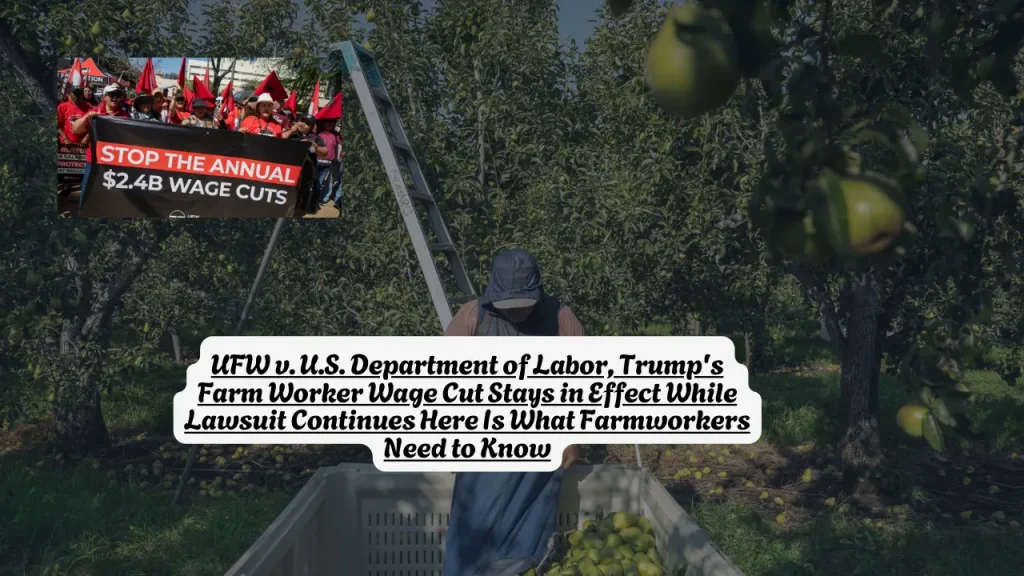
| Hundreds of farmworkers from California, Georgia, Washington, and Texas rally outside the Fresno federal courthouse before the injunction hearing | March 18, 2026 |
| Injunction hearing before Judge Kirk Sherriff, Fresno, CA | March 18, 2026 |
| Judge Sherriff denies preliminary injunction — finds UFW failed to show irreparable harm; wage cut rule remains in effect | May 14, 2026 |
| Case proceeds to discovery on merits | Ongoing |
| Ruling on legality of the wage cut rule | TBD — not yet scheduled |
Frequently Asked Questions
Is there a lawsuit against the Trump administration over the H-2A farmworker wage cut?
Yes. A coalition of 18 farmworkers, the United Farm Workers, and the UFW Foundation filed suit against the Trump administration on November 21, 2025, in the U.S. District Court for the Eastern District of California, arguing that the Department of Labor’s revised Adverse Effect Wage Rate methodology unlawfully slashes wages and could shift hiring incentives away from U.S. workers.
Did the court stop the wage cuts?
No — not yet. Judge Sherriff rejected the UFW’s bid to block the new wage scale, ruling that the UFW failed to show it or domestic farmworkers have been harmed, though the ruling does not prevent UFW from going forward with its lawsuit.
Does the wage cut only affect H-2A guest workers?
No. It is important for all farm workers to know that this wage cut doesn’t just impact workers on H-2A visas — it impacts all farmworkers. Domestic workers sharing job sites with H-2A workers are already seeing their wages pulled down to the new lower rates.
How much money are farmworkers losing under this rule?
The Trump administration’s wage cut rule is estimated to transfer over $4 billion in wages from workers to employers annually. At the individual level, the cut amounts to between $3 and $7 per hour depending on the state and job classification.
When will a final ruling come in this case?
TBD — the case is now in the discovery phase following the May 14 injunction denial. A ruling on whether the rule is actually unlawful could come later in 2026 or into 2027 depending on how quickly the case moves through the Eastern District of California.
Can I file my own lawsuit against my employer if my wages were cut?
Possibly. If your employer is paying you below the applicable Adverse Effect Wage Rate — even the lower new one — you may have a separate wage theft claim. Speak with a free legal consultation from a farmworker legal advocate or an unpaid wages lawsuit attorney who handles agricultural labor cases.
Has a similar wage cut rule been struck down before?
Yes. The first Trump administration attempted a similar rule change in 2020 but was thwarted by a UFW and UFW Foundation lawsuit that resulted in a ruling that the modification adversely and illegally affected wages and working conditions of U.S. farmworkers. The UFW argues the same legal outcome should result here.
Sources & References
- UFW Foundation — Official Case Statement (November 21, 2025): https://ufwfoundation.org/u-s-farm-workers-sue-trump-administration-to-save-american-farm-jobs-and-wages/
- UFW — Injunction Hearing Rally Statement (March 18, 2026): https://ufw.org/farm-workers-rally-against-aewr-rule-change-before-injunction-hearing/
- UFW — Injunction Denial Statement (May 14, 2026): https://ufw.org
- Agri-Pulse — Injunction Denial Reporting (May 14, 2026): https://www.agri-pulse.com/articles/24687-judge-denies-injunction-request-to-halt-new-farmworker-wage-rates
Prepared by the AllAboutLawyer.com Editorial Team and reviewed for factual accuracy against UFW official case records, Courthouse News Service trial reporting, and Agri-Pulse court coverage on May 16, 2026. Last Updated: May 16, 2026
Disclaimer: This article is for informational purposes only and does not constitute legal advice. Legal claims and outcomes depend on specific facts and applicable law. For advice regarding a particular situation, consult a qualified attorney.
About the Author
Israr Ahmad is a legal content researcher with 4+ years of experience covering class action settlements and consumer rights cases. He has researched and published coverage of 2,500+ settlements using verified court records, settlement administrator filings, and government sources. Learn more about Israr.