
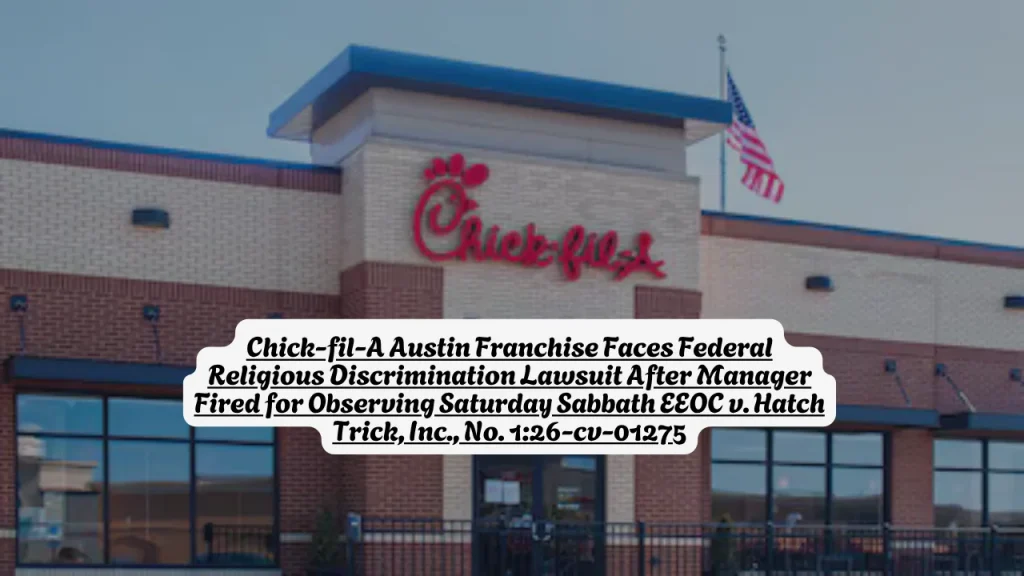
Chick-fil-A Austin Franchise Faces Federal Religious Discrimination Lawsuit After Manager Fired for Observing Saturday Sabbath EEOC v. Hatch Trick, Inc., No. 1:26-cv-01275
Hatch Trick, Inc., a Chick-fil-A franchisee operating multiple locations in Austin, Texas, violated federal law by refusing to reasonably accommodate an employee’s request to refrain from working on Saturdays in observance of her Sabbath day and instead fired her, the U.S. Equal Employment Opportunity Commission charged in a lawsuit announced on May 14, 2026. If you work in the restaurant industry and have ever been denied a religious accommodation at work, this case speaks directly to your legal rights.
EEOC v. Hatch Trick, Inc. — Quick Facts
| Field | Detail |
| Lawsuit Filed | May 14, 2026 |
| Defendant | Hatch Trick, Inc. (Chick-fil-A franchisee, Austin, Texas) |
| Alleged Violation | Title VII of the Civil Rights Act of 1964 — religious discrimination and failure to provide reasonable accommodation |
| Who Is Affected | The terminated manager (unnamed); potentially other employees at Hatch Trick locations |
| Current Court Stage | Active litigation — early stage |
| Court & Jurisdiction | U.S. District Court for the Western District of Texas, Austin Division |
| Case Number | 1:26-cv-01275 |
| Plaintiff | U.S. Equal Employment Opportunity Commission (EEOC) |
| EEOC Office | EEOC San Antonio Field Office — Director Norma Guzman |
| Next Hearing Date | TBD — pending court scheduling |
| Official Case Source | eeoc.gov/newsroom |
| Last Updated | May 16, 2026 |
What Is the Hatch Trick Chick-fil-A Religious Discrimination Lawsuit About?
The story here is straightforward — and that is what makes it so striking.
According to the EEOC’s lawsuit, the employee, who managed Hatch Trick’s delivery drivers at one of its Austin locations, is a member of the United Church of God denomination, which observes a Saturday Sabbath. Before she was even hired, she told the company she could not work on Saturdays because of her faith. The company said that was fine. Then it changed its mind.
The company initially honored the request, the EEOC said, but later told her she would be required to work Saturdays. The employee met several times with company officials and proposed alternatives that would have allowed her to continue in her managerial role while observing her Sabbath. Every alternative she offered was rejected.
The federal agency alleges Hatch Trick rejected those options and instead told the employee she would have to move to a non-managerial delivery driver position with lower pay, fewer benefits and reduced hours. When the employee declined the reassignment, she was fired.
That sequence — promise accommodation, withdraw accommodation, offer a punishing demotion as the only option, then terminate when the employee refuses — is exactly what Title VII is designed to prevent. The EEOC claims the actions violated Title VII of the Civil Rights Act of 1964, which requires employers to provide reasonable accommodations for employees’ sincerely held religious beliefs unless doing so would create an undue hardship.
The irony is not lost on anyone. Chick-fil-A is facing a federal lawsuit over alleged religious discrimination, despite the chain’s well-known tradition of closing its restaurants on Sundays to allow employees a day of rest. The Sunday closure policy is one of the most recognized expressions of faith-based business practice in American fast food. Saturday was a different day — and a different franchisee made a different call.
The EEOC filed suit after first attempting to reach a pre-litigation settlement through its administrative conciliation process. Settlement talks broke down, and the agency went to court.
This lawsuit is part of a broader pattern of EEOC enforcement under current leadership. Since assuming the position of chair at the EEOC, Andrea Lucas has prioritized actions against employers who interfere with employees expressing their religious beliefs, saying the Biden administration overlooked religious discrimination.
Related article: IKEA Illegal Ieepa Tariff Overcharges Class Action Lawsuit, Did You Pay More Because of Illegal Tariffs?
Are You Part of This Lawsuit?
This is a government enforcement action — not a class action with a claim form. The EEOC is suing on behalf of the terminated manager and the broader public interest in enforcing federal law. Individual employees who were harmed are not required to file anything to benefit from any relief the court orders.
That said, if you work or have worked at a Hatch Trick Chick-fil-A location in Austin and experienced similar treatment, your situation may be relevant to this case. Here is how to assess your own position.
You may have a religious discrimination claim if:
- You work or worked for a restaurant, retail business, or any employer with 15 or more employees in the United States
- You have a sincerely held religious belief — including beliefs tied to organized religion, or deeply held moral or ethical beliefs observed with the strength of religious conviction
- Your employer denied your request for a schedule change, dress code exception, or other accommodation tied to your religious practice
- Your employer retaliated against you — by demoting you, cutting your hours, or firing you — after you requested a religious accommodation or refused to abandon your religious practice
You are likely NOT covered by this specific lawsuit if:
- You were not employed by Hatch Trick, Inc. in Austin, Texas — this case involves one specific franchisee, not Chick-fil-A as a chain
- Your employer had fewer than 15 employees at the time of the alleged discrimination
Chick-fil-A sent the following statement regarding the lawsuit: “It’s important to know that, as a franchise business, all employment decisions are solely the responsibility of each individual restaurant owner.” Chick-fil-A Inc. is not named as a defendant in this case. Only Hatch Trick, Inc. — the franchisee — faces liability here.
What Is the EEOC Seeking in This Lawsuit?
This is not a settlement — no money has been awarded and no relief ordered. Here is what the EEOC is asking the court to require.
If the EEOC ultimately wins, the agency can seek make-whole relief such as back pay, reinstatement, injunctive orders and other corrective measures, with the specific remedies left for the court to decide.
In plain terms, “make-whole relief” means putting the employee back in the position she would have been in had the discrimination never happened. That typically includes recovery of lost wages from the date of termination, restoration to her management role if she wants it, and compensation for other financial losses tied to the wrongful termination. The court may also order Hatch Trick to implement new training and policies for its Austin locations.
EEOC San Antonio Field Office Director Norma Guzman said: “Religious discrimination in the workplace is unlawful, and employers must make reasonable accommodations for employees’ sincerely held beliefs. Title VII protects employees’ rights to observe their religious beliefs, and no employee’s livelihood should come at the expense of their religious convictions.”
What Should You Do If You Experienced Similar Treatment at Work?
If you have been denied a religious accommodation or fired after requesting one, federal law gives you specific tools — but there are deadlines you need to know about.
File a charge with the EEOC first. Before you can sue an employer for religious discrimination under Title VII, you must file a charge with the EEOC. In Texas, you generally have 300 days from the date of the discriminatory act to file. Missing this deadline can forfeit your right to bring a claim. File online at publicportal.eeoc.gov or call 1-800-669-4000.
Document everything right now. Write down the dates you requested an accommodation, the names of supervisors you spoke to, what alternatives you proposed, what you were offered in return, and the exact circumstances of any demotion or termination. Save any written communications, texts, or emails. This documentation is the foundation of any workplace harassment claim or religious discrimination case.
Understand what “reasonable accommodation” means. Common religious accommodations include flexible scheduling, voluntary shift substitutions or swaps, and job reassignments. Courts weigh undue hardship by looking at the employer’s size and operating costs. A large restaurant chain operating multiple locations has significantly more flexibility to accommodate schedule changes than a single-location small business — which works in your favor if you work for a multi-site franchise operator like Hatch Trick.
Speak with an employment discrimination attorney. Most employment lawyers handling religious discrimination cases offer a free legal consultation. Given the strict filing deadlines under Title VII, do not wait.
EEOC v. Hatch Trick — Case Timeline
| Milestone | Date |
| Employee discloses during job interview that she observes a Saturday Sabbath and cannot work Saturdays | TBD — prior to hiring |
| Hatch Trick initially honors Saturday accommodation | TBD — confirmed by EEOC complaint |
| Hatch Trick reverses course — begins scheduling employee for Saturday shifts | TBD — confirmed by EEOC complaint |
| Employee meets with management multiple times; proposes scheduling alternatives to stay in her managerial role | TBD — prior to 2026 |
| Hatch Trick offers demotion to delivery driver with lower pay, fewer benefits, and reduced hours | TBD — confirmed by EEOC complaint |
| Employee declines demotion; Hatch Trick terminates her employment | TBD — confirmed by EEOC complaint |
| EEOC attempts pre-litigation conciliation — talks fail | Prior to May 2026 |
| EEOC files suit — EEOC v. Hatch Trick, Inc., Case No. 1:26-cv-01275, U.S. District Court, Western District of Texas, Austin Division | May 14, 2026 |
| Hatch Trick response to complaint | TBD — not yet filed publicly |
| Next scheduled hearing | TBD — pending court scheduling |
| Expected resolution timeline | TBD — case in early litigation stage |
Frequently Asked Questions
Is there a lawsuit against a Chick-fil-A franchise for religious discrimination?
Yes. The EEOC filed suit against Hatch Trick, Inc., a Chick-fil-A franchisee operating multiple Austin locations, on May 14, 2026, in the U.S. District Court for the Western District of Texas, Austin Division, Case No. 1:26-cv-01275, alleging the company violated Title VII by refusing to accommodate a manager’s Saturday Sabbath observance and then firing her.
Is Chick-fil-A Inc. named in this lawsuit?
No. Chick-fil-A franchisees set their own employment policies, and Chick-fil-A Inc. is not named in the lawsuit. Only the franchisee — Hatch Trick, Inc. — is the defendant.
Do I need to do anything right now to be part of this case?
This is not a class action. The EEOC is pursuing this case on behalf of the specific employee and the public interest. If you experienced similar religious discrimination at a Hatch Trick location or any other employer, you should file your own EEOC charge before your filing deadline expires — do not wait for this case to conclude.
When will this lawsuit settle or go to trial?
TBD — the case was filed May 14, 2026, and is in the early stage. EEOC enforcement actions often resolve through negotiated settlements, but the timeline depends on how aggressively Hatch Trick contests the allegations. No trial date has been set.
What is the United Church of God and what does a Saturday Sabbath mean?
The United Church of God is a Christian denomination that observes the Sabbath on Saturday — from Friday sunset to Saturday sunset — based on its reading of scripture. This practice is a sincerely held religious belief protected under Title VII. The employee is not required to prove her belief is mainstream or widely shared — only that it is sincerely held. Courts and the EEOC have long recognized Saturday Sabbath observance as protected religious practice.
Can my employer force me to choose between my job and my religion?
No. Title VII of the Civil Rights Act of 1964 prohibits discrimination because of religion and requires employers to provide reasonable accommodation for an employee’s sincerely held religious beliefs or practices unless doing so would cause an undue hardship on the business. An employer who forces that choice — and then fires you for making it — is engaging in textbook religious discrimination.
What if my employer says accommodating me would be an undue hardship?
Undue hardship is a real legal defense — but it is a high bar. Courts weigh undue hardship by looking at the employer’s size and operating costs. A multi-location franchise operation has far more scheduling flexibility than a small business, making it much harder to argue that a single Saturday off per week creates undue hardship. The EEOC’s complaint in this case implicitly challenges Hatch Trick’s claim — if any — that it could not have accommodated a weekly day off through scheduling alternatives.
Sources & References
- EEOC Official Press Release — EEOC v. Hatch Trick, Inc. (May 14, 2026): https://www.eeoc.gov/newsroom/eeoc-sues-hatch-trick-inc-religious-discrimination
- U.S. District Court, Western District of Texas — Case No. 1:26-cv-01275: https://www.txwd.uscourts.gov
- Law360 — Case Reporting (May 14, 2026): https://www.law360.com/articles/2477884/chick-fil-a-worker-fired-for-sabbath-observance-eeoc-says
Prepared by the AllAboutLawyer.com Editorial Team and reviewed for factual accuracy against the official EEOC press release and case filing records at eeoc.gov on May 16, 2026. Last Updated: May 16, 2026
Disclaimer: This article is for informational purposes only and does not constitute legal advice. Legal claims and outcomes depend on specific facts and applicable law. For advice regarding a particular situation, consult a qualified attorney.
About the Author
Israr Ahmad is a legal content researcher with 4+ years of experience covering class action settlements and consumer rights cases. He has researched and published coverage of 2,500+ settlements using verified court records, settlement administrator filings, and government sources. Learn more about Israr.