
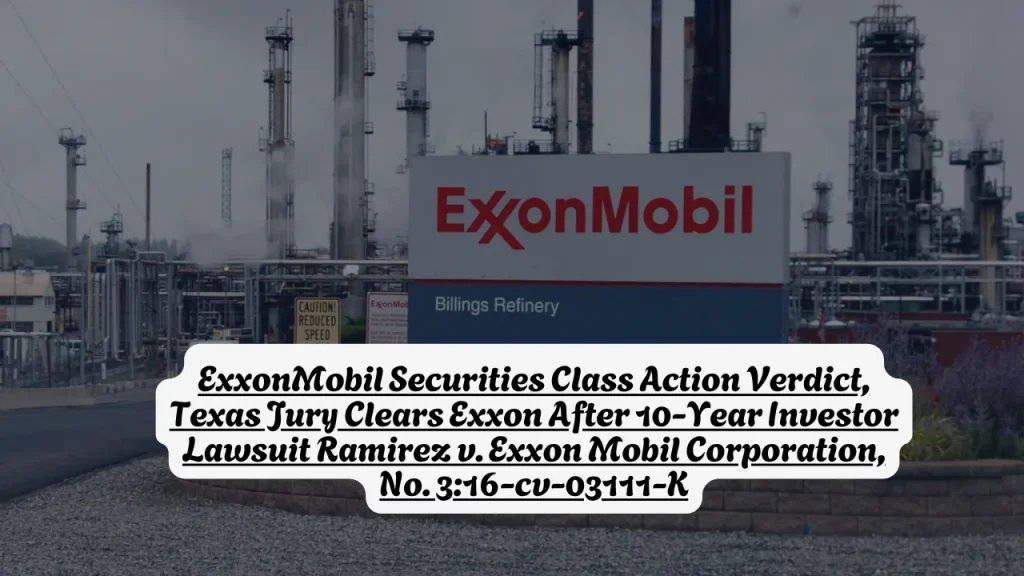
ExxonMobil Securities Class Action Verdict, Texas Jury Clears Exxon After 10-Year Investor Lawsuit Ramirez v. Exxon Mobil Corporation, No. 3:16-cv-03111-K
A Dallas-area jury cleared ExxonMobil on May 14, 2026, finding that investors failed to prove misrepresentations about the value and profitability of the company’s Canadian bitumen holdings and Rocky Mountain dry gas operations in a securities class action that had been working its way through the courts for nearly a decade. If you purchased ExxonMobil stock between February 24, 2016, and October 28, 2016, this verdict directly affects your legal rights.
Case Quick Facts — Ramirez v. Exxon Mobil Corporation, No. 3:16-cv-03111-K
| Field | Detail |
| Verdict Date | May 14, 2026 |
| Verdict | Complete defense — ExxonMobil not liable |
| Defendant | Exxon Mobil Corporation; Rex W. Tillerson; Andrew P. Swiger; Jeffrey J. Woodbury; David S. Rosenthal |
| Alleged Violation | Sections 10(b) and 20(a) of the Securities Exchange Act of 1934; Rule 10b-5 |
| Class Period | February 24, 2016 — October 28, 2016 |
| Court & Jurisdiction | U.S. District Court, Northern District of Texas (Dallas Division) |
| Judge | Hon. Ed Kinkeade |
| Lead Plaintiff | Pennsylvania pension fund (lead plaintiff) |
| Lead Plaintiff Counsel | Robbins Geller Rudman & Dowd LLP |
| Defense Counsel | Latham & Watkins LLP; Paul, Weiss, Rifkind, Wharton & Garrison LLP |
| Official Case Website | www.ExxonMobilSecuritiesLitigation.com |
| Last Updated | May 16, 2026 |
What Was the ExxonMobil Securities Lawsuit About?
This case started with a fundamental question: Did ExxonMobil tell its investors the truth about the financial health of its oil and gas operations during 2016?
In the lawsuit against ExxonMobil, a Pennsylvania pension fund alleged that the defendants made a series of purportedly false and misleading statements about the company’s use of proxy and greenhouse gas costs in its business planning, certain asset impairments ExxonMobil recognized in the western United States, and ExxonMobil’s assessment of certain proved reserves in Canada.
The Kearl Lake operation — a major oil sands project in Alberta, Canada — sat at the center of the case. Plaintiffs alleged ExxonMobil knew that only a drastic rise in prices could prevent the Kearl operations from being de-booked, and that the company failed to warn investors that the Kearl operation was highly likely to be de-booked at year-end 2016, not just that some proved reserves may be de-booked if prices remained at their current level.
On October 28, 2016, ExxonMobil announced its financial results for the third quarter of 2016, disclosing that nearly 20% of its proved oil and gas reserves might no longer satisfy the SEC’s “proved reserves” definition. Investors argued that this news should have come much sooner — and that holding it back inflated ExxonMobil’s stock price during the class period. The plaintiffs claimed ExxonMobil also had a specific motive: investors told the Texas jury that the oil giant hid the truth to snag a better interest rate in a bond offering.
Former ExxonMobil CEO Rex Tillerson testified that the company followed rules dictating annual reports to investors when it came to detailing its Kearl Lake reserves, and that the energy giant did not mislead investors. After nearly three weeks of trial, the jury agreed.
Related article: Washington State Foster Care Lawsuit, Immigrant Youth Face Deportation Because DCYF Won’t Help Them S.O.L. v. Washington DCYF, King County Superior Court
For a broader look at how Section 10(b) securities fraud cases work and what investors can typically expect from this type of litigation, see AllAboutLawyer.com’s guide to consumer class action lawsuits.
Who Was Part of the ExxonMobil Class Action?
The court certified the following class: all persons who purchased or otherwise acquired Exxon Mobil Corporation common stock between February 24, 2016, and October 28, 2016, inclusive, and were damaged thereby.
You were likely a class member if:
- You purchased or acquired ExxonMobil (NYSE: XOM) common stock between February 24, 2016, and October 28, 2016
- You held that stock and suffered losses when ExxonMobil’s share price declined following the October 28, 2016 reserves disclosure
- You are a U.S. investor and did not submit a written request to exclude yourself from the class before the February 5, 2026, opt-out deadline
You were likely NOT included if:
- You purchased ExxonMobil stock outside the certified class period — Judge Kinkeade rejected the three-year class period the plaintiff sought and certified a much narrower window
- You submitted a timely written exclusion request before the February 5, 2026 deadline
- Your alleged losses related only to ExxonMobil’s proxy and greenhouse gas cost disclosures — the court refused to certify any class concerning those alleged misstatements, finding they had no price impact
What the Jury Decided — and Why It Matters
The investors failed to prove misrepresentations about the value and profitability of Exxon’s Canadian bitumen holdings and Rocky Mountain dry gas operations, the Dallas-area jury said in responses written on the court’s instruction document. The trial took place in the U.S. District Court for the Northern District of Texas, overseen by Judge Ed Kinkeade.
The jury found that Exxon did not breach securities laws with its representations of how much money some of its operations were making. In securities fraud terms, this means the jury concluded that ExxonMobil’s public statements about the Kearl Lake reserves and its other operations during 2016 were not materially false or misleading under Section 10(b) of the Securities Exchange Act of 1934.
This verdict ends the litigation as it stands. Because ExxonMobil prevailed, no settlement fund will be created and class members will not receive any payments from this case. The investors were evaluating next steps following the verdict, meaning an appeal is possible — but no filing has been publicly confirmed as of the publication date of this article.
What Happens Next — What Class Members Should Know
The jury’s verdict means no money will be distributed from this case unless the plaintiffs successfully appeal and the outcome changes on remand. Here is what that means in practice.
No payment is coming from this verdict. Class members will not receive a settlement check or court-ordered damages as a result of this trial outcome. The lawsuit concluded in ExxonMobil’s favor.
Watch for any appeal announcement. Plaintiffs’ counsel at Robbins Geller Rudman & Dowd LLP has not yet publicly confirmed whether they intend to appeal. Any appeal would go to the U.S. Court of Appeals for the Fifth Circuit. If you were a class member, monitor www.ExxonMobilSecuritiesLitigation.com and the official case docket for any post-trial filings.
If you excluded yourself before February 5, 2026, you are not bound by this verdict and retain the right to pursue your own individual legal claim against ExxonMobil. Speak with a securities litigation attorney before any applicable statutes of limitations expire.
If you remained in the class, you are bound by this judgment. You generally cannot bring your own separate lawsuit about these same claims.
ExxonMobil Securities Class Action Timeline
| Milestone | Date |
| Class action originally filed in Northern District of Texas | 2016 |
| Consolidated complaint filed against all defendants, alleging violations of Sections 10(b) and 20(a) of the Securities Exchange Act of 1934 | July 26, 2017 |
| Judge Kinkeade certifies narrow class period (Feb. 24 – Oct. 28, 2016); rejects broader class and proxy cost claims | August 21, 2023 |
| Class opt-out deadline (Verita Global, notice administrator) | February 5, 2026 |
| Trial begins before Judge Ed Kinkeade, Northern District of Texas | April 27, 2026 |
| Investors present opening arguments — allege Kearl Lake misrepresentations caused stock drop | April 28, 2026 |
| Former CEO Rex Tillerson testifies in ExxonMobil’s defense | May 1, 2026 |
| ExxonMobil files mid-trial motion for judgment as a matter of law | May 8, 2026 |
| Texas federal jury clears ExxonMobil — complete defense verdict | May 14, 2026 |
| Plaintiffs evaluate next steps (potential appeal) | TBD — not yet publicly confirmed |
Frequently Asked Questions
What was the ExxonMobil securities class action lawsuit about?
The lawsuit alleged ExxonMobil made material misstatements by failing to adequately disclose in its 2015 Form 10-K and quarterly SEC filings throughout 2016 that its Kearl Lake oil sands operations were highly likely to be removed from the company’s proved reserves at year-end 2016. Plaintiffs alleged this kept ExxonMobil’s stock price artificially inflated during the class period.
Did ExxonMobil investors win or lose this case?
Investors lost. A Texas federal jury cleared ExxonMobil on May 14, 2026, finding the company did not breach securities laws with its representations of how much money some of its operations were making. No damages were awarded and no settlement fund will be created from this verdict.
Am I still eligible to receive money from this case?
No. Because the jury ruled in ExxonMobil’s favor, class members will not receive any payment from this litigation as it currently stands. If plaintiffs successfully appeal and the case results in a judgment or settlement on remand, that could change — but that outcome is not guaranteed.
Can I still file my own lawsuit against ExxonMobil?
If you remained in the class and did not exclude yourself before February 5, 2026, you are bound by this verdict and generally cannot bring your own separate lawsuit about the same claims. If you excluded yourself before that deadline, you may still have individual legal options — consult a class action lawsuit attorney promptly.
Is there a chance the verdict gets overturned on appeal?
Possibly. Securities defense verdicts are rarely overturned on appeal, but plaintiffs retain the right to challenge the verdict in the U.S. Court of Appeals for the Fifth Circuit. No appeal has been publicly filed as of May 16, 2026.
How do I know if I was part of the ExxonMobil class action?
The class covers all persons who purchased or otherwise acquired ExxonMobil Corporation common stock between February 24, 2016, and October 28, 2016, inclusive, and were damaged thereby. If you held XOM stock during that window and suffered losses tied to the October 2016 reserves announcement, you were likely a class member. Check your 2016 brokerage records or contact the notice administrator, Verita Global, via www.ExxonMobilSecuritiesLitigation.com.
What does Section 10(b) mean and why does it matter in this case?
Section 10(b) of the Securities Exchange Act of 1934 is the primary federal law prohibiting securities fraud. It makes it illegal for a company or its executives to make materially false or misleading statements in connection with the purchase or sale of a security. The lead plaintiff alleged that ExxonMobil and its executives violated Sections 10(b) and 20(a) of the Securities Exchange Act of 1934. The jury’s finding that ExxonMobil did not breach these laws means the plaintiffs failed to meet the legal standard required to hold the company liable.
Sources & References
- Law360 — Texas Jury Clears Exxon (May 14, 2026): https://www.law360.com/classaction/articles/2477899
- Bloomberg Tax — ExxonMobil Wins at Securities Trial (May 14, 2026): https://news.bloombergtax.com/securities-law/exxonmobil-prevails-in-securities-trial-over-downturn-accounting
- Official Case Website — Ramirez v. Exxon Mobil Corporation, No. 3:16-cv-03111-K: https://www.exxonmobilsecuritieslitigation.com
- U.S. District Court, Northern District of Texas — Court Docket: https://www.txnd.uscourts.gov
Prepared by the AllAboutLawyer.com Editorial Team and reviewed for factual accuracy against official court records at www.ExxonMobilSecuritiesLitigation.com and Law360 trial reporting on May 16, 2026. Last Updated: May 16, 2026
Disclaimer: This article is for informational purposes only and does not constitute legal advice. Legal claims and outcomes depend on specific facts and applicable law. For advice regarding a particular situation, consult a qualified attorney.
About the Author
Israr Ahmad is a legal content researcher with 4+ years of experience covering class action settlements and consumer rights cases. He has researched and published coverage of 2,500+ settlements using verified court records, settlement administrator filings, and government sources. Learn more about Israr.