
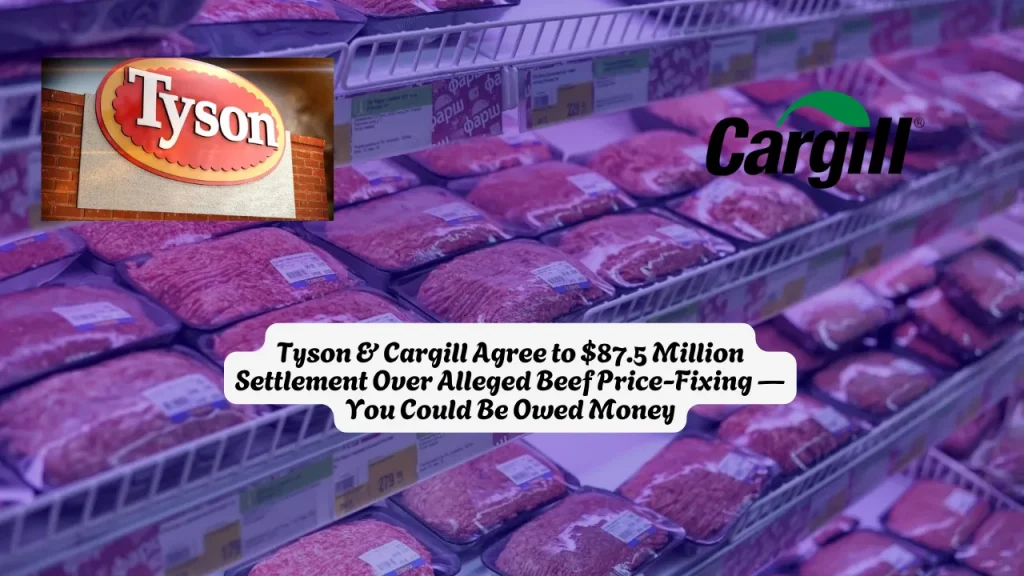
Tyson & Cargill Agree to $87.5 Million Settlement Over Alleged Beef Price-Fixing, You Could Be Owed Money
If you bought beef at a grocery store between August 2014 and December 2019, you may be eligible for a cash payment — no receipt required. Here’s everything you need to know.
Quick Case Snapshot
| Field | Details |
| Plaintiffs | U.S. consumers (indirect beef purchasers) |
| Defendants | Tyson Foods, Inc. / Tyson Fresh Meats, Inc.; Cargill, Inc. / Cargill Meat Solutions Corporation |
| Other Named Defendants | JBS USA, National Beef Packing (not yet settled) |
| Court | U.S. District Court, District of Minnesota |
| Case Number | 0:22-md-3031 |
| Judge | Judge John R. Tunheim |
| Claims Alleged | Antitrust price-fixing; market allocation conspiracy; violations of the Sherman Antitrust Act |
| Total Settlement | $87.5 million ($55M from Tyson + $32.5M from Cargill) |
| Class Period | August 1, 2014 – December 31, 2019 |
| Preliminary Approval | December 17, 2025 |
| Claim Deadline | June 30, 2026 |
| Final Approval Hearing | May 12, 2026 |
| Official Settlement Website | OverchargedForBeef.com |
| Current Status | Settlement open — claims being accepted |
What This Lawsuit Is About
Every time you threw a ribeye on the grill, made a Sunday pot roast, or grabbed short ribs from your local Walmart or Costco between 2014 and 2019, you may have been paying artificially inflated prices — and two of America’s biggest meat companies just agreed to pay $87.5 million because of it.
This is an antitrust class action lawsuit claiming that several major beef processors — including JBS, Cargill, National Beef, and Tyson Foods — conspired to limit the supply of beef and increase prices in the market. The plaintiffs allege that the defendants entered into a market allocation agreement and stopped competing against each other for market share, with the alleged purpose and effect of increasing their profit margins and the price consumers paid for beef.
Tyson, the largest U.S. meat company, will pay $55 million. Cargill agreed to pay $32.5 million. The proposed settlements are the first for consumers in this price-fixing litigation, which began in 2019. Neither company has admitted any wrongdoing.
What the Lawsuit Alleges — The Full Story
How the Alleged Conspiracy Worked
The antitrust class action claims that several beef processors entered into a market allocation agreement and stopped competing against each other for market share. The alleged purpose and effect of this agreement was to increase their margins and increase the price consumers paid for beef.
Under normal market conditions, competing meat processors would try to undercut each other on price, benefiting consumers. The complaint alleges that instead, Tyson, Cargill, JBS, and National Beef coordinated to restrict how much beef was available in the market. Less supply with steady demand means higher prices — and the lawsuit claims consumers were the ones paying for it at the checkout line, steak by steak, year after year.
How Long Did It Go On?
The class period runs from August 1, 2014 through December 31, 2019 — a full five and a half years during which the complaint alleges consumers were systematically overcharged every time they bought eligible beef cuts at grocery stores and supermarkets across 27 U.S. states and the District of Columbia.
Who Else Is Involved?
Tyson and Cargill agreed to cooperate with consumers as they pursue price-fixing claims against the remaining defendants, JBS USA and National Beef Packing, who have not settled and deny the accusations made against them. This cooperation is a significant non-monetary benefit of the settlement — the two settling companies will essentially assist in building the case against the others.
The Settlement — How Much Will You Get?
Class members who submit a timely, valid claim form are eligible to receive a one-time, pro-rated cash payout proportional to the amount of beef they purchased during the class period. Class members may elect to receive this payout via check or electronic payment.
The exact amount per person is not predetermined. After deducting attorneys’ fees, litigation costs, service awards for class representatives, and administration expenses, the settlement administrator will distribute the remaining funds among approved claimants.
The attorneys pursuing the case are expected to receive 33.3% of the settlement for their legal fees, which comes to approximately $29 million. The remaining amount will be divided among all valid claimants proportionally based on how much eligible beef they purchased.
Your individual payout will depend on two things: how much qualifying beef you estimate you purchased during the class period, and how many total claims are filed. The more people who file, the smaller each individual share — which is why filing sooner rather than later is generally advisable.
Related article: Impac Mortgage Holdings Data Breach Exposes Social Security Numbers — Victims Waited Two Years for Notice
Are You Eligible? Check This First
You Qualify If:
You purchased beef products between August 1, 2014 and December 31, 2019 to feed yourself, family, or friends — and you purchased them indirectly, meaning you bought them at a grocery store or supermarket rather than directly from one of the defendants.
You must also have purchased beef in one of these 27 eligible states or jurisdictions:
Arizona, California, the District of Columbia, Florida, Illinois, Iowa, Kansas, Massachusetts, Maine, Michigan, Minnesota, Missouri, Montana, Nebraska, Nevada, New Hampshire, New Mexico, New York, North Carolina, North Dakota, Oregon, Rhode Island, South Dakota, Tennessee, Utah, West Virginia, and Wisconsin.
Eligible Beef Products Include:
The sweeping settlement applies to dozens of fresh and frozen beef products sold at grocery stores. More than 280 beef products are eligible, including tri-tip steak, top sirloin steak, tomahawk, tenderloin tips, T-bone, short ribs, ribeye, and more. The full list is searchable at OverchargedForBeef.com.
These Beef Products Are NOT Covered:
The following popular beef products are not included: Premium — USDA Prime, organic, 100% grass-fed, Wagyu, and “American-Style Kobe Beef.” Specialty — No Antibiotics Ever (NAE), antibiotic-free, kosher, halal, and certified humane. Also excluded is any ground, marinated, seasoned, flavored, breaded, or cooked beef.
In short: the standard everyday beef cuts most Americans buy at the supermarket — your typical supermarket steaks, roasts, and ribs — are covered. The premium, specialty, and processed categories are not.
How to File Your Claim — Step by Step
Filing is straightforward and no receipt or proof of purchase is required at the time of submission.
Step 1 — Go to the official website: Visit OverchargedForBeef.com. This is the only official court-approved settlement portal.
Step 2 — Complete the claim form: All claimants must provide an estimate of how many pounds of eligible beef products they purchased on a monthly basis and how much they spent per month. They do not need to provide any documentation at this time; however, the settlement administrator may ask for additional information or documentation to support their claim.
Step 3 — Choose your payment method: You can elect to receive your payment by check or electronic payment.
Step 4 — Submit before the deadline: Claims must be submitted by June 30, 2026 — either online or by mailing a PDF claim form to: Consumer Indirect Beef Litigation, c/o Settlement Administrator, P.O. Box 3605, Portland OR, 97208-3605.
Be honest. Submit only truthful information. False claims can be rejected and may carry penalties.
Defendants’ Response
Tyson and Cargill deny wrongdoing. The court has not ruled that the beef companies did anything wrong. The settlements are proposed and require final court approval. Both companies agreed to settle without any admission of liability — a standard practice in large antitrust class actions where the cost and uncertainty of litigation make settlement strategically sensible even for defendants who dispute the allegations.
Defendants JBS USA Food Co., Swift Beef Co., JBS Packerland Inc., and National Beef Packing Co. have not settled. Litigation against those parties continues.
Legal Context: Why This Case Matters
The Sherman Antitrust Act
The beef antitrust lawsuit alleged that several major processors deliberately reduced the supply of beef in the market to raise prices and increase profit margins, effectively ceasing competition with each other, in violation of the Sherman Antitrust Act. The Sherman Act, passed in 1890, is the foundational federal law prohibiting anticompetitive business practices. Market allocation agreements — where competitors agree to divide up markets and stop competing — are among the most serious violations the law addresses, often treated as illegal per se (meaning automatically illegal, without the need to prove actual harm in each case).
Part of a Broader Meat Industry Reckoning
This settlement does not stand alone. The settlement comes as meat giants resolve a litany of lawsuits from consumers, food distributors and grocery stores pointing to price-fixing in beef, pork and chicken. JBS settled for $52.5 million to resolve similar claims in 2022.
There is also a separate Tyson settlement: Tyson Foods agreed to pay $82.5 million to settle a class action lawsuit brought by grocers and distributors — not consumers — who alleged it illegally inflated beef prices between 2015 and 2021.
And separately again, Tyson Foods agreed to pay $48 million to resolve claims it conspired to fix the price of pork by constricting supply, benefiting a class of indirect commercial purchasers of pork between June 28, 2014 and June 30, 2018.
Taken together, these settlements represent one of the largest waves of meat industry antitrust enforcement in U.S. history — and signal that regulators and plaintiffs’ attorneys are taking supply-restriction schemes in the food sector extremely seriously.
How Big Is the Potential Class?
Attorneys for the plaintiffs estimated there are approximately 36 million potential class members across 26 states and the District of Columbia. If even a small fraction of those eligible file claims, the payout per person will be modest — but the collective accountability the lawsuit represents is significant.
Current Status & What Happens Next
Here is the exact timeline of what is still ahead:
December 17, 2025 — Preliminary settlement approval granted by the court.
March 30, 2026 — Deadline to opt out or object to the settlement (now passed).
May 12, 2026 — Final approval hearing before Judge John R. Tunheim in the U.S. District Court of Minnesota. The court will formally decide whether to approve the settlements.
June 30, 2026 — Claim deadline. All claim forms must be submitted online or postmarked by this date.
After June 30, 2026 — Compensation will begin to be distributed to class members only after final approval is granted and any appeals are resolved.
If the court approves the settlement on May 12 and there are no appeals, payments could begin in late 2026 or early 2027. Appeals, if filed, could delay this further.
Your Three Options as a Class Member
Option 1 — File a Claim: You will receive a cash payment and give up your right to sue Cargill and Tyson over these legal claims. Submit a claim form by June 30, 2026.
Option 2 — Opt Out: You will not receive money from these settlements, but you keep your right to sue Cargill and Tyson on your own. The opt-out deadline of March 30, 2026 has now passed.
Option 3 — Object: You remain bound by the settlement but can tell the court why you think it is unfair. If you opted out, you cannot object.
For most people, Option 1 — filing a claim — is the only remaining viable choice, since the opt-out deadline has passed.
FAQs: What People Are Asking Right Now
Q: Is this the Tyson beef lawsuit or the Tyson pork lawsuit?
This specific $87.5 million settlement is about beef. Tyson is also separately settling a pork price-fixing case for $48 million — that is a different lawsuit with different eligibility rules.
Q: Do I need a receipt to file a claim?
No. You simply need to estimate how much eligible beef you purchased per month and how much you spent. The settlement administrator may request documentation later, but it is not required to file.
Q: I live in Texas — can I still file?
Texas is not among the 27 eligible “Repealer Jurisdictions” for this settlement, so Texas residents are generally not covered. Check the full state list above to confirm your state’s eligibility.
Q: What if I bought beef at Walmart, Costco, or Target?
Yes, purchases from major grocery retailers like Walmart and Costco are covered — the retailers themselves are not defendants in this lawsuit.
Q: How much will I actually receive?
Exact amounts are not yet determined. Your payout will be proportional to how much qualifying beef you purchased and how many total valid claims are filed. With an estimated 36 million potential class members, individual payouts are likely to be modest unless you purchased very large quantities.
Q: What is OverchargedForBeef.com?
That is the official, court-approved settlement website where you can file your claim, check eligible products, and find the PDF claim form for mail submission.
Q: What happens if I do nothing?
You will receive no payment and will be legally bound by the settlement — meaning you give up the right to sue Tyson and Cargill separately over these same claims.
Q: Can people outside the U.S. file?
No. The settlement covers purchases made in specific U.S. states only.
Last Updated: April 20, 2026
This article is for informational purposes only and does not constitute legal advice. Allegations in a complaint are not findings of fact. The settlements described are pending final court approval. All parties are presumed innocent unless and until proven otherwise in court. For claim-specific questions, visit OverchargedForBeef.com or contact the settlement administrator directly.
About the Author
Israr Ahmad is a legal content researcher with 4+ years of experience covering class action settlements and consumer rights cases. He has researched and published coverage of 2,500+ settlements using verified court records, settlement administrator filings, and government sources. Learn more about Israr.