
Driscoll’s Strawberries Recall and the 2026 Pesticide Report, What Is True, What Is Not, and What Consumers Should Actually Do
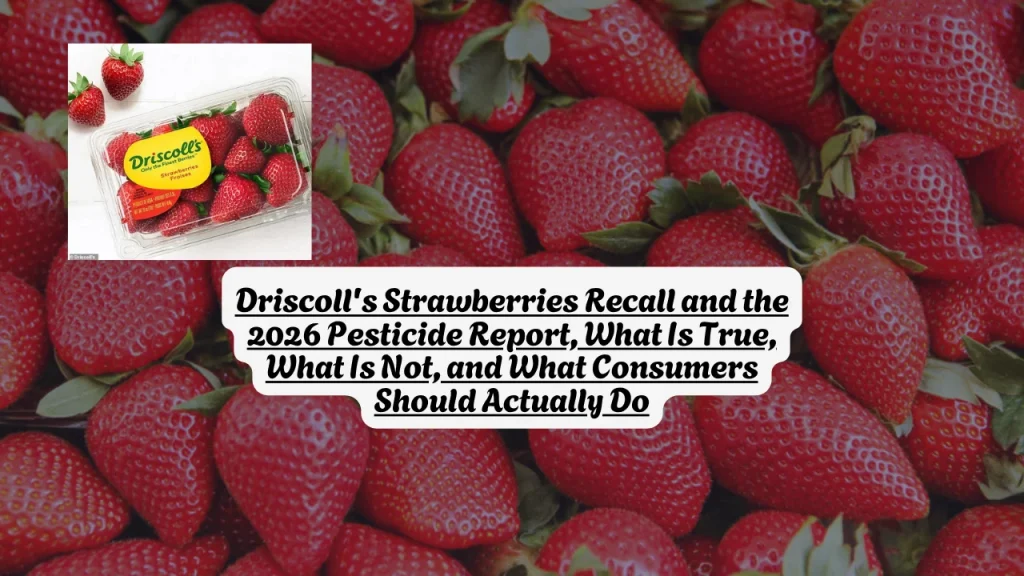
There is no active recall of Driscoll’s strawberries as of May 18, 2026. No U.S. government agency — not the FDA, not the EPA, not the USDA — has issued a recall, safety alert, or market withdrawal for any Driscoll’s strawberry product currently on shelves. What is circulating online is based on a May 2026 independent consumer watchdog report that found pesticide residues in a single sample of conventional Driscoll’s strawberries. Here is the full, accurate picture.
Quick Facts
| Field | Detail |
| Active Official Recall | None — as of May 18, 2026 |
| Who Conducted the Test | Mamavation (consumer watchdog), not a government agency |
| Lab Used | Haereticus Environmental Laboratory, EPA-certified, Virginia |
| Test Date | May 4, 2026 |
| Sample Tested | One box of conventional Driscoll’s strawberries, Southern California |
| Pesticides Found | 12 residues detected in conventional sample |
| PFAS-Linked Pesticides | 8 of the 12 identified as PFAS-linked or fluorinated compounds |
| Within U.S. EPA Limits? | Yes — all residues were within current U.S. federal tolerance levels |
| Organic Sample Result | No detectable pesticide or PFAS residues |
| Driscoll’s Response | States full compliance with U.S. federal, state, and local regulations |
| Governing Agencies | U.S. EPA, California Department of Pesticide Regulation |
| Last Updated | May 18, 2026 |
What the Watchdog Report Actually Found
A consumer watchdog report published on May 16, 2026, revealed that conventional strawberries from Driscoll’s contained residues of 12 different pesticides, including chemical compounds linked to PFAS. The investigation was conducted by consumer advocacy organization Mamavation, which purchased organic and conventional Driscoll’s strawberries from a Southern California grocery store and tested them at an EPA-certified facility, Haereticus Environmental Laboratory in Virginia.
The highest chemical concentration detected was tetrahydrophthalimide (THPI), a byproduct linked to the fungicide captan, at 302 parts per billion (ppb). Laboratory analysts also detected pyrimethanil at 310 ppb, cyprodinil at 125 ppb, fludioxonil at 60 ppb, flonicamid at 32 ppb, flupyradifurone at 27 ppb, and fluxapyroxad at lower levels.
According to the lab, residues of the 12 pesticides were at levels prohibited in the European Union, Taiwan, Chile, Korea, and Russia. However, that comparison deserves context — those countries set their own limits independently, and different countries draw the line at different places. U.S. EPA tolerance levels are legally binding in the United States, and the residues found fell within them.
What the Report Did Not Say — And What Headlines Got Wrong
Experts note consistently that detecting pesticide residue does not necessarily mean a food poses a health risk. EPA tolerance levels are designed to remain well below amounts considered harmful based on current scientific evidence.
Mamavation said its advisors recommend organic strawberries as a way to reduce exposure to pesticides and PFAS. The group also said it only spot-checks the industry and cannot predict what it will find in brands or products it has not tested. Products and manufacturing practices can also change without notice, which means one lab result cannot stand in for every box on every shelf.
In contrast to the conventional produce findings, the organic Driscoll’s strawberries tested during the investigation showed no detectable pesticide or PFAS residues. That is the most actionable fact in the entire report — and most viral posts about this story leave it out entirely.
Related article: Papa John’s Cookie Tracking Class Action, Did They Spy on You After You Said No?
What Driscoll’s Said
A Driscoll’s spokesperson told the Daily Mail: “Driscoll’s takes seriously and closely follows scientific best practices and regulatory guidance on research related to food-safety risks. Driscoll’s and our independent grower partners operate in full compliance with applicable U.S. federal, state and local pesticide and food-safety regulations, including frequent oversight by the U.S. Environmental Protection Agency and the California Department of Pesticide Regulation.”
The Hepatitis A Claim: Misinformation Spreading Online
Social media posts — particularly on TikTok — are linking Driscoll’s to Hepatitis A outbreaks. This is misinformation. The FDA investigated a 2022 Hepatitis A outbreak linked to fresh organic strawberries branded as FreshKampo and HEB — not Driscoll’s. That outbreak is over and was officially closed by the CDC. Driscoll’s has issued a public statement confirming its strawberries are not linked to any Hepatitis A investigation by the FDA or any other agency. Do not share or act on those claims.
The 2022 Recall: Closed and No Longer Relevant
Driscoll’s did face a voluntary recall in January 2022 — but it has been terminated. That recall involved strawberries treated with the pesticide Etoxazole that exceeded the government’s Maximum Residual Limit. The recall was classified as Class III — meaning the exposure level was unlikely to cause serious health consequences. All affected product was removed from shelves in 2022 and is long past shelf life. It has no bearing on strawberries available for purchase today.
What You Should Actually Do Right Now
- Do not throw away strawberries based on social media posts. No recall is active. No government agency has issued a safety alert for Driscoll’s strawberries as of May 18, 2026.
- Check the FDA’s official recall database at fda.gov/food/recalls-outbreaks-emergencies before acting on any food recall claim you see online. If it is not there, there is no recall.
- Consider buying organic if pesticide exposure concerns you. The organic Driscoll’s strawberries tested showed no detectable pesticide or PFAS residues. For parents concerned about pesticide exposure in children, who tend to eat strawberries in significant quantities, this is a meaningful data point.
- Wash all strawberries thoroughly before eating. The FDA recommends rinsing fresh produce under running water before consumption, regardless of brand.
- Follow the EWG Dirty Dozen list. Strawberries have long appeared near the top of the Environmental Working Group’s annual Dirty Dozen list, with 99% of tested samples containing at least one pesticide residue and about 30% containing 10 or more. This is an industry-wide issue, not unique to Driscoll’s.
Common Misconceptions
Myth: Driscoll’s strawberries have been recalled in 2026. Fact: No. The FDA has issued no recall, safety alert, or market withdrawal for Driscoll’s strawberries in 2025 or 2026. The 2022 recall was terminated and no longer applies to anything currently on sale.
Myth: Pesticide residues found in the test mean the strawberries are dangerous. Fact: While the detected residues appear to fall within U.S. federal tolerance levels, the report alleged several exceeded stricter international standards and raised concerns about cumulative exposure to PFAS-linked pesticides. Whether current U.S. limits are strict enough is an ongoing scientific and regulatory debate — but residues within those limits are legal and not classified as a food safety emergency.
Myth: Driscoll’s strawberries caused a Hepatitis A outbreak. Fact: The FDA’s 2022 Hepatitis A investigation involved FreshKampo and HEB-branded strawberries, not Driscoll’s. That outbreak was declared over by the CDC. Driscoll’s has publicly confirmed it is not linked to any current Hepatitis A investigation.
Frequently Asked Questions
Is there an active recall of Driscoll’s strawberries?
No. As of May 18, 2026, no U.S. government agency has issued a recall for Driscoll’s strawberries. Always verify recall claims at fda.gov before acting.
Are PFAS “forever chemicals” the same as PFAS-linked pesticides?
Not exactly. PFAS are a broad family of synthetic chemicals. “PFAS-linked pesticides” are fluorinated pesticide compounds that share structural similarities with PFAS. They can persist in the environment, but the health risks from residue levels found in food are the subject of ongoing scientific debate — not settled consensus.
Are organic Driscoll’s strawberries safer than conventional?
Based on this single test, yes. The organic Driscoll’s strawberries tested showed no detectable pesticide or PFAS residues. One test cannot speak for all batches, but choosing organic reduces pesticide exposure risk across the board.
What law governs pesticide limits in U.S. food?
The Federal Food, Drug, and Cosmetic Act (FFDCA) directs the EPA to set Maximum Residue Limits (MRLs) for pesticides in food. The FDA enforces those limits and can mandate recalls when products exceed them.
Do I need a lawyer if I was harmed by a food product?
If you believe you suffered a health injury from a food product, a product liability or consumer protection attorney can evaluate whether you have a claim. For a starting point, see the consumer protection resources at AllAboutLawyer.com. Our previous coverage of how product recalls are handled under U.S. consumer law also provides useful context.
Sources
- Mamavation: PFAS-Laden Pesticides Found in Driscoll’s Strawberries
- Daily Mail / MSN: Cancer-Linked Toxins Found in America’s Favorite Strawberry Brand
- Driscoll’s Official Statement: Driscoll’s Strawberries Are Safe to Eat
- FDA Recall Database: fda.gov/food/recalls-outbreaks-emergencies
- FDA 2022 Hepatitis A Investigation: Outbreak Investigation — Strawberries (May 2022)
Prepared by the AllAboutLawyer.com Editorial Team and reviewed for factual accuracy against FDA official records, Mamavation’s original report, and Daily Mail/MSN reporting. Last Updated: May 18, 2026.
Disclaimer: This article is for general informational and educational purposes only and does not constitute legal advice. Laws vary by state and jurisdiction. For advice about your specific situation, consult a qualified attorney.
About the Author
Israr Ahmad is a legal content researcher with 4+ years of experience covering class action settlements and consumer rights cases. He has researched and published coverage of 2,500+ settlements using verified court records, settlement administrator filings, and government sources. Learn more about Israr.