
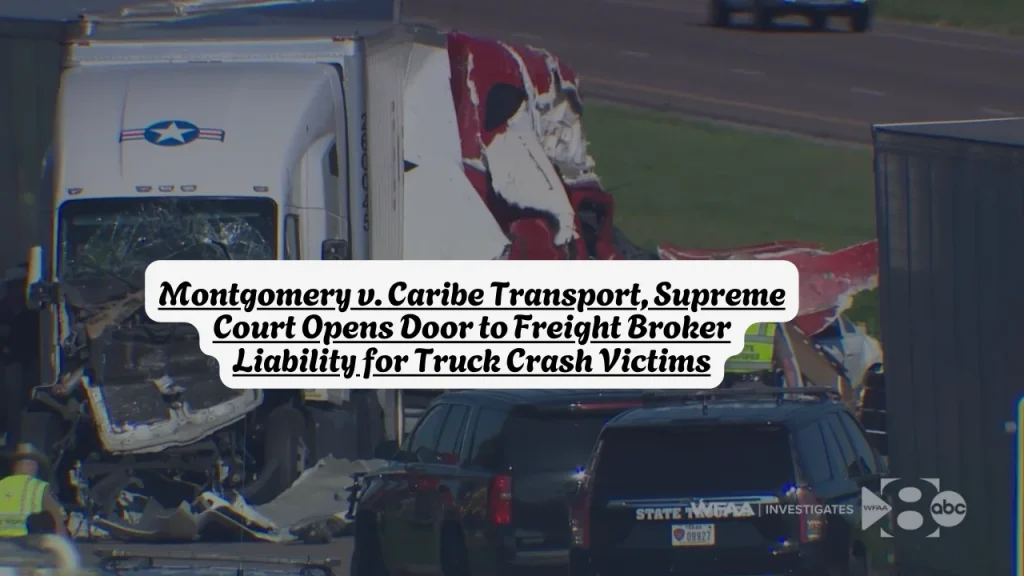
Montgomery v. Caribe Transport, Supreme Court Opens Door to Freight Broker Liability for Truck Crash Victims
Negligent hiring is a legal theory that holds a company responsible when it hires another party it knew — or should have known — posed a danger to others. On May 14, 2026, the U.S. Supreme Court ruled unanimously that freight brokers can be sued under state negligence law for hiring unsafe motor carriers, stripping the industry’s largest middlemen of the federal preemption shield they had used for decades to avoid responsibility when the carriers they dispatch cause catastrophic highway crashes. The decision is a major win for truck accident victims and a significant shift in how liability is assigned across the American freight industry.
Quick Facts
| Field | Detail |
| Case Name | Montgomery v. Caribe Transport II, LLC |
| Case No. | 24-1238 |
| Decided | May 14, 2026 |
| Court | U.S. Supreme Court |
| Vote | 9-0 (unanimous) |
| Opinion Author | Justice Amy Coney Barrett |
| Key Law | Federal Aviation Administration Authorization Act (FAAAA), 49 U.S.C. § 14501(c)(2)(A) |
| Defendant (Freight Broker) | C.H. Robinson Worldwide, Inc. |
| Governing Claim | Negligent hiring under state tort law |
| Last Updated | May 18, 2026 |
What Happened: One Man’s Crash, Nine Years of Litigation
Shawn Montgomery was severely injured in an accident in Illinois when a tractor-trailer driven by Yosniel Varela-Mojena struck his vehicle. The shipment was coordinated by C.H. Robinson Worldwide, Inc. Montgomery alleged that C.H. Robinson knew or should have known from Caribe Transport’s conditional Federal Motor Carrier Safety Administration (FMCSA) safety rating — with deficiencies in driver qualification, hours of service, maintenance, and crash rate — that hiring Caribe was reasonably likely to cause accidents.
Montgomery’s lawsuit said C.H. Robinson should share liability because it hired the carrier despite those problems. His appeal was backed by more than two dozen states, who said a win for him would help bolster safety in an industry that moves billions of tons of goods across billions of miles every year.
Lower courts had dismissed the case against the broker. The Supreme Court reversed that dismissal entirely.
The Legal Shield That No Longer Exists
For years, freight brokers across the country had used a federal law — the Federal Aviation Administration Authorization Act, or FAAAA — to get negligent hiring lawsuits thrown out before they ever reached a jury. The argument was simple: federal law regulates interstate trucking, so state injury claims against brokers are preempted (blocked) by federal law.
The freight brokerage industry’s federal preemption defense is now over. If you are a freight broker operating in the United States today, the preemption defense you have been relying on since 2023, when the Seventh Circuit decided Ye v. GlobalTranz, is gone. You are now subject to state tort law in every jurisdiction where you arrange transportation.
The FAAAA preempts state laws related to prices, routes, and services for commercial trucking companies and brokers. However, a safety exception allows states to maintain safety regulatory authority with regard to motor vehicles. The Court found that the plaintiff’s negligent-hiring claim fell within the FAAAA’s safety exception and therefore was not preempted.
Justice Barrett’s majority opinion was remarkably brief for a ruling of this consequence. In eight pages, with no dissent, she reversed the Seventh Circuit and sent the case back for further proceedings. The Restatement (Second) of Torts, Section 411, imposes a duty of reasonable care in employing a contractor for work carrying a risk of physical harm — Barrett cited it directly in the opinion.
Related article: $69M ChemoCentryx Investor Securities Settlement, Check If You Qualify for a Payment
The Gap This Article Covers: What It Means If You Were Injured in a Truck Crash
Every industry article focuses on what brokers must do now. Here is what this ruling means if you or someone you love was hurt in a crash involving a commercial truck.
Before this ruling, even if a broker hired a carrier with a documented history of crashes, failed inspections, and safety violations, your attorney likely could not sue the broker directly — federal preemption would block the claim. Plaintiff’s attorneys who handle commercial motor vehicle crash cases have been building these case files for years, waiting for the preemption question to resolve.
That wait is over. If a freight broker arranged the shipment that put a dangerous truck on the road that injured you, you may now have a direct claim against that broker under your state’s negligence law. The carrier the broker selected, the safety record it ignored, the data it declined to check — all of it is now discoverable, admissible, and can be presented to a jury.
Identifying whether a freight broker was involved in a crash requires access to shipping records, load confirmations, and FMCSA safety data. An experienced truck accident attorney can subpoena those records. If you or a family member was injured in a commercial truck accident, the personal injury and consumer protection resources at AllAboutLawyer.com can help you understand your rights and find qualified legal representation. Our earlier coverage of how courts handle corporate liability in large-scale injury cases also provides useful context on how these claims develop.
Industry Reaction and What Changes Next
The freight industry response was immediate and concerned. Janelle Griffith, managing director and global logistics practice leader at Marsh Risk, stated the decision “represents an important development for freight brokers and their insurers,” adding that “brokers may see increased involvement in bodily injury litigation related to carrier selection, which could lead to higher defense costs and potential indemnity exposure.”
Brian Watt, who runs a freight logistics company in Florida, said brokers will now have to focus more on the safety records of the truckers they contract with, rather than just looking for the cheapest and fastest option. He noted that more than 28,000 federally licensed brokers currently operate in the United States with virtually no meaningful federal safety oversight regarding how they select carriers.
The decision could increase insurance costs for freight brokers that eventually “cascade through the economy” and result in higher prices for consumers, Justice Kavanaugh wrote in a concurrence joined by Justice Samuel Alito. At the same time, Kavanaugh acknowledged the other side of that equation — that “if brokers can be held liable for disregarding poor safety records, they have a strong incentive to do business only with safe and reliable motor carriers.”
The ruling was opposed by the Trump administration and companies like Amazon, who argued against exposing logistics companies to liability under a “patchwork” of state laws. The Court’s unanimous vote overrode those objections.
Common Misconceptions
Myth: This ruling means Montgomery has won. Fact: The decision does not mean Montgomery will necessarily win the lawsuit, which the company is contesting. The ruling only opens the door — the case now goes back to lower courts for the underlying negligent hiring claim to be litigated.
Myth: Only C.H. Robinson is affected. Fact: The opinion is written about brokers because C.H. Robinson is a broker, but the logic applies to anyone in the supply chain who selects a carrier and has access to publicly available safety data showing that the carrier presents an elevated risk.
Myth: Federal law still protects brokers from state lawsuits. Fact: The Court found that a claim alleging a freight broker negligently hired a carrier falls within the FAAAA’s safety exception and is therefore not preempted — the federal shield no longer applies to safety-based negligent hiring claims.
Frequently Asked Questions
What is a freight broker and why does this ruling matter?
A freight broker is a company that connects businesses needing to ship goods with trucking companies that haul them. More than 28,000 federally licensed brokers currently operate in the United States. Before this ruling, brokers could avoid lawsuits even when they hired carriers with known safety problems. Now they cannot.
Can I sue a freight broker if a truck injured me?
Possibly, yes. If a freight broker arranged the load that put an unsafe truck on the road, you may now bring a negligent hiring claim against that broker under state law. Whether you have a viable claim depends on the specific facts, the broker’s knowledge of the carrier’s safety record, and your state’s negligence standards. An attorney can evaluate your case.
What law governs this ruling?
The Federal Aviation Administration Authorization Act (FAAAA), specifically 49 U.S.C. § 14501(c)(2)(A) — the safety exception — which preserves state authority to regulate motor vehicle safety even where federal preemption would otherwise apply.
Do I need a lawyer for a truck accident involving a freight broker?
Yes. Identifying a broker’s role in a crash, obtaining shipping records, and building a negligent hiring claim requires legal expertise and discovery tools. Truck accident cases involving brokers are now more complex — and potentially more valuable — than before this ruling.
What safety data is relevant to a negligent hiring claim?
Relevant data includes a carrier’s Federal Motor Carrier Safety Administration (FMCSA) safety rating, deficiencies in driver qualification, hours of service, maintenance records, and crash history. All of this is now discoverable in litigation against a broker.
Sources
- U.S. Supreme Court: Montgomery v. Caribe Transport II, LLC, No. 24-1238 (May 14, 2026)
- FMCSA Safety Data: ai.fmcsa.dot.gov
Prepared by the AllAboutLawyer.com Editorial Team and reviewed for factual accuracy against the Supreme Court opinion, AP reporting, and legal analysis from Cozen O’Connor and Ogletree Deakins. Last Updated: May 18, 2026.
Disclaimer: This article is for general informational and educational purposes only and does not constitute legal advice. Laws vary by state and jurisdiction. For advice about your specific situation, consult a qualified attorney.
About the Author
Israr Ahmad is a legal content researcher with 4+ years of experience covering class action settlements and consumer rights cases. He has researched and published coverage of 2,500+ settlements using verified court records, settlement administrator filings, and government sources. Learn more about Israr.