
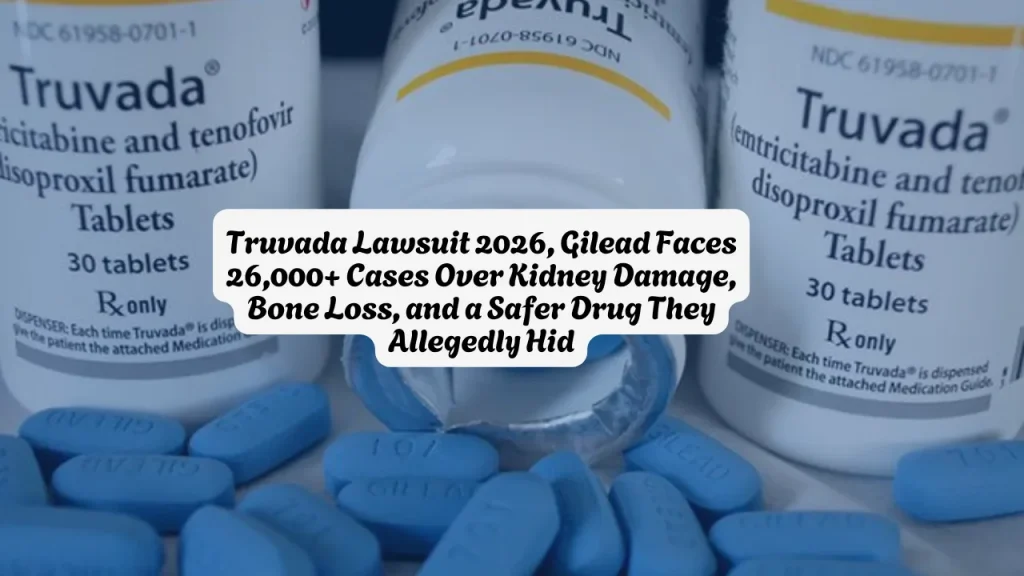
Truvada Lawsuit 2026, Gilead Faces 26,000+ Cases Over Kidney Damage, Bone Loss, and a Safer Drug They Allegedly Hid
Tens of thousands of HIV patients have sued Gilead Sciences, the maker of Truvada, claiming the company knew its drug caused severe kidney disease and bone loss — and deliberately delayed releasing a safer alternative to protect profits. Gilead has offered $40 million to resolve roughly 2,600 federal cases, but more than 24,000 additional state lawsuits remain active in California. The entire litigation now hinges on a landmark decision expected from the California Supreme Court in 2026.
Quick Case Snapshot
| Field | Details |
| Plaintiffs | Thousands of current and former Truvada users |
| Defendant | Gilead Sciences, Inc. |
| Federal Court | U.S. District Court, Northern District of California (MDL 2881) |
| State Court | California Superior Court (consolidated) |
| Claims Alleged | Product liability, failure to warn, negligent design defect, fraudulent concealment |
| Damages Sought | Varies per plaintiff; $50,000–$1M+ estimated range for severe cases |
| Federal Settlement Offered | $40 million (covering ~2,625 federal plaintiffs) |
| Avg. Federal Payout | ~$12,500 per plaintiff |
| State Cases Active | 24,000+ in California |
| Current Status | Awaiting California Supreme Court ruling — pivotal decision expected mid-2026 |
What Is the Truvada Lawsuit About? (The Fast Answer)
Lawsuits allege that Gilead failed to adequately warn about kidney side effects and bone risks in its TDF-based HIV drugs, and that the drug maker knew about a safer alternative but withheld it.
This is not a single lawsuit. The litigation also includes Viread, Atripla, Complera, and Stribild lawsuits because all these drugs contain tenofovir disoproxil fumarate (TDF), an ingredient that plaintiffs argue is toxic to the bones and kidneys.
The core accusation against Gilead goes beyond just bad warning labels. Patients allege that it was not until Gilead was nearing the end of its patent protection for TDF drugs, and would soon face competition from generics, that it worked to release TAF drugs — now marketed as a safer alternative. In other words: profits first, patient safety second.
The Safer Drug Gilead Allegedly Hid: TDF vs. TAF Explained
At the heart of this entire lawsuit is one key question — did Gilead know about a safer HIV drug and sit on it?
The plaintiffs allege that Gilead chose profits over patient safety when it continued manufacturing and marketing TDF instead of switching to tenofovir alafenamide fumarate (TAF) — a safer alternative. Although TDF suppressed the effects of HIV, its use carried a risk of skeletal and kidney damage. The plaintiffs alleged that TAF could be equally effective at treating HIV while carrying a lower risk of adverse effects, and that Gilead was aware of this prior to TDF’s market placement in 2001.
Plaintiffs allege that Gilead deliberately staggered its patents — releasing TDF first, then TAF later when TDF’s patent was expiring and generics were about to flood the market. Because TAF’s patent expired four years later than TDF’s, the company could theoretically encourage doctors to start patients on TDF, then switch them to TAF, effectively extending its monopoly.
Injuries Linked to Truvada: What Patients Claim Happened to Them
TDF drugs like Viread and Truvada are alleged to be highly toxic to the kidneys and bones, and can cause permanent kidney failure and bone fractures.
Specific injuries alleged in Truvada lawsuits include kidney disease and failure, significant bone density loss, osteoporosis, bone fractures, and in severe cases, the need for dialysis. Factors that increase case value include severe kidney failure or dialysis requirements, significant bone fractures, chronic osteoporosis, and duration of Truvada use.
Relatedd article: Sam’s Club Christmas Decoration Recalled Over Burn Risk Here’s How to Get Your $170 Back
Latest 2026 Update: Everything Now Rests With the California Supreme Court
This is the most important thing to understand about where this case stands right now.
The California Supreme Court has agreed to review a lower appellate court decision. Briefing is underway, with plaintiffs’ response due in November 2025 and Gilead’s reply expected by January 2026. Oral argument will likely be scheduled sometime in the first half of 2026, and a decision is typically issued within 90 days after oral argument.
The pivotal legal question before the court is whether plaintiffs need to prove Truvada itself was defective — or whether it is enough to show that Gilead held back a safer alternative. This distinction is massive. If the court sides with plaintiffs, it could open the door to far larger settlements across all 24,000+ California state cases.
Meanwhile, at the federal level, Gilead indicated in June 2024 that it reached an agreement in principle to pay $40 million to settle approximately 2,625 federal lawsuits covering plaintiffs who suffered kidney problems and bone fractures.
Settlement Amounts: How Much Is a Truvada Case Worth?
The $40 million federal settlement averages approximately $12,500 per plaintiff — far less than what many with severe injuries are seeking.
Individual payouts in Truvada cases may range from $50,000 to over $1 million depending on medical damage. Attorney fees typically run 25–40% of settlement payouts, with the remainder going to the plaintiff.
If California courts rule against Gilead in 2025–2026, expect significantly larger settlement amounts per person across the board. The California ruling is effectively the single biggest factor determining future compensation levels for the tens of thousands of remaining claimants.
Who Is Eligible to File a Truvada Lawsuit?
You may qualify to file a claim if all of the following apply to you:
To be eligible, plaintiffs must have taken Truvada or another HIV drug containing TDF, and subsequently experienced health issues such as kidney disease, kidney failure, bone fractures, or bone loss. Additionally, plaintiffs must demonstrate that they incurred medical bills and other expenses due to these health complications.
The TDF drugs covered in this litigation include Truvada, Viread, Atripla, Complera, and Stribild — all manufactured by Gilead Sciences.
Having medical documentation that validates the injuries and correlates them with Truvada use can significantly strengthen a potential claim. If you were not adequately informed about the potential risks associated with Truvada, that can also play a role in your eligibility.
You likely do NOT qualify if you took only TAF-based drugs (such as Descovy or Biktarvy), experienced only minor side effects, or cannot document a diagnosed kidney or bone condition linked to TDF use.
How to File a Truvada Claim: Step-by-Step
Patients who believe they were harmed by Truvada can begin by consulting a specialized attorney experienced in pharmaceutical product liability lawsuits.
Here is the practical process:
Step 1 — Gather your medical records. Collect prescriptions showing TDF drug use, lab results showing kidney function decline (creatinine levels, GFR), and bone density scans or fracture records.
Step 2 — Contact a product liability attorney. Most Truvada attorneys offer free consultations with no upfront fees. Product liability lawyers provide free consultations and case evaluations to help individuals determine if they may be eligible to file an HIV drug lawsuit.
Step 3 — File your case. Most Truvada lawsuits are grouped into multidistrict litigation (MDL), which allows courts to handle shared evidence efficiently while still evaluating each claim individually.
Step 4 — Watch the California Supreme Court ruling. The court’s 2026 decision will likely define the trajectory of all remaining cases, including potential settlement offers.
⚠️ Important: Every state limits how long you have to file a Truvada lawsuit. Statutes of limitations vary but typically run 2–3 years from the date of injury discovery. Do not delay consulting an attorney.
Gilead’s Defense
Gilead Sciences has consistently disputed the central claims in the Truvada litigation. The company has argued that federal drug regulations preempt state-law liability claims — essentially that FDA approval shields it from lawsuits over drug design. Gilead’s argument for summary judgment based on federal preemption against strict liability claims was rejected by the court.
Gilead has not publicly admitted wrongdoing and continues to contest the allegations, particularly the theory that it had a legal duty to bring TAF to market sooner than it did. The California Supreme Court review was granted largely at Gilead’s request, signaling the company is still fighting hard to eliminate the core legal theory driving the state cases.
Legal Context: Why This Case Is Bigger Than Just Truvada
As of mid-2025, about 2,600 cases are still active in federal court under MDL 2881, and more than 24,000 related lawsuits are moving forward in California state courts. This makes it one of the largest active pharmaceutical litigations in the United States.
The legal principle being tested — whether a drug company can be liable for not releasing a safer drug, even if the drug it sold wasn’t technically defective — is novel and could reshape pharmaceutical product liability law nationwide. If the California Supreme Court upholds the appellate court’s ruling, it would create a new legal duty for drug makers to proactively bring safer alternatives to market when they are available.
What Happens Next: 2026 Timeline
| Milestone | Expected Timing |
| Gilead’s California Supreme Court reply brief | January 2026 |
| California Supreme Court oral argument | First half of 2026 |
| California Supreme Court ruling | Within 90 days of oral argument |
| Bellwether trials (if ruling favors plaintiffs) | Late 2026 or 2027 |
| Broader settlement negotiations | Following court ruling |
Frequently Asked Questions
Q: Is there a Truvada class action lawsuit I can join right now?
As of August 2025, lawyers continue to accept potential Truvada lawsuits. These are individual product liability cases consolidated into MDL proceedings — not a traditional class action where one settlement covers everyone automatically. Each plaintiff’s case and payout is evaluated individually.
Q: Has Gilead paid out any settlements yet?
Yes, partially. Gilead agreed in principle to pay $40 million to settle approximately 2,625 federal court cases. However, the far larger body of California state cases remains unresolved and awaiting the Supreme Court ruling.
Q: What is the average Truvada lawsuit payout?
The federal settlement averages approximately $12,500 per plaintiff, but that figure is widely considered too low by many plaintiffs with severe injuries. Individual payouts for serious kidney or bone injuries could be substantially higher, particularly if California state cases result in larger verdicts or settlements.
Q: Do I need to have stopped taking Truvada to file a lawsuit?
No. You can still be taking the medication and file a lawsuit for past and ongoing harm. What matters is documented injury and provable causation.
Q: How long will the Truvada lawsuit take to resolve?
Pharmaceutical lawsuits often take years due to complex medical evidence, expert testimony requirements, disputes over causation, and the large number of plaintiffs involved. The California Supreme Court ruling in 2026 will be the single biggest factor in determining how quickly — and favorably — remaining cases can resolve.
Q: What if a family member died from conditions linked to Truvada?
Family members of those who died from conditions allegedly caused by taking Truvada may also be eligible to file lawsuits. Consult a product liability attorney about wrongful death claims.
Last Updated: April 17, 2026
This article is for informational purposes only and does not constitute legal advice. Allegations referenced in this article are claims made in court filings and have not been proven in court. All parties are presumed innocent unless and until proven otherwise. Consult a licensed attorney for advice specific to your situation.
About the Author
Israr Ahmad is a legal content researcher with 4+ years of experience covering class action settlements and consumer rights cases. He has researched and published coverage of 2,500+ settlements using verified court records, settlement administrator filings, and government sources. Learn more about Israr.
This is bullshit how much more pain do I have to I during?