
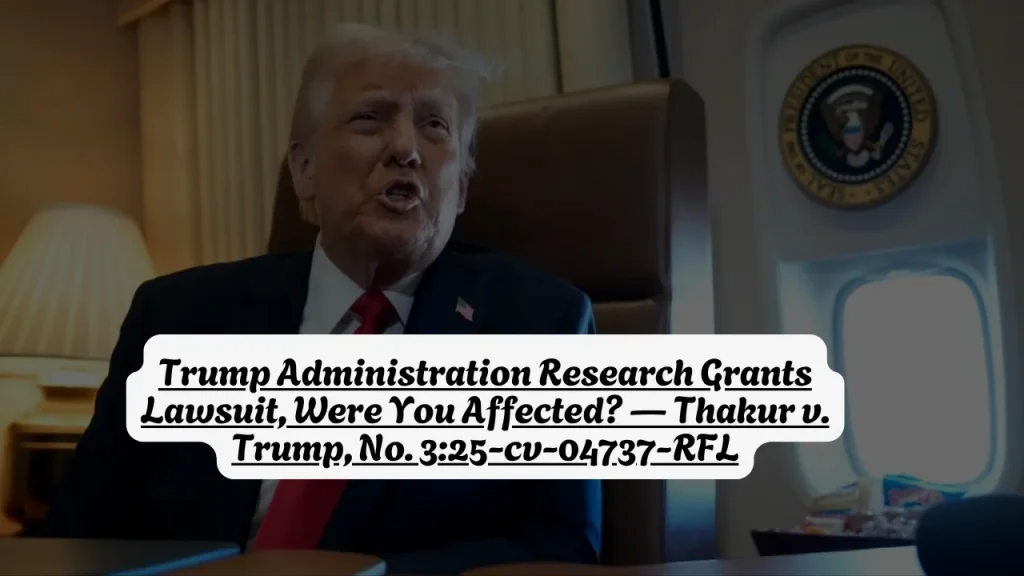
Trump Administration Research Grants Lawsuit, Were You Affected? — Thakur v. Trump, No. 3:25-cv-04737-RFL
Federal agencies admitted in court last week that they used keywords — words like “diversity,” “gender,” “vaccine hesitancy,” and “COVID-19” — to screen and terminate research grants. Lawyers for the University of California professors who sued call that admission proof the terminations were illegal. The case, Thakur v. Trump, could decide whether nearly $2 billion in canceled research funding gets restored — and it’s not just a UC problem.
Trump Administration Research Grants Lawsuit — Key Facts
| Lawsuit Filed | June 4, 2025 |
| Defendant | Trump administration, DOGE, NSF, NEH, EPA, NIH/HHS, and other federal agencies |
| Alleged Harm | Grants terminated using keyword screening tied to viewpoint, not grant performance |
| Law Alleged | First Amendment (viewpoint discrimination); Administrative Procedure Act (arbitrary and capricious action) |
| Who Is Affected | UC researchers, faculty, staff, and academic appointees across the 10-campus UC system with terminated, suspended, denied, or reduced federal grants since spring 2025 |
| Court & Case Number | U.S. District Court, N.D. Cal., No. 3:25-cv-04737-RFL (Judge Rita F. Lin) |
| Current Stage | Plaintiffs seeking summary judgment instead of trial; hearing set for Oct. 20, 2026 |
| Lead Plaintiff Deadline | N/A — not a lead-plaintiff securities case |
| Settlement Status | No settlement. EPA reportedly in early talks to resolve its part of the case — terms UNVERIFIED, not yet public |
| Last Updated | July 23, 2026 |
Who Is Being Sued and Why?
The named defendants aren’t a company — they’re the Trump administration and a list of federal agencies, including the National Science Foundation, National Endowment for the Humanities, EPA, NIH, and the Department of Government Efficiency (DOGE). Starting in spring 2025, these agencies sent form termination letters to UC grant recipients citing shifts in agency priorities. Plaintiffs say the real reason was viewpoint: research touching diversity, equity, gender, or COVID-19 got flagged and cut, regardless of the work’s quality or compliance record.
What Happened Between April 2025 and July 2026?
In April 2025, several agencies began terminating multi-year grants held by UC researchers, citing executive orders aimed at eliminating diversity, equity, and inclusion programs from federally funded work. Dr. Neeta Thakur, a UCSF associate professor, filed suit on behalf of affected UC researchers, arguing the terminations violated the First Amendment and the Administrative Procedure Act — the federal law requiring agencies to explain, individually, why they’re pulling funding rather than applying a blanket rule after the fact.
Judge Rita F. Lin sided with the researchers early and often. She issued preliminary injunctions ordering agencies to reinstate grants that lacked grant-specific justification, and she’s continued to rule for the plaintiffs through a series of follow-up disputes, including a fight over roughly 300 additional UCLA grants suspended months later.
The newest twist: in stipulations filed in federal court in mid-July 2026, the agencies confirmed something the plaintiffs had suspected all along. According to court filings, the agencies said they did not terminate grants based on any noncompliance with the terms of the award, and instead relied on general screening criteria rather than reviewing each grant individually. Plaintiffs’ lawyers argue that keyword-based mass termination — rather than case-by-case review — is itself evidence the government was targeting disfavored viewpoints. That’s not a settlement offer. It’s an admission inside active litigation, and the plaintiffs are now asking Judge Lin to rule on the merits without a trial.
If you’re a researcher who had a grant paused, denied, or pulled since last spring — this is the case that could get that decision reversed, or could set the ground rules for how the government has to justify doing it again.
Are You Part of the Thakur v. Trump Case?
Here’s exactly how to know if this case includes you.
- UC faculty, researchers, or academic staff whose federal grant was terminated, suspended, denied, or reduced since spring 2025
- Anyone whose termination notice cited a shift in “agency priorities” rather than a grant-specific compliance problem
- Researchers at UCLA whose grants were part of the roughly 300 additional suspensions tied to separate antisemitism and athletics-related allegations
- Graduate students and program staff whose positions depended on one of the terminated grants
Not covered: researchers outside the UC system, and grants terminated for documented, grant-specific compliance failures unrelated to the keyword screening described above.
UC Researchers Outside California — Are You Still Covered?
The certified class is limited to the 10-campus UC system. But researchers at other public and private universities facing similar keyword-based terminations aren’t without options — related suits, including one brought by the American Association of University Professors, raise the same constitutional arguments in other jurisdictions. If your institution isn’t UC, this case won’t cover you directly, but its outcome will likely shape how those parallel cases are argued.
Not sure whether your specific grant termination fits this case or a related one? A free consultation with a civil rights or administrative law attorney can help you figure out where you stand before the Oct. 20 hearing.
What Are the Researchers Asking the Court to Award?
No money yet. No claim form yet. This isn’t a settlement fund case — plaintiffs want the court to formally rule that the terminations were unconstitutional and order the grants restored, not to cut checks to a class of claimants.
What Could UC Researchers Receive If the Case Resolves in Their Favor?
If Judge Lin grants summary judgment, the likely outcome is reinstatement of the terminated grants and their funding — not a cash award. Lawyers for the professors have told the court that the stakes are considerable, warning that permanent cancellation would cost researchers, graduate students, and program staff their careers and disrupt ongoing work. Even a win at the district court doesn’t end it — the federal agencies can still appeal to the Ninth Circuit, which has already stepped into this case once before on a related procedural question. Talk to an attorney before assuming any outcome is final.
What Should Affected Researchers Do Right Now?
- Most current UC class members don’t need to file anything to be included — this is being litigated as a class action, not an individual claims process.
- Save your termination notice, any correspondence about “agency priorities,” and records of the funding and staff affected.
- Document the specific financial and professional losses tied to the terminated grant.
- There’s no lead plaintiff deadline here — Dr. Thakur and co-plaintiffs are already established representatives.
- Watch the docket. The next major date is the Oct. 20, 2026 hearing in the Northern District of California, No. 3:25-cv-04737-RFL.
- If your grant isn’t part of the UC class, an individual APA or First Amendment claim may still be available — a class action lawyer can walk you through whether that route makes sense.
For a broader look at how class membership and eligibility work in cases like this, see our guide on how to join a class action lawsuit.
Trump Administration Research Grants — Frequently Asked Questions, No. 3:25-cv-04737-RFL
Is there an active lawsuit over research grant cancellations right now?
Yes. Thakur v. Trump, No. 3:25-cv-04737-RFL, has been active in the Northern District of California since June 2025, with new stipulations filed in July 2026.
Do I need to do anything right now to be part of the case?
If you’re a UC researcher whose grant was affected, you likely don’t need to file anything yourself — this is proceeding as a class action, not an individual claims process.
When will the research grants case resolve?
No trial date is set. Judge Lin has scheduled an Oct. 20, 2026 hearing on the plaintiffs’ request for summary judgment instead of a full trial.
Can I file my own lawsuit instead of relying on this case?
Yes, if your situation falls outside the certified UC class — for example, if you’re at a different institution. An administrative law attorney can assess whether an individual APA or First Amendment claim applies to your grant.
How will I find out if this case resolves?
Court filings are public through the Northern District of California’s case page and PACER. Bookmark the docket for No. 3:25-cv-04737-RFL for updates.
What specific laws do the agencies allegedly violate?
Plaintiffs allege violations of the First Amendment (viewpoint discrimination) and the Administrative Procedure Act, which requires grant-specific justification before termination.
What did the agencies actually admit to?
In signed court stipulations, the agencies confirmed they used keyword screening — rather than individual grant review — tied to terms including diversity, gender, vaccine hesitancy, and COVID-19.
Could UC researchers get money if this case resolves in their favor?
Unlikely in the traditional sense. The primary remedy sought is reinstatement of terminated grants, not a cash settlement fund — though lost funding and disrupted work could factor into future individual claims.
Sources Used in This Article
- U.S. District Court, N.D. Cal. — Thakur et al v. Trump et al, Case No. 3:25-cv-04737-RFL, Cases of Interest page: https://cand.uscourts.gov/thakur-et-al-v-trump-et-al/
- PACER docket via PacerMonitor — Thakur et al v. Trump et al (3:25-cv-04737): https://www.pacermonitor.com/public/case/58387936/Thakur_et_al_v_Trump_et_al
- Ninth Circuit opinion, Thakur v. Trump, No. 25-4249 (2026): https://law.justia.com/cases/federal/appellate-courts/ca9/25-4249/25-4249-2026-05-26.html
- CalMatters — “White House admits it used keywords to kill billions worth of California research grants,” July 21, 2026: https://calmatters.org/education/higher-education/2026/07/research-grants-california-2/
Researched and written by Israr Ahmad, legal content researcher and founder of AllAboutLawyer.com. All facts verified against official Northern District of California court records and CalMatters reporting on July 23, 2026. Last Updated: July 23, 2026.
This article is for informational purposes only and does not constitute legal advice. Laws vary by state and individual circumstances differ. For advice about your specific situation, consult a qualified attorney.
About the Author
Israr Ahmad is a legal content researcher with 4+ years of experience covering class action settlements and consumer rights cases. He has researched and published coverage of 2,500+ settlements using verified court records, settlement administrator filings, and government sources. Learn more about Israr.