
Torchy’s Tacos Cow Tooth Lawsuit, Texas Woman Seeks $250,000 Over Tooth Found in Democrat Taco
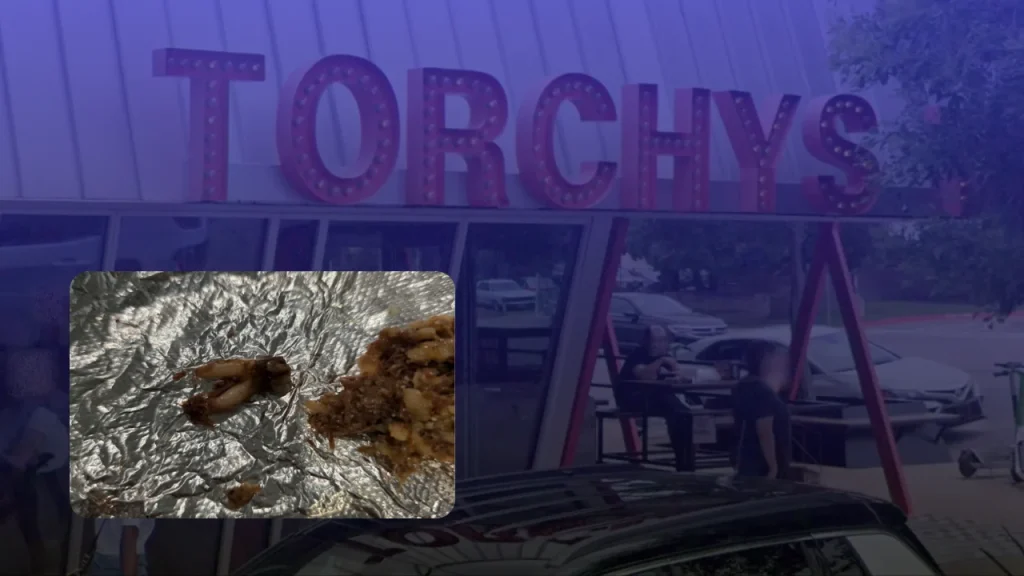
A Texas woman, Nohemi Castillo, has sued Torchy’s Tacos and its management company, Success Foods Management Group LLC, after allegedly finding what looked like a cow tooth in a takeout taco bought at the chain’s South Congress Avenue restaurant in Austin. The lawsuit, filed in Travis County district court, seeks monetary relief of $250,000 or less. Torchy’s says its review identified the object as a cow tooth, but the company has not admitted legal liability, and no judgment or settlement has been reported as of October 18, 2026.
Torchy’s Tacos Cow Tooth Lawsuit: Quick Facts
| Detail | What is known |
| Plaintiff | Nohemi Castillo |
| Defendants | Torchy’s Tacos and Success Foods Management Group LLC, doing business as Torchy’s Tacos |
| Case caption | Nohemi Castillo v. Torchy’s Tacos and Success Foods Management Group LLC d/b/a Torchy’s Tacos |
| Court | Travis County district court, Texas |
| Filing date | October 13, 2026 (as reported by the San Antonio Express-News) |
| Incident date | June 9, 2026 |
| Location | 1822 South Congress Avenue, Austin, Texas |
| Food involved | Takeout “Democrat” taco made with beef barbacoa |
| Alleged object | A cow tooth |
| Alleged consequences | Felt “grossed out and sickened,” saw a doctor that night and received prescription medication; no specific diagnosis reported |
| Amount sought | $250,000 or less |
| Reported claims | Negligence, breach of implied warranties (Texas UCC), Texas Deceptive Trade Practices Act (DTPA) and Food Safety Modernization Act (FSMA) |
| Company response | Torchy’s says it identified the item as a cow tooth after a review; says barbacoa uses natural beef cheek from a supplier and that it is working with the supplier on procedures |
| Status | Lawsuit filed; no ruling, settlement or class action reported |
| Where to read the filing | Travis County District Clerk records |
1. What Happened to Nohemi Castillo at Torchy’s Tacos?
According to court documents described by FOX 7 Austin, Castillo says that on June 9 she ordered takeout tacos from the Torchy’s at 1822 South Congress Avenue and found what appeared to be a cow tooth in a taco, which she says she almost swallowed. She reported feeling “grossed out and sickened,” visiting a doctor that night and receiving prescription medication. The lawsuit says the store manager was notified, but it is unclear whether he did anything about it.
The complaint alleges Torchy’s failed to properly inspect, prepare or monitor food and taco meat to keep foreign objects from entering the food before it was sold. It also alleges the company knew of “various problems” with its sold food products before selling her the taco. These are allegations, not findings.
What did Torchy’s say?
Torchy’s said that after receiving the guest complaint it conducted a thorough review and identified the item as a cow tooth. It also said its barbacoa is made from natural beef cheek from a supplier, that such an occurrence is rare in meat processing, and that it is working with the supplier to reinforce procedures. Identifying the object is not an admission of negligence. It does not establish when the tooth entered the food, whose procedures failed, or whether Castillo has legally recoverable damages.
2. What “$250,000 or Less” Means
Texas Rule of Civil Procedure 47 requires a petition to state the category of damages sought, and one category is “only monetary relief of $250,000 or less, excluding interest, statutory or punitive damages and penalties, and attorney fees and costs.” The phrase in Castillo’s lawsuit appears to track that rule. It is a pleading category, not a guarantee of an award, and it does not mean she has already incurred $250,000 in losses. Cases that plead only $250,000 or less may also fall under Rule 169’s expedited-actions process, which limits discovery and speeds up the case. Confirm in the docket whether the case is governed by Rule 169.
What damages could she claim?
| Type | What she would need to show |
| Past medical expenses | Records tying reasonable expenses to the incident |
| Future medical expenses | Evidence that future care is reasonably necessary |
| Pain and suffering / physical impairment | Evidence of a legally recoverable physical injury and its link to the incident |
| Mental anguish | Rules vary by claim (see below) |
| Court costs and interest | Applicable rules and the outcome |
A doctor’s visit and prescription help document that she sought care, but they do not automatically prove the defendant caused an injury. The defense will likely examine the records, including what the prescription was for and whether any physical injury was documented. Finding an object in food, even one that was nearly swallowed, does not guarantee recovery.
Can she recover for emotional distress alone?
That is a likely battleground. In negligence cases, Texas generally does not recognize a freestanding claim for negligent infliction of emotional distress (Boyles v. Kerr, 855 S.W.2d 593 (Tex. 1993)), and mental-anguish damages usually require an accompanying physical injury or another qualifying basis. A warranty or DTPA claim may allow different remedies, depending on the facts. Which theory supports which damages will depend on the evidence and on how the court reads her claims.
3. The Negligence Claim
Negligence generally requires a legal duty, a breach, causation and legally recognized damages. In a restaurant case, the relevant conduct could include how ingredients were sourced, received, prepared, inspected and served.
The plaintiff may argue that reasonable inspection or preparation would have caught the tooth. The defense may respond that the tooth entered during upstream processing despite reasonable procedures, that it was not reasonably detectable, or that no specific failure caused the incident. Reported allegations of prior notice are not established until proven.
Evidence that could matter:
- The tooth and any remaining food
- Photographs of the object, packaging and order label
- Receipts and order records
- Medical records
- Supplier and processing records
- Quality-control procedures and inspection logs
- Prior customer complaints involving foreign objects
- Communications between the restaurant and supplier
- Manager and employee statements about the complaint
A claim for gross negligence and punitive damages has not been reported in this case. In Texas, exemplary damages are governed by Chapter 41 of the Civil Practice and Remedies Code and require a higher showing than ordinary negligence.
4. Implied Warranty of Merchantability (Texas UCC)
Castillo alleges breach of implied warranties under the Texas Uniform Commercial Code. Texas Business and Commerce Code § 2.314 creates an implied warranty of merchantability for sales of goods by a merchant, and it expressly treats serving food or drink for value, whether consumed on or off the premises, as a sale. That means a restaurant taco is covered even though it is prepared rather than packaged.
Goods must be fit for their ordinary purpose. Castillo can argue that a taco with a tooth in it was not fit to eat as served. Torchy’s can argue the object was a natural part of the beef cheek and that the evidence does not show a breach that caused recoverable damages. Courts in food cases often ask whether the object is something a consumer would reasonably expect in the dish. I did not confirm how Texas courts currently frame that test for a case like this, so treat it as an open question for the court.
An implied warranty of fitness for a particular purpose (§ 2.315) requires facts beyond the ordinary expectation that food be safe to eat, and the reporting does not show it was pleaded.
The usual limitations period for sale-of-goods warranty claims is four years (§ 2.725), which is longer than the two-year periods for negligence and the DTPA.
5. Texas Deceptive Trade Practices Act (DTPA)
The DTPA (Texas Business and Commerce Code Chapter 17) allows consumers to sue for specified deceptive acts, breaches of warranty and unconscionable conduct. A plaintiff must show the statutory elements, including consumer status, a prohibited act and that the act was a producing cause of her damages.
- Remedies. A prevailing consumer can recover economic damages and, in some cases, mental-anguish damages, and a court may award up to three times those damages when the defendant acted knowingly. A prevailing consumer can also recover reasonable and necessary attorney’s fees and costs under § 17.50.
- 60-day notice. Section 17.505 requires written notice at least 60 days before filing suit for damages, describing the complaint and the damages and expenses claimed. If notice is impracticable because suit must be filed to prevent limitations from expiring, it is not required. If the plaintiff did not give notice, the defendant can ask the court to abate (pause) the case with a verified plea until notice is given and the 60 days run.
- Limitations. DTPA claims have a two-year statute of limitations (§ 17.565), running from the act or from when the consumer discovered or should have discovered it.
The incident date (June 9) and filing date (October 13) are about four months apart. Because the DTPA requires 60 days’ notice, the filing is not automatically defective, but the sources do not say whether notice was sent. If the case is abated, that is a delay, not a dismissal on the merits.
6. The Federal Food Safety Modernization Act (FSMA) Claim
FSMA strengthened preventive food-safety controls, including hazard analysis for physical hazards at covered food facilities. The reported complaint cites FSMA, but a key legal issue is whether it can support a private claim.
- Under 21 U.S.C. § 337(a), proceedings to enforce the Federal Food, Drug, and Cosmetic Act generally must be brought by and in the name of the United States, with limited exceptions. Courts often reject private claims that rest directly on the federal food-safety statutes.
- Restaurants are generally exempt from the FDA’s food-facility registration requirement (21 C.F.R. § 1.226(d)), and preventive-control rules are tied to covered facilities. Whether FSMA obligations apply to the restaurant, as opposed to the supplier or processor, must be analyzed carefully.
A court may question a standalone FSMA claim. That would not decide the state-law negligence, warranty or DTPA claims, and federal food-safety standards can still be offered as evidence of what care was reasonable.
7. Texas Food-Safety Laws
Texas regulates food service through several laws. The Texas Department of State Health Services lists the Texas Food, Drug, and Cosmetic Act (Health and Safety Code Chapter 431), the food-service establishment law (Chapter 437) and the Texas Food Establishment Rules (25 Texas Administrative Code Chapter 228).
- Chapter 431. Section 431.081 describes when food is adulterated, including food that contains certain harmful substances or is prepared under unsanitary conditions. Section 431.021 prohibits introducing adulterated food into commerce. Whether a cow tooth in barbacoa meets the definition depends on the statutory language and the facts.
- Chapters 437 and 228. These govern permitting, inspection and enforcement for restaurants.
These laws are primarily enforced by health authorities. They do not automatically create a private claim, though they may help show the standard of care.
Has a regulator acted?
None of the reporting reviewed shows an inspection citation, closure order or permit action tied to this incident. A civil suit does not automatically close a restaurant. For foodborne-illness reports in Austin or Travis County, Austin Public Health lists 512-972-5555. For other restaurant complaints, the City directs people to 3-1-1 or 512-974-2000. Confirm the current contact details on the City of Austin website.
8. What the FDA Says About Hard or Sharp Foreign Objects
The FDA’s Compliance Policy Guide 555.425 addresses food adulteration involving hard or sharp foreign objects. It explains that such objects can cause injuries to the mouth, throat and digestive tract and damage to teeth and gums, and it sets criteria for regulatory action that consider the object’s size, the type of food and whether the food is ready to eat. The guide is directed at FDA enforcement, not a rule that decides civil liability, and it distinguishes some natural food components that consumers expect from unexpected objects. The reports do not give the tooth’s size or whether it was sharp, which could matter.
9. Could the Beef Supplier Be Responsible?
Possibly, depending on the evidence. Torchy’s says its barbacoa uses beef cheek from a supplier. If the tooth got into the meat during processing, the supplier or processor could become relevant. A restaurant cannot necessarily avoid responsibility just because an ingredient came from a supplier, and the supplier’s role does not automatically eliminate the restaurant’s own duties.
Tools Texas law provides include:
- Responsible third parties. Under Chapter 33 of the Civil Practice and Remedies Code (proportionate responsibility), a defendant can ask to designate a responsible third party, so a jury can assign a percentage of responsibility to others.
- Third-party claims. A defendant can seek contribution or indemnity from another party where procedural and substantive rules allow.
- Chapter 82 (products liability). For qualifying products-liability actions, a manufacturer must indemnify an innocent seller for certain losses (§ 82.002), and the law limits the liability of some nonmanufacturing sellers unless specified conditions are met (§ 82.003). Whether these provisions apply to a restaurant selling prepared food is a question the reports do not answer.
No report shows that Torchy’s has filed a third-party claim against any supplier.
10. What Could Happen Next?
- Response. The defendants will answer under the Texas Rules of Civil Procedure, admitting or denying allegations and raising defenses.
- Challenges. They may challenge particular claims, such as FSMA, the DTPA elements or the damages, or seek abatement over DTPA notice.
- Discovery. Records and testimony about food handling, supplier processes, the object and the claimed injuries.
- Resolution. Settlement, which is not an admission of liability, or trial.
No settlement fund, claim form or class action has been reported. This is an individual lawsuit. Other Torchy’s customers are not automatically part of it, and anyone with a separate incident must evaluate their own evidence, injury and rights, including filing deadlines.
11. What to Do If You Find a Tooth or Other Object in Restaurant Food
- Stop eating. Do not swallow the object or keep eating to check for more.
- Photograph the object, the food, the packaging and the receipt or order label.
- Preserve the object and remaining food in a sealed container if safe, and keep the packaging.
- Document the purchase with the receipt, order confirmation, date, time and location.
- Report the incident to the restaurant and, if appropriate, the local health authority, and keep any written response.
- Seek medical care if you swallowed the object or have pain, choking, bleeding or other symptoms.
- Keep records of medical bills, prescriptions and lost wages.
- Mind the deadlines. In Texas, personal-injury negligence claims and DTPA claims generally have two-year limitations periods, and the DTPA requires 60 days’ written notice before most suits. Speak to a licensed Texas attorney about your specific situation.
A refund does not necessarily resolve a possible injury claim, and finding an object in food does not guarantee a successful lawsuit.
Frequently Asked Questions About the Torchy’s Tacos Cow Tooth Lawsuit
Who is suing Torchy’s Tacos over a cow tooth?
Nohemi Castillo sued Torchy’s Tacos and Success Foods Management Group LLC in Travis County district court. She alleges a cow tooth was in a Democrat taco bought in Austin on June 9, 2026.
How much is she seeking?
Monetary relief of $250,000 or less, as pleaded. The amount, if any, depends on the evidence and outcome.
Which taco was it?
A Democrat taco made with beef barbacoa from the South Congress Avenue location.
Did Torchy’s admit it was a cow tooth?
Torchy’s said its review identified the item as a cow tooth. That is not an admission of negligence or liability.
What laws does the lawsuit involve?
Reported claims are negligence, breach of implied warranty under the Texas UCC, the Texas DTPA and the federal FSMA. Texas food-safety laws may be relevant background.
Can she win just because a tooth was in the taco?
The object is important evidence, but she must prove the elements of each claim, including causation and legally recoverable damages.
Does FSMA let any customer sue a restaurant?
No. Federal food-safety law is generally enforced by the government, and the court may question whether FSMA supports a private claim.
Could the supplier be responsible?
Possibly, if the tooth entered during processing, but that does not automatically remove the restaurant’s responsibility.
Has Torchy’s settled or recalled anything?
No settlement or recall related to this allegation was verified.
Is this a class action?
No class action has been reported.
Is Torchy’s Tacos closed or under investigation?
No closure or regulatory action related to this allegation was verified.
Sources and Legal References
- FOX 7 Austin — Austin woman sues Torchy’s Tacos after finding ‘cow tooth’ in her taco (October 15, 2026). https://www.fox7austin.com/news/torchys-tacos-cow-tooth-lawsuit-austin-texas
- San Antonio Express-News — Torchy’s Tacos sued by Texas woman who claims she found a cow tooth in her food (October 16, 2026). https://www.expressnews.com/news/texas/article/texas-woman-sues-torchys-tacos-cow-tooth-claims-22480614.php
- Texas Business and Commerce Code §§ 2.314, 2.315, 2.725. https://statutes.capitol.texas.gov/GetStatute.aspx?Code=BC&Value=2.314
- Texas Business and Commerce Code Chapter 17 (DTPA), including §§ 17.50, 17.505, 17.565. https://tcss.legis.texas.gov/Docs/bc/htm/bc.17.htm
- Texas Rules of Civil Procedure 47 and 169.
- Texas Civil Practice and Remedies Code Chapters 33, 41 and 82. https://tcss.legis.texas.gov/resources/CP/htm/CP.82.htm
- Texas Health and Safety Code Chapters 431 and 437. https://statutes.capitol.texas.gov/GetStatute.aspx?Code=HS&Value=431
- Texas Department of State Health Services — Statutes and Laws for Retail Food Establishments. https://www.dshs.texas.gov/retail-food-establishments/statutes-laws-retail-food-establishments
- 25 Texas Administrative Code Chapter 228 (Texas Food Establishment Rules).
- FDA — Compliance Policy Guide 555.425, Foods Adulteration Involving Hard or Sharp Foreign Objects. https://www.fda.gov/regulatory-information/search-fda-guidance-documents/cpg-sec-555425-foods-adulteration-involving-hard-or-sharp-foreign-objects
- FDA — Food Safety Modernization Act. https://www.fda.gov/food/food-safety-modernization-act-fsma/full-text-food-safety-modernization-act-fsma
- 21 U.S.C. § 337(a); 21 C.F.R. § 1.226(d). https://uscode.house.gov/us/usc/119-120/t21/s337/
- Boyles v. Kerr, 855 S.W.2d 593 (Tex. 1993).
- Austin Public Health — Report Foodborne Illness. https://www.austintexas.gov/services/report-foodborne-illness
- Travis County District Clerk — civil case search.
For related reading from AllAboutLawyer.com, see A&D Foods Meat Recall, 167,639 Pounds Pulled Nationwide Over Fake USDA Inspection Marks and McCain Foods Recalls 650K Pounds Tater Tot Recall, What You Need to Know About the Plastic Contamination.
Disclaimer: This article explains publicly reported allegations and potentially applicable law. It is not a finding that Torchy’s Tacos or any supplier violated any law, and it is not legal advice. Statutes and deadlines are summarized, can change and depend on specific facts. Consult a licensed Texas attorney about your situation. The case’s outcome and any damages remain undetermined.
About the Author
Israr Ahmad is a legal content researcher with 4+ years of experience covering class action settlements and consumer rights cases. He has researched and published coverage of 2,500+ settlements using verified court records, settlement administrator filings, and government sources. Learn more about Israr.