
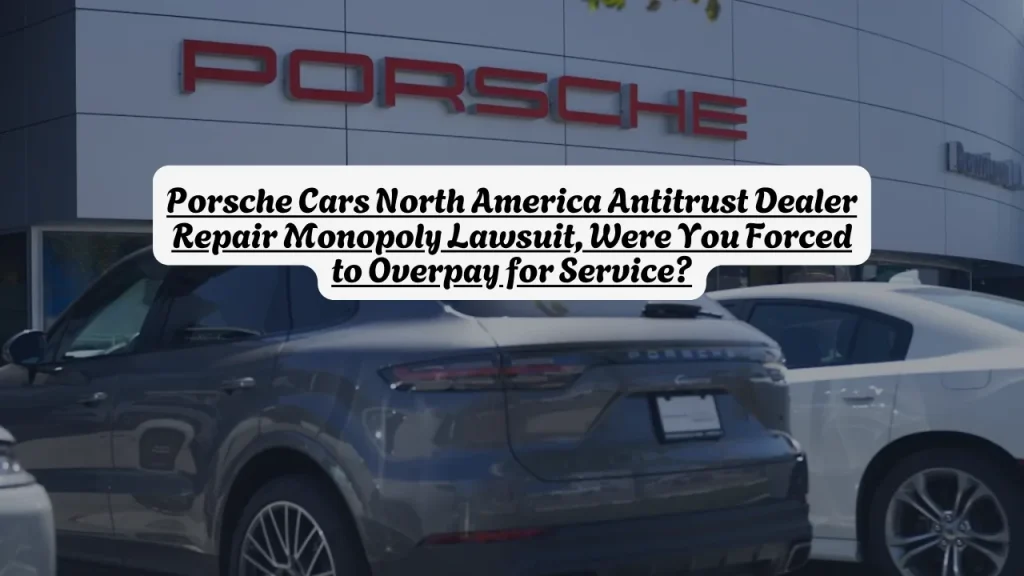
Porsche Cars North America Antitrust Dealer Repair Monopoly Lawsuit, Were You Forced to Overpay for Service?
Porsche Cars North America is facing a class action lawsuit filed in the U.S. District Court for the Northern District of Georgia alleging it intentionally engineered its vehicles to lock out independent repair shops — forcing owners to pay dealer prices for everything from an oil change to a complex repair. If you paid a Porsche-authorized dealer for service on a vehicle built since 2021, this lawsuit may already include you.
Quick Facts: Porsche Antitrust Repair Lawsuit
| Field | Detail |
| Lawsuit Filed | May 6, 2026 |
| Defendant | Porsche Cars North America, Inc. |
| Alleged Violation | Unlawful monopolization of repair services market — federal antitrust law |
| Who Is Affected | U.S. owners/entities who paid a Porsche dealer for repairs or maintenance on Porsche vehicles sold from January 1, 2021, to present |
| Current Court Stage | Early litigation — no class certification yet |
| Court & Jurisdiction | U.S. District Court for the Northern District of Georgia, Case No. 1:26-cv-02553 |
| Lead Plaintiff | Fleet Salvage Systems, Inc., Longwood, Florida |
| Next Hearing Date | TBD — case filed May 6, 2026; no scheduling order yet available |
| Official Case Website | TBD — no official case site established yet |
| Last Updated | May 16, 2026 |
Current Status: Where the Porsche Antitrust Case Stands
- The lawsuit was filed on May 6, 2026, in the U.S. District Court for the Northern District of Georgia, Case No. 1:26-cv-02553. The case is in its earliest stage — Porsche has not yet filed a formal response.
- No class has been certified yet. The court must first determine whether this case qualifies to proceed as a class action on behalf of all affected Porsche owners nationwide.
- No settlement exists, no claim form is open, and no payment timeline has been established. Porsche owners do not need to take any action right now to preserve their potential inclusion.
What Is the Porsche Lawsuit About? Fleet Salvage Systems, Inc. v. Porsche Cars North America, Inc., No. 1:26-cv-02553
Porsche Cars North America — the exclusive U.S. importer of Porsche vehicles — faces an antitrust class action over claims it has unlawfully monopolized the market for repair services. The theory is straightforward: Porsche allegedly designed its vehicles so that only authorized dealers can access the electronic tools needed to complete repairs, leaving independent mechanics with no way to finish the job.
The lawsuit alleges that Porsche engineered its electronic control units so that only authorized dealers can interact with them for service, repairs, and routine maintenance, effectively preventing independent automotive mechanics from working on vehicles from the brand. That means no access to diagnostics, no calibration tools, no software resets — and no ability to compete with Porsche’s dealer network on price.
Porsche’s dealers are alleged to maintain a 100% market share and charge supra-competitive prices for all repairs and maintenance on affected vehicles, while Porsche itself reaps additional profits through parts sales. These authorized dealers charge more for service and use more expensive parts, forcing owners to suffer increased costs while limiting their options as consumers. This is what antitrust law calls an illegal monopoly — using market power to crush competition and inflate prices.
Related article: Kars4Kids False Advertising Ruling, California Bans the Jingle And a Federal Lawsuit Is Coming for Donors Nationwide
This case sits squarely within the broader right-to-repair class action movement, which saw John Deere face a $99 million antitrust settlement in 2026 for similar software-locking tactics in the agricultural equipment market.
Are You Part of the Porsche Class Action Lawsuit?
If you own or have owned a Porsche and paid for dealer service since 2021, here is how to know whether this lawsuit covers you.
You may be part of this class if:
- You are a person or entity in the United States who paid a Porsche-authorized dealer to perform repairs or maintenance services on an affected vehicle
- Your vehicle is a Porsche sold between January 1, 2021, and the present
- You were unable to complete service at an independent repair shop because of Porsche’s software or electronic access restrictions
- You paid dealer prices for work you would have taken to an independent provider if that option had been available
You are likely NOT included if:
- Your Porsche was sold before January 1, 2021
- You performed all service at independent shops without any issue
- You have never paid for repair or maintenance work at a Porsche-authorized dealership during the class period
The exact number of class members is not yet known, but Fleet Salvage Systems estimates thousands of individuals and entities throughout the country who paid Porsche dealers for repairs or services would be affected.
If you have also experienced issues with other Porsche vehicle systems, the Volvo infotainment class action offers a useful comparison for how early-stage automotive software defect lawsuits typically progress.
What Are Porsche Owners Seeking in This Lawsuit?
The complaint does not seek a specific dollar figure — that is typical at this early stage of antitrust litigation. What plaintiffs are asking the court to do is bigger than a single check.
Plaintiffs allege that Porsche’s restrictions inflate service and repair prices above competitive levels, harming competition for servicing and repairs in violation of antitrust laws. Under federal antitrust law — specifically the Sherman Antitrust Act — companies found liable for monopolization can face treble damages, meaning the court can award three times the actual overcharges paid by class members.
At the center of the lawsuit is the growing debate over vehicle software access and the broader right-to-repair movement. Plaintiffs argue that even basic maintenance procedures have become tied to proprietary software systems controlled exclusively by the automaker and its dealer network. In addition to money damages, plaintiffs are expected to seek injunctive relief — a court order requiring Porsche to open its diagnostic tools to independent repair providers.
No settlement fund exists. No claim form is open. No payment is available right now. That is not a reason to dismiss this case — it is simply where the litigation stands.
What Should You Do If You Were Affected by Porsche?
Most Porsche owners who qualify are automatically included in the proposed class — you do not need to hire an attorney or take any formal action to preserve your potential place in this lawsuit.
Here are the practical steps to take right now:
- Save your dealer service records. Every invoice, work order, and receipt from a Porsche-authorized dealership since January 1, 2021, is potential evidence of the overcharges at the center of this case. Keep them somewhere safe.
- Document any time an independent shop couldn’t complete your repair. If a mechanic ever told you they couldn’t clear a code, reset a service indicator, or complete a calibration because of Porsche’s software restrictions, write it down with dates, shop names, and what was said.
- Monitor the PACER docket. The case is publicly filed as Fleet Salvage Systems, Inc. v. Porsche Cars North America, Inc., No. 1:26-cv-02553. Court filings are available at pacer.gov. When major developments happen — class certification, a settlement offer, a hearing date — they appear there first.
- If you want individual legal advice, consult a consumer rights lawyer or class action lawsuit attorney familiar with antitrust cases. This is especially worth doing if your overcharges were significant or you have strong documentation of being turned away by independent shops.
Porsche Antitrust Lawsuit Timeline
| Milestone | Date |
| Lawsuit Filed | May 6, 2026 |
| Porsche Response Due | TBD — typically 21 days after service of process |
| Class Certification Motion | TBD — typically filed 12–18 months after filing |
| Last Major Court Ruling | TBD — case too new for prior rulings |
| Next Scheduled Hearing | TBD — no scheduling order yet issued |
| Expected Settlement Timeline | TBD — antitrust class actions of this type typically take 2–4 years |
Frequently Asked Questions
Is there a class action lawsuit against Porsche over dealer repairs?
Yes. Porsche Cars North America was hit with a proposed class action in Georgia federal court alleging it unlawfully monopolizes the market for repair services performed on Porsche vehicles sold since 2021 by intentionally designing them so that only authorized dealers can complete the repairs. The case is Fleet Salvage Systems, Inc. v. Porsche Cars North America, Inc., No. 1:26-cv-02553.
Do I need to do anything right now to be included in the Porsche lawsuit?
No. If you paid a Porsche dealer for service on a 2021-or-newer vehicle, you are likely already part of the proposed class. No action is required at this stage. When and if a settlement is reached, affected owners will receive notice with instructions on how to file a claim.
What started this lawsuit — the Porsche class action in 2026?
The plaintiff, Fleet Salvage Systems, took its Porsche Cayenne to an independent repair facility in June 2025 for an oil change and oil filter replacement. After completing the mechanical work, the mechanics could not reset the oil life monitor because only Porsche and its dealers were able to clear the code. That simple service call revealed a broader system the lawsuit calls an illegal repair monopoly.
When will a settlement be reached in the Porsche antitrust case?
No settlement exists and no timeline is set. Antitrust class actions of this complexity typically take two to four years from filing to resolution. The case was filed May 6, 2026, and is in the earliest possible stage. Monitor the PACER docket at case No. 1:26-cv-02553 for updates.
Can I file my own lawsuit against Porsche instead of joining the class?
Yes. You have the right to opt out of any class action and pursue an individual claim. If your overcharges were substantial and you have strong documentation, a consumer rights lawyer with antitrust experience can advise you whether an individual case makes sense. Opting out of a class means you would not share in any eventual class settlement.
How will I know if the Porsche lawsuit settles?
If the case settles, the court requires that all class members receive notice — typically by mail or email — with details on how to file a claim. You can also monitor the PACER docket or check AllAboutLawyer.com, where we will update this article as the case develops.
Am I affected if I took my Porsche to a dealer only because an independent shop couldn’t do the work?
The lawsuit targets all persons and entities in the United States who paid a Porsche-authorized dealer to perform repairs or maintenance services on affected vehicles sold from January 1, 2021, to the present. If electronic access restrictions pushed you to a dealer you would not otherwise have chosen, you fit exactly the harm this lawsuit describes.
Prepared by the AllAboutLawyer.com Editorial Team and reviewed for factual accuracy against the PACER docket (Case No. 1:26-cv-02553, U.S. District Court for the Northern District of Georgia) and reporting by Law360 and Courthouse News Service on May 16, 2026. Last Updated: May 16, 2026
Sources & References
- PACER Docket: Fleet Salvage Systems, Inc. v. Porsche Cars North America, Inc., No. 1:26-cv-02553, U.S. District Court for the Northern District of Georgia — pacermonitor.com
- Law360 reporting, May 7, 2026: law360.com
- Courthouse News Service, May 7, 2026: courthousenews.com
Disclaimer: This article is for informational purposes only and does not constitute legal advice. Legal claims and outcomes depend on specific facts and applicable law. For advice regarding a particular situation, consult a qualified attorney.
About the Author
Israr Ahmad is a legal content researcher with 4+ years of experience covering class action settlements and consumer rights cases. He has researched and published coverage of 2,500+ settlements using verified court records, settlement administrator filings, and government sources. Learn more about Israr.