
Subaru EyeSight Class Action Lawsuit, Newer Models Can Slam on the Brakes for No Reason, Suit Says
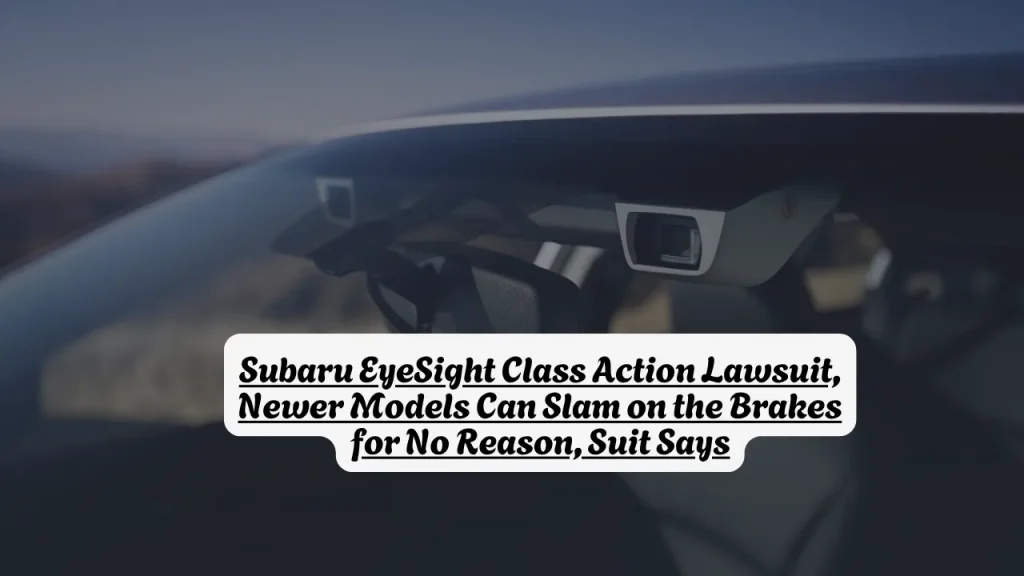
Subaru of America faces a proposed class action lawsuit alleging that the EyeSight Driver Assist Technology in certain 2022–2026 models is defective, as the collision-avoidance feature can cause a vehicle to abruptly slow down or stop entirely without driver input or any obstacle present. If your Subaru has ever hit the brakes on a clear highway with nothing in front of you, you are not imagining it — and you may be part of this lawsuit.
Quick Facts: Subaru EyeSight Defective Braking Lawsuit
| Field | Detail |
| Case Name | Hall et al. v. Subaru of America, Inc. |
| Case Number | No. 1:26-cv-05266 |
| Court | U.S. District Court, District of New Jersey |
| Date Filed | May 11, 2026 |
| Defendant | Subaru of America, Inc. |
| Alleged Violation | Defective product, false advertising, fraudulent concealment |
| Settlement Status | Litigation phase — no settlement yet |
| Claim Deadline | TBD — no claim form exists yet |
| Payout Per Person | TBD — no settlement has been reached |
| Last Updated | May 20, 2026 |
What Is the Subaru EyeSight Lawsuit About? Hall et al. v. Subaru of America, Inc., No. 1:26-cv-05266
The 87-page lawsuit claims that Subaru of America has “actively concealed” the defect plaguing its autonomous emergency braking (AEB) system. The suit alleges the AEB system is prone to malfunction and can activate without cause or fail to activate when necessary, causing a vehicle to suddenly brake or come to a complete stop in the middle of the road.
The lawsuit says that although Subaru touts the “superior safety” of EyeSight-equipped vehicles, it has concealed that the systems are “poorly” calibrated and integrated and prone to failure in real-world driving conditions. The calibration failures lead to miscommunication within the systems involved in automatic emergency braking, including the vehicles’ sensors, cameras, brakes, and transmission.
The AEB system is dependent on cameras and sensors mounted to the exterior front and rear of the vehicle. When an object is detected, information from those cameras and sensors is run through a control module with a proprietary algorithm to calculate speed, acceleration, and distance. The lawsuit claims Subaru “overreached” with regard to the capabilities of the system by improperly tuning the driver-assistance features to fully apply the brakes when the vehicle perceives a stationary object — causing the AEB to activate “unnecessarily early and with unnecessary force,” presenting a clear-cut safety hazard.
This is a defective product lawsuit under the legal theory that Subaru sold vehicles advertised as safer than they actually are. For a broader understanding of how defective product lawsuits work and what consumers can recover, AllAboutLawyer.com covers active automotive class actions across the country.
According to the complaint, Subaru has known of the apparent braking system defect since at least 2012, based on pre-release testing data, early consumer complaints to dealers, and warranty claims. That timeline matters legally — it supports a fraudulent concealment claim, which can extend the period during which consumers can still file.
Related article: Jan. 6 Officers Harry Dunn and Daniel Hodges Sue to Block Trump’s $1.8B Anti-Weaponization Fund Are Police Who Defended the Capitol Now at Greater Risk?
Are You Part of the Subaru EyeSight Class Action Lawsuit?
The class action lawsuit looks to cover residents of the United States or its territories who purchased or leased, other than for resale, any of the following vehicles: 2023–2026 Subaru Legacy, Outback, and Ascent; 2024–2026 Subaru Impreza and Crosstrek; 2022–2026 Subaru Forester and WRX; and 2025–2026 Subaru BRZ.
You may be part of this class if:
- You purchased or leased any of the vehicles listed above in the model years shown
- Your EyeSight system has braked suddenly with no obstacle present
- Your EyeSight system failed to brake when it should have
- Your vehicle experienced erratic lane corrections, involuntary steering wheel interventions, or the system shutting off without warning and forcing you to restart the vehicle to regain function
- You paid out of pocket for EyeSight-related repairs that Subaru declined to cover
You are likely NOT included if:
- You own a model year older than what is listed (2013–2021 owners were covered under the prior settlement — see below)
- You purchased your vehicle outside the United States or its territories
- You purchased a Subaru model not listed above
What Plaintiffs Are Seeking in This Subaru EyeSight Case
This is an active lawsuit, not a settlement. No money is available yet and no claim form exists. The plaintiffs are asking the court to certify a nationwide class, hold Subaru accountable for selling vehicles with a known defect, and require compensation for damages — including the diminished value of affected vehicles and out-of-pocket repair costs paid by owners. The suit also seeks changes to how Subaru calibrates and discloses EyeSight system limitations going forward.
Notably, Subaru agreed to a class action settlement in a case that alleged the same AEB and EyeSight problems in earlier model year vehicles. The lawsuit posits that the ongoing nature of the EyeSight problems shows that Subaru has failed to take remedial measures to improve the AEB system. In other words, the prior settlement covered 2013–2021 models — and plaintiffs say Subaru never actually fixed the underlying problem before rolling out newer vehicles with the same defective tech.
What Happened With the Earlier Subaru EyeSight Settlement
This is the second time Subaru has faced a major class action over EyeSight. In April 2021, nine plaintiffs sued Subaru claiming the EyeSight pre-collision braking, rear automated braking, and lane-keeping assist features in certain 2013–2021 models could malfunction. About 3.4 million Subarus were implicated in that lawsuit, including Outback, Forester, Legacy, and Crosstrek models.
That settlement received final approval on November 5, 2025. Class members who qualified could receive up to 75% reimbursement for out-of-pocket repair expenses and warranty benefits. The claim deadline for that prior settlement was September 27, 2025 — if you had an older model and missed it, that window has closed.
Class members who submitted timely claims before the deadline should expect payment by May 10, 2026. For settlement status questions, contact the Settlement Administrator: Subaru EyeSight Settlement c/o JND Legal Administration, P.O. Box 91063, Seattle, WA 98111.
The new lawsuit — Hall et al. v. Subaru of America, No. 1:26-cv-05266 — is a separate case covering 2022–2026 models only. Owning one of the newer models does not affect your rights under the prior settlement if you also owned an older qualifying vehicle. If you need guidance on how consumer protection laws work in cases like this, speaking with a product liability attorney for a free legal consultation is a smart first step.
What Should You Do If You Own One of These Subaru Models?
No settlement exists yet, and you do not need to file anything right now. Here is what you should do today:
- Save every service record. Any dealer visit where EyeSight errors, sudden braking, or warning lights were noted is key documentation.
- Note every incident. Write down the date, location, speed you were traveling, and what the system did. These notes matter later.
- Do not ignore warning lights. If your EyeSight system flags an issue, have it documented by a Subaru dealer — even if they say nothing is wrong.
- Monitor the case docket. This case is filed as No. 1:26-cv-05266 in the U.S. District Court for the District of New Jersey. You can follow public updates at PACER.gov.
- Do not sell or trade your vehicle without preserving your documentation — you may need proof of ownership and records later.
Most class members are automatically included if they meet the vehicle and date criteria. You do not need to join, register, or do anything active at this stage to preserve your rights.
Subaru EyeSight Class Action Lawsuit Timeline
| Milestone | Date |
| Subaru EyeSight defect allegedly known | At least since 2012, per complaint |
| Original EyeSight lawsuit filed (2013–2021 models) | April 2021 |
| Prior settlement — final court approval | November 5, 2025 |
| Prior settlement — claim deadline | September 27, 2025 |
| Prior settlement — payments expected | By May 10, 2026 |
| New lawsuit filed (Hall et al., 2022–2026 models) | May 11, 2026 |
| Class certification motion | TBD — not yet scheduled |
| Next court hearing | TBD — case in early litigation phase |
| Expected settlement in new case | TBD — no settlement discussions confirmed |
Frequently Asked Questions
Is there a class action lawsuit against Subaru for EyeSight braking problems?
Yes. Two separate lawsuits exist. The first — covering 2013–2021 models — settled in November 2025 with payments expected by May 2026. A new lawsuit, Hall et al. v. Subaru of America, No. 1:26-cv-05266, was filed May 11, 2026 in the U.S. District Court for the District of New Jersey and covers 2022–2026 models.
Do I need to do anything right now to be included in the new lawsuit?
No. If you purchased or leased one of the qualifying 2022–2026 vehicles in the U.S., you are likely automatically included in the proposed class. Just preserve your documentation and monitor the case for updates.
When will a settlement be reached in the Hall v. Subaru case?
TBD — the case was only filed on May 11, 2026 and is in its earliest stage. No settlement talks have been announced. Cases like this typically take one to three years to resolve.
Can I file my own individual lawsuit against Subaru instead of waiting?
Yes. If your damages are significant — for example, you were in an accident caused by sudden EyeSight braking — you may have grounds for an individual product liability claim. Speak with a consumer rights lawyer before opting out of the class.
How will I know when the new Subaru EyeSight lawsuit settles?
The case is publicly tracked as No. 1:26-cv-05266 on PACER.gov. If a settlement is approved, class members receive mailed notice at the address on file with their vehicle registration or via their dealer’s records.
Does my 2022–2026 Subaru automatically get the warranty extension from the prior settlement?
No. The prior Subaru EyeSight settlement covered certain 2013–2024 model vehicles, and warranty extensions were tied to specific VINs under that deal. The new lawsuit is a separate filing and has not produced any warranty relief yet. Check the prior settlement VIN lookup tool at the JND Legal Administration settlement website to confirm your older vehicle’s eligibility.
Will filing a claim affect my ability to sue Subaru separately?
If a settlement is eventually reached in the new case and you submit a claim, that typically resolves your right to sue separately for the same defect. If your damages are serious, consult a class action lawsuit attorney before accepting any settlement payment.
Sources & References
- Official Complaint — Hall et al. v. Subaru of America, Inc., No. 1:26-cv-05266, U.S. District Court for the District of New Jersey, filed May 11, 2026
Prepared by the AllAboutLawyer.com Editorial Team and reviewed for factual accuracy against the court-filed complaint (No. 1:26-cv-05266) and prior settlement court records from the U.S. District Court for the District of New Jersey. Last Updated: May 20, 2026
Disclaimer: This article is for informational purposes only and does not constitute legal advice. Legal claims and outcomes depend on specific facts and applicable law. For advice regarding a particular situation, consult a qualified attorney.
About the Author
Israr Ahmad is a legal content researcher with 4+ years of experience covering class action settlements and consumer rights cases. He has researched and published coverage of 2,500+ settlements using verified court records, settlement administrator filings, and government sources. Learn more about Israr.
So my eyesight shuts down mostly at night now. It worked great in the past. For almost 2 years now, it shuts down and i lose cruise control and all computer things. My TMPS has shut down. Not warning on tires at all now. I have been to two dealer shops and they cannot fix it and have charged me lots of money and changed my battery without asking and would not return my old battery which was 2 years old and working well.