
States Sue Trump Administration Over $1.5 Billion Offshore Wind Buyouts — New York v. U.S. Department of the Interior, No. 1:26-cv-05851
Nine states just sued the federal government over something you’re probably already paying for: your electric bill. On September 22, 2026, New York led seven other states in suing the U.S. Department of the Interior in the Eastern District of New York, case number 1:26-cv-05851. California filed two of its own lawsuits the same week. All of them challenge a single scheme — paying wind energy companies to walk away from projects that were supposed to power millions of homes.
This isn’t a class action you can join, and there’s no claim form. But if you live in a state with rising electricity demand, this case will likely affect what you pay for power in the next few years. Here’s what happened, why it happened, and what to watch for next.
States v. Interior — Key Facts
| Lead Case | New York, et al. v. U.S. Department of the Interior, et al. |
| Case Number | 1:26-cv-05851 |
| Court | U.S. District Court for the Eastern District of New York |
| Filed | September 22, 2026 |
| Plaintiff States | New York, New Jersey, Connecticut, Delaware, Maine, Massachusetts, Rhode Island, Vermont |
| Related Suits | California v. Interior & Invenergy (N.D. Cal.); California v. Interior & Golden State Wind, filed Aug. 28, 2026 (N.D. Cal.) |
| Defendants | U.S. Dept. of the Interior, Interior Secretary Doug Burgum, BOEM, Acting BOEM Director Matthew Giacona, U.S. DOJ, AG Todd Blanche |
| Companies Involved | Bluepoint Wind LLC, Invenergy affiliates, Golden State Wind LLC |
| Money at Stake | $765 million (Bluepoint) + $653 million (Invenergy, East Coast) + $111 million (Invenergy, California) + $120 million (Golden State Wind) ≈ $1.5 billion in this round of suits; over $4 billion total paid out since March 2026 |
| Laws Cited | Administrative Procedure Act, National Environmental Policy Act, Outer Continental Shelf Lands Act, Judgment Fund Act, Antideficiency Act |
| What States Want | A court order voiding the settlements, reinstating the wind leases, and blocking further payouts |
| Case Status | Active — complaints filed, no ruling yet |
| Last Updated | September 25, 2026 |
Who’s Being Sued, and Why?
The lawsuits name the U.S. Department of the Interior and its wind-leasing arm, the Bureau of Ocean Energy Management. Interior controls who gets to build energy projects in federal waters — and, under Secretary Doug Burgum, it’s used that power to pay companies to stop building. Bluepoint Wind, Invenergy, and Golden State Wind aren’t accused of wrongdoing themselves. They’re named because the settlements they signed are the thing the states want a court to erase.
What Did the Administration Do?
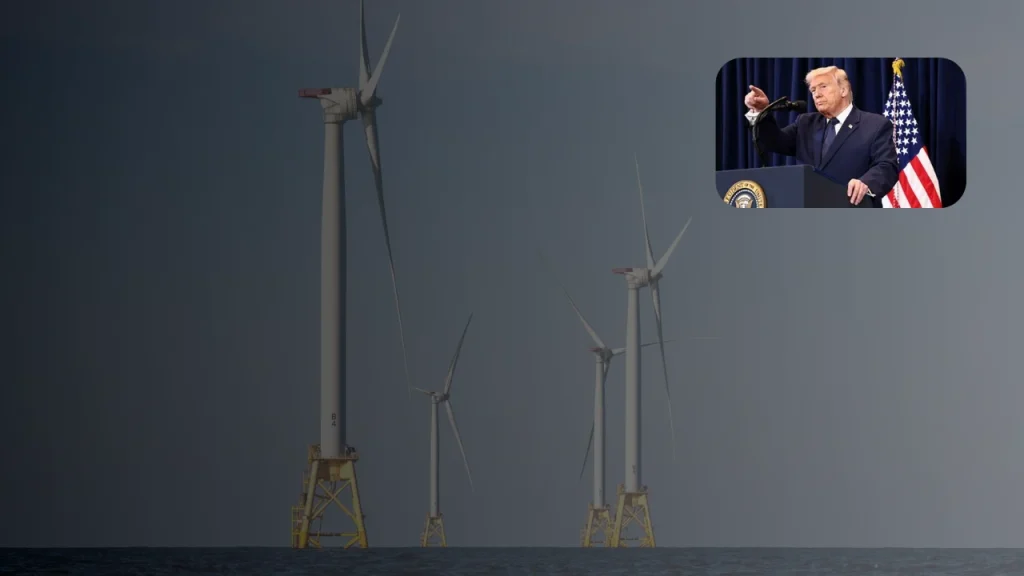
Start with the money. Bluepoint Wind paid $765 million in 2022 to win a competitive auction for lease OCS-A 0537, a 71,000-acre stretch of ocean between New York and New Jersey. It planned to build a wind farm capable of generating 2.4 gigawatts — enough for roughly 1.5 million homes. In April 2026, Interior handed Bluepoint that same $765 million back from something called the Judgment Fund, a Treasury account Congress set aside specifically to pay legitimate legal settlements. In exchange, Bluepoint agreed to cancel the lease and put the money into a liquefied natural gas facility instead.
That’s not an isolated deal. Interior cut a nearly identical arrangement with Invenergy for $653 million covering three more leases, and separately paid roughly $111 million to another Invenergy entity and $120 million to Golden State Wind to abandon projects off California’s coast. TotalEnergies got $928 million the same way back in March. Add it up, and the government has now committed more than $4 billion in taxpayer money to pay companies not to build energy projects the government itself approved years earlier.
The states argue Interior invoked “classified national security concerns” to justify the cancellations, but never held the hearing OCSLA requires, never calculated fair-market compensation the way the law demands, and never notified the governors of the affected states — a step OCSLA specifically requires before any action like this. And there’s a deeper problem with the money itself: the Judgment Fund can only be tapped to settle claims where a lawsuit was actually imminent. According to the complaint, records show Interior and Bluepoint were drafting cancellation paperwork together weeks before the “national security” review that supposedly triggered it — the kind of timeline that makes a real legal threat look more like a formality.
That timeline is worth sitting with for a second. If the settlement came first and the justification came after, the “lawsuit” it claims to resolve was never really at risk of happening.
Related article: Trump Administration Asks the Supreme Court, for a Third Time, to Restart Third-Country Deportations — DHS v. D.V.D., No. 26A406
Why This Should Matter to You
You don’t need to own a wind company to feel this. New York’s grid operator already projects electricity demand climbing 8% by 2030 and 24% by 2040, driven by data centers and economic growth, right as older gas plants retire. The Bluepoint project alone was expected to deliver power straight into New York City’s grid zone. Cancel enough of these leases, and the region has fewer new sources of electricity coming online at exactly the moment it needs more — which tends to push prices up, not down.
New England and Delaware get pulled into this too, even though the canceled lease sits off New York and New Jersey. Both regions import electricity from New York during winter, when their own systems are most strained. Less offshore wind in the pipeline means tighter supply everywhere connected to that grid.
What Happens Next
There’s no claim to file and no deadline for the public to act on. This is states versus the federal government, litigated in court on a timeline the judges will set. Here’s the rough sequence to expect:
| Milestone | Status / Date |
| Interior–Bluepoint settlement signed | April 27, 2026 |
| Interior–Invenergy (East Coast) settlement signed | June 17, 2026 |
| California Notice of Intent to Sue (Invenergy) | July 16, 2026 |
| California v. Golden State Wind filed | August 28, 2026 |
| New York-led coalition suits filed | September 22, 2026 |
| California v. Invenergy (Morro Bay) filed | September 22, 2026 |
| Federal government’s response/motion to dismiss | UNVERIFIED — not yet scheduled as of this writing |
| Preliminary injunction ruling | UNVERIFIED — no hearing date set |
Worth knowing: courts have already ruled against the administration in similar fights this year. A federal judge in Massachusetts vacated an earlier blanket wind-permitting freeze in December 2025, and several 2025 suspension orders on East Coast wind projects were separately blocked by courts in January and February 2026 after judges found the “national security” justification didn’t hold up under review. That track record is part of why the states feel confident challenging this settlement structure too — though past results in other cases don’t decide this one.
Frequently Asked Questions — States v. Interior, No. 1:26-cv-05851
Is there a class action I can join over this offshore wind lawsuit?
No. This is a lawsuit brought by state attorneys general against a federal agency, not a consumer class action. There’s no class to join and no claim form to file.
Why are states suing over a company’s decision to cancel its own lease?
The states argue Bluepoint and Invenergy didn’t walk away voluntarily — Interior paid them hundreds of millions of taxpayer dollars to do it, using a fund Congress reserved for real legal settlements, not policy payouts.
How much money is actually at stake in the September 2026 filings?
Roughly $1.5 billion across the Bluepoint, East Coast Invenergy, and California Invenergy settlements challenged in this round, on top of over $4 billion Interior has committed to similar deals since March 2026.
Could this raise my electricity bill?
It’s not automatic, but grid operators in New York, New England, and the mid-Atlantic have flagged rising demand and tightening supply. Canceling planned generation capacity, including offshore wind, is one factor regulators watch when forecasting future electricity prices.
What law says Interior can’t do this?
The states point to the Administrative Procedure Act, the Outer Continental Shelf Lands Act, the National Environmental Policy Act, and the Judgment Fund Act — arguing the settlements skip required hearings, misuse a Treasury fund meant for real legal claims, and ignore Congress’s exclusive control over federal spending.
Do these lawsuits stop the wind projects from being cancelled right now?
Not automatically. The states are asking the court to void the settlements and reinstate the leases, but no ruling has been issued yet. The leases remain cancelled unless and until a judge orders otherwise.
Has a court ruled on a similar Trump administration wind policy before?
Yes. A federal court in Massachusetts vacated an earlier wind-permitting freeze in December 2025, and courts blocked several 2025 project suspension orders in early 2026 on similar national-security grounds. The government did not appeal those rulings.
Who represents the states in this case?
The lead case is filed by New York Attorney General Letitia James, joined by the attorneys general of New Jersey, Connecticut, Delaware, Maine, Massachusetts, Rhode Island, and Vermont. California Attorney General Rob Bonta filed separate, concurrent suits over the California leases.
Sources Used in This Article
- New York v. U.S. Department of the Interior, Complaint for Declaratory and Injunctive Relief, No. 1:26-cv-05851 (E.D.N.Y. filed Sept. 22, 2026): https://ag.ny.gov/sites/default/files/court-filings/new-york-et-al-v-u.s-department-of-the-interior-et-al-complaint-for-declaratory-and-injunctive-relief-2026.pdf
- New York Attorney General press release, Sept. 22, 2026: https://ag.ny.gov/press-release/2026/attorney-general-james-and-governor-hochul-announce-lawsuit-challenging-trump
- California Attorney General press release re: Golden State Wind, Aug. 28, 2026: https://oag.ca.gov/node/628958
- KEYT News, “California Sues Trump Administration Over Deal To Kill Local Offshore Wind Project,” Sept. 22, 2026: https://keyt.com/news/2026/09/22/california-sues-trump-administration-over-deal-to-kill-local-offshore-wind-project
- Stateline, “States file new lawsuits against Trump’s payouts stopping offshore wind,” Sept. 22, 2026: https://stateline.org/2026/09/22/states-file-new-lawsuits-against-trumps-payouts-stopping-offshore-wind/
- Associated Press, “Multistate lawsuit aims to block Trump deals canceling offshore wind projects,” Sept. 23, 2026: https://www.wcax.com/2026/09/23/multi-state-lawsuit-aims-block-trump-deals-canceling-offshore-wind-projects/
- Bloomberg Law, “Trump Deals to Cancel Offshore Wind Projects Draw State Lawsuits”: https://news.bloomberglaw.com/environment-and-energy/trump-deals-to-cancel-offshore-wind-projects-draw-state-lawsuits
Researched and written by Israr Ahmad, legal content researcher and founder of AllAboutLawyer.com. All facts verified against the filed federal complaint in New York v. U.S. Department of the Interior, No. 1:26-cv-05851 (E.D.N.Y.), the New York and California Attorneys General’s official press releases, and contemporaneous reporting from Stateline, the Associated Press, and Bloomberg Law, as of September 25, 2026. Last Updated: September 25, 2026.
Disclaimer: This article is for informational purposes only and does not constitute legal advice. Laws vary by state and individual circumstances differ. For advice about your specific situation, consult a qualified attorney.
About the Author
Israr Ahmad is a legal content researcher with 4+ years of experience covering class action settlements and consumer rights cases. He has researched and published coverage of 2,500+ settlements using verified court records, settlement administrator filings, and government sources. Learn more about Israr.