
Search Warrant vs. Arrest Warrant vs. Indictment vs. Target Letter, What Each One Really Means
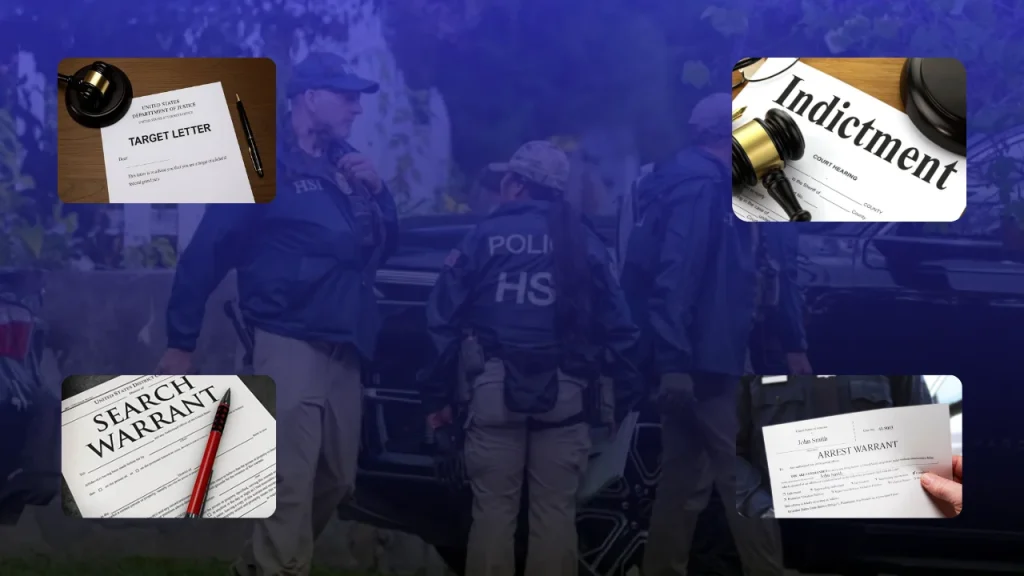
A search warrant, an arrest warrant, an indictment and a target letter can all appear during a criminal investigation, but each does a different job. A search warrant authorizes a search. An arrest warrant authorizes taking a person into custody. An indictment is a formal accusation by a grand jury. A target letter is a notice from prosecutors about a person’s status in an investigation.
None of them proves guilt. And receiving a search warrant or a target letter does not, by itself, mean you have been charged with a crime.
| Legal document | What it does | Legal basis | Standard to obtain | Who issues it | Does it formally charge a crime? |
| Search warrant | Authorizes a search of a described place, person or property and seizure of described items | Fourth Amendment; Fed. R. Crim. P. 41 | Probable cause that evidence, contraband or other listed items will be found in that place | Judge or magistrate judge | No |
| Arrest warrant | Authorizes law enforcement to take a named person into custody | Fourth Amendment; Fed. R. Crim. P. 4 and 9 | Probable cause that an offense was committed and the named person committed it | Judge or magistrate judge | Not by itself. It rests on a complaint, indictment or information, which is the charging document |
| Indictment | Formally accuses a person of one or more crimes | Fifth Amendment; Fed. R. Crim. P. 6 and 7 | Grand jury finds probable cause (at least 12 jurors must agree) | Federal or state grand jury | Yes |
| Target letter | Tells a person that prosecutors consider them a likely defendant in a grand jury investigation | DOJ Justice Manual § 9-11.000 (internal policy) | No court standard; prosecutors’ own judgment that there is substantial evidence linking the person to a crime | Federal prosecutor (U.S. Attorney’s Office or DOJ component) | No |
These documents don’t arrive in a fixed order. Agents can search a business months before anyone is charged. A person can receive a target letter and never be indicted. A person can be indicted and ordered to appear in court without being arrested. And a search warrant can be executed at the home of someone who is not suspected of anything.
The U.S. Department of Justice explains that federal investigations involve gathering evidence, prosecutorial review and, when appropriate, criminal charges, and that investigations can end without a prosecution. See the DOJ’s Justice 101 guide to the investigation stage.
How a Federal Criminal Investigation Usually Progresses
┌──────────────────────────┬──────────────────────────┬──────────────────────────┐
│ STAGE 1 │ STAGE 2 │ STAGE 3 │
│ EVIDENCE GATHERING │ NOTICE & GRAND JURY │ FORMAL CHARGES │
├──────────────────────────┼──────────────────────────┼──────────────────────────┤
│ • Interviews, informants │ • Grand jury subpoenas │ • Complaint, indictment │
│ • Subpoenas │ • Target or subject │ or information filed │
│ • Search warrants │ letters (optional) │ • Arrest warrant or │
│ • Records and data │ • Grand jury testimony │ summons │
│ requests │ • Pre-charge discussions │ • Initial appearance, │
│ │ with defense counsel │ arraignment, trial │
└──────────────────────────┴──────────────────────────┴──────────────────────────┘
This is a typical pattern, not a required one. Real cases skip stages, repeat them or end at any point. A complaint-based arrest, for example, can happen before any grand jury action at all.
1. What Is a Search Warrant?
A search warrant is a written order from a judge or magistrate judge authorizing law enforcement to search a specific place, person or property and to seize specific items.
The Fourth Amendment protects people against unreasonable searches and seizures and provides that warrants may issue only upon probable cause, supported by oath or affirmation, and “particularly describing the place to be searched, and the persons or things to be seized.” In federal investigations, Federal Rule of Criminal Procedure 41 governs how warrants are requested, issued, executed and returned.
What does probable cause mean for a search warrant?
Probable cause means there is a “fair probability” that contraband or evidence of a crime will be found in a particular place. The Supreme Court uses a practical, totality-of-the-circumstances test (Illinois v. Gates, 462 U.S. 213 (1983)). The agent seeking the warrant submits a sworn affidavit setting out the facts that support it.
The judge is not deciding that anyone is guilty. The question is narrower: does the information justify searching this place for these items? Probable cause to search a location is not proof that the person who owns or occupies it committed a crime.
Can police search property belonging to someone who isn’t suspected of a crime?
Yes. The Supreme Court held in Zurcher v. Stanford Daily, 436 U.S. 547 (1978), that a warrant may issue to search premises of a person not suspected of wrongdoing if there is probable cause that evidence of a crime will be found there. An employer, a relative, a business partner, a bank, an internet provider or a cloud-storage company can all be searched or served with a warrant because they hold evidence about someone else.
That is why the occupant of a searched location is not automatically a suspect, let alone a defendant.
What must a valid search warrant contain?
- Probable cause supported by a sworn affidavit.
- Particularity. The warrant must describe the place and the items to be seized with enough detail that officers are not given open-ended discretion (Groh v. Ramirez, 540 U.S. 551 (2004)).
- Neutral and detached review. A judge or magistrate judge, not the investigating agent, decides whether to issue it.
- Proper authority and venue. Rule 41(b) sets out when a magistrate judge may issue a warrant for property inside or outside the district, including specific provisions for remote electronic access in certain circumstances.
How are search warrants executed?
Rule 41(e) and (f) set several baseline requirements for federal warrants:
- The warrant must direct execution within a stated period of no more than 14 days.
- Execution must generally occur in the daytime (6:00 a.m. to 10:00 p.m.) unless the judge authorizes otherwise for good cause.
- Officers must give the person searched a copy of the warrant and a receipt for property taken, or leave them at the premises.
- Officers must prepare an inventory and return the warrant to the court.
Officers executing a warrant generally must announce their presence and purpose before forcing entry (18 U.S.C. § 3109; Wilson v. Arkansas, 514 U.S. 927 (1995)), subject to exceptions such as risk of violence or destruction of evidence. The Supreme Court has held that a knock-and-announce violation does not by itself require suppression of evidence (Hudson v. Michigan, 547 U.S. 586 (2006)). Officers may also detain occupants during the search of a home (Michigan v. Summers, 452 U.S. 692 (1981)). Detention during a search is not an arrest and does not mean a person has been charged.
Digital searches: phones, computers and cloud accounts
Electronic searches raise additional issues. Rule 41(e)(2)(B) allows a warrant to authorize seizing or copying electronically stored information and reviewing it later. The Supreme Court has recognized that phones hold the “privacies of life” and generally require a warrant to search (Riley v. California, 573 U.S. 373 (2014)), and that historical cell-site location records generally require a warrant as well (Carpenter v. United States, 585 U.S. 296 (2018)). Records held by providers can also be obtained under the Stored Communications Act, 18 U.S.C. § 2703.
Sealed warrants and delayed notice
Search warrant applications and affidavits are often sealed while an investigation is active, which is why the public frequently cannot see the evidence presented to the judge. A sealed affidavit does not mean the warrant is invalid, and it does not mean wrongdoing has been proved. In limited circumstances, a court may also allow notice of a search to be delayed (18 U.S.C. § 3103a).
Searches that involve privileged material
When a search may reach attorney-client communications, such as a law office or a business’s legal files, DOJ policy calls for special procedures, often including a separate “filter” or “taint” team that screens out privileged material (see Justice Manual § 9-13.420). Courts also review privilege disputes.
Can a search warrant be challenged?
Yes, though results depend on the facts. Common avenues include:
- A motion to suppress evidence in a criminal case if the search violated the Fourth Amendment (Fed. R. Crim. P. 12(b)(3)(C)).
- A challenge to the affidavit if it contained deliberate or reckless falsehoods material to probable cause (Franks v. Delaware, 438 U.S. 154 (1978)).
- A motion for return of property under Rule 41(g) by a person aggrieved by a seizure.
Courts also apply the good-faith exception, which can preserve evidence obtained in reasonable reliance on a warrant later found defective (United States v. Leon, 468 U.S. 897 (1984)). Suppression is not automatic.
Search warrant vs. other ways police search without one
A warrant is the default rule, but courts recognize exceptions, including consent, exigent circumstances, plain view, searches incident to lawful arrest and the automobile exception. A search without a warrant is not automatically unlawful, and a search with a warrant is not automatically valid.
For a current news example of the gap between a judicially authorized search and a criminal charge, see Why Was Ilhan Omar’s Home Searched? Fraud Allegations, Legal Issues and What Happens Next.
2. What Is an Arrest Warrant?
An arrest warrant is a court order directing law enforcement to take a named person into custody and bring that person before a judge to answer criminal allegations. A search warrant focuses on a place and things. An arrest warrant focuses on a person.
How is an arrest warrant issued in federal court?
There are two common routes:
- On a criminal complaint (Rule 4). A complaint is a sworn written statement of the essential facts of the offense (Rule 3). If the complaint or accompanying affidavit establishes probable cause to believe an offense was committed and the defendant committed it, the judge must issue an arrest warrant. At the government’s request, the judge may issue a summons instead, which directs the person to appear without being arrested.
- After an indictment or information (Rule 9). When a grand jury returns an indictment or the government files an information, the court issues an arrest warrant or summons at the government’s request.
Is an arrest warrant the same as a charge?
Not exactly. The warrant authorizes the arrest, while the charging document underneath it (a complaint, indictment or information) is what formally accuses the person of a crime. In practice, an arrest warrant means a judge has found probable cause on a criminal accusation, so it is a serious development. It is still only a probable-cause finding. It is not a finding of guilt.
Can someone be arrested without a warrant?
Yes. Officers may make a warrantless arrest in a public place when they have probable cause that a felony has been committed (United States v. Watson, 423 U.S. 411 (1976)). Warrantless arrests are also permitted for certain offenses committed in an officer’s presence, even minor ones (Atwater v. City of Lago Vista, 532 U.S. 318 (2001)). Home arrests are different. Absent consent or exigent circumstances, police need an arrest warrant to enter a suspect’s own home to arrest him (Payton v. New York, 445 U.S. 573 (1980)), and a search warrant to enter a third party’s home to look for the suspect (Steagald v. United States, 451 U.S. 213 (1981)).
State rules on warrantless arrests vary, so the exact authority depends on the jurisdiction and offense.
What happens when an arrest warrant is executed?
- Under Rule 4(c)(3), an officer who has the warrant must show it to the defendant. If the officer doesn’t have it, the officer must inform the defendant of the warrant’s existence and the offense charged and, on request, show it as soon as possible.
- The arrested person must be brought before a magistrate judge without unnecessary delay (Rule 5(a)). Where a person is arrested without a warrant, the Constitution requires a prompt judicial determination of probable cause, generally within 48 hours (Gerstein v. Pugh, 420 U.S. 103 (1975); County of Riverside v. McLaughlin, 500 U.S. 44 (1991)).
- At the initial appearance, the judge advises the defendant of the charges and of the right to counsel, the right to remain silent and the right to a preliminary hearing where applicable, and considers release or detention under the Bail Reform Act, 18 U.S.C. § 3142 (Rule 5(d)).
- If the person was arrested on a complaint, a preliminary hearing (Rule 5.1) tests probable cause unless an indictment is returned first. It must be held within 14 days if the defendant is in custody and 21 days if not.
State warrants, bench warrants and federal warrants
Not every “warrant” is the same kind. A bench warrant is issued when someone misses a court date or violates a court order. State arrest warrants follow state law, and a state warrant can be entered into national databases and executed in other states. If you believe a warrant exists for you, a criminal-defense attorney can check the court record and arrange a lawful way to address it.
3. What Is an Indictment?
An indictment is a formal written accusation, returned by a grand jury, charging a person with one or more crimes. It is the document that formally begins a felony prosecution in federal court.
The Fifth Amendment provides that no person shall be held to answer for a “capital, or otherwise infamous crime” without a grand jury presentment or indictment, with limited exceptions such as certain military cases. Under Rule 7(a), an offense punishable by death or by imprisonment for more than one year must be prosecuted by indictment unless the defendant validly waives it (Rule 7(b)). The indictment must be a “plain, concise, and definite written statement of the essential facts constituting the offense charged” (Rule 7(c)(1)).
How does a grand jury work?
- A federal grand jury has 16 to 23 members (Rule 6(a)).
- Prosecutors present witnesses, documents and other evidence. Under Rule 6(d), only government attorneys, the witness under examination, interpreters and a court reporter may be present. The target’s lawyer is not in the room, although a witness may step out to consult counsel.
- An indictment may be returned only if at least 12 jurors concur (Rule 6(f)). A returned indictment is called a “true bill.” If the grand jury declines, it returns a “no bill.”
- The proceedings are secret. Secrecy obligations bind grand jurors and government personnel but not witnesses, who may generally disclose their own testimony (Rule 6(e)(2)).
The grand jury does not decide guilt. It decides whether there is probable cause to formally charge. Courts have held that the grand jury may rely on hearsay (Costello v. United States, 350 U.S. 359 (1956)) and that prosecutors are not required to present exculpatory evidence to it (United States v. Williams, 504 U.S. 36 (1992)). This is why people say a grand jury would “indict a ham sandwich.” The saying exaggerates, but it points to a real feature of the system: the standard is low, and the process is one-sided by design.
Does an indictment mean someone is guilty?
No. An indictment is an accusation, not evidence of guilt. A defendant is presumed innocent, and the government must prove every element beyond a reasonable doubt (In re Winship, 397 U.S. 358 (1970)) at trial, or the defendant must plead guilty.
Can someone be indicted without being arrested?
Yes. Indictment and arrest are separate events. After an indictment, the court issues an arrest warrant or a summons (Rule 9). Many white-collar defendants, for example, are allowed to self-surrender or appear voluntarily. Under Rule 6(e)(4), a court can seal an indictment until the defendant is in custody or released pending trial, which means a person can be indicted before the public knows.
Is an indictment the only way to be formally charged?
No. Three charging instruments exist in federal court:
- Complaint (Rule 3): a sworn statement of facts, often used to support an early arrest. Felony cases that begin by complaint generally must be followed by an indictment or information.
- Information (Rule 7): a charge filed by the prosecutor without a grand jury, used for misdemeanors and for felonies where the defendant waives indictment, often as part of a plea agreement.
- Indictment: returned by a grand jury.
So the absence of an indictment does not always mean the absence of formal charges.
After an indictment: key deadlines and protections
- Arraignment (Rule 10): the defendant is read the charges and enters a plea.
- Speedy Trial Act (18 U.S.C. § 3161): an indictment or information must generally be filed within 30 days of arrest (§ 3161(b)), and trial must generally begin within 70 days of the indictment or first appearance, whichever is later (§ 3161(c)(1)). Many delays are excluded from the clock, so these limits are often extended in practice (§ 3161(h)).
- Statute of limitations: most federal non-capital crimes must be charged within five years (18 U.S.C. § 3282), though many offenses have longer periods set by statute.
- Pretrial motions (Rule 12): defendants can move to dismiss defective charges, suppress evidence and challenge other issues.
- Superseding indictments: prosecutors can obtain a new indictment that adds or changes charges.
State court differences
The Fifth Amendment’s grand jury requirement applies to federal prosecutions. The Supreme Court held long ago that states are not required to use grand juries (Hurtado v. California, 110 U.S. 516 (1884)). Some states require grand jury indictment for serious felonies, while others allow prosecutors to file an information after a preliminary hearing. Terminology, timelines and procedure vary, so always check the specific state’s rules.
4. What Is a DOJ Target Letter?
A target letter is a communication from federal prosecutors telling a person that the government regards them as a target of a federal grand jury investigation. It exists to give notice, and in many cases to invite the person to talk to prosecutors or testify.
Targets, subjects and witnesses
The Justice Manual (§ 9-11.151) draws these distinctions:
- Target: a person as to whom the prosecutor or grand jury has substantial evidence linking him or her to the commission of a crime and who, in the judgment of the prosecutor, is a putative defendant.
- Subject: a person whose conduct is within the scope of the grand jury’s investigation.
- Witness: a person with information relevant to the investigation who is not suspected of wrongdoing.
These are internal DOJ labels. They are not criminal charges, and they are not judicial findings.
Is a target letter a criminal charge?
No. It is not an indictment, an arrest warrant or a conviction. It is also not a court order. Target letters typically say that the person is a target of an investigation into possible violations of specified statutes, may state that the recipient has a privilege against compelled self-incrimination and the right to consult counsel, and may invite the recipient to contact prosecutors or testify. Contents differ from office to office, and there is no mandatory form.
Does the government have to send a target letter?
No. DOJ policy (see Justice Manual §§ 9-11.151 and 9-11.153) generally contemplates advising targets of their status before they are asked to testify, but it allows exceptions where notice could risk flight, danger to others or obstruction of the investigation. The Justice Manual also states that its policies are internal guidance and do not create enforceable rights for defendants. The Supreme Court has held that a grand jury witness who is a target need not be given warnings about that status for the testimony to be used (United States v. Washington, 431 U.S. 181 (1977)). A person can therefore be indicted without ever receiving a target letter, and can be treated as a target without being told.
Does a target letter mean an indictment is coming?
Not necessarily. It is the strongest signal short of a charge that prosecutors see the recipient as a potential defendant, and it should be taken very seriously. But evidence changes, and some targets are never charged. DOJ policy permits prosecutors to tell a person that target status has ended, but this is discretionary and not guaranteed.
Target letter vs. subpoena
A target letter is not a subpoena. A grand jury subpoena is a legal demand to testify or produce records, and ignoring one can lead to contempt. The letter and the subpoena may arrive together or separately. A person who receives either should have an attorney review exactly what is being demanded.
Can a target be forced to testify?
A person has a Fifth Amendment privilege against compelled self-incrimination, but it is not a blanket right to ignore a subpoena. The privilege is generally asserted question by question, and its application depends on the circumstances. The government can sometimes compel testimony by granting immunity under 18 U.S.C. §§ 6002 and 6003, which bars use of the compelled testimony and evidence derived from it in a later prosecution (Kastigar v. United States, 406 U.S. 441 (1972)). This is an area where individual legal advice is essential.
5. Full Side-by-Side Comparison
| Feature | Search warrant | Arrest warrant | Indictment | Target letter |
| Issued or created by | Judge or magistrate judge | Judge or magistrate judge | Grand jury | Federal prosecutor |
| Main purpose | Search for and seize listed items | Take a named person into custody | Formally charge criminal offenses | Notify a person of target status |
| Legal threshold | Probable cause to search a place | Probable cause that the named person committed an offense | Grand jury finds probable cause (12+ of 16–23 jurors) | DOJ internal policy; no court standard |
| Constitutional / legal source | Fourth Amendment; Rule 41 | Fourth Amendment; Rules 4 and 9 | Fifth Amendment; Rules 6 and 7 | Justice Manual § 9-11.000 |
| Authorizes a search? | Yes, within its scope | No | No | No |
| Authorizes an arrest? | No | Yes | No, but typically followed by a warrant or summons | No |
| Formally charges a crime? | No | Rests on a complaint, indictment or information | Yes | No |
| Proves guilt? | No | No | No | No |
| Can be secret or sealed? | Yes | Yes | Yes, temporarily | Not filed with a court |
| Is a court involved? | Yes | Yes | Yes | No |
| Can occur without the others? | Yes | Yes | Yes | Yes |
6. Standards of Proof: Why These Documents Don’t Prove Guilt
Much of the confusion in news coverage comes from mixing up the different legal standards used at different stages. In rough order from lowest to highest:
- Reasonable suspicion: enough to briefly stop and question someone.
- Probable cause: a fair probability, based on the facts, that a crime occurred or that evidence will be found. This supports search warrants, arrest warrants and grand jury indictments.
- Proof beyond a reasonable doubt: the standard the government must meet to convict at trial (In re Winship).
A search warrant, an arrest warrant and an indictment all rest on probable cause. None of them requires proof of guilt. Every criminal defendant is presumed innocent until proven guilty (Coffin v. United States, 156 U.S. 432 (1895)). That is why a person can be searched, arrested or indicted and still be acquitted, have the charges dismissed, or never be tried.
7. Can Someone Receive All Four in One Case?
Yes, but there is no required sequence. Here is one hypothetical:
Investigators suspect a company used false invoices to obtain money. A judge issues a search warrant for the company’s accounting records and devices, and agents seize evidence. After review, prosecutors send a target letter to an executive and invite her lawyer to meet. Months later, a grand jury returns an indictment charging the executive with specific offenses. The court issues a summons, and she appears for arraignment.
In another case, a person is arrested on a complaint before any search. In another, a person receives a target letter and is never charged. In another, agents search a business owned by someone who is never charged at all. Each document must be read according to its own legal function.
8. What Happens After Each Step?
After a search warrant is executed
Agents review seized material, interview witnesses and consult prosecutors. Possible outcomes include further investigation, additional warrants or subpoenas, a grand jury investigation, a target letter, formal charges, or no charges at all. Investigations can last months or years, and many end without any public announcement.
After an arrest warrant is executed
The person is processed and brought before a magistrate judge for an initial appearance, where counsel is addressed and release or detention is decided. The case then proceeds to a preliminary hearing or indictment, arraignment, pretrial motions, and then a plea, trial or dismissal.
After an indictment
The defendant is arraigned, the court sets conditions of release or detention, discovery begins, and pretrial motions are filed. The case then ends in a plea, a trial verdict, or a dismissal.
After a target letter
There is no automatic next step. Typical responses, usually through counsel, include contacting prosecutors, discussing whether the person will testify, producing documents, or negotiating a pre-indictment resolution. Prosecutors may also continue investigating without further contact.
9. What Should You Do in Each Situation?
This section is general information, not legal advice. If any of these situations is real, contact a licensed criminal-defense attorney immediately.
If you receive a target letter or subpoena
- Do not ignore it. Keep the letter and everything that came with it, and note every deadline.
- Contact a federal criminal-defense lawyer before responding to prosecutors or agents. Statements made without counsel can be used later.
- Do not destroy, alter or hide documents or data. Obstruction can be its own crime (18 U.S.C. §§ 1512(c) and 1519), and it is often easier to prove than the underlying allegation.
- Do not lie to federal agents. Knowingly making a materially false statement in a federal matter is a crime under 18 U.S.C. § 1001, even if the person was not under oath.
If agents arrive with a search warrant
- Stay calm and do not physically resist or interfere. Resisting can lead to new charges and does not stop the search.
- Ask to see the warrant and ask for a copy and a receipt of items taken.
- You are not required to consent to anything beyond the warrant, and you can say so clearly. Say “I do not consent to any search beyond the warrant.”
- You are not required to answer questions. You can say that you want to speak to a lawyer before answering anything. Do not lie, and do not volunteer explanations.
- Call a lawyer, document what was taken, and write down what happened as soon as possible.
If you learn you may be arrested or a warrant exists
- Do not run or hide. Flight can worsen your position and affect release decisions.
- Contact a criminal-defense attorney. A lawyer can often check the court record, arrange a voluntary surrender and prepare for the initial appearance.
- If arrested, say clearly that you want a lawyer and will remain silent. Under Miranda v. Arizona, 384 U.S. 436 (1966), police must warn a person in custody before interrogating, and a clear request for counsel must end questioning.
Note on the Sixth Amendment
The Sixth Amendment right to counsel attaches once formal adversary judicial proceedings begin, such as a formal charge, indictment or initial appearance (Rothgery v. Gillespie County, 554 U.S. 191 (2008)). Before that, protection against self-incrimination and the right to a lawyer during custodial questioning come from the Fifth Amendment and Miranda. This is why a target letter itself does not trigger a Sixth Amendment right.
10. Can an Investigation End Without Charges?
Yes. Prosecutors may decide the evidence is insufficient, that the conduct isn’t criminal, or that prosecution isn’t warranted. A grand jury may also decline to indict. Because there is usually no public notice when an investigation closes, the lack of news does not mean a person has been formally cleared. Newly discovered evidence can revive a matter, subject to the statute of limitations.
11. Federal vs. State: Why Your Case May Look Different
This guide focuses on federal procedure because the Federal Rules of Criminal Procedure and Justice Manual provide a uniform framework. State systems differ in important ways:
- Charging method: some states require grand jury indictment for serious felonies, while others use prosecutor-filed informations after a preliminary hearing.
- Terminology: “target letter” is a federal practice, and other jurisdictions may use different notices or none at all.
- Warrant rules: state constitutions and statutes may give more protection than the Fourth Amendment, and each state has its own warrant procedures and time limits.
- Deadlines: speedy trial and limitation periods are set by state law.
If your matter is in state court, ask a lawyer licensed in that state which rules apply.
Key Takeaways
- A search warrant authorizes a search of a place, not an arrest or a charge. The occupant may be a witness, a bystander or a third party who simply holds records.
- A target letter is a notice, not a charge. It signals that prosecutors view you as a likely defendant, and it should prompt immediate legal advice.
- An indictment is a formal accusation, not a finding of guilt. The government must still prove its case beyond a reasonable doubt.
- An arrest warrant authorizes custody based on probable cause and a charging document, and it triggers prompt court appearance rights.
- All of these rest on probable cause or internal DOJ policy, not proof of guilt.
- Look for the actual court documents. Headlines often blur the difference between a search, an investigation and a charge. The charging document is what shows what, if anything, a person has been formally accused of.
The Bottom Line
A search warrant, arrest warrant, indictment and target letter each have a distinct legal meaning, and none of them, standing alone, establishes guilt. A search warrant authorizes a search. An arrest warrant authorizes an arrest. An indictment formally charges criminal offenses. A target letter notifies a person that prosecutors consider them a likely defendant. What happens next depends on the specific document, the underlying evidence and the rules of the court involved.
Related reading on AllAboutLawyer.com:
- Has Ilhan Omar Ever Been Charged With a Crime? What the Public Record Shows
- Ilhan Omar’s Lawyers Demand Return of Seized Property, Allege Federal Agents Ignored Judge’s Restrictions in Home Search
Legal disclaimer: This article is for general informational purposes only and does not constitute legal advice. AllAboutLawyer.com is a legal information website, not a law firm, and the author is a legal content researcher, not an attorney. Laws and procedures vary by jurisdiction and change over time, and the outcome of any case depends on its specific facts. If you are under investigation, have received a subpoena or target letter, or have been searched or arrested, consult a licensed criminal-defense attorney in your jurisdiction immediately.
Primary Legal Sources
Constitution
- U.S. Constitution, Fourth Amendment
- U.S. Constitution, Fifth Amendment
- U.S. Constitution, Sixth Amendment
Federal Rules of Criminal Procedure
- Federal Rules of Criminal Procedure (official text)
- Rule 3: The Complaint
- Rule 4: Arrest Warrant or Summons on a Complaint
- Rule 5: Initial Appearance
- Rule 5.1: Preliminary Hearing
- Rule 6: The Grand Jury
- Rule 7: The Indictment and the Information
- Rule 9: Arrest Warrant or Summons on an Indictment or Information
- Rule 10: Arraignment
- Rule 12: Pleadings and Pretrial Motions
- Rule 41: Search and Seizure
Federal statutes
- 18 U.S.C. § 3109: Breaking doors or windows for entry or exit
- 18 U.S.C. § 3103a: Additional grounds for issuing warrant
- 18 U.S.C. § 3142: Release or detention of a defendant pending trial
- 18 U.S.C. § 3161: Time limits and exclusions (Speedy Trial Act)
- 18 U.S.C. § 3282: Offenses not capital
- 18 U.S.C. § 1001: Statements or entries generally
- 18 U.S.C. § 1512: Tampering with a witness, victim, or an informant
- 18 U.S.C. § 1519: Destruction, alteration, or falsification of records
- 18 U.S.C. § 2703: Required disclosure of customer communications or records
- 18 U.S.C. §§ 6002–6003: Immunity of witnesses
Department of Justice
- DOJ Justice 101: Investigation
- DOJ Justice Manual § 9-11.000: Grand Jury
- DOJ U.S. Attorney’s Office Frequently Asked Questions
Key Supreme Court cases cited
Illinois v. Gates, 462 U.S. 213 (1983); Zurcher v. Stanford Daily, 436 U.S. 547 (1978); Groh v. Ramirez, 540 U.S. 551 (2004); Franks v. Delaware, 438 U.S. 154 (1978); United States v. Leon, 468 U.S. 897 (1984); Wilson v. Arkansas, 514 U.S. 927 (1995); Hudson v. Michigan, 547 U.S. 586 (2006); Michigan v. Summers, 452 U.S. 692 (1981); Riley v. California, 573 U.S. 373 (2014); Carpenter v. United States, 585 U.S. 296 (2018); United States v. Watson, 423 U.S. 411 (1976); Atwater v. City of Lago Vista, 532 U.S. 318 (2001); Payton v. New York, 445 U.S. 573 (1980); Steagald v. United States, 451 U.S. 213 (1981); Gerstein v. Pugh, 420 U.S. 103 (1975); County of Riverside v. McLaughlin, 500 U.S. 44 (1991); Costello v. United States, 350 U.S. 359 (1956); United States v. Williams, 504 U.S. 36 (1992); Hurtado v. California, 110 U.S. 516 (1884); United States v. Washington, 431 U.S. 181 (1977); Kastigar v. United States, 406 U.S. 441 (1972); In re Winship, 397 U.S. 358 (1970); Coffin v. United States, 156 U.S. 432 (1895); Miranda v. Arizona, 384 U.S. 436 (1966); Rothgery v. Gillespie County, 554 U.S. 191 (2008).
About the Author
Israr Ahmad is a legal content researcher with 4+ years of experience covering class action settlements and consumer rights cases. He has researched and published coverage of 2,500+ settlements using verified court records, settlement administrator filings, and government sources. Learn more about Israr.